Page 225 of 399

Downloaded from www.Manualslib.com manuals search engine Driving On Grades
Reduce speed and shift to a lower gear before you start down a long or
steep downgrade. If you don’t shift down, you might have to use your
brakes
so much that they would get hot and no longer work well.
On a long uphill grade, shift down and reduce your speed to around 45
mph (70 km/h) or less to reduce the possibility of engine and transaxle
overheating.
If your trailer weighs more than 1,000 pounds (450 Kg) and you have an
automatic transaxle with Overdrive, you may want to drive in “3” instead
of Overdrive.
Parking on Hills
You really should not park your vehicle, with a trailer attached, on a hill.
If something goes wrong, your rig could start to move. People can be
injured, and both your vehicle and the trailer can be damaged.
But
if you ever have to park your rig on a hill, here’s how to do it:
Apply your regular brakes, but do not shift into “P” (Park).
0 Have someone place chocks under the trailer wheels.
When the wheel chocks are in place, release the regular brakes until
Reapply the regular brakes. Then shift into “P” (Park) firmly and
the
chocks absorb the load.
apply your parking brakes.
Release the regular brakes.
When You Are Ready to Leave Afier Parking on a Hill
1. Apply your regular brakes and hold the pedal down while you:
Start your engine;
Shift into a gear; and
Be sure the parking brake has released.
2. Let up on the brake pedal.
212
r
r
.-
r- -
Page 236 of 399
Downloaded from www.Manualslib.com manuals search engine 1. Sling Type
2. Wheel Lift
3. Car Carrier
If your vehicle has been changed or modified since it was factory-new by
adding aftermarket items like fog lamps, aero skirting, or special tires and
wheels, these instructions and illustrations may not be correct.
Before you do anything, turn on the hazard warning flashers.
When you call, tell the towing service:
That your vehicle cannot be towed from the front or rear with
That your vehicle has front-wheel drive.
The make, model, and year of your vehicle.
Whether you can still move the shift lever.
sling-type
equipment.
0 If there was an accident, what was damaged.
223
Page 237 of 399
Downloaded from www.Manualslib.com manuals search engine When the towing service arrives, let the tow operator know that this
manual contains detailed towing instructions and illustrations. The
operator may want to see them.
A CAUTION:
To he@ avoid injury to you or others:
When your vehicle is being towed, have the ignition key off. The steering
wheel should be clamped in
a straight-ahead position, with a clamping
device designed for towing service.
Do not use the vehicle’s steering
column lock for this. The transaxle-should be
in Neutral and the parking
brake released.
224
Page 238 of 399
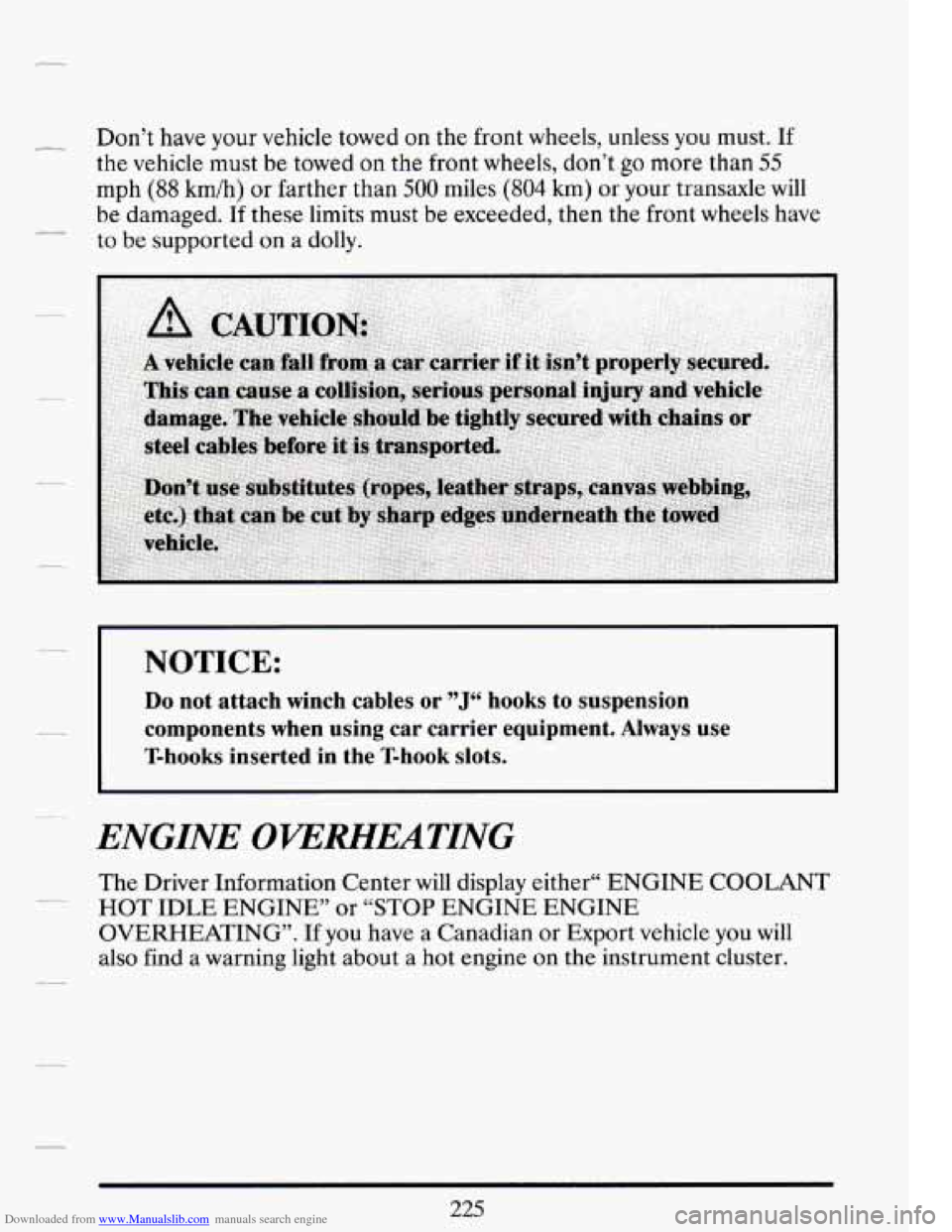
Downloaded from www.Manualslib.com manuals search engine Don't have your vehicle towed on the front wheels, unless you must. If
the vehicle must be towed on the front wheels, don't go more than 55
mph (88 km/h) or farther than 500 miles (804 km) or your transaxle will
be damaged. If these limits must be exceeded, then the front wheels have
to be supported on a dolly.
NOTICE:
Do not attach winch cables or "J" hooks to suspension
components when using car carrier equipment. Always use
T-hooks inserted in the T-hook slots.
ENGINE OKE..EATING
The Driver Information Center will display either" ENGINE COOLANT
HOT IDLE ENGINE' or
"STOP ENGINE ENGINE
OVERHEATING". If
you have a Canadian or Export vehicle you will
also find a warning light about a hot engine on the instrument cluster.
225
Page 249 of 399

Downloaded from www.Manualslib.com manuals search engine IFA TIRE GOES FLAT
It’s unusual for a tire to “blow out” while you’re driving, especially if you
maintain your tires properly. If air goes out of a tire, it’s much more likely
to leak out slowly. But
if you should ever have a “blowout,” here are a
few tips about what to expect and what to do:
If a front tire fails, the flat tire will create a drag that pulls
the vehicle
toward that side. Take your foot
off the accelerator pedal and grip the
steering wheel firmly. Steer to maintain lane position, then gently brake
to a stop well out of the traffic lane.
A rear blowout, particularly on a curve, acts much like a skid and may
require the same correction you’d use
in a skid. In any rear blowout,
remove your foot from the accelerator pedal. Get
the vehicle under
control by steering the way you want the vehicle to go. It may be
very
bumpy and noisy, but you can still steer. Gently brake to a stop, well off
the road if possible.
If a tire goes flat, the next section shows how to use your jacking
equipment to change a flat tire safely.
ro
t-
236
Page 250 of 399
Downloaded from www.Manualslib.com manuals search engine - CHANGING A FLAT TIRE
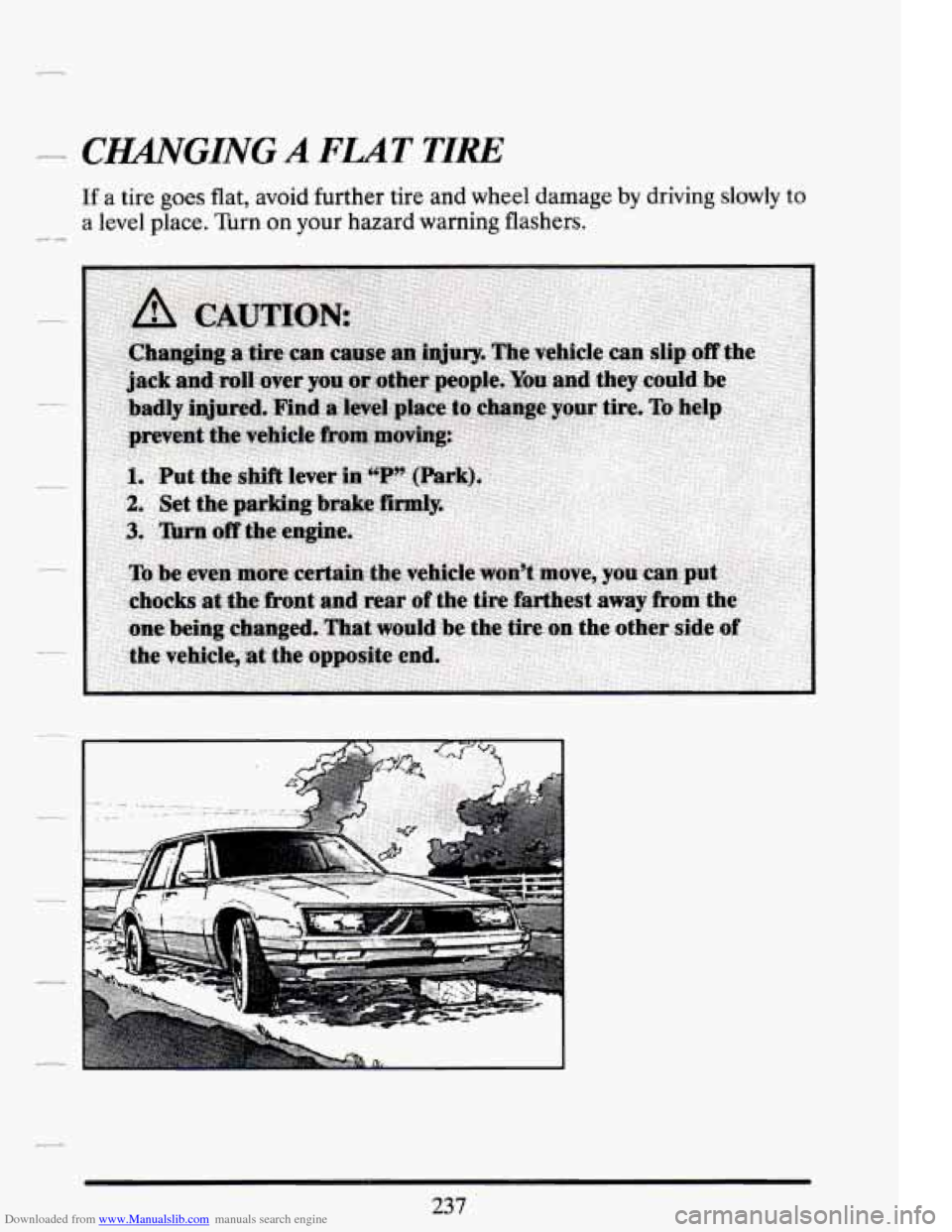
If a tire goes flat, avoid further tire and wheel damage by driving slowly to
a level dace. Turn on your hazard warning flashers. --
237
Page 252 of 399
Downloaded from www.Manualslib.com manuals search engine i !
Then remove the wing nut that secures the jack and wheel wrench and
.remove them from the trunk.
n
-
n
Attach the wheel wrench to the jack bolt and rotate.it clockwise (to the
right). That will raise the lift head a little.
239
Page 253 of 399
Downloaded from www.Manualslib.com manuals search engine Use the flat end of
the wheel wrench,
gently prying along
the edge
of the cover
until it comes
off.
NOTICE:
Be careful not to scratch the aluminum wheel edge. Don’t try to
remove it with
your hands.
Using the wheel
wrench, loosen all the
wheel nuts.
Do not
remove them yet.
240