Page 293 of 399
Downloaded from www.Manualslib.com manuals search engine BATTERY
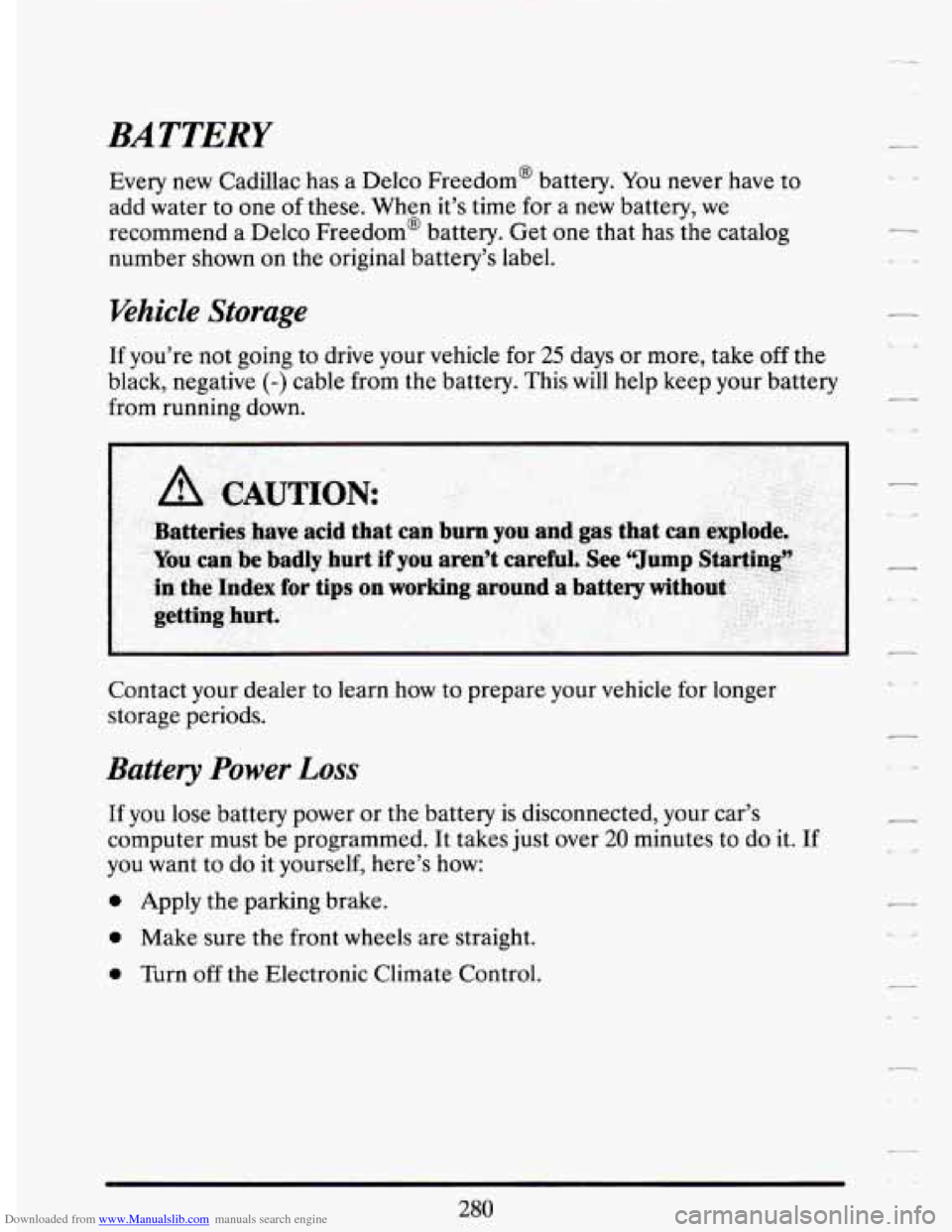
Every new Cadillac has a Delco Freedom@ battery. You never have to
add water to one of these. When it’s time for a new battery, we
recommend a Delco Freedom@ battery. Get one that has
the catalog
number shown
on the original battery’s label.
Vehicle Storage
If you’re not going to drive your vehicle for 25 days or more, take off the
black, negative
(-) cable from the battery. This will help keep your battery
from running down.
Contact your dealer to learn how
to prepare your vehicle for longer
storage periods.
Battery Power Loss
If you lose battery power or the battery is disconnected, your car’s
computer must be programmed. It takes just over
20 minutes to do it. If
you want to do it yourself, here’s how:
0 Apply the parking brake.
0 Make sure the front wheels are straight.
0 Turn off the Electronic Climate Control.
280
-
-
Page 307 of 399
Downloaded from www.Manualslib.com manuals search engine If your tires have valve caps, be sure to put them back on. They help
prevent leaks by keeping out dirt and moisture.
Tire Inspection -and Rotation
To make your tires last longer, have them inspected andxotated. at the
mileages recommended
in the Maintenance Schedule.
Use this rotation
pattern.
After the tires have been rotated, adjust the front and rear inflation
pressure as shown on the Tire-Loading Information label. Make certain
that all
wheel nuts are properly tightened. See “Wheel Nut Torque” in the
Index.
294
Page 310 of 399

Downloaded from www.Manualslib.com manuals search engine Treadwear
The treadwear grade is a comparative rating based on the wear rate of
the tire when tested under controlled conditions on a specified
government test course. For example, a tire graded
150 would wear one
and a half
(1 1/2) times as well on the government course as a tire graded
100. The relative performance of tires depends upon the actual
conditions
of their use, however, and may depart significantly from the
norm due to variations in driving habits, service practices and differences
in road characteristics and climate.
Traction - A, B, C
The traction grades, from highest to lowest are: A, B, and C. They
represent the tire’s ability to stop on wet pavement as measured under
controlled conditions on specified government test surfaces
sf asphalt
and concrete.
A tire marked C may have poor traction performance.
Warning: The traction grade assigned to this tire is based on braking
(straight-ahead) traction tests and does not include cornering (turning)
traction.
Temperature = A, B, C
The temperature grades are A (the highest), B, and C, representing the
tire’s resistance to the generation
of heat and its ability to dissipate heat
when tested under controlled conditions on a specified indoor laboratory
test wheel. Sustained high temperature can cause the material of the tire
to degenerate and reduce tire life, and excessive temperature can lead to
sudden tire €ailure. The grade
C corresponds to a level of performance
which all passenger car tires must meet under the Federal Motor Vehicle
Safety Standard
No. 109. Grades B and A represent higher levels of
performance
on the laboratory test wheel than the minimum required by
law.
Warning: The temperature grade for this tire
is established for a tire that
is properly inflated and not overloaded. Excessive speed, underinflation,
or excessive loading, either separately or
in combination, can cause heat
buildup and possible tire failure.
These grades are molded on the sidewalls of passenger car tires.
297
Page 311 of 399

Downloaded from www.Manualslib.com manuals search engine While the tires ava.ilable as standard or optional equipment on General
Motors vehicles may vary with respect to these grades, all such tires
meet
General Motors performance standards and have been approved for use
on General Motors vehicles. All passenger type
(P Metric) tires must
conform to Federal safety requirements
in addition to these grades.
Wheel Alignment and Tire Balance
The wheels on your vehicle were aligned and balanced carefully at the
factory to give you the longest tire life and best overall performance.
In most cases, you
will not need to have your wheels aligned again.
However,
if you notice unusual tire wear or your vehicle pulling one way
or
the other, the alignment may need to be reset. If you notice your
vehicle vibrating when driving on a smooth road, your wheels may need
to be rebalanced.
Wheel Replacement
Replace any wheel that is bent, cracked or badly rusted. If wheel nuts
keep coming loose, the wheel, wheel bolts, and wheel nuts should be
replaced. If the wheel leaks air, replace
it (except some aluminum wheels,
which can sometimes be repaired). See your Cadillac dealer
if any of
these conditions exist.
Your dealer
will know the kind of wheel you need.
Each new wheel should have the same load carrying capacity, diameter,
width, offset, and be mounted the same way as
the one it replaces.
If you need to replace any of your wheels, wheel bolts, or wheel nuts,
replace them only with new GM original equipment parts. This way,
you
will be sure to have the right wheel, wheel bolts, and wheel nuts for your
Cadillac model.
298
Page 312 of 399
Downloaded from www.Manualslib.com manuals search engine Using the wrong replacement wheels, wheel bolts, or wheel nuts
on your vehide can be dangerous. It could affect the braking
and handling
of your vehicle, make your tires lose air and make
you lose control. You could have a collision in which
you or
others could be iqjured.
Always use the correct wheel, wheel
bolts, and wheel nuts for replacement.
NOTICE:
The wrong wheel can also cause problems with bearing life,
brake cooling, speedometer/odometer calibration, headlight
aim, bumper height, vehicle ground clearance, and tire
or tire
chain clearance to the body and chassis.
Used Replacement Wheels
I
I A CAUTION:
Putting a used wheel on your vehicle is dangerous. You can’t
know how it% been used or how many miles it’s been driven. It
could fail suddenly and cause an accident.
If you have to replace
a wheel use a GM original equipment wheel.
299
Page 320 of 399

Downloaded from www.Manualslib.com manuals search engine - Don’t wash your vehicle in the direct rays of the sun. Don’t use strong soaps
or chemical detergents. Use liquid hand, dish or car washing (mild
detergent) soaps. Don’t use cleaning agents that contain acid or-abrasives.
All cleaning agents should be flushed promptly and not allowed to dry on the
surface, or they could stain. Dry
the finish with a soft, clean chamois or a
100% cotton towel to avoid surface scratches and water spotting.
High pressure car washes may cause water to enter your vehicle.
-
Finish Care
Occasional waxing or mild polishing of your Cadillac may be necessary to
remove residue from the paint finish. You can get
GM approved cleaning
products from your dealer. (See “Appearance Care”
in the Index.)
Your Cadillac has a “ba~ec~at/clearc~at” paint finish. The clearcoat gives
more depth and gloss to the colored basecoat. Always use waxes and polishes
that are non-abrasive and made for a basecoat/clearcoat paint finish.
NOTICE:
- Machine compounding or aggressive polishing on a basecoat/
clearcoat paint finish may dull the finish
or leave swirl marks.
ALUMINUM WHEELS
Your aluminum wheels have a protective coating similar to the painted
surface
of your Cadillac. Don’t use strong soaps, chemicals, chrome
polish, abrasive cleaners or abrasive cleaning brushes on them because
you could damage this coating. After rinsing thoroughly, a wax may be
- applied.
.
NOTICE:
Don’t use an automatic vehicle wash that has hard silicon
carbide cleaning brushes. These brushes can take
off the
protective coating.
307
Page 336 of 399
Downloaded from www.Manualslib.com manuals search engine Rubber bushings are used at the lower control arm pivots. The upper end
of the strut is isolated by a rubber mount which contains a bearing to
allow for wheel turning. The Speed Sensing Suspension automatically
controls the damping rate
of the struts.
The lower end
of the steering knuckle pivots on a ball joint riveted to the
control arm. The ball joint
is connected ,to the steering knuckle with a
castellated nut and cotter pin.
ShortlLong Arm Suspension (SLA)
Your vehicle uses an independent short/long arm rear suspension. All the
rear suspension components are mounted
on a suspension support which
is attached to the body at four points and is
fully isolated with bushings
and insulators to minimize road noise. Each rear wheel is connected to
the suspension support through the suspension knuckle using
an upper
and lower control arm and
toe link. --
Page 337 of 399

Downloaded from www.Manualslib.com manuals search engine The control arms and toe link are attached to the suspension support on
the inboard side, and to a suspension knuckle on the outboard side. The
hub and bearing assembly is mounted to the knuckle and
is a single,
non-serviceable unit which eliminates the need for wheel bearing
adjustment. The load leveling
(ELC) shock absorbers are attached to the
lower control arm, with
the upper end of the shock attached to the
suspension support. The springs are held in position between the lower
control arms and a pocket in the suspension support.
The suspension system also incorporates a
new damping system known as
Speed Sensing Suspension. This system controls the damping forces
in
the shock absorbers and struts, in response to various road and driving
conditions. The systems are capable of making these damping changes
extremely fast.
A computer receives inputs from vertical acceleration sensors, wheel to
body position sensors, vehicle speed sensor,
lift and dive signals. This
computer evaluates the input from these sensors, to control the damping
of each
of the struts and shocks independently to provide varied levels of
suspension control.
The system also has
the capability of providing Speed Sensitive Steering
control. This system changes your steering effort based on your vehicle
speed.
c-