Page 171 of 308
Parking on Hills
You really should not park your vehicle, with a trailer
attached,
on a hill. If something goes wrong, your rig
could start to move. People can be injured, and both
your vehicle and the trailer can be damaged.
But
if you ever have to park your rig on a hill, here’s
how
to do it:
0 Shift into a gear; and
2. Have someone place chocks under the trailer wheels,
3. When the wheel chocks are in place, release the
regular brakes until the chocks absorb the load.
4. Reapply the regular brakes. Then apply your parking
brake, and
then shift to “P” (Park).
5. Release the regular brakes.
When You Are Ready to Leave After
Parking
on a Hill
0 Release the parking brake.
2. Let up on the brake pedal.
3. Drive slowly until the trailer is clear of the chocks.
4. Stop and have someone pick up and store the chocks.
Maintenance When Trailer Towing
Your vehicle will need service more often when you’re
pulling a trailer. See the Maintenance Schedule for more
on this. Things that are especially important
in trailer
operation are automatic transaxle fluid (don’t overfill),
engine oil, belt, cooling system, and brake adjustment.
Each of these is covered
in this manual, and the Index
will help you find them quickly. If you’re trailering, it’s
a good idea to review these sections before you start
your trip.
Check periodically to see that all hitch nuts and bolts are
tight.
1. Apply your regular brakes and hold the pedal down
while you:
0 Start your engine;
169
ProCarManuals.com
Page 241 of 308
When It’s Time for New Tires
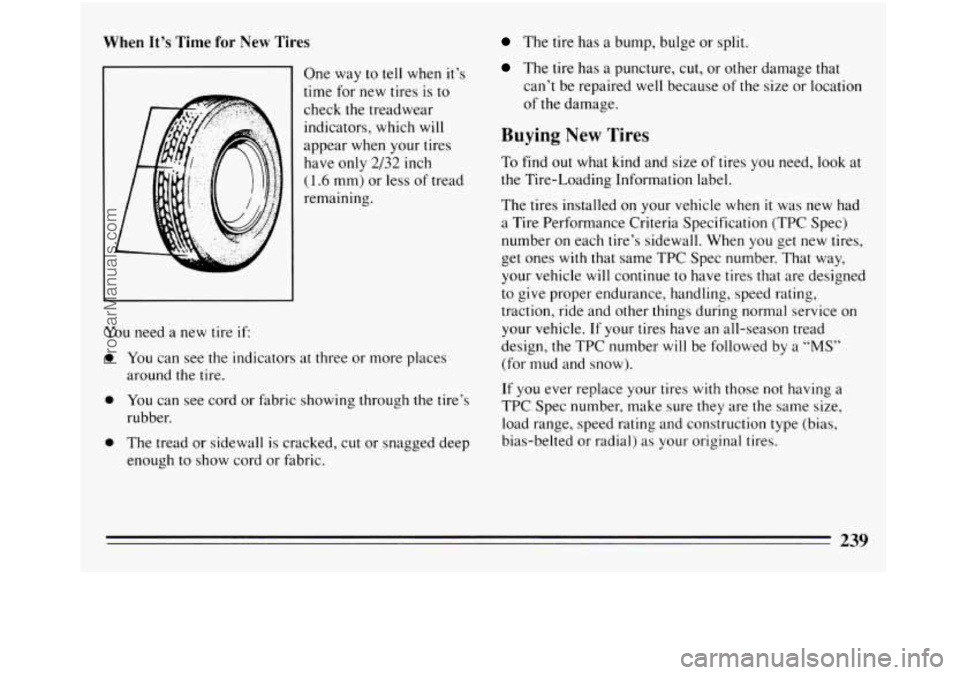
One way to tell when it’s
time for new tires
is to
check the treadwear
indicators, which will
appear when your tires
have
only 2/32 inch
(1.6 mm) or less of tread
remaining.
You need a new tire
if
0 You can see the indicators at three or more places
around the tire.
0 You can see cord or fabric showing through the tire’s
rubber.
0 The tread or sidewall is cracked, cut or snagged deep
enough to show cord or fabric.
The tire has a bump, bulge or split.
The tire has a puncture, cut, or other damage that
can’t be repaired well because of the size or location
of the damage.
Buying New Tires
To find out what kind and size of tires you need, look at
the Tire-Loading Information label.
The tires installed on your vehicle
when it was new had
a Tire Performance Criteria Specification (TPC Spec)
number on each tire’s sidewall. When you get new tires,
get ones
with that same TPC Spec number. That way,
your vehicle
will continue to have tires that are designed
to give proper endurance, handling, speed rating,
traction, ride and other things during normal service on
your vehicle. If your tires have an all-season tread
design, the TPC number will be followed by a
“MS”
(for mud and snow).
If you ever replace your tires with those not having a
TPC Spec number, make sure they are the same size,
load range, speed rating and construction type (bias,
bias-belted or radial) as your original tires.
239
ProCarManuals.com
Page 249 of 308
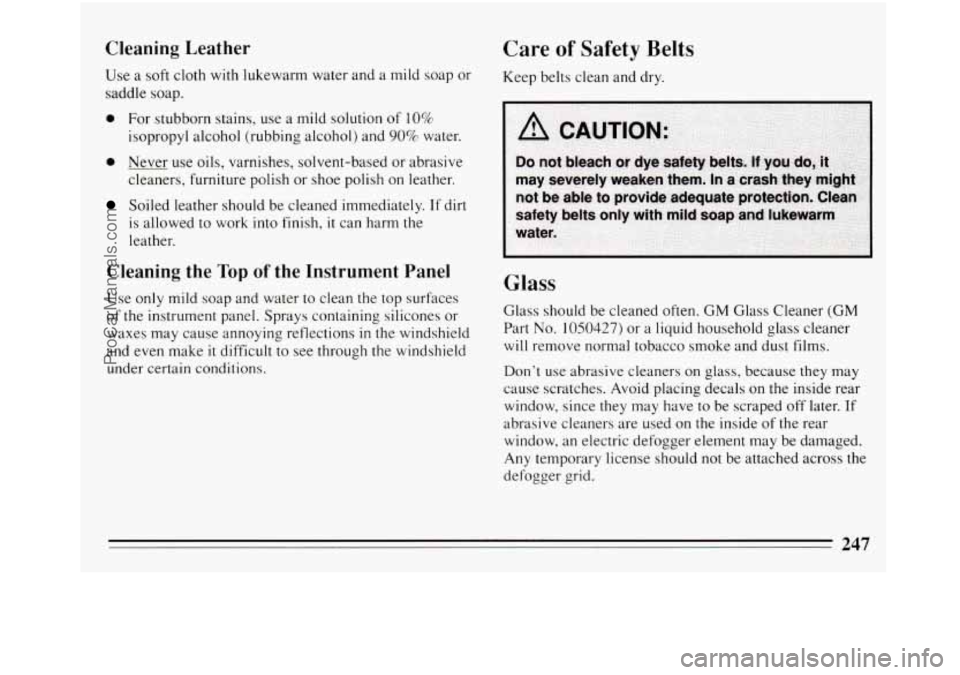
Cleaning Leather
Use a soft cloth with lukewarm water and a mild soap or
saddle soap.
0 For stubborn stains, use a mild solution of 10%
isopropyl alcohol (rubbing alcohol) and 90% water.
0 Never use oils, varnishes, solvent-based or abrasive
cleaners, furniture polish or shoe polish on leather.
Soiled leather should be cleaned immediately. If dirt
is allowed to work into finish, it can harm the
leather.
Cleaning the Top of the Instrument Panel
Use only mild soap and water to clean the top surfaces
of the instrument panel. Sprays containing silicones or
waxes may cause annoying reflections
in the windshield
and even make
it difficult to see through the windshield
under certain conditions.
Care of Safety Belts
Keep belts clean and dry.
I not be able to provide adequate protection. Clean
Glass
Glass should be cleaned often. GM Glass Cleaner (GM
Part No. 1050427) or a liquid household glass cleaner
will remove normal tobacco smoke and dust films.
Don’t use abrasive cleaners on glass, because they may
cause scratches. Avoid placing decals on the inside rear
window, since they may have to be scraped off later.
If
abrasive cleaners are used on the inside of the rear
window, an electric defogger element may be damaged.
Any temporary license should not be attached across the
defogger grid.
247
ProCarManuals.com
Page 263 of 308
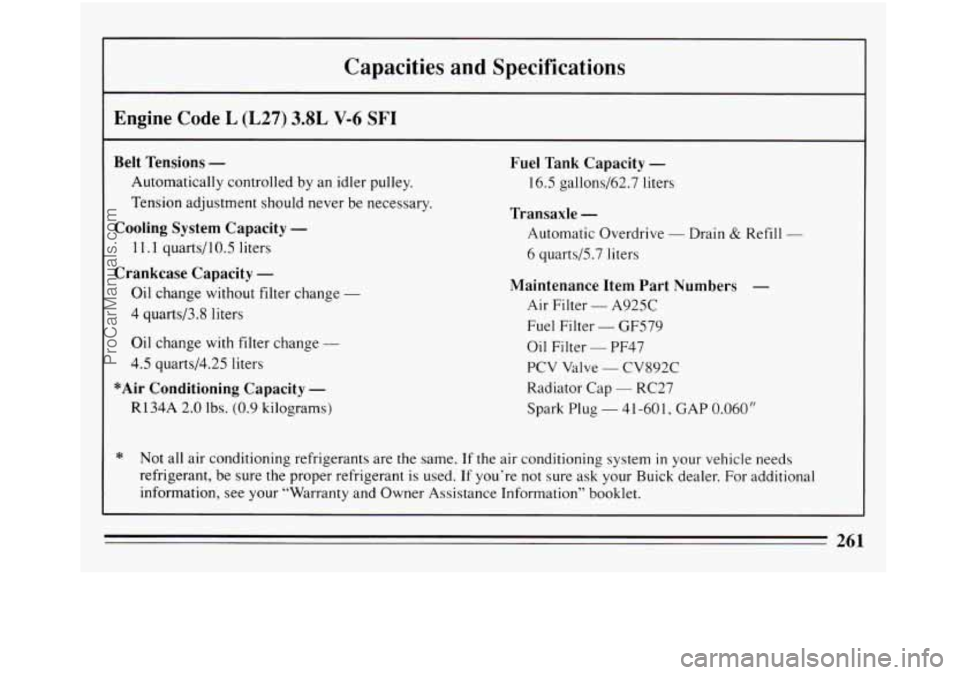
Capacities and Specifications
Engine Code L (L27) 3.8L V-6 SF1
Belt Tensions -
Automatically controlled by an idler pulley.
Tension adjustment should never be necessary.
Cooling System Capacity -
11.1 quartsl10.5 liters
Crankcase Capacity -
Oil change without filter change -
4 quarts/3.8 liters
Oil change with filter change -
4.5 quarts/4.25 liters
*Air Conditioning Capacity -
R134A 2.0 lbs. (0.9 kilograms)
Fuel Tank Capacity -
16.5 gallons/62.7 liters
Transaxle -
Automatic Overdrive - Drain & Refi 11 -
6 quarts/5.7 liters
Maintenance Item Part Numbers -
Air Filter - A925C
Fuel Filter
- GF579
Oil Filter
- PF47
PCV Valve
- CV892C
Radiator Cap
- RC27
Spark Plug
- 4 1-60 1, GAP 0.060”
* Not all air conditioning refrigerants are the same. If the air conditioning system in your vehicle needs
refrigerant, be sure the proper refrigerant is used. If you’re not sure ask your Buick dealer. For additional
information, see your “Warranty and Owner Assistance Information” booklet.
261
ProCarManuals.com
Page 264 of 308
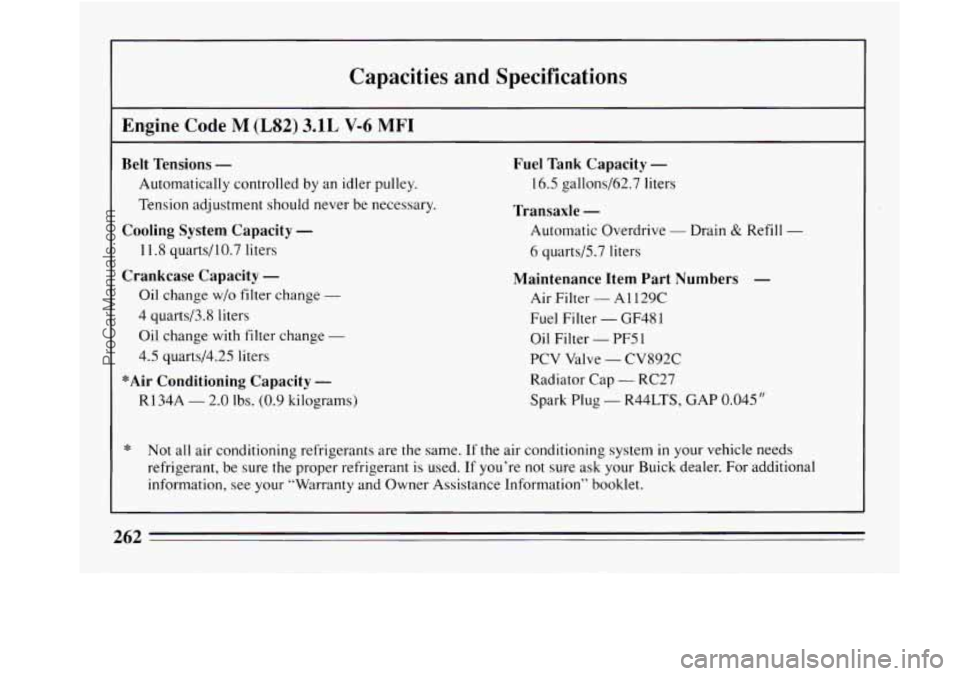
Capacities and Specifications
Engine Code M (LS2) 3.1L V-6 MFI
Belt Tensions -
Automatically controlled by an idler pulley.
Tension adjustment should never be necessary.
Cooling System Capacity -
11.8 quartsll0.7 liters
Crankcase Capacity -
Oil change w/o filter change -
4 quarts/3.8 liters
Oil change with filter change
-
4.5 quarts/4.25 liters
*Air Conditioning Capacity -
R134A - 2.0 lbs. (0.9 kilograms)
Fuel Tank Capacity -
16.5 gallons/62.7 liters
Transaxle -
Automatic Overdrive - Drain & Refill -
6 quarts/5.7 liters
Maintenance Item Part Numbers -
Air Filter - A 1 129C
Fuel Filter - GF48 1
Oil Filter - PF5 1
PCV Valve - CV892C
Radiator Cap
- RC27
Spark Plug
- R44LTS, GAP 0.045”
* Not all air conditioning refrigerants are the same. If the air conditioning system in your vehicle needs
refrigerant, be sure the proper refrigerant is used. If you’re not sure ask your Buick dealer. For additional
information, see your “Warranty and Owner Assistance Information” booklet.
262
ProCarManuals.com
Page 270 of 308
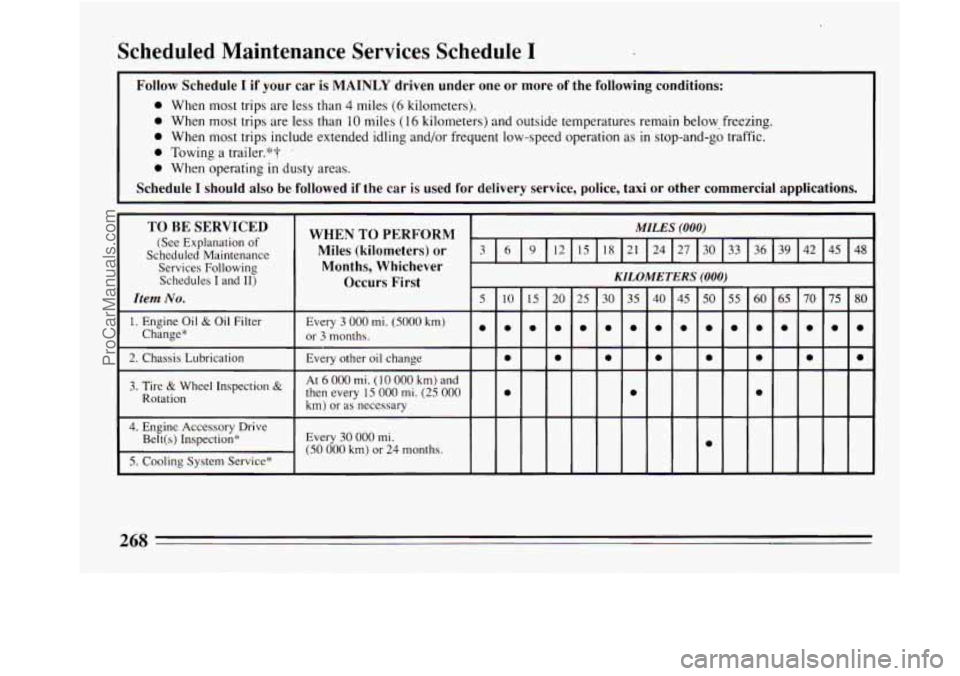
Scheduled Maintenance Services Schedule I
Follow Schedule I if your car is MAINLY driven under one or more of the following conditions:
0 When most trips are less than 4 miles (6 kilometers).
0 When most trips are less than 10 miles (16 kilometers) and outside temperatures remain below freezing.
0 When most trips include extended idling and/or frequent low-speed operation as in stop-and-go traffic.
0 Towing a trailer."? '
0 When operating in dusty areas.
I
Schedule I should also be followed if the car is used for delivery service, police, taxi or other commercial applications.
TO BE SERVICED
(See Explanation of
Scheduled Maintenance
Services Following Schedules
I and 11)
Item No.
1. Engine Oil & Oil Filter
Change"
2. Chassis Lubrication
3. Tire & Wheel Inspection &
Rotation
4. Engine Accessory Drive
Belt(s) Inspection*
5. Cooling System Service*
268
ProCarManuals.com
Page 272 of 308
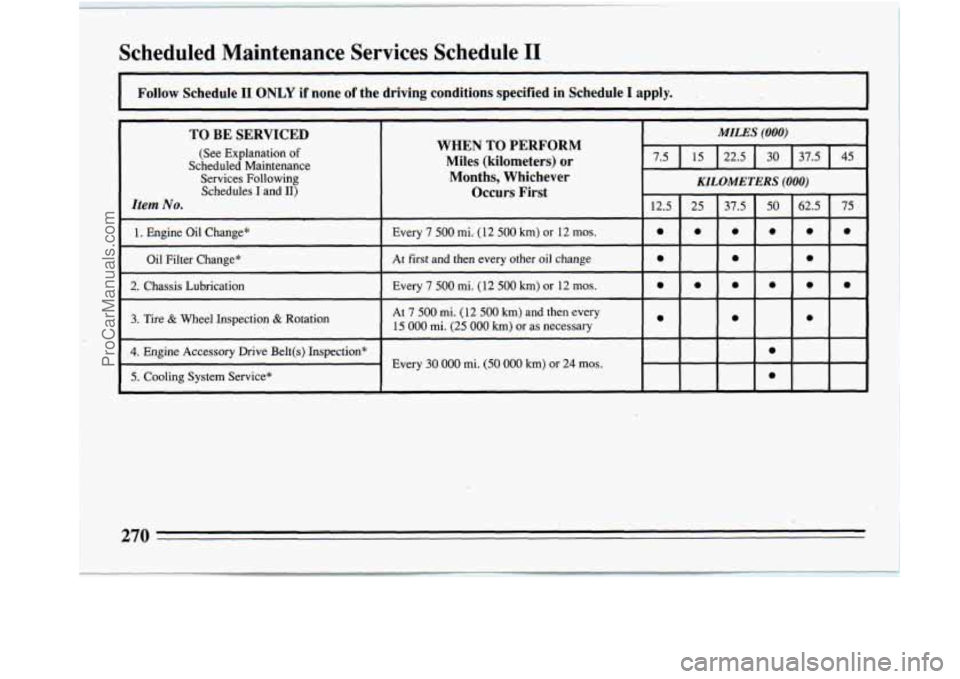
Scheduled Maintenance Services Schedule I1
I Follow Schedule II ONLY if none of the driving conditions specified in Schedule I apply. I
TO BE SERVICED
(See Explanation of
Scheduled Maintenance
Services Following
Schedules
I and IIj
Item No.
1. Engine Oil Change*
Oil Filter Change*
2. Chassis Lubrication ,_ . .
I 3. Tire & Wheel Inspection & Rotation
I MILES /OOO)
WHEN TO PERFORM
Miles (kilometers) or ,Months, Whichever
I Occurs First
12.5
Every 7 500 mi. (12 500 km) or 12 mos. a
~ At first and then every other oil change a
1 Every 7 500 mi. (12 500 km) or 12 mos. 0
I
At 7 500 mi. (12 500 km) and then every
15 000 mi. (25 000 km) or as necessary
4. Engine Accessory Drive Belt(s) Inspection*
5. Cooling System Service* Every 30
000 mi. (50 000 km) or 24 mos.
KILOMETERS (000)
270
ProCarManuals.com
Page 274 of 308
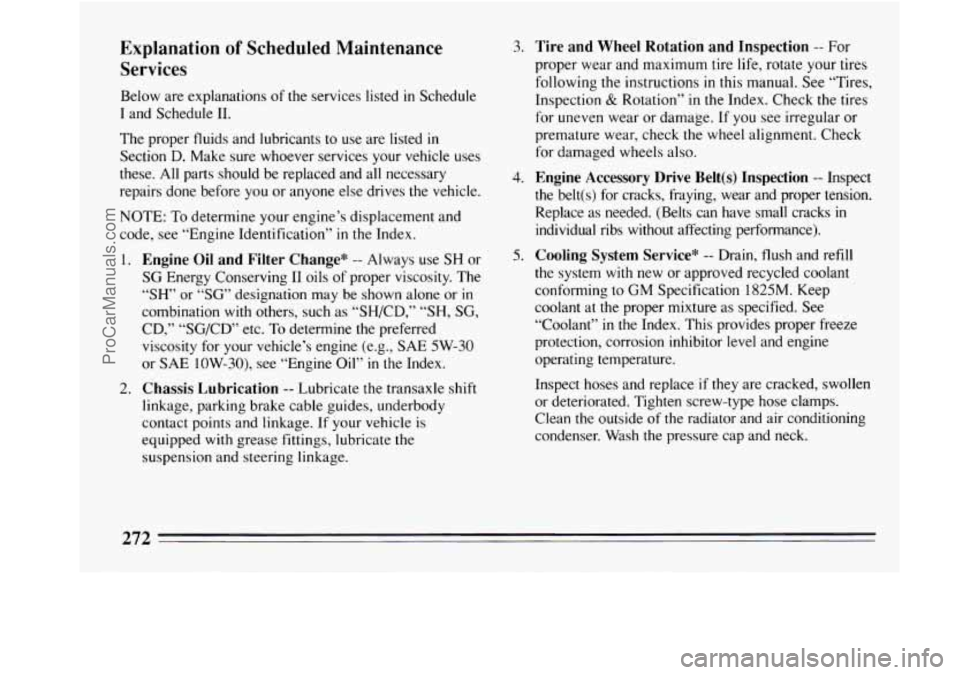
Explanation of Scheduled Maintenance
Services
Below are explanations of the services listed in Schedule
I and Schedule 11.
The proper fluids and lubricants to use are listed
in
Section D. Make sure whoever services your vehicle uses
these. All
parts should be replaced and all necessary
repairs done before you or anyone else drives the vehicle.
NOTE: To determine your engine’s displacement and
code, see “Engine Identification”
in the Index.
1.
Engine Oil and Filter Change* -- Always use SH or
SG Energy Conserving I1 oils of proper viscosity. The
“SH” or “SG” designation may be shown alone or in
combination with others, such as “SH/CD,” “SH, SG,
CD,” “SG/CD” etc.
To determine the preferred
viscosity for your vehicle’s engine (e.g., SAE 5W-30-
or SAE 10W-30), see “Engine Oil” in the Index.
2. Chassis Lubrication -- Lubricate the transaxle shift
linkage, parking brake cable guides, underbody
contact points and linkage. If your vehicle is
equipped with grease fittings, lubricate the
suspension and steering linkage. 3.
4.
5.
Tire
and Wheel Rotation and Inspection -- For
proper wear and maximum tire life, rotate your tires
following the instructions
in this manual. See “Tires,
Inspection
& Rotation” in the Index. Check the tires
for uneven wear or damage. If you see irregular or
premature wear, check the wheel alignment. Check
for damaged wheels also.
Engine Accessory Drive Belt(s) Inspection -- Inspect
the belt(s) for cracks, fraying, wear and proper tension.
Replace as needed. (Belts can have small cracks
in
individual ribs without affecting performance).
Cooling System Service* -- Drain, flush and refill
the system
with new or approved recycled coolant
conforming to GM Specification
1825M. Keep
coolant at the proper mixture as specified. See
“Coolant”
in the Index. This provides proper freeze
protection, corrosion inhibitor level and engine
operating temperature.
Inspect hoses and replace if they are cracked, swollen
or deteriorated. Tighten screw-type hose clamps.
Clean the outside of the radiator and air conditioning
condenser. Wash the pressure cap and neck.
272
ProCarManuals.com