Page 222 of 308
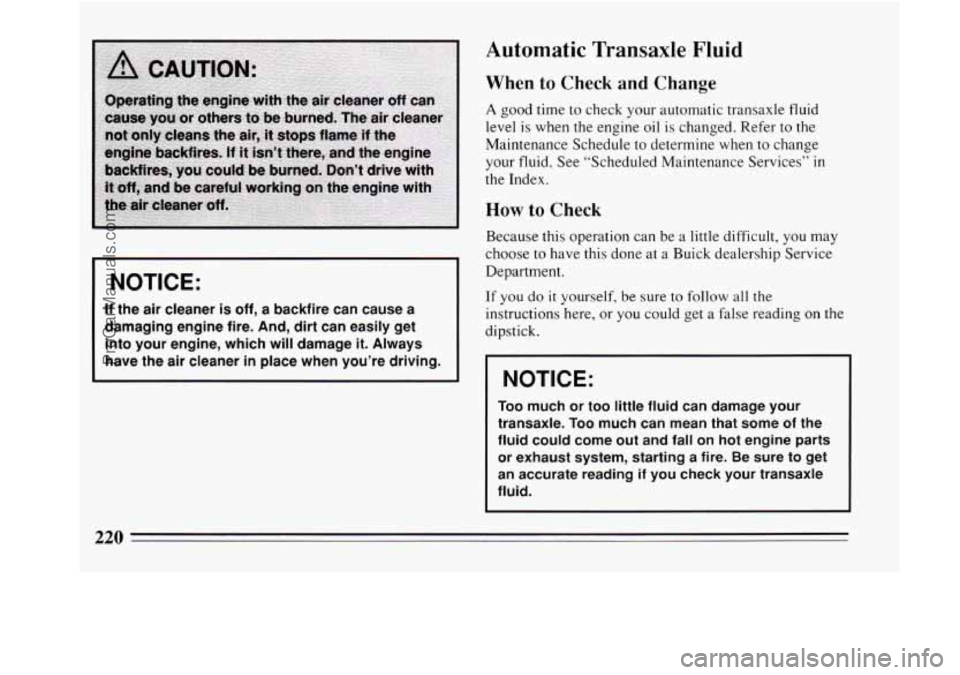
I NOTICE:
If the air cleaner is off, a backfire can cause a
damaging engine fire. And, dirt can easily get
into your engine, which will damage
it. Always
have the air cleaner
in place when you’re driving.
Automatic Transaxle Fluid
When to Check and Change
A good time to check your automatic transaxle fluid
level
is when the engine oil is changed. Refer to the
Maintenance Schedule to determine when to change
your fluid. See “Scheduled Maintenance Services” in
the Index.
How to Check
Because this operation can be a little difficult, you may
choose to have this done at a Buick dealership Service
Department.
If you do it yourself, be sure to follow all the
instructions here, or you could get a false reading on the
dipstick.
NOTICE:
Too much or too little fluid can damage your
transaxle.
Too much can mean that some of the
fluid could come out and fall on hot engine parts
or exhaust system, starting a fire. Be sure to get
an accurate reading
if you check your transaxle
fluid.
ProCarManuals.com
Page 257 of 308

Fuse Block
Amp Description
1.
2.
10
10
3. 20
4.
2s
5. IO
6. 15
7. 15
8. 1s
9. 20
10.
1s
11. 5
12. 1s
13. 15 Radio
& Clock, Steering
Wheel Radio Switches.
Headlight Switch, Air Bag Diagnostic Module, ABS
Lamp Driver Module, Daytime Running Lamps
Module (w/DRL), TCC/Brake Switch, Cruise
Control Cut-Out Switch, Instrument Cluster, Chime
Module, Rear Defogger Timer Relay
A/C HI Blower Relay
Wipermasher Switch
Turn Signal Flasher
TCC/Brake Switch, Hazard Flasher
Vanity Mirror, Lights, I/P Compartment Light,
Courtesy Lights, Trunk Courtesy Light,
Dome/Reading Lights, Cigar Lighter.
Air Bag Diagnostic Module
Power Door Locks, Remote Keyless Entry System
Cigar Lighter
Theft Deterrent Decoder Module
Heater, Vent A/C Solenoid Box, A/C LO Blower
Relay
Chime Module, Electronic Brake Control Module.
Theft Deterrent Decoder Module, Radio, Passive
Restraint Timer Relay, Low Oil Level Module
1s.
Amp Description
14. 15 Air Temperature Valve Motors, Instrument Cluster,
Daytime Running Lights Module (w/DRL), HVAC
Control Assembly, Multi-Function Lever, Heated
Oxygen Sensor
#2, Passenger Temperature Control
Electrical Center
#2, ABS Relay
16. 10 Antenna Relay, Outside Mirror Control, Front
Window/Door Lock Switches, Front Door Handle
Switches
17.
Not Used
18. 5 Air Bag Diagnostic Module
5 Electronic Brake Control Module, Underhood
n
CTSY ARBGl DRLKS
@m@
ClLTR VATS HVAC
This fuse panel is inside the
glove
box. Pull the cover
down to access the
fuses.
Some spare fuses and a fuse
puller are included.
255
ProCarManuals.com
Page 266 of 308
I
IMPORTANT:
KEEP ENGINE OIL
AT THE PROPER
LEVEL AND CHANGE AS
RECOMMENDED
Protection
Plan
Have you purchased the GM Protection Plan? The
Plan supplements
your new vehicle warranties. See
your Buick dealer for details.
Introduction
A Word About Maintenance
We at General Motors want to help you keep your
vehicle
in good working condition. But we don’t know
exactly how you’ll drive it. You may drive very short
distances only a few times a week. Or you may drive
long distances all the time in very hot, dusty weather.
You may use your vehicle in making deliveries. Or you
may drive
it to work, to do errands or in many other
ways.
Because of all the different ways people use their
GM
vehicles, maintenance needs vary. You may even need
more frequent checks and replacements than you will
find
in the schedules in this part. So please read this part
and note how you drive. If you have any questions on
how-to keep your vehicle
in good condition, see your
Buick dealer, the place many
GM owners choose to
have their maintenance work done. Your dealer can be
relied upon to use proper parts and practices.
264
ProCarManuals.com
Page 274 of 308
Explanation of Scheduled Maintenance
Services
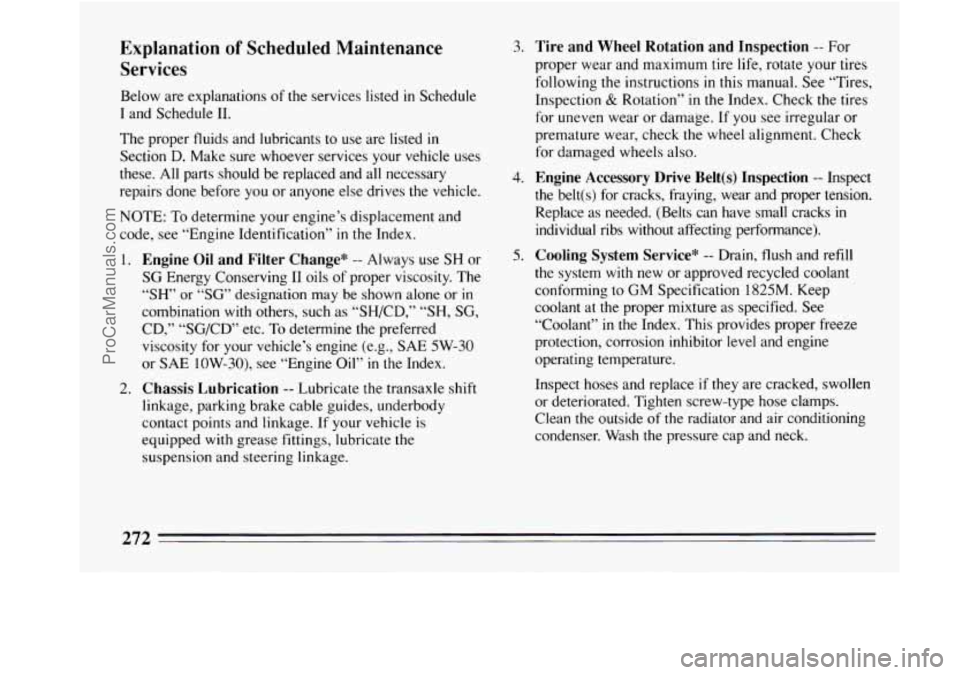
Below are explanations of the services listed in Schedule
I and Schedule 11.
The proper fluids and lubricants to use are listed
in
Section D. Make sure whoever services your vehicle uses
these. All
parts should be replaced and all necessary
repairs done before you or anyone else drives the vehicle.
NOTE: To determine your engine’s displacement and
code, see “Engine Identification”
in the Index.
1.
Engine Oil and Filter Change* -- Always use SH or
SG Energy Conserving I1 oils of proper viscosity. The
“SH” or “SG” designation may be shown alone or in
combination with others, such as “SH/CD,” “SH, SG,
CD,” “SG/CD” etc.
To determine the preferred
viscosity for your vehicle’s engine (e.g., SAE 5W-30-
or SAE 10W-30), see “Engine Oil” in the Index.
2. Chassis Lubrication -- Lubricate the transaxle shift
linkage, parking brake cable guides, underbody
contact points and linkage. If your vehicle is
equipped with grease fittings, lubricate the
suspension and steering linkage. 3.
4.
5.
Tire
and Wheel Rotation and Inspection -- For
proper wear and maximum tire life, rotate your tires
following the instructions
in this manual. See “Tires,
Inspection
& Rotation” in the Index. Check the tires
for uneven wear or damage. If you see irregular or
premature wear, check the wheel alignment. Check
for damaged wheels also.
Engine Accessory Drive Belt(s) Inspection -- Inspect
the belt(s) for cracks, fraying, wear and proper tension.
Replace as needed. (Belts can have small cracks
in
individual ribs without affecting performance).
Cooling System Service* -- Drain, flush and refill
the system
with new or approved recycled coolant
conforming to GM Specification
1825M. Keep
coolant at the proper mixture as specified. See
“Coolant”
in the Index. This provides proper freeze
protection, corrosion inhibitor level and engine
operating temperature.
Inspect hoses and replace if they are cracked, swollen
or deteriorated. Tighten screw-type hose clamps.
Clean the outside of the radiator and air conditioning
condenser. Wash the pressure cap and neck.
272
ProCarManuals.com
Page 276 of 308
Section B: Owner Checks and
Services
Listed below are owner checks and services which
should be performed at the intervals specified to help
ensure the safety, dependability and emission control
performance
of your vehicle.
Be sure any necessary repairs are completed at once.
Whenever any fluids or lubricants are added to your
vehicle, make sure they are
the proper ones, as shown in
Section
D.
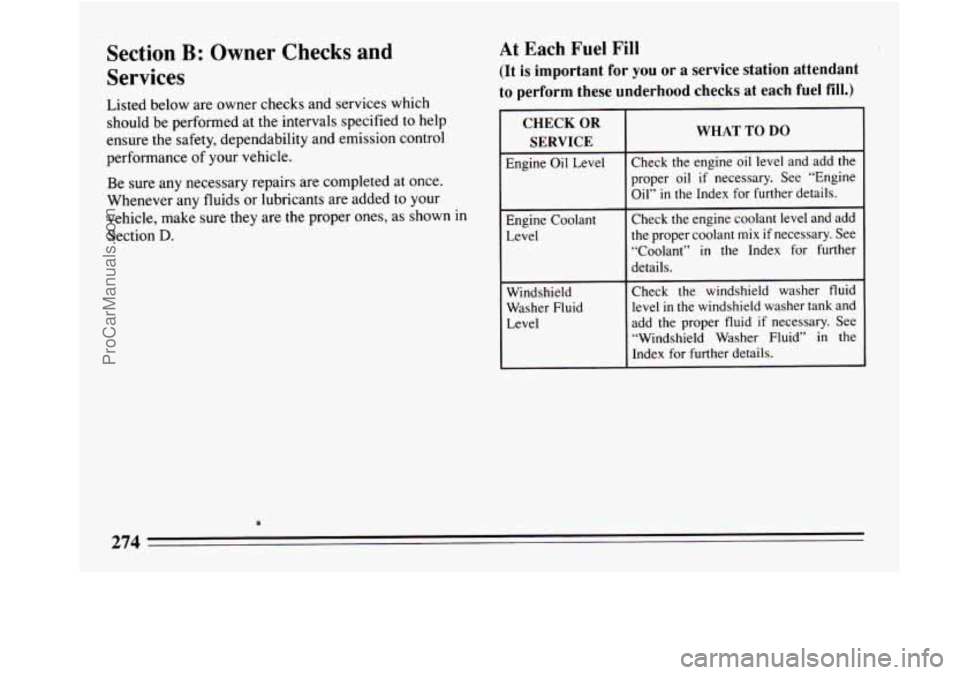
At Each Fuel Fill
(It is important for you or a service station attendant
to perform these underhood checks at each fuel fill.)
CHECK OR
I SERVICE
Engine Oil Level
Level
Level
WHAT TO DO
Check the engine oil level and add the
proper oil
if necessary. See “Engine
Oil” in the Index for further details.
Check the engine coolant level and add
the proper coolant
mix if necessary. See
“Coolant”
in the Index for further
details.
Check the windshield washer fluid
level
in the windshield washer tank and
add the proper fluid
if necessary. See
“Windshield Washer Fluid” in the
Index for further details.
0
274
ProCarManuals.com