Page 29 of 308
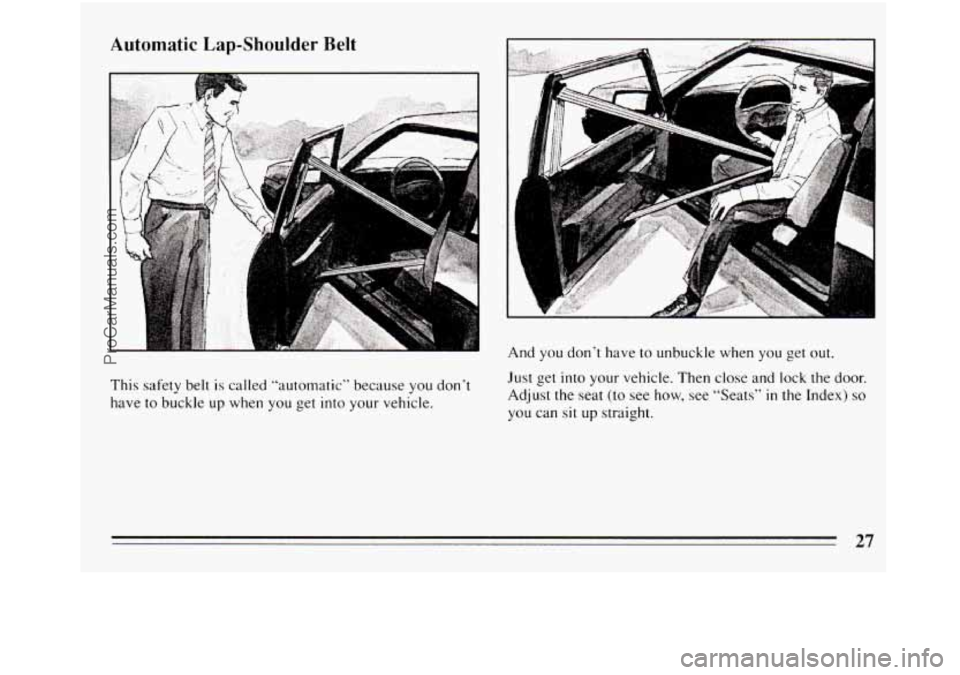
This safety belt is called “automatic” because you don’t
have to buckle up when you get into your vehicle. And you
don’t have to unbuckle when
you get out.
Just get into your vehicle. Then close and lock the door.
Adjust
the seat (to see how, see “Seats” in the Index) so
you can sit up straight.
27
ProCarManuals.com
Page 30 of 308
The safety belt locks if there’s a sudden stop or a crash.\
It’s possible that an automatic belt could keep you from
fully opening a door. That can happen if the door was
slammed shut very hard. Just close the door all the way,
then slowly open it. If that doesn’t
fix it, then your
Buick needs service.
We hope you’ll always keep your automatic belt
buckled. However, you may need to unbuckle it in an
emergency.
And you would need to unbuckle it to let
someone get into the center front seat position, if ,your
vehicle has one.
r
The lap belt should be worn as low on the hips as
possible. In a crash, this applies force to the strong pelvic bones. And you’d be less likely to slide under the
lap belt.
If you slid under it, the belt would apply force
at
your abdomen. This could cause serious or even fatal
injuries. The shoulder belt should
go over the shoulder
and across the chest. These parts of the body are best
able to take belt restraining forces.
28
ProCarManuals.com
Page 31 of 308
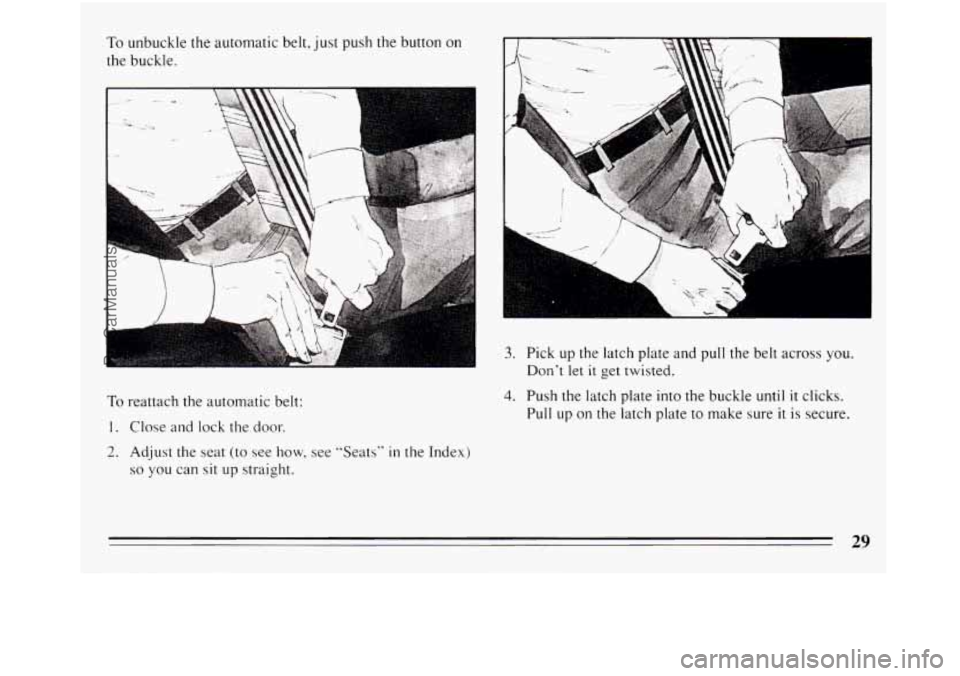
To unbuckle the automatic belt, just push the button on
the buckle.
To reattach the automatic belt:
1. Close and lock the door.
2. Adjust the seat (to see how, see "Seats" in the Index)
so you can sit up straight.
3. Pick up the latch plate and pull the belt across you.
Don't let it get twisted.
4. Push the latch plate into the buckle until it clicks.
Pull up on the latch plate to make sure
it is secure.
29
ProCarManuals.com
Page 32 of 308
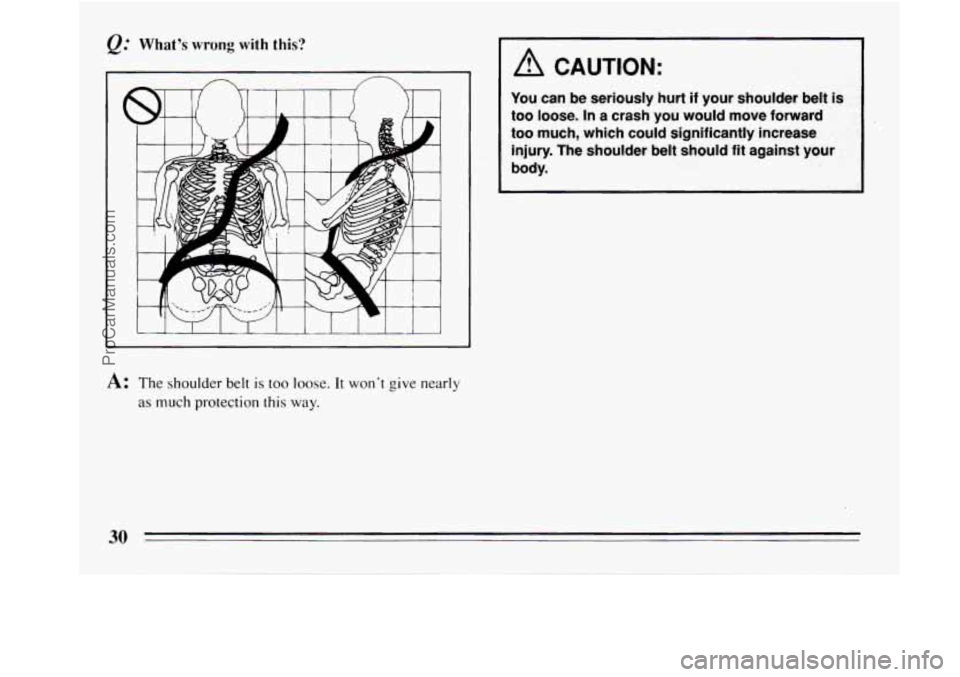
What's wrong with this?
t
A: The shoulder belt is too loose. It won't give nearly
as much protection this way.
. .. , , ,, .. . . . .. . . r_
You can be seriously hurt if your shoulder be&'&
~ ... ...,. qy "' . , $:,<., ~ : .. ..:i&,> $j.:;&f .:.:,,:%.
too loose. In a crash you would move forward
too much, which could significantly
increase
injury. The shoulder belt should fit against your
30
ProCarManuals.com
Page 33 of 308
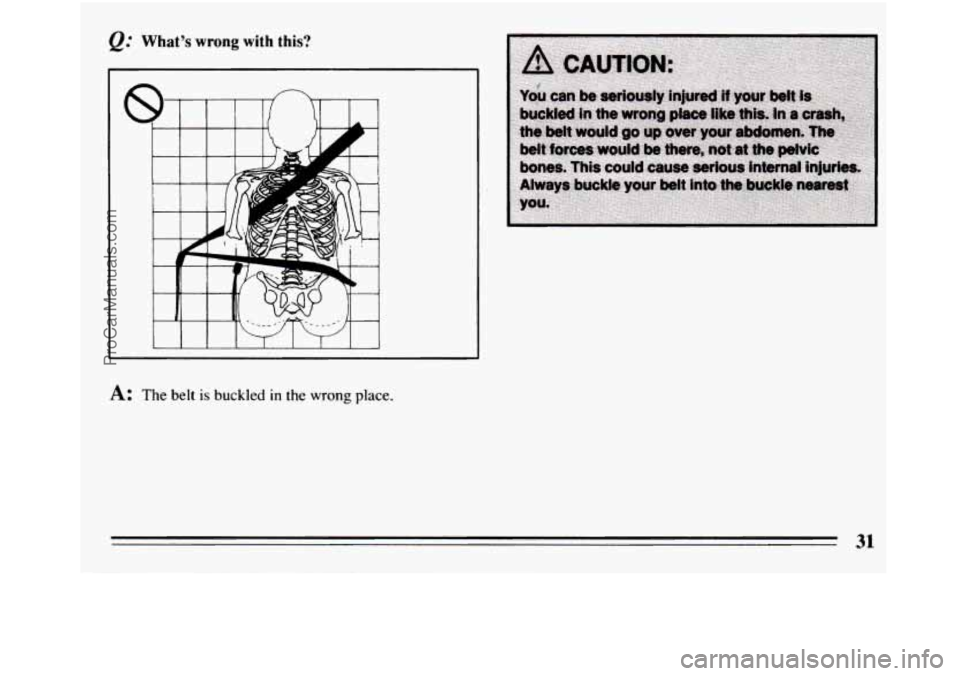
What’s wrong with this?
A: The belt is buckled in the wrong place.
31
ProCarManuals.com
Page 34 of 308
Q: What’s wrong with this?
A: The shoulder belt is worn under the arm. It should
be worn over the shoulder at all times.
I A CAUTION:
You can be seriously injured if you wear the
shoulder belt under your arm.
In a crash, your
body would move
too far forward, which would
increase the chance of head and neck injury.
Also, the belt would apply too much force to the
ribs, which aren’t
as strong as shoulder bones.
You could also severely injure internal organs
like your liver or spieen.
32
ProCarManuals.com
Page 35 of 308
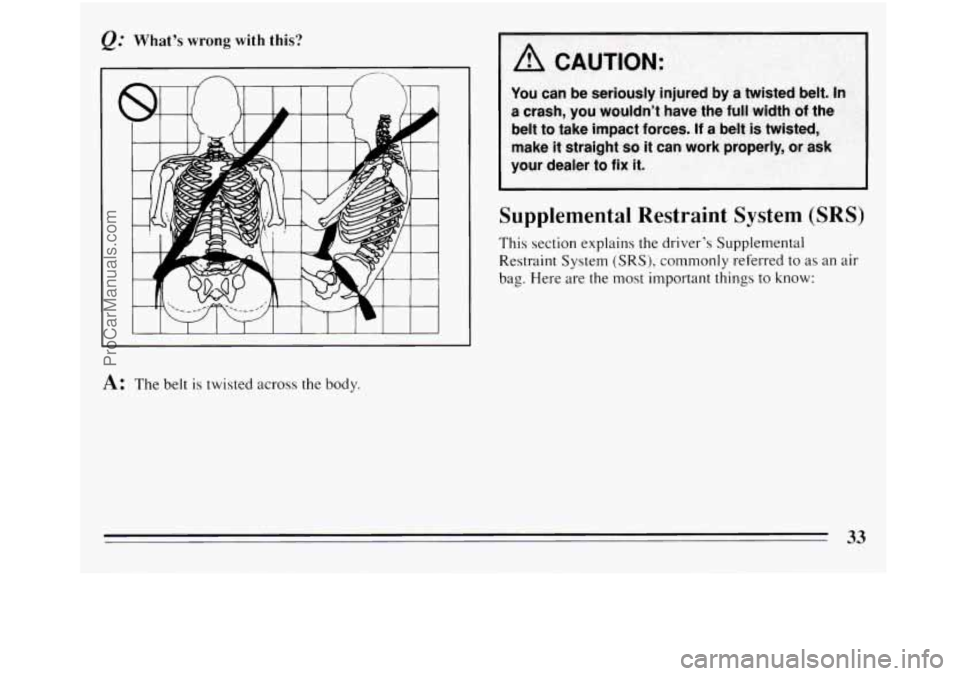
&.’ What’s wrong with this?
I I I I 1 I I 1 I 1 I
A: The belt is twisted across the body.
Supplemental Restraint System (SRS)
This section explains the driver’s Supplemental
Restraint System
(SRS), commonly referred to as an air
bag. Here are the most important things to know:
33
ProCarManuals.com
Page 38 of 308
When is an air bag expected to inflate?
The air bag is designed to inflate in moderate to severe
frontal or near-frontal crashes. The air bag will only
inflate if the velocity of the impact is above the designed
threshold level. When impacting straight into a wall that
does not move or deform,
the threshold level for most
GM vehicles is between 9 and 15 mph (14 and 23
km/h). However, this velocity threshold depends on the
vehicle design and may be several miles-per-hour faster
or slower. In addition, this threshold velocity will be
considerably higher if the vehicle strikes an object such
as a parked car which will move and deform on impact.
The air bag is also not designed
to inflate in rollovers,
side impacts, or rear impacts where the inflation would
provide
no occupant protection benefit.
In any particular crash, the determination of whether
the
air bag should have inflated cannot be based solely on
the level of damage on the vehicle(s). Inflation is
determined by the angle
of the impact and the vehicle’s
deceleration, of which vehicle damage is only one
indication. Repair cost is
not a good indicator of
whether an air bag should have deployed.
What makes an air bag inflate?
In a frontal impact of sufficient severity, the air bag
sensing system detects that
the vehicle is suddenly
stopping as a result of a crash. The sensing system
triggers a chemical reaction of the sodium azide sealed
in the inflator. The reaction produces nitrogen gas,
which inflates the cloth bag. The inflator, cloth bag, and
related hardware are all part of the air bag inflator
module packed inside the steering wheel.
How does an air bag restrain?
In moderate to severe frontal or near-frontal collisions,
even belted occupants can contact the steering wheel.
The air bag supplements the protection provided by
safety belts. Air bags distribute the force of the impact
more evenly over the occupant’s upper body, stopping
the occupant more gradually. But air bags would not
provide protection
in many types of collisions, including
rollovers and rear and side impacts, primarily because
an occupant’s motion is not toward the air bag. Air bags
should never be regarded as anything more than a
supplement to safety belt protection in moderate to
severe frontal and near-frontal collisions.
36
ProCarManuals.com