Page 60 of 308
Securing a Child Restraint in a Center Seat
Position 1. Make the belt as long as possible by tilting the latch
plate and pulling
it along the belt.
u
When you secure a chiId restraint in a center seating
position, you'll be using the lap belt.
See the earlier section about the top strap if the child
restraint has one.
A
I
58
ProCarManuals.com
Page 61 of 308
2.
3.
4.
Put the restraint on the seat. Follow the instructions
for the child restraint.
Secure the child
in the child restraint as the
instructions say.
Run the vehicle’s safety belt through or around the
restraint. The child restraint instructions
will show
you how.
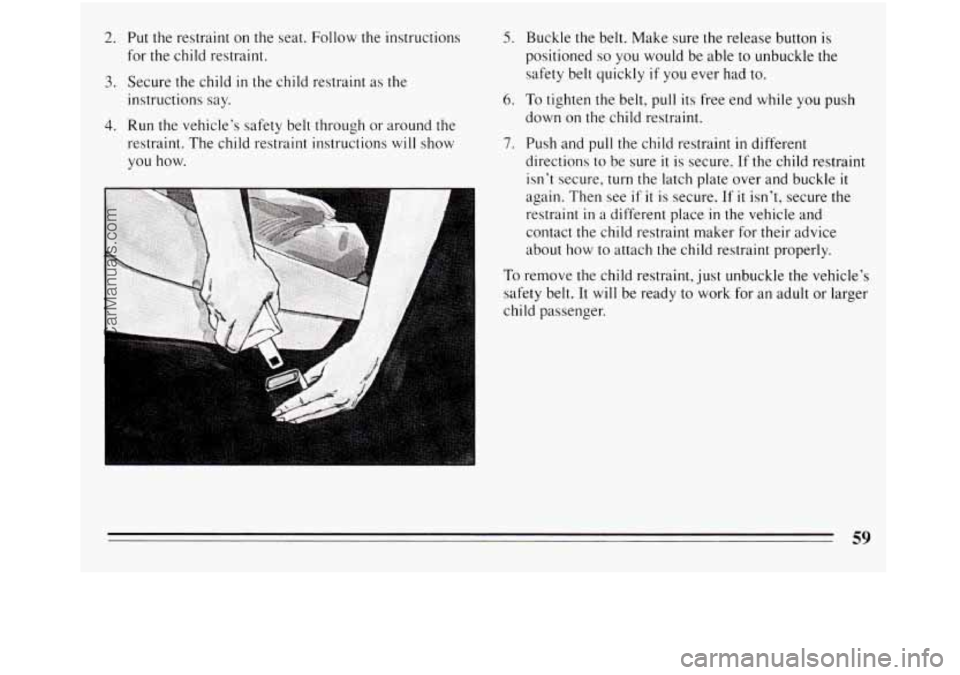
5. Buckle the belt. Make sure the release button is
positioned so you would be able to unbuckle the
safety belt quickly
if you ever had to.
6. To tighten the belt, pull its free end while you push
down
on the child restraint.
7. Push and pull the child restraint in different
directions
to be sure it is secure. If the child restraint
isn’t secure, turn the latch plate over and buckle
it
again. Then see if it is secure. If it isn’t, secure the
restraint
in a different place in the vehicle and
contact the child restraint maker for their advice
about how to attach
the child restraint properly.
To remove the child restraint, just unbuckle the vehicle’s
safety belt. It will be ready to work for an adult or larger
child passenger.
59
ProCarManuals.com
Page 62 of 308
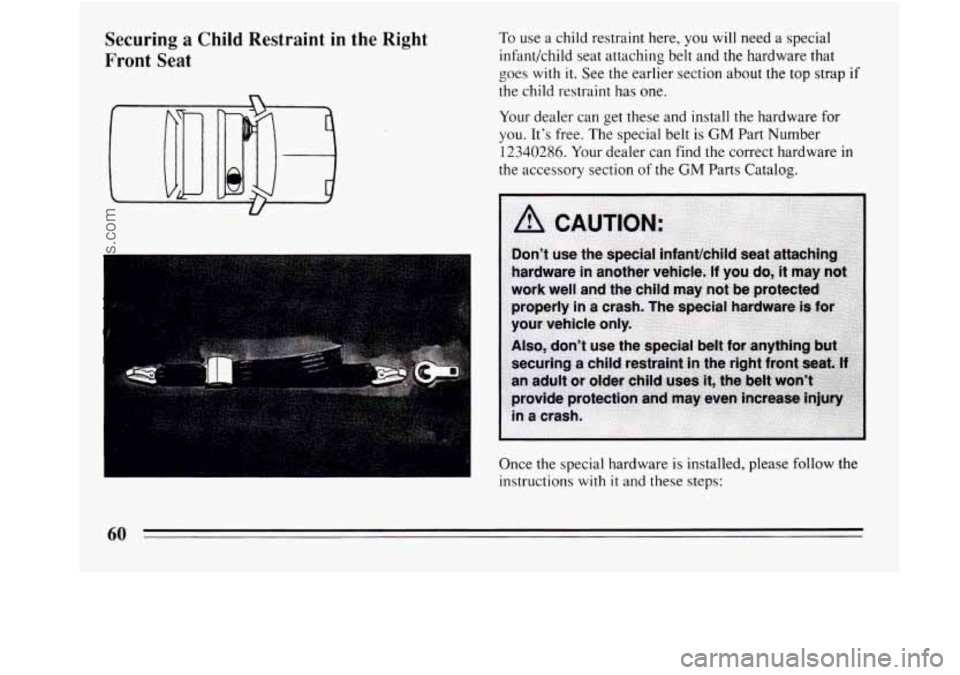
Securing a Child Restraint in the Right
Front
Seat
To use a child restraint here, you will need a special
infant/child seat attaching belt and the hardware that
goes with
it. See the earlier section about the top strap if
the child restraint has one.
Your dealer can get these and install the hardware
for
you. It’s free. The special belt is GM Part Number
12340286. Your dealer can find the correct hardware in
the accessory section of the
GM Parts Catalog.
Once the special hardware is installed, please follow the
instructions
with it and these steps:
60
ProCarManuals.com
Page 64 of 308
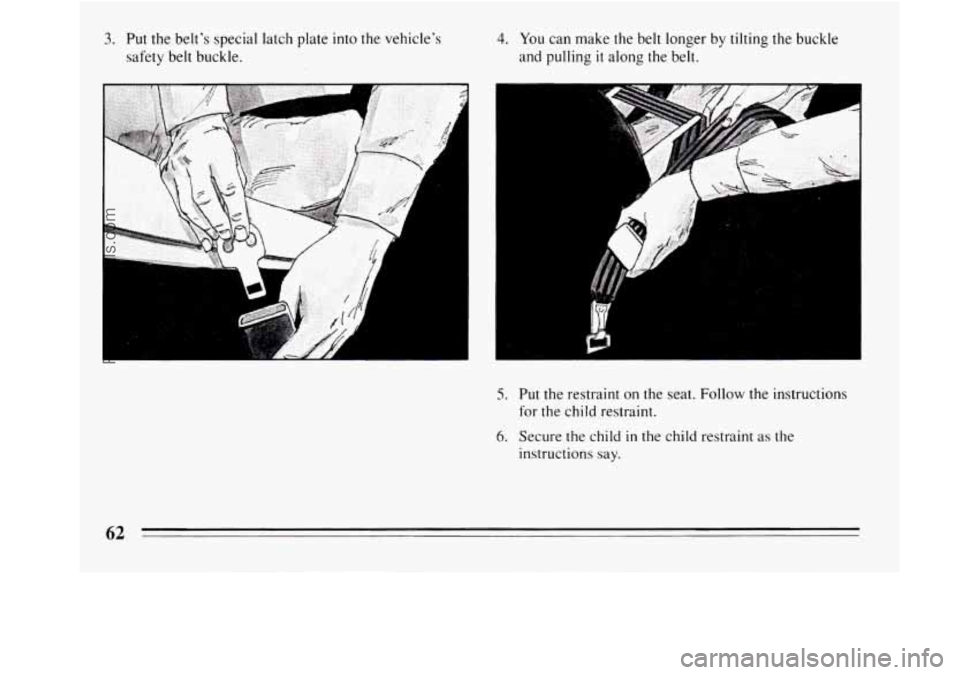
3. Put the belt's special latch plate into the vehicle's
safety belt buckle.
I
4. You can make the belt longer by tilting the buckle
and pulling
it along the belt.
.:
5. Put the restraint on the seat. Follow the instructions
for the child restraint.
6. Secure the child in the child restraint as the
instructions say.
62
ProCarManuals.com
Page 65 of 308
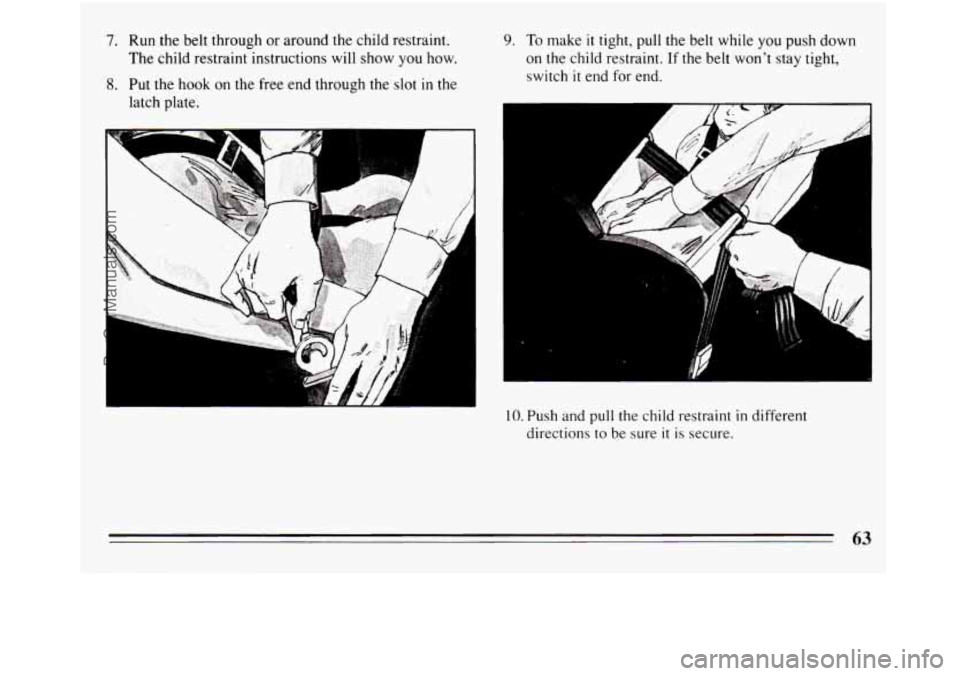
7. Run the belt through or around the child restraint.
The child restraint instructions will show
you how.
8. Put the hook on the free end through the slot in the
latch plate.
x
9. To make it tight, pull the belt while you push down
on the child restraint. If the belt won't stay tight,
switch
it end for end.
10. Push and pull the child restraint in different
directions to be sure
it is secure.
63
ProCarManuals.com
Page 80 of 308

PASS-Key@II
Your vehicle is
equipped
with the
PASS-Key@II
(Personalized
Automotive Security
System) theft deterrent
system. PASS-Key(%
is a passive theft
deterrFnt system. This
means you don’t have
to do anything different
to arm or disarm the
system.
It works
when you insert or remove the key from the
ignition. PASS-Key% uses a resistor pellet
in the
ignition key that matches a decoder
in your vehicle.
When the PASS-Key% system senses that someone
is
using the wrong key, it shuts down the vehicle’s starter
and
fuel systems. For about three minutes, the starter
won’t work and fuel won’t
go to the engine. If someone
tries to start your vehicle again or uses another key
during this time, the vehicle will not start. This
discourages someone from randomly trying different keys
with different resistor pellets in an
attempt to make
a match.
The ignition key must be clean and dry before it’s
inserted
in the ignition or the engine may not start. If the
engine does not start, the key may be dirty or wet. Turn
the ignition off.
Clean and dry the key. Wait about three minutes and
try
again. If the starter still won’t work, and the key appears
to be clean and dry, wait about three minutes and try the
other ignition key. At this time, you may also want to
check the fuse (see “Fuses and Circuit Breakers’’
in the
Index). If the starter won’t work
with the other key, your
vehicle needs service. If your vehicle does start, the first
ignition key may be faulty. See your Buick dealer or a
locksmith who can service
the PASS-Key@II.
If you accidentally use
a key that has a damaged or
missing resistor pellet, the starter won’t work. But you
don’t have to wait three minutes before trying one of
the
other ignition keys.
See your Buick dealer or a locksmith who can service
the PASS-Key(% to have a new key made.
If you lose or damage a PASS-Key% ignition key, see
your Buick dealer or a locksmith who can service
PASS-Key@II to have a new key made.
78
ProCarManuals.com
Page 113 of 308
Luggage Carrier (Option)
If you have the optional luggage carrier, you can load
things on the deck lid of your vehicle. The luggage
carrier has slats attached to the deck lid, a rear rail, and
tiedowns.
NOTICE:
Loading cargo that weighs more than 50 Ibs
(23 kg) on the luggage carrier may damage your
vehicle. When you carry large things, never let
them hang over the rear or the sides of your
vehicle. Load your cargo
so that it rests on the
slats and does not scratch
or damage the
vehicle. Put the cargo against the rear rail and
fasten
it securely to the luggage carrier.
Don’t exceed the maximum vehicle capacity when
loading your Buick. For more information on vehicle
capacity and loading, see “Loading Your Vehicle”
in the
Index.
To prevent damage or loss of cargo as you’re driving,
check
now and then to make sure the luggage carrier
and cargo are still securely fastened.
The Instrument Panel: Your
Information System
I
Your instrument panel is designed to let you know at a
glance how your car is running. You’ll know how fast
you’re going, how much fuel you’re using, and many
other things
you’ll need to now to drive safely and
economically.
Speedometer and Odometer
Your speedometer lets you see your speed in both miles
per hour (mph) and kilometers per hour (km/h). Your
odometer shows how far
your vehicle has been driven,
in either miles (used in the U.S.) or kilometers (used in
Canada).
111
ProCarManuals.com
Page 163 of 308
I
............... .. I ...... .... .?". .<. ... I
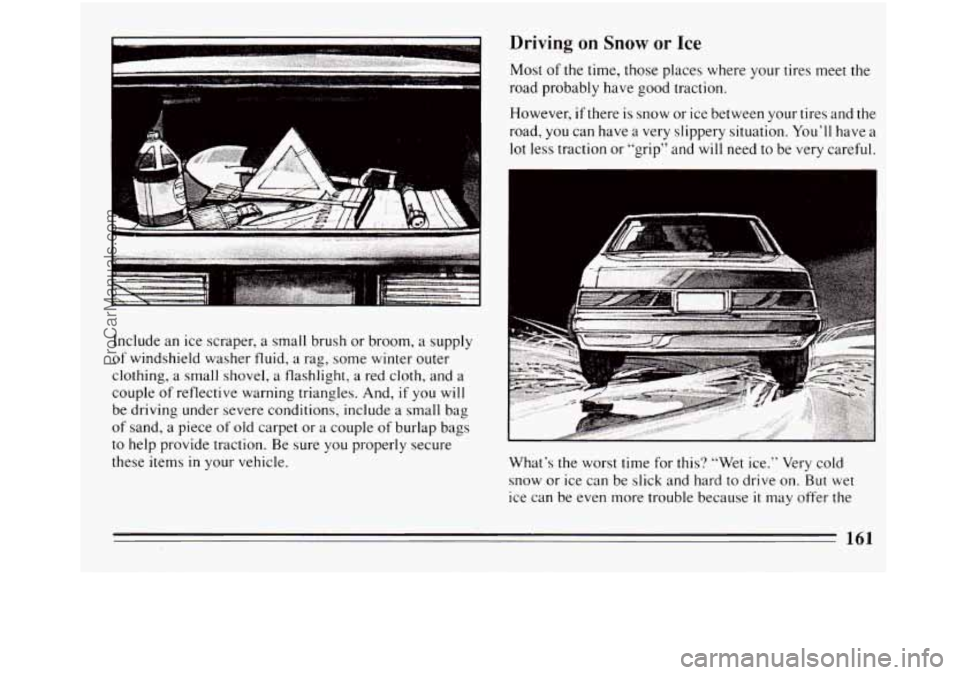
Include an ice scraper, a small brush or broom, a supply
of windshield washer fluid, a rag, some winter outer
clothing, a small shovel,
a flashlight, a red cloth, and a
couple
of reflective warning triangles. And, if you will
be driving under severe conditions, include a small bag
of sand, a piece of old carpet or a couple of burlap bags
to help provide traction.
Be sure you properly secure
these items
in your vehicle.
What's the worst time for this? "Wet ice." Very cold
snow or ice can be slick and hard to drive
on. But wet
ice can be even more trouble because
it may offer the
161
ProCarManuals.com