Page 46 of 324
Lap-Shoulder Belt
The positions next to the windows have lap-shoulder
belts. Here’s how to wear one properly.
1. Pick up the latch plate and pull the belt across you.
Don’t let it get twisted.
2. Push the latch plate into the buckle until it clicks.
Pull up on the latch plate to make sure it is secure. When the
lap belt is pulled out all the way, it will
lock.
If it does, let it go back all the way and start
again. If the belt is not long enough, see “Safety Belt
Extender” at the end
of this section. Make sure the
release button on the buckle is positioned
so you
would be able to unbuckle the safety belt quickly if
you ever had to.
ProCarManuals.com
Page 47 of 324
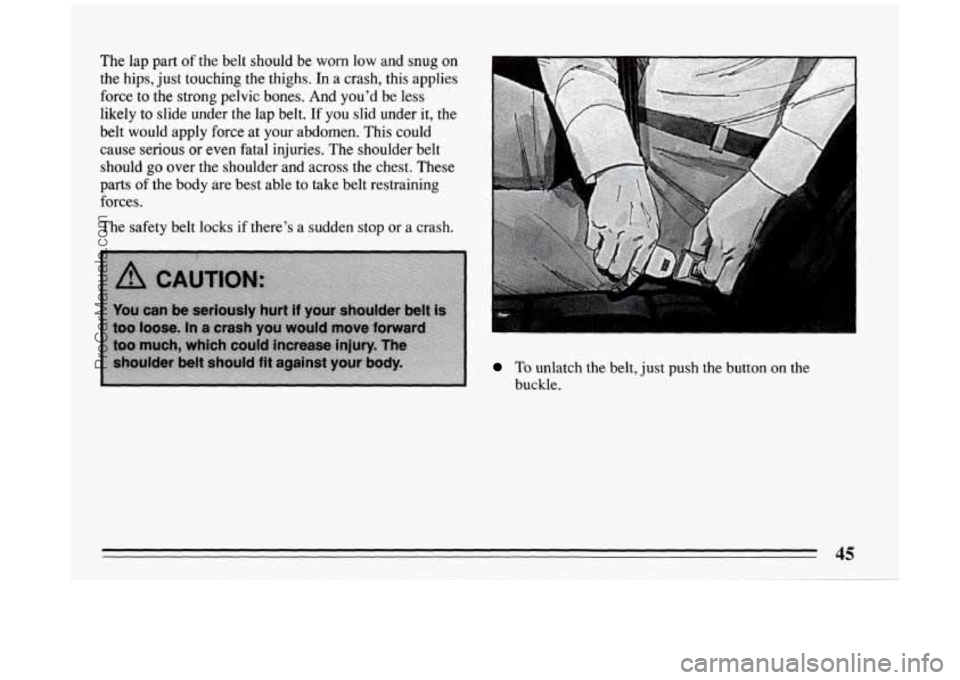
The lap part of the belt should be worn low and snug on
the hips, just touching the thighs.
In a crash, this applies
force to the strong pelvic bones. And you’d be less
likely to slide under the lap belt.
If you slid under it, the
belt would apply force at your abdomen. This could
cause serious or even fatal injuries. The shoulder belt
should go over the shoulder and across the chest. These
parts
of the body are best able to take belt restraining
forces.
The safety belt locks if there’s a sudden stop or a crash.
To unlatch the belt, just push the button on the
buckle.
45
ProCarManuals.com
Page 53 of 324
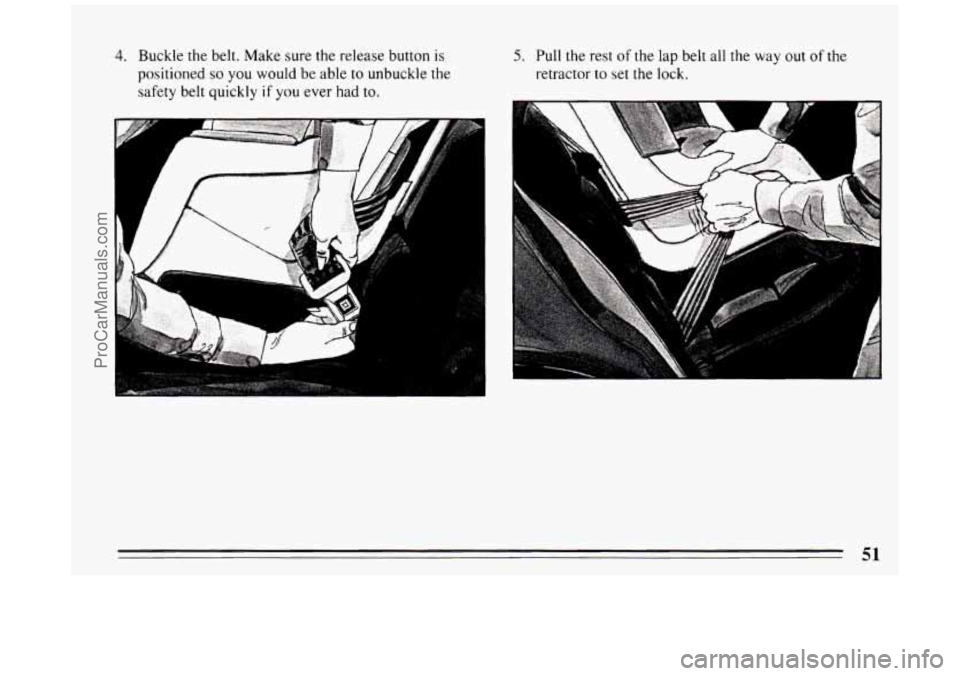
4. Buckle the belt. Make sure the release button is
positioned so you would be able to unbuckle the
safety belt quickly
if you ever had to.
5. Pull the rest of the lap belt all the way out of the
retractor to set
the lock.
R
a
51
ProCarManuals.com
Page 58 of 324
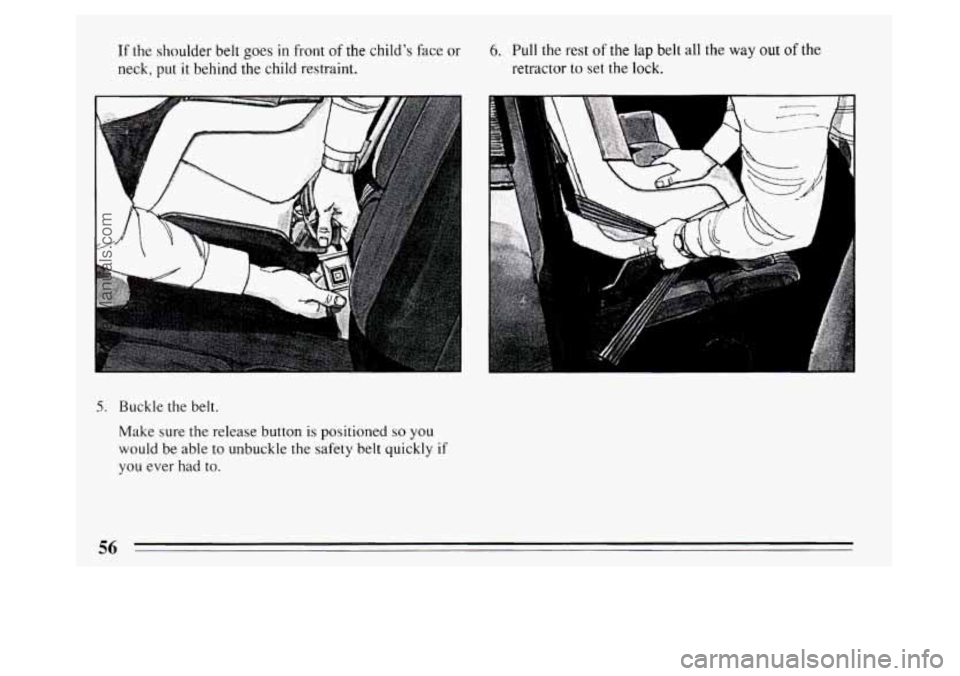
If the shoulder belt goes in front of the child's face or
neck, put
it behind the child restraint.
6. Pull the rest of the lap belt all the way out of the
retractor to set the lock.
5. Buckle the belt.
Make sure the release button is positioned
so you
would be able to unbuckle the safety belt quickly if
you ever had to.
56
ProCarManuals.com
Page 65 of 324

Part 2 Features and Controls
Here you can learn about the many standard and optional features on your Buick. and information on starting. shifting
and braking
. Also explained are the instrument panel and the warning systems that tell you if everything is working
properly
.. and what to do if you have a problem .
Part 2 includes:
Keys ........................................................................\
.... 64
DoorLocks
....................................................................... \
65
NewVehicleBreak-In
.............................................................. 79
StartingtheEngine
................................................................. 81
Shifting the Transaxle .............................................................. 83
Windows ........................................................................\
. 93
93
Turn Signal/Headlight Beam Lever
.................................................... 94
Headlight High-Low Beam Changer
.............................................. 96
Windshield Wipermasher
...................................................... 96
Cruisecontrol
................................................................ 98
Headlights
........................................................................\
103
Mirrors
........................................................................\
.. 108
Instrumentpanel ................................................................... 119
Speedometer and Odometer ..................................................... 119
Warning Lights, Gages and Indicators ............................................. 120
TiltSteeringWheel ................................................................
. . 63
ProCarManuals.com
Page 66 of 324
Keys
/d CAUTION:
Leaving young children in a vehicle with the
ignition key
is dangerous for many reasons. A
child or others could be badly injured or even
killed.
They could operate power windows or other
controls or even make the vehicle move. Don’t
leave the keys in a vehicle with young children.
The
the
i
ignitio~
gnition n keys
only.
are for
The door
keys are for the
doors and all other
locks.
64
ProCarManuals.com
Page 67 of 324
When a new Park Avenue is delivered, the dealer
removes the plugs from
the keys, and gives them to the
first owner. However, if the ignition key does not have a
plug, there may be a bar-coded key tag instead.
Each plug has a code on it that tells your dealer or a
qualified locksmith how
to make extra keys. Keep the
plugs
in a safe place. If you lose your keys, you’ll be
able to have new ones made easily using these plugs. If
your ignition keys don’t have plugs, go to your Buick
dealer for the correct key code
if you need a new
ignition key.
NOTICE:
Your Buick has a number of new features that
can help prevent theft. But you can have a lot
of
trouble getting into your vehicle if you ever lock
your keys inside. You may even have to damage
your vehicle to get in.
So be sure you have extra
keys.
Key Reminder Warning
If you leave your keys in the ignition, you will hear a
warning tone when you turn off the ignition and open
the driver’s door.
Door Locks
65
ProCarManuals.com
Page 68 of 324
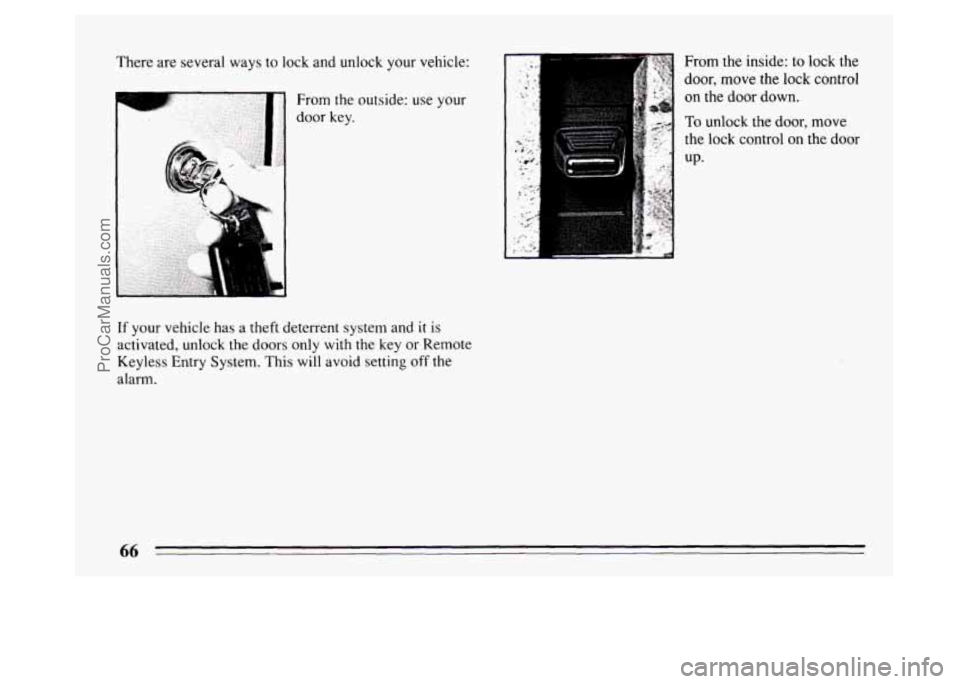
There are several ways to lock and unlock your vehicle:
From the
door key. outside:
use your
If your vehicle has a theft deterrent system and it is
activated, unlock the doors only with the key
or Remote
Keyless Entry System. This will avoid setting
off the
alarm. From
the inside: to lock the
door, move the lock control
on the door down.
To unlock the door, move
the
lock control on the door
66
ProCarManuals.com