1994 BUICK PARK AVENUE engine overheat
[x] Cancel search: engine overheatPage 11 of 324
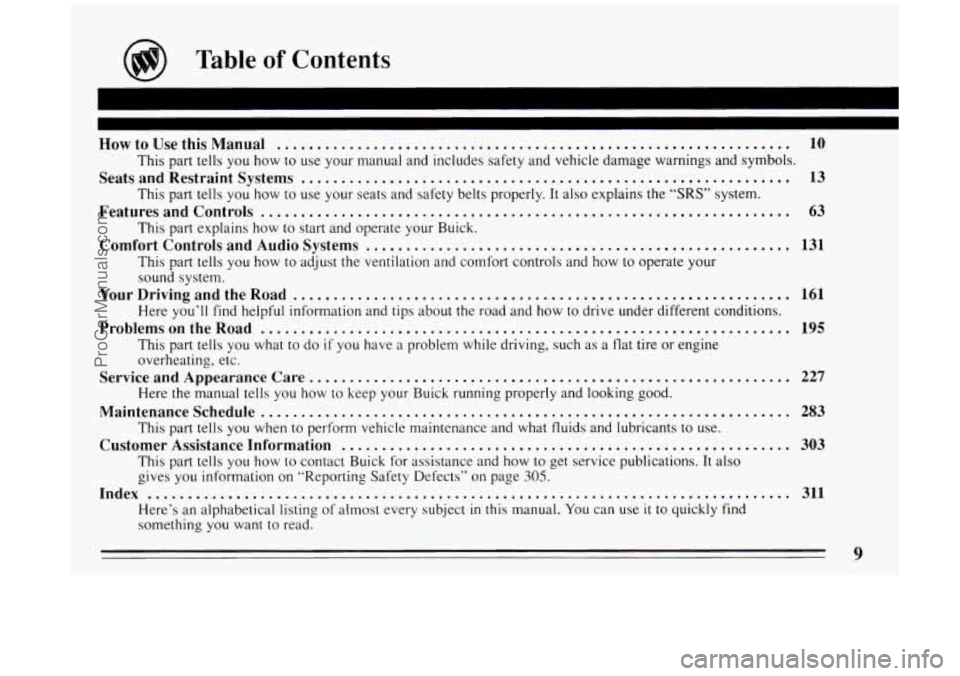
Table of Contents
How to Use this Manual ................................................................ 10
This part tells you how to use your manual and includes safety and vehicle damage \
warnings and symbols.
Seats and Restraint Systems ............................................................. 13
This part tells you how to use your seats and safety belts properl\
y. It also explains the “SRS” system.
FeaturesandControls .................................................................. 63
This part explains how to start and operate your Buick.
Comfort Controls and Audio Systems ..................................................... 131
This part tells you how to adjust the ventilation and comfort controls and how to operate your
sound system.
Here you’ll find helpful information and tips about
the road and how to drive under different conditions.
ProblemsontheRoad .................................................................. 195
This part tells you what to do if you have a problem while driving, such as a flat tire or engine
overheating, etc.
Here
the manual tells you how to keep your Buick running properly and \
looking good.
This part tells you when to perform vehicle maintenance and what fluids and lubricants to use.
This part tells you how
to contact Buick for assistance and how to get service publications. It also
gives you information on “Reporting Safety Defects” on pag\
e
305.
Here’s an alphabetical listing of almost every subject in this manual. You can use it to quickly find
something you want to read.
YourDrivingandtheRoad .............................................................. 161
Serviceand Appearancecare
............................................................ 227
Maintenanceschedule .................................................................. 283
Customer Assistance Information
........................................................ 303
Index
........................................................................\
........ 311
9
ProCarManuals.com
Page 88 of 324
NOTICE:
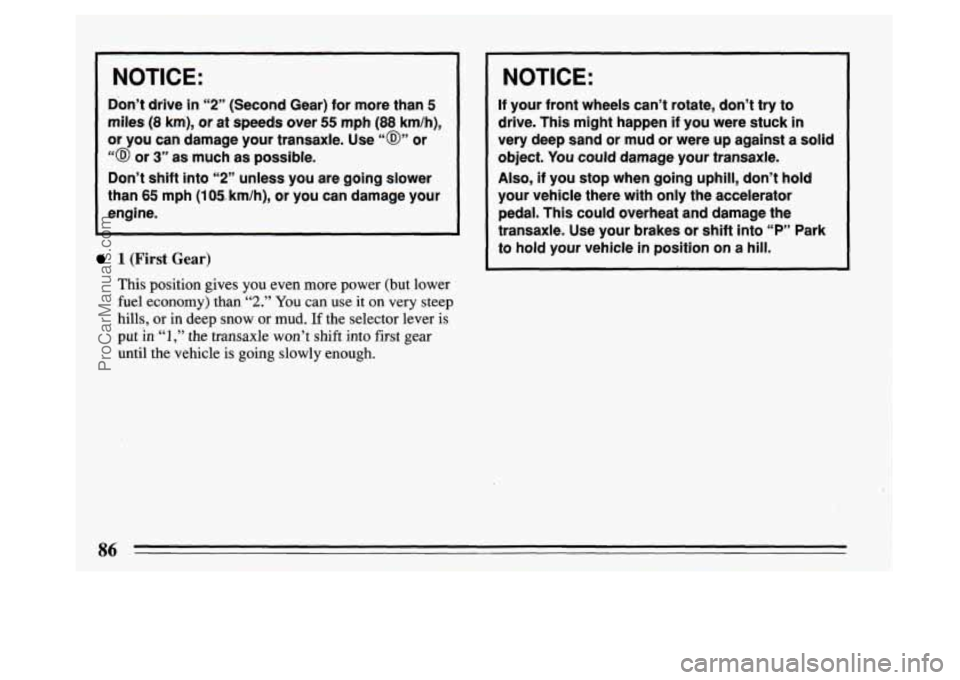
Don’t drive in “2” (Second Gear) for more than 5
miles (8 km), or at speeds over 55 mph (88 km/h),
or you can damage your transaxle. Use
“@” or
“@ or 3” as much as possible.
Don’t shift into
“2” unless you are going slower
than
65 mph (105 km/h), or you can damage your
engine.
1 (First Gear)
This position gives you even more power (but lower
fuel economy) than
“2.” You can use it on very steep
hills, or in deep snow or mud. If the selector lever is
put in
“1,” the transaxle won’t shift into first gear
until the vehicle is going slowly enough.
NOTICE:
If your front wheels can’t rotate, don’t try to
drive. This might happen if you were stuck in
very deep sand
or mud or were up against a solid
object. You could damage your transaxle.
Also, if you stop when going uphill, don’t hold
your vehicle there
with only the accelerator
pedal. This could overheat and damage the
transaxle. Use your brakes or shift into
“P” Park
to hold your vehicle in position on a hill.
ProCarManuals.com
Page 125 of 324
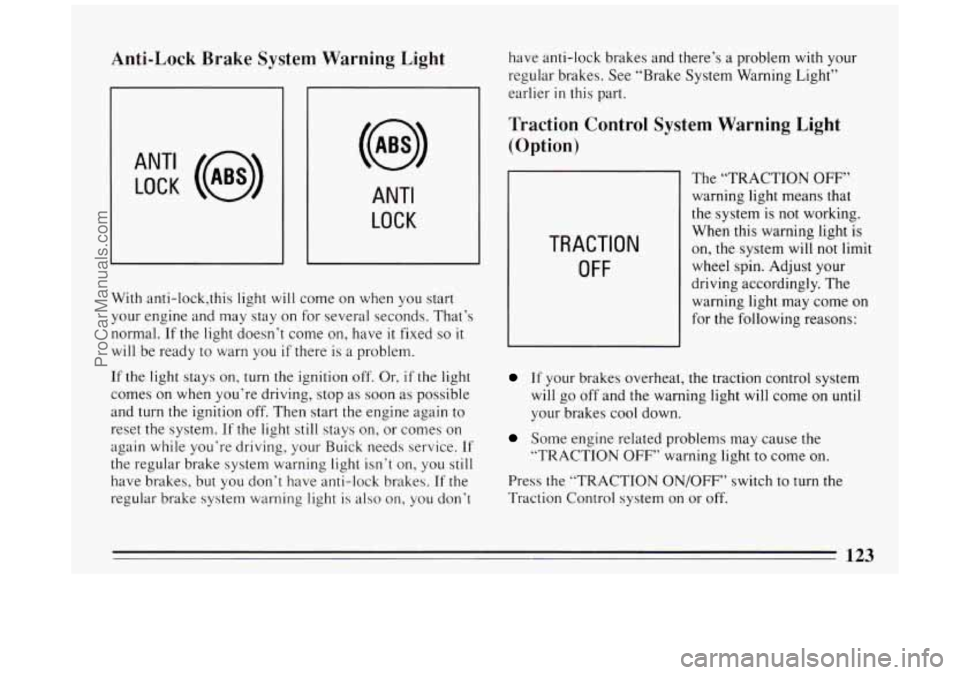
Anti-Lock Brake System Warning Light
ANT‘ LOCK (a)
ANTI
LOCK
J
With anti-lock,this light will come on when you start
your engine and may stay on for several seconds. That’s
normal.
If the light doesn’t come on, have it fixed so it
will be ready to warn you if there is a problem.
If the light stays on, turn the ignition
off, Or, if the light
comes on when you’re driving, stop as soon as possible
and
turn the ignition off. Then start the engine again to
reset the system.
If the light still stays on, or comes on
again while you’re driving, your Buick needs service.
If
the regular brake system warning light isn’t on, you still
have brakes, but you don’t have anti-lock brakes. If the
regular brake system warning light is also on, you don’t have
anti-lock brakes and there’s a problem
with your
regular brakes. See “Brake System Warning Light”
earlier
in this part.
Traction Control System Warning Light
(Option)
TRACTION
OFF
The “TRACTION OFF”
warning light means that
the system is not working.
When this warning light is
on, the system will not limit
wheel spin. Adjust your
driving accordingly. The
warning light may come on
for the following reasons:
If your brakes overheat, the traction control system
will go off and the warning light will come on
until
your brakes cool down.
Some engine related problems may cause the
“TRACTION
OFF’’ warning light to come on.
Press the “TRACTION ON/OFF” switch to turn the
Traction Control system on or off.
123
ProCarManuals.com
Page 126 of 324
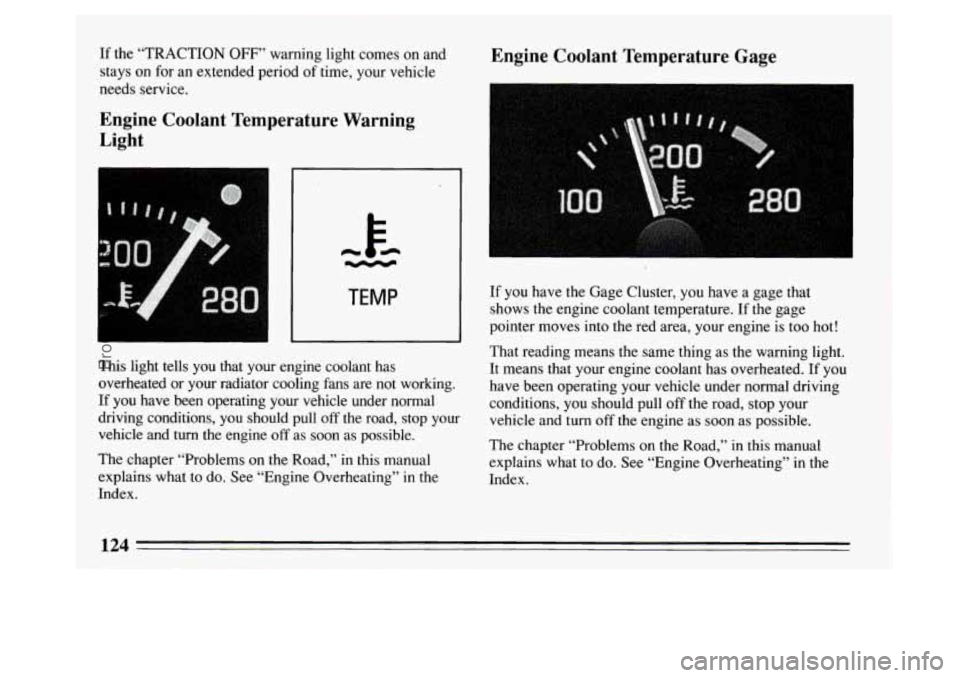
Engine Coolant Temperature Gage If the “TRACTION OFF” warning light comes on and
stays on for an extended period of time, your vehicle
needs service.
Engine Coolant Temperature Warning
Light
TEMP
This light tells you that your engine coolant has
overheated or your radiator cooling fans are not working.
If you have been operating your vehicle under normal
driving conditions, you should pull
off the road, stop your
vehicle and turn the engine
off as soon as possible.
The chapter “Problems on the Road,” in this manual
explains what to do. See “Engine Overheating” in the
Index.
If you have the Gage Cluster, you have a gage that
shows the engine coolant temperature.
If the gage
pointer moves into the red area, your engine is too hot!
That reading means the same thing as the warning light.
It means that your engine coolant has overheated. If you
have been operating your vehicle under normal driving
conditions, you should pull
off the road, stop your
vehicle and
turn off the engine as soon as possible.
The chapter “Problems on the Road,” in this manual
explains what to do. See “Engine Overheating” in the
Index.
124
ProCarManuals.com
Page 195 of 324
Turn Signals When Towing a Trailer
When you tow a trailer, your vehicle has to have a
different turn signal flasher and extra wiring. The green
arrows on your instrument panel
will flash whenever
you signal a turn or lane change. Properly hooked up,
the trailer lights
will also flash, telling other drivers
you’re about to turn, change lanes or stop.
When towing a trailer, the green arrows on your
instrument panel will flash for turns even
if the bulbs on
the trailer are burned out. Thus, you may
think drivers
behind you are seeing your signal when they are not. It’s
important to check occasionally to be sure the trailer
bulbs are still working.
Your vehicle has bulb warning lights. When you plug
trailer lights into your vehicle’s lighting system, its bulb
warning lights may not
let you know if one of your
lights goes out.
So, when you have trailer lights plugged
in, be sure to check your vehicle and trailer lights from
time to time to be sure they’re all working. Once you
disconnect the trailer lights, the bulb warning lights
again can tell you
if one of your vehicle lights is out.
Driving On Grades
Reduce speed and shift to a lower gear before you start
down a long or steep downgrade. If you don’t shift down,
you might have to use your brakes
so much that
they would get hot and no longer work well.
On a long uphill grade, shift down to “D or 3” (Drive)
and reduce your speed to around
45 mph (70 km/h) to
reduce the possibility of engine and transaxle
overheating.
Parking on Hills
You really should not park your vehicle, with a trailer
attached,
on a hill. If something goes wrong, your rig
could start to move. People can be injured, and both
your vehicle and the trailer can be damaged.
But
if you ever have to park your rig on a hill, here’s
how
to do it:
1. Apply your regular brakes, but don’t shift into “P”
(Park) yet.
2. Have someone place chocks under the trailer wheels.
3. When the wheel chocks are in place, release the
regular brakes until the chocks absorb the load.
4. Reapply the regular brakes. Then apply your parking
brake, and the shift to
“P” (Park).
5. Release the regular brakes.
193
ProCarManuals.com
Page 197 of 324
Part 5 Problems on the Road
Here you’ll find what to do about some problems that can occur on the road .
Part 5 includes:
Hazard Warning Flashers .................................................. ....
Other Wa-ning Devices ........................................ ...............
“Jump”Starting ...................................................................
TowingYourBuick ................................................................
Engineoverheating ................................................................
IfaTireGoesFlat .................................................................
ChangingaFlatTire ................................................................
Compact Spare Tire .................................................................
If You’re Stuck in Sand, Mud, Ice or Snow ..............................................
196
197
198
203
207
214
215
224
225
195
ProCarManuals.com
Page 209 of 324
Engine Overheating
You will find a warning light about a hot engine on your
Buick instrument panel and if you have the optional
gage cluster, a coolant temperature gage. You will also
find a low coolant warning light.
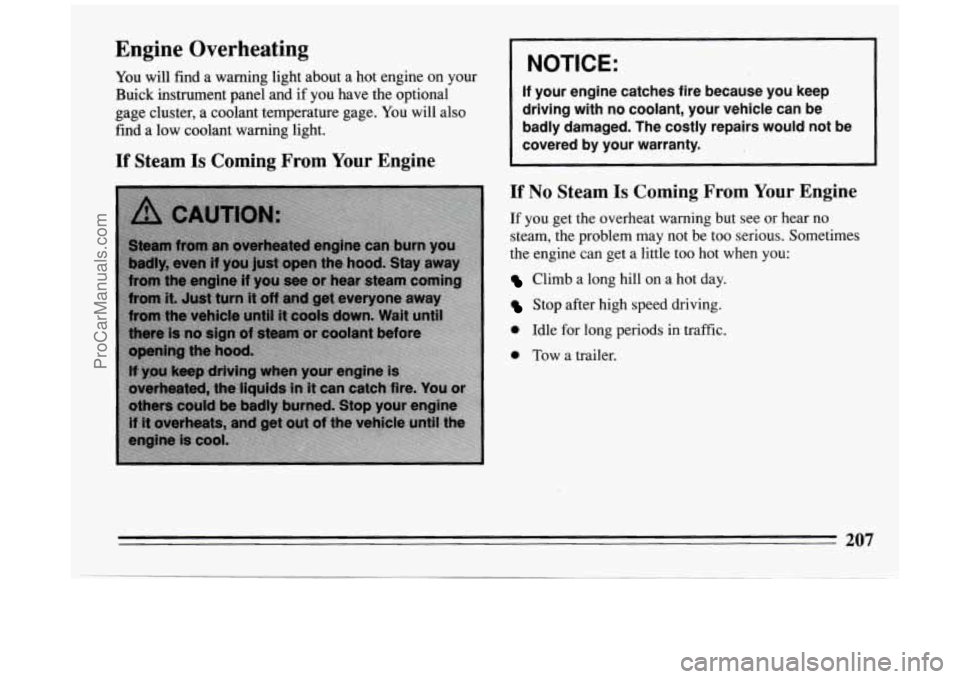
If Steam Is Coming From Your Engine
NOTICE:
If your engine catches fire because you keep
driving with no coolant, your vehicle can be
badly damaged. The costly repairs would not be
covered by your warranty.
If NO Steam Is Coming From Your Engine
If you get the overheat warning but see or hear no
steam, the problem may not be too serious. Sometimes
the engine can get a little too hot when you:
Climb a long hill on a hot day.
Stop after high speed driving.
0 Idle for long periods in traffic.
0 Tow a trailer.
207
ProCarManuals.com
Page 210 of 324
If you get the overheat warning with no sign of steam,
try this for a minute or
so:
1. Turn off your air conditioner.
2. Turn on your heater to full hot at the highest fan
speed and open the window as necessary.
3. If you’re in a traffic jam, shift to “N” (Neutral).
If you no longer have the overheat warning, you can
drive. Just to be safe, drive slower for about ten minutes.
If the warning doesn’t come back on, you can drive
normally.
If the warning continues, pull over, stop, and park your
vehicle right away.
If there’s still no sign of steam, you can idle the engine
for two or three minutes while you’re parked, to see
if
the warning stops. But then, if you still have the
warning, TURN OFF THE ENGINE AND GET
EVERYONE OUT OF THE VEHICLE until it cools
down.
You may decide not to lift the hood but to get service
help right away. When you
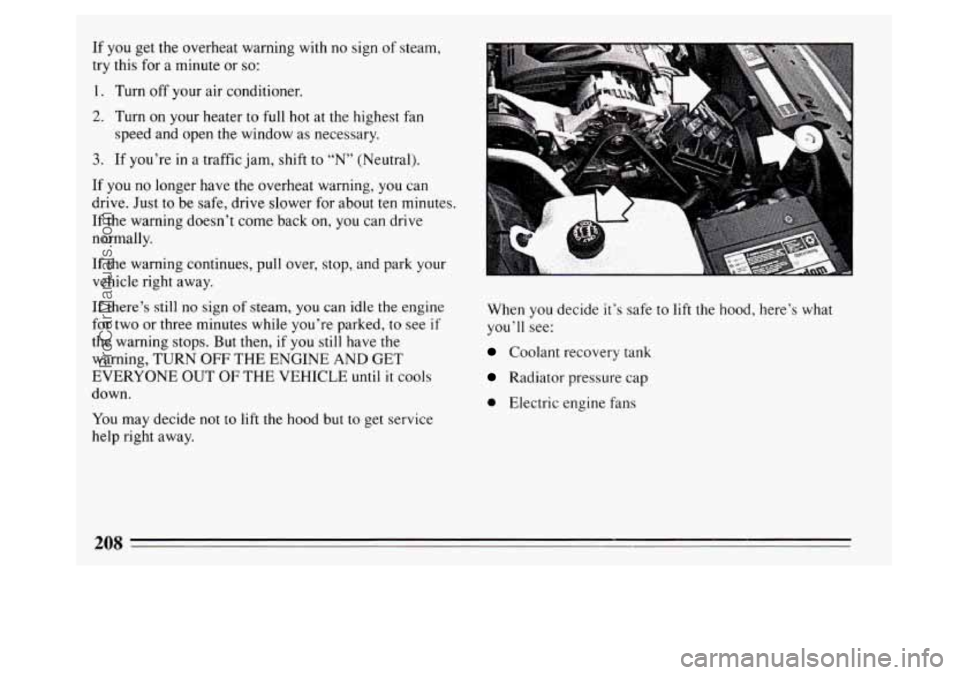
decide it’s safe to lift the hood, here’s what
you’ll see:
Coolant recovery tank
Radiator pressure cap
0 Electric engine fans
208
ProCarManuals.com