1993 VOLKSWAGEN GOLF light
[x] Cancel search: lightPage 68 of 156
Downloaded from www.Manualslib.com manuals search engine CONTROLS AND EQUIPMENT
Sun visors
• Turn crank opening protective cap to the
right.
•
Take crank out of retainer, insert in the
opening and close sliding roof.
• Replace crank
in the retainer and turn
protective cap over the crank opening.
•
Insert cover lugs in the roof trim. Then
using a sc rewdriver (out of the vehicle tools)
s
lide headlining trim over the cover retain
ing strip . Slide cover to rear slight ly.
Sun visors
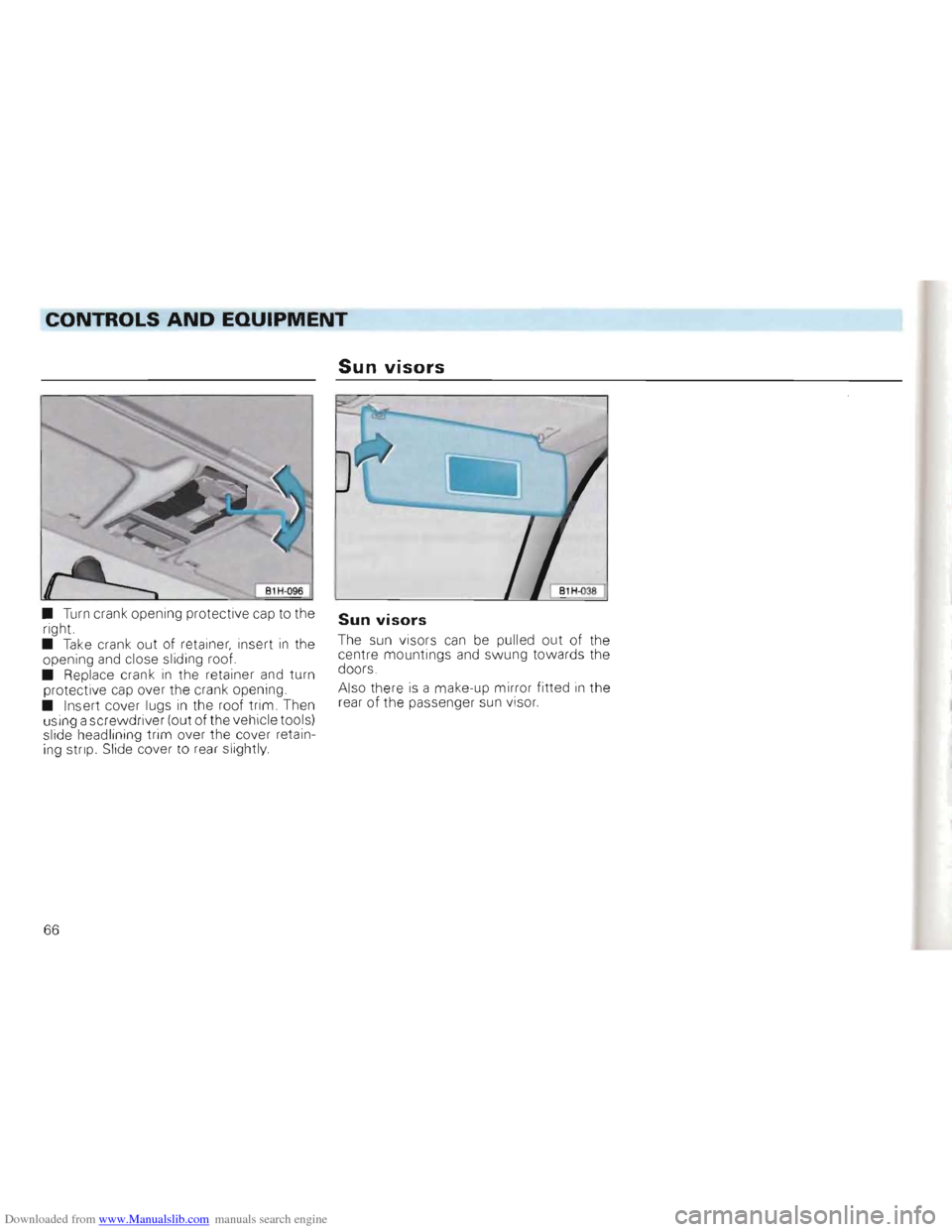
The sun visors can be pulled out of the
centre mountings and swung towards the
doors.
Also there
is a make-up mirror fitted in the
rear of the passenger sun visor.
66
Page 69 of 156
Downloaded from www.Manualslib.com manuals search engine CONTROLS AND EQUIPMENT
Interior lights
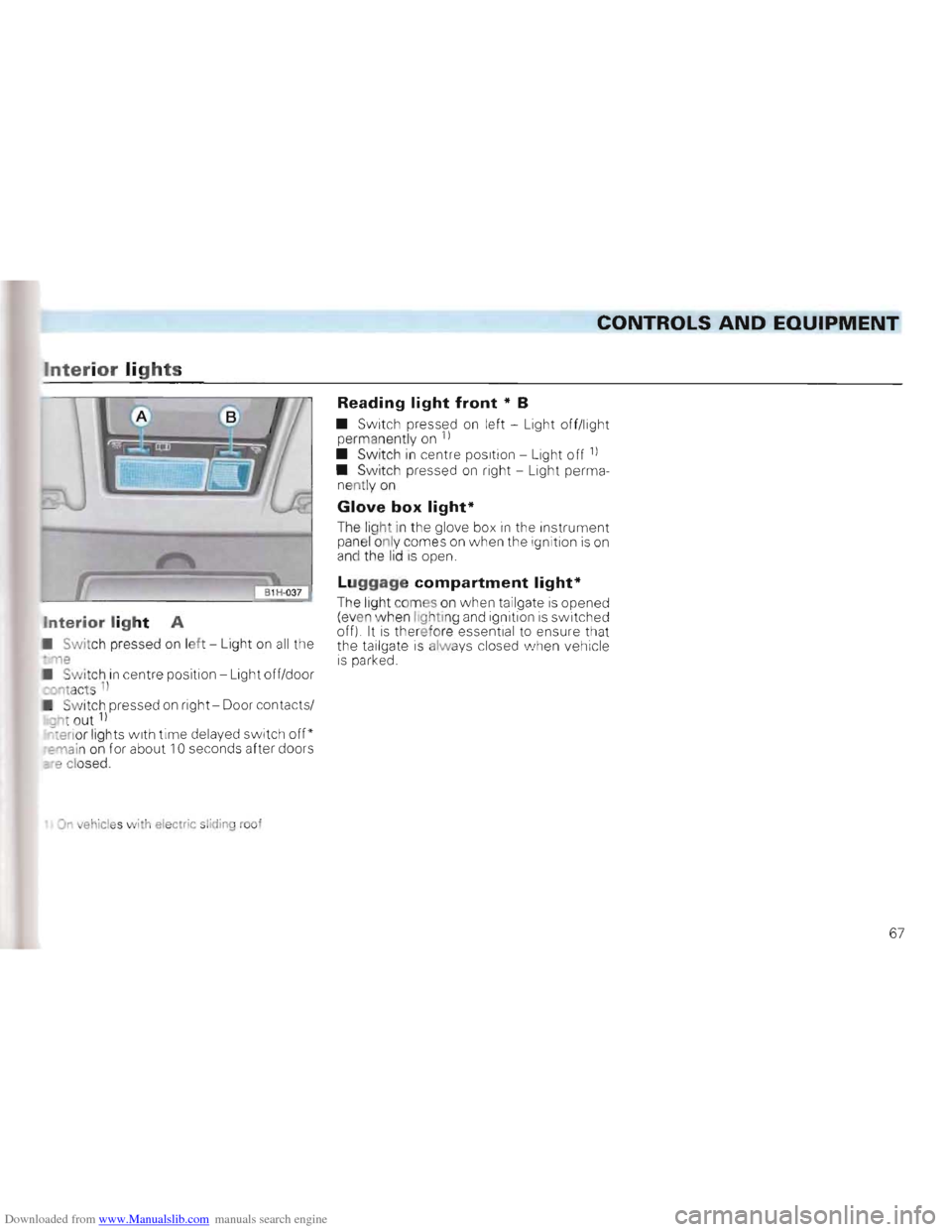
nterior lig h t A
Switch pr essed on leh -Light on all the "TIe SWitc h in centre position -Light off/door
:O'1t acts ]) Sw itch pressed on right -Door contacts/ 9"t out 1) ter io r lights with time delayed switch off"' E'TIain on for about 10 seconds after doors co e closed.
On veh ic le s with electric sliding roof
Reading light front * B
• Switch press ed on left -Light off/light
per manently on 1 )
• Switch in centre position -Light off 1)
• SWitch pressed on right -Light perma
n e ntly on
Glove box light*
The ligh t in the glove box in the instrument
pane l o nly com es on when the ignition is on and the lid I S open.
L uggage compartment light*
The light comes on when tailgate is opened
(ev en w hen li g hti ng and ignition is switched off) It is there for e essential to ensure that
the tailgate is always closed INhen vehicle is parked.
67
Page 70 of 156
Downloaded from www.Manualslib.com manuals search engine CONTROLS AND EQUIPMENT
Cigarette lighter
The cigarette lighter is switched on by
pushing in the element. When the heating
element glows, the lighter springs out auto
matically -pull it out immediately and use it.
The
cigarette lighter socket can be
used for other electrical accessories with a
capacity of up to 120 watts. However, when the engine is not running this will discharge
the battery. For further information see
chapter Accessories on page
111 .
•
Attention • Be careful when using the cigarette lighter! Careless or uncontrolled use of the cigarette lighter can cause burns. The cigarette lighter and the socket also work when the ignition is switched off and the key removed. For this reason children should never be left in the vehicle on their own.
Ashtray
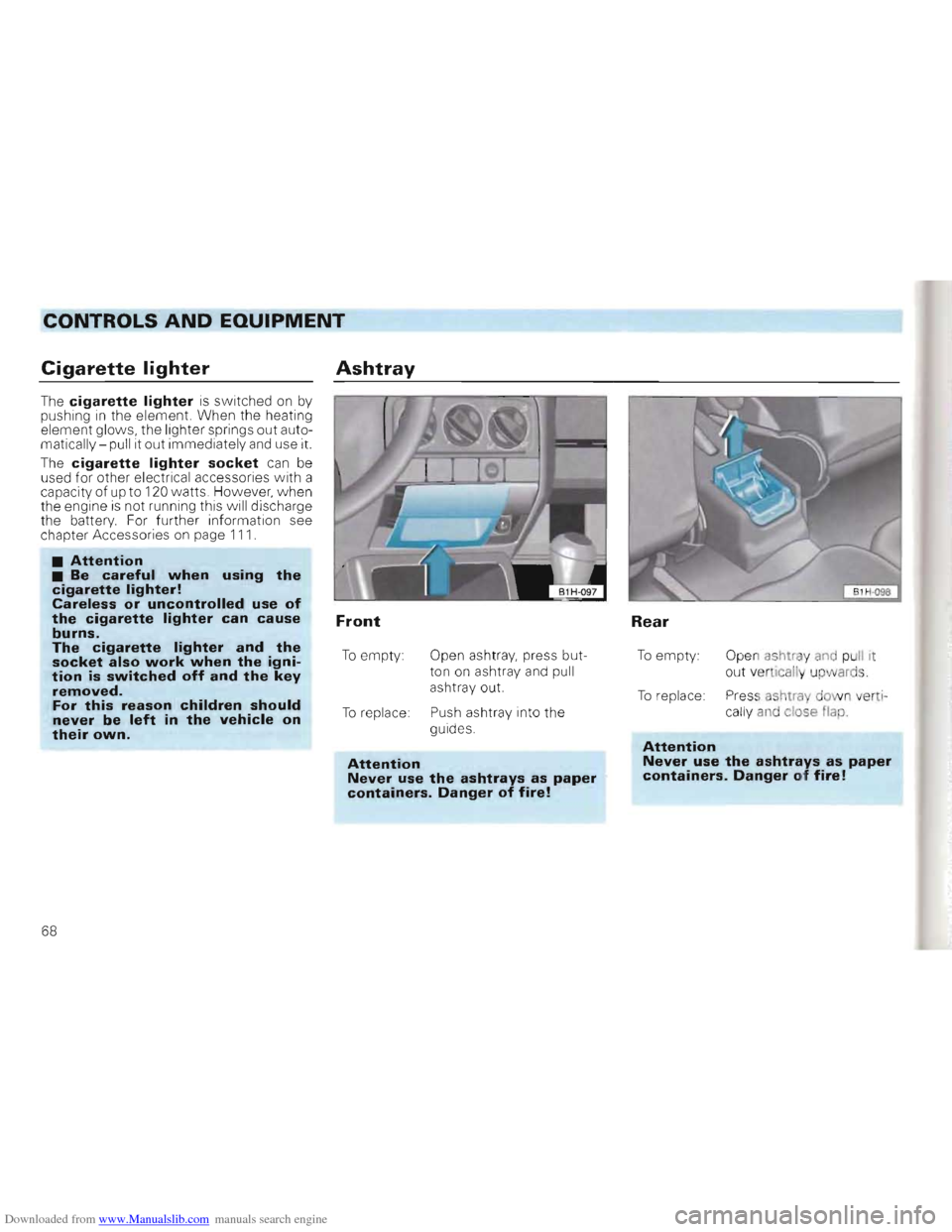
Front
To empty: Open ashtray, press but
ton
on ashtray and pull
ashtray out.
To replace Push ashtray into the
guides.
Attention Never use the ashtrays as paper containers. Danger of fire!
Rear
To empty
To replace: O
pen ashtra y and pull it
out ver ticall y u
pwards
P re ss ashtray
down ve rti cally and close flap.
Attention Never use the ashtrays as pape r containers. Danger of fire!
68
Page 73 of 156
Downloaded from www.Manualslib.com manuals search engine DRIVING TIPS
The first 1500 km -and afterwards
Running-in
D Uring the first few opera ting hours the engine interna l friction is hig her than later on
w hen all the moving parts have b edded
d own . How well this running-in process is
d one depe nds to a considerab le exten t on th e w ay the vehicle is dri ven during the first
1 500 km (1000 miles)
Up to 1000 kilometers
the follo win g general rules apply :
• Do not use full throttle • Do not drive faster than 3/4 of top speed • Avoid high engine speeds
• Trailer towing should if possib le be
avoided .
Attention • New tyres must also be .. run in" because they do not have maximum adhesion at the start. This must be taken into account by driving carefully during the first 100 km_ •
•
New brake linings must also be run in and do not have the optimum friction properties during the first 200 km. The slightly reduced braking effect can be compensated for by more pressure on the brake pedal. This also applies when new linings have been fitted.
From 1000 -1500 km
The speed can gradu ally be increased to the
road or eng in e maximum.
During and after the running-in
period the following applies:
• Do not overre v th e engine when cold
eithe r in neutra l or in th e gears .
All speeds and revs given are only valid
w hen engine is properly warm.
r:Gb Do not drive with the engine C!!t) speed unnecessarily high changing up early helps to save fuel, reduces noise and protects the environment -see also page 72.
• Do not let engine labour -ch ange down
when eng ine no lo nger runs s m oothly .
After the running-in period
• On v ehic les with a rev counter* th e maxim um perm issib le e ngine speed is shown by the begin ning of the red zone on
the rev counter scale. The needle of the
c o unter must not mov e into this zone.
E xtreme ly
hig h engine revs w ill be auto
matically go verned.
71
Page 75 of 156
Downloaded from www.Manualslib.com manuals search engine DRIVING TIPS
The technical prerequisites
for a low fuel consumpt ion and efficienc y "" ere " built in" at the factory. Particular Im
p ortance was placed on the lowes t possible
d is turban ce to the enviro nme nt. To retain and make the best possible use of these characteristics attent ion should be paid to the fo llow ing points
~Even those vehicles which do W not have a catalytic converter should be driven on unleaded petrol for the sake of the environment.
~The prescribed maintenance W operations should be carried out exactly as specified in the Service Schedule.
Having your vehicle regularly serviced by a Volkswagen dealer not only ensures that it is always operationally fit, but it also ensures economy, lowest possible burden on the environment and a long service life.
~Check the tyre pressures every 4 W weeks.
Low tyre pressures increase the rolling resistance. This not only increases the fuel consumption and tyre wear, but the handling is also impaired.
~Do not carry unnecessary ballast W in the luggage boot
Particularly in town traffic when one has to accelerate often, weight has a great influence on the fuel consumption. As a
rule ofthumb: For every 100 kg ofweight the consumption increases by approximately litre per 100 km.
~Remove roof rack immediately Wafter use
Particularly at high speeds the increased air resistance makes itself felt considerably.
~Electrical consumers should W only be switched on when they are actually required
Heated rear windows, additional driving lights and heater blower consume a considerable amount of current. The higher alternator load also increases the fuel consumption. For instance, overa period of 10 hours, the heated rear window will increase the fuel consumption by approximately 1 litre.
~Check the fuel consumption regW ularly
The fuel consumption should be checked each time the tank is filled up. By doing this inconsistencies on the vehicle which lead to an increased fuel consumption can be discovered sooner.
• Check the engine oil level each time the tank is filled up The oil consumption depends to a g reat ex
tent on the engine load and speed. Depend
ing on the style of driving the consumption
can be as much as 1 .0 litr es/1 000 km .
It
IS no rmal fo r the oil consumption of a ne w
engine to reach its lowest level after a cer
tain mileage has be en covered . The con
sumption cannot be properly assessed until
the vehicle has run appro x. 5000 km.
This also applies to the fuel consumption
and the engine output.
73
Page 78 of 156
Downloaded from www.Manualslib.com manuals search engine DRIVING TIPS
Anti-locking brake system *
The AB S plays a major part in i ncreasing the active safety of the vehicle . The big adva ntage when compa red with a conve ntional brake system is t hat even when braking
hard on a s lippery road surfac e the bes t
poss ib le ste erabili ty is retained for the road
cond it io n because the wheels do not lock.
H
owever o ne mus t not expec t the ABS
sys tem t~ sho rt en the brak ing dis ta nce in all co nditions. When driv ing on grave l or o n
fr esh snow cove ring a slipp ery surf ace, I.e. when one shou ld be driving very care fully In
a ny case, the s topping distance may even be slightly longer
How the ABS system works
A n automatic check is made when a speed
of approx. 7 km/h is reached,. When this
hap pens a pumping no ise can be heard. W
he n the tu
rning speed of a w heel reac hes a leve l which is too low fo r the ve hicle speed
and it ten ds to lock , the brake pre ssu re to
t his whee l is r educ ed. On the fron t axle the
b rake press ure is regulated fo r eac h wheel
ind iv idually, whereas on the rear axle, the
press ure is regulated fo r bo th wheels at the
sam e tim e. As a result the braking effect IS the same f or both rear w heels and the driving stabi lity is reta ined as f a r as po~sible. This regulating process makes Itself known by movement .of the b~ake pedal and is accompanied by nOises. This is do ne deli berat ely as a warni ng to the
driver that a wheel or the wheels a re In th e
lock ing range So that the ABS can r egu la te
effec tively in th is range the brake peda l
must remai n depressed -on no account
should it be pumped l
Attention However the ABS system cannot overcome the physical limits. This must be borne in mind particularly on slippery or wet roads. When the ABS com es into the control range the speed must immediately be adapted to the road and traffic conditions. The increased amount of safety available must not tempt one into taking risks.
If a def ect occurs o n the ASS It is indicated by a warni ng lamp -see page 49.
76
Page 79 of 156
Downloaded from www.Manualslib.com manuals search engine DRIVING TIPS
Trailer towing
The vehicle is intended main ly for the trans
portation of persons and luggage but it can, with the appropriate technical equipment,
also be used to tow a trailer.
Technical requirements
• If the vehicle is suppl ied with a factoryfi tted towing bracket, all that is technically
a nd legally necessary for trailer towing wil l
have been taken into account.
• If the trailer to be towed
has a 7 pin plug, an adapte r cable can be used whi ch IS ob
tained from a Volkswagen dealer.
• Volkswagen dealers have
all the necessary information on the In stallation of towing
brackets and the fitti ng of a heavy-duty cooling system. The installation should there
f ore be done by them .
Operations instructions
• On the Golf saloon with a factory
fitted towing bracket* the removable ball
coupling will
be fitted. Fitting/remo ving in
struc tions and instructions on correct stowage of the ball coupling in the spare wheel
well can be found in a linen bag in the ve
hicle luggage compartment.
•
On the Golf estate with a factory fitted
towing bracket* the remova ble ball coupl
ing is stored inside the vehicle next to the
spare wheel, together w ith instructions on
fitting.
• Pitching movements between towing
vehicle
and trailer can be reduced by hea vy
duty springs and shock absorbers on the
rear axle. If these springs and shock absorbers have not alread y been fitted at the
factory, they can, in many cases, be service
installed by a Volkswagen dealer.
• The permissible trailer weight -see
page 144 -m ust not
be exceeded on any account.
• If the the trailer weight
is below the
permissible maximum, a correspondingly
steeper gradient
can be climbed. •
The given trailer weights
are only appli
cable for altitudes up to 1000 m above sea level. As the engine output and thus the
climbing ability drops due to the decreasing
air density , the weight of vehic le and trailer
must also be reduced by 10 % for each
further 1000 m or part thereof.
• Where possible make full use of the
maximum permissible drawbar weight
on ball of the towing bracket -see page 144
but do not exceed it.
• While observing the permissible trailer
and drawbar weight, distribute the load in the trailer so that heavy objects are as nea r as possible to the axle. The objects must
also be secured so that they cannot slip
about.
• Check the ty
re pressures on the towing
v ehicle, and adjust for full load conditions,
and also check the pressures on the trailer
• T he headlight settings, should
be checked w ith trailer attached before mov
ing off and adjusted as necessary. On vehicles with headlight beam control it is on ly necessary to turn the knurled disc in dash in the appropriate directIOn .
77
Page 80 of 156
Downloaded from www.Manualslib.com manuals search engine DRIVING TIPS
Driving instructions
To obtain the best possible handling of ve
hicle and trailer, the following should be
noted :
•
Try to avoid driving w ith an unladen ve
hicle and a loaded trailer. If this cannot be
avoided, only drive
slowly to allow for the
unfavourable weight distribution .
• As driving stability
of vehicle and trailer
decreases when the speed increases do not drive at the maximum permissible top speed in unfavourable road, weather or wind conditions -particularly when going
downhill.
In any case the speed must be reduced im
mediately the trailer shows the slightest
sign of snaking . On no account try to stop
the snakin g by accelerating.
• For safety reasons one should not drive
faster than 80
km/h (50 mph). This also
applies in countries where higher speeds
are permitted. •
Al
ways brake in good time. If the trailer
has an overrun brake, apply the brakes gen
tl y at firs t then firmly. This will avoid the Je rk
ing caused by the trailer wheels loc king. Change down before going down a steep
hill so that the engine can act as a braka.
•
When a lon g climb in a low gear with ex
tremel y high engine revs must be nego
tiated at exceptionally high ambient temperatures the coolant temperature gauge must be observed. When the gauge needle
moves to the upper end of the scale, the
road speed must be reduced immediately
If nevertheles s the warning lamp flashes,
stop
immediatel y and allow the engine to
cool off at id l ing speed for several minutes.
• The coo ling
effect of the radiator fan can
not be increased by changing down, be
cause the speed of the fan is not dependent
on the engine speed. One should the refore
not change down even when towing a
trailer as 10ll g as the engine can cope without the vehicle speed dropping too much .
General notes
• It is advisable to hav e the vehicle serviced between the Insp ection in tervals it it
is used frequently for towing a trailer .
• The trailer and draw
bar load figures on
the data plate of the towing bracke t are for test ce rtific ation only. The correct figures
for the vehicle, which may be lower t han
th ese figures, are given in the eh icle documents and in this manual.
78