1993 VOLKSWAGEN GOLF belt
[x] Cancel search: beltPage 20 of 156
Downloaded from www.Manualslib.com manuals search engine CONTROLS AND EQUIPMENT
Airbag-System*
Vehicles with Airbag System for the driver and passenger can be recognized by an inscription "AI RBAG" on the steering wheel padded plate and on the right end of the dash panel.
Supplementary to the three point seat belts the Airbag System offers additional protection for the driver's and passenger's head and chest In a serious
frontal collision.
Apart
from its normal protective function the seat belt also has the task of keeping the
driver or passenger in such a position so
that the Airbag can offer maximum protec
tion in the case of a frontal collision.
The Airbag system will not be triggered for:
• Side collisions
• Rear collisions
•
Rol l i ng-over
• Minor frontal collisions
Therefore the seat belts should always be used not only for reasons of statutory regulations, but also for safety reasons!
Essentially the system consists of
• The electronic control and monitoring
unit
• Both airbags (air sack
with gas gener
ator) with gas generator for the:
- Driver (in steering wheel),
- Passenger (in right of dash panel)
• A
warning lamp in the dash panel -see
page 49.
The functional readiness of the Airbag
System is electronically monitored.
Each
time the ignition is switched on the
warning lamp lights for about 3 seconds
(self diagnosis).
The system has a fault, if
• When switching on the ignition the warn ing lam p does not light.
•
After swi tching on the ignition the warn
ing la m p does not extinguish after about 3
second s
• The warning lamp
comes on or flickers
du rin g the Journey.
Attention
When a fault is present the sys
tem should be checked by a
Volkswagen dealer immediately.
Otherwise there is the danger
that the Airbag will not be acti
vated in the case of an accident.
18
Page 23 of 156
Downloaded from www.Manualslib.com manuals search engine CONTROLS AND EQUIPMENT
Safety for children
Children under 12 years of age should normally travel on the rear seat1). Depending upon their age, height and weight, they must be protected with either a child restraint system or the seat belt provided. For reasons of safety, the child restraint system should be fitted in the middle of the bench seat or behind the passenger seat.
Attention Children under 1.50 m (5') tall must not use normal seat belts without the child restraint system. This could cause injury to the stomach and neck.
Ob serv e any statutor y regulation s to th e conrary .
Only officially approved ch ild restraint sys
te ms w hich are suitable for the child should
be used.
T he
ECE-R 21 standard 44 app lies to child re
straint systems. This categorizes restraint
systems Into four classes:
Cla ss 0: 0-10 kg
(approx to 9 months)
C lass 1 9
-18 kg
(approx . 8 m onths to 4 years)
Class
2: 15-25 kg
(approx. 3 to 7 yea rs)
Class 3: 22 -36 kg
(approx 6 to 12 years)
Child
restraint systems tested according to
ECE-R standard 44 are clearly marked w ith
the ECE-R test mark 44 (capital E in a Circle,
with test number below) .
Class 0
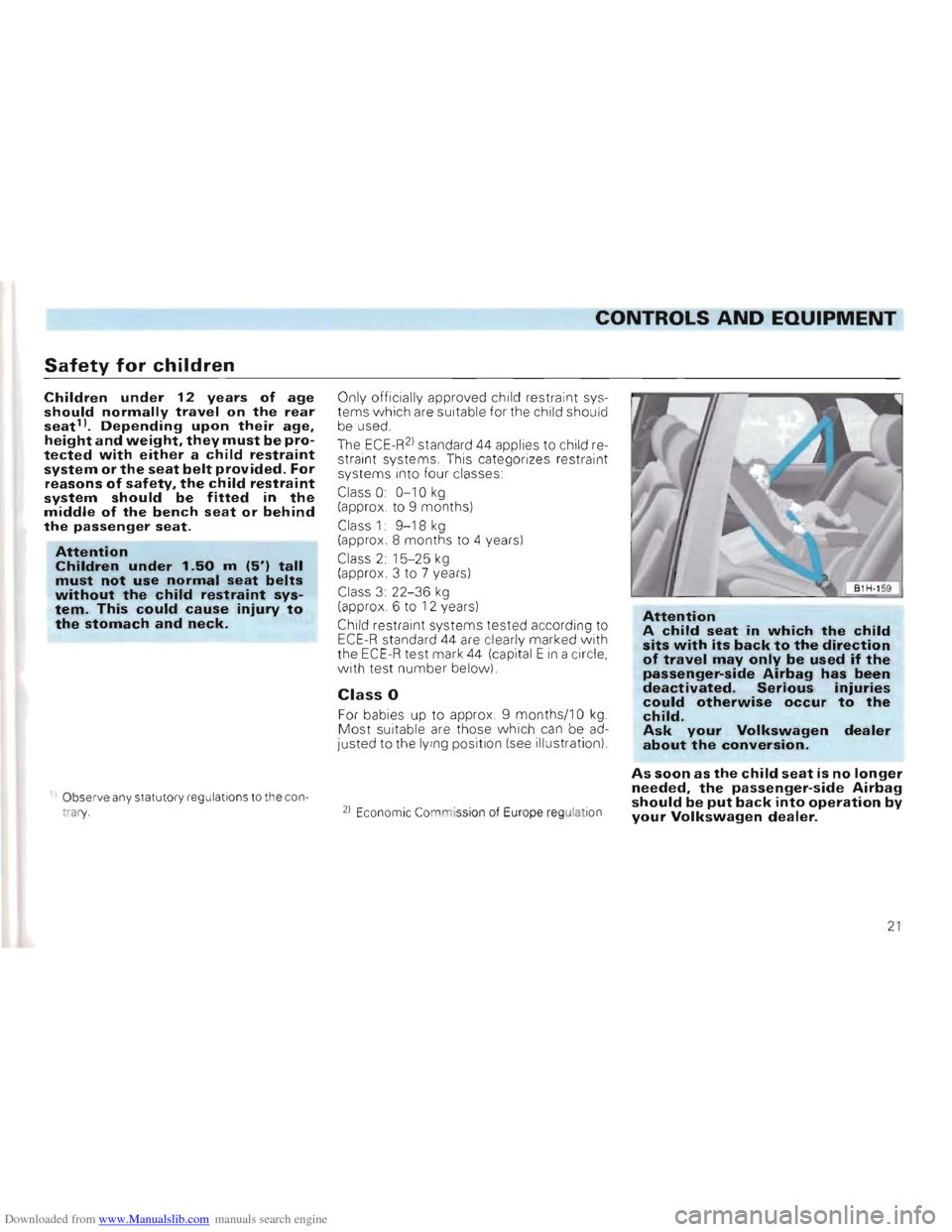
For babies up to app rox . 9 months/10 kg Most suitable are those which can be ad
Justed to the lY ing position (see Illustration)
2) Econom ic Co mission of Europe regulat ion
Attention A child seat in which the child sits with its back to the direction of travel may only be used if the passenger-side Airbag has been deactivated. Serious injuries could otherwise occur to the child. Ask your Volkswagen dealer about the conversion.
As soon as the child seat is no longer needed, the passenger-side Airbag should be put back into operation by your Volkswagen dealer.
21
Page 24 of 156
Downloaded from www.Manualslib.com manuals search engine CONTROLS AND EQUIPMENT
Class 1
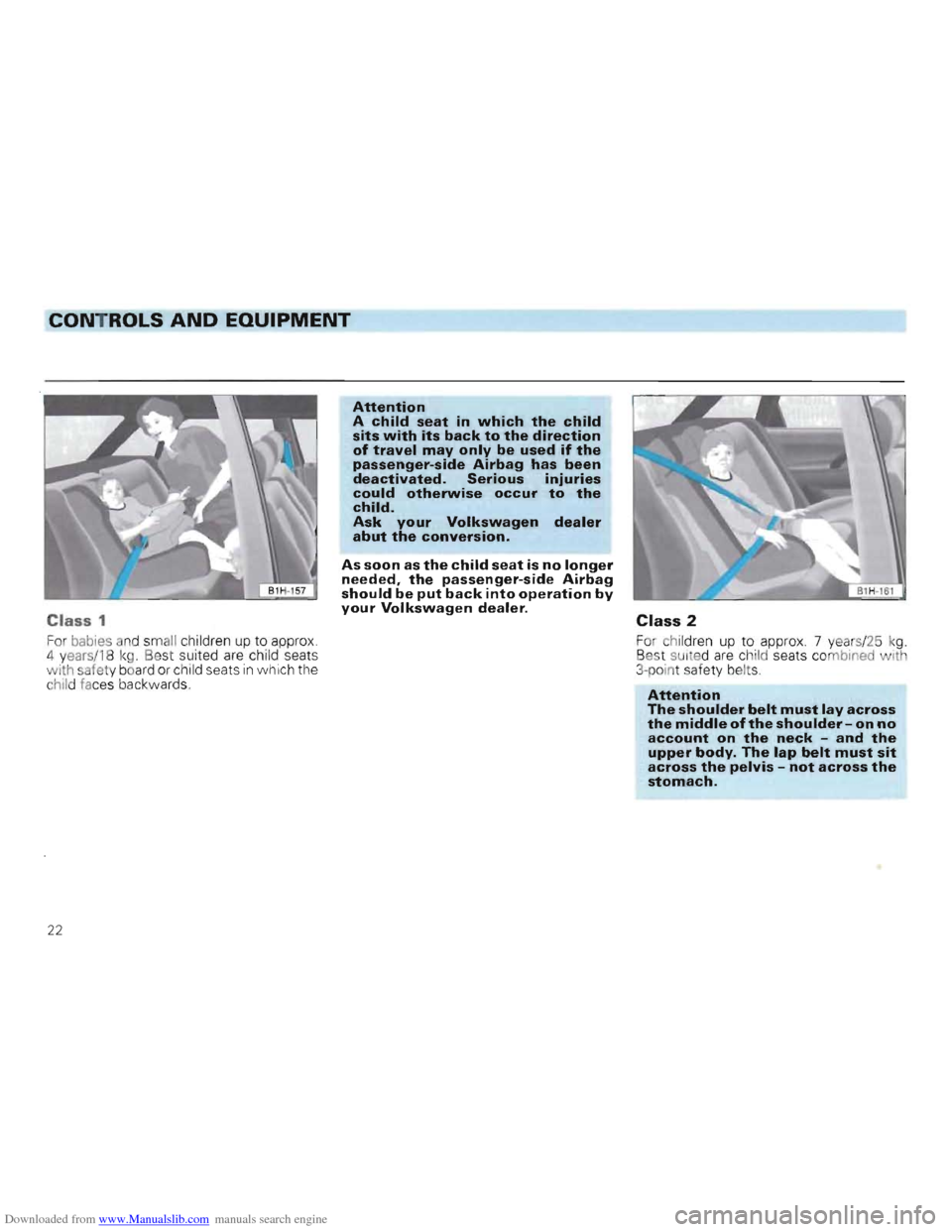
For babies an d sm all children up to approx.
4 years/ 18 kg. Best sui ted are child seats with safety board or chi ld seats in which the
c hild faces backwards.
Attention A child seat in which the child sits with its back to the direction of travel may only be used if the passenger-side Airbag has been deactivated. Serious injuries could otherwise occur to the child. Ask your Volkswagen dealer abut the conversion.
A s soon as the child seat is no longer needed, the passenger-side Airbag should be put back into operation by your Volkswagen dealer. Class 2
Fo children up to approx . 7 year s/2 5 kg. Best sU it e d are chil d seats co mbined with 3-point safe ty be lt s .
Attention The shoulder belt must lay across the middle of the shoulder -on no a ccount on the neck -and the upper body. The lap belt must sit across the pelvis -not across the stomach.
22
Page 25 of 156
Downloaded from www.Manualslib.com manuals search engine CONTROLS AND EQUIPM ENT
Cla ss 3
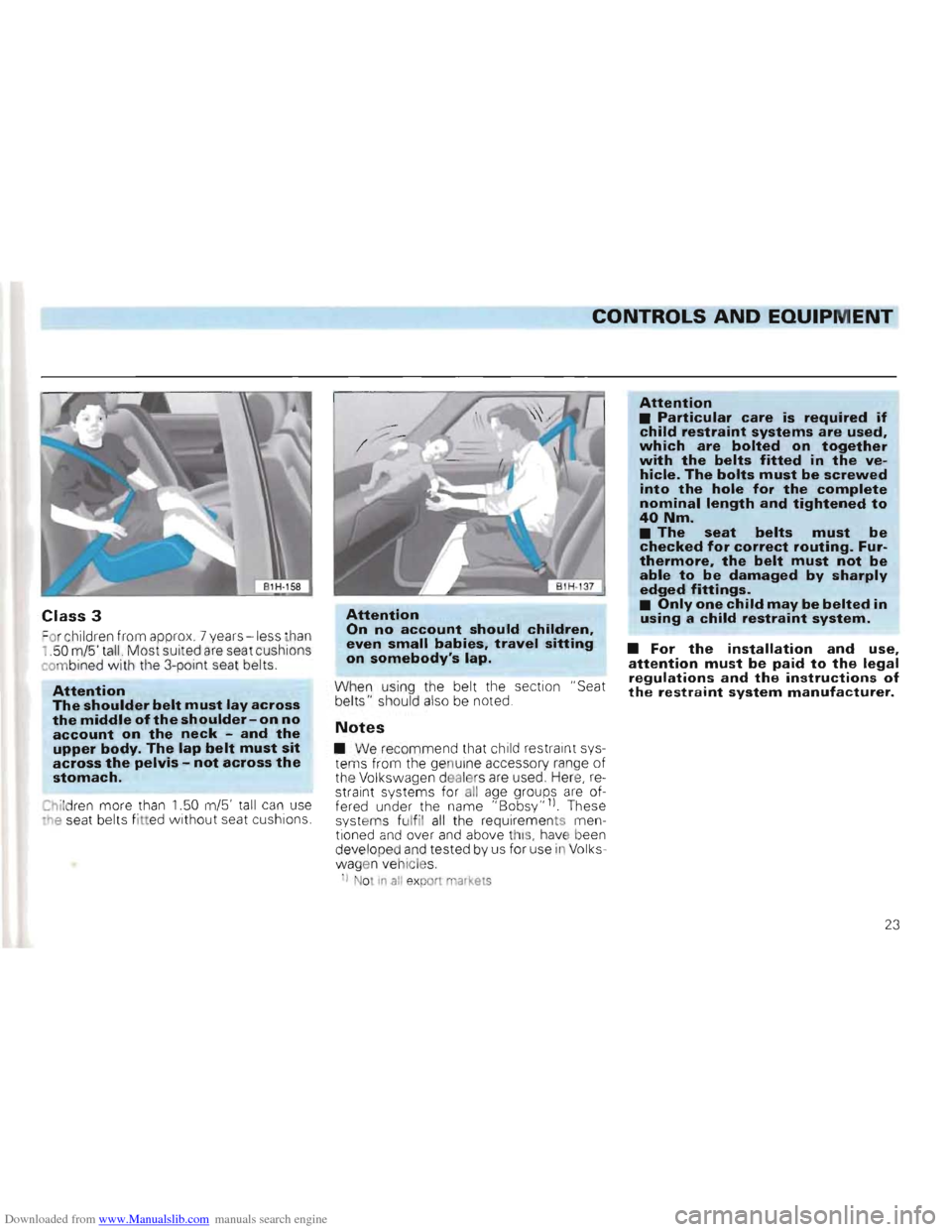
=o r c h ild ren from approx . 7 years -les s than i .50 m/5' tall. Most suited are seat cushions
co mbined with the 3-po int seat belts.
Attention The shoulder belt must lay across the middle of the shoulder-on no account on the neck -and the upper body. The lap belt must sit across the pelvis -not across the stomach.
Child ren more than 1.50 m/5' tall can use "lle seat belt s fitted without seat cushions.
Attention
On no account should children,
even small babies, travel sitting
on somebody's lap.
When using the belt the section "Seat
belts" should also be noted.
Notes
• We recommend that child restraint sys
tems from the genuine access ory range of
th e Volkswag en dealer s are used. Here, re
straint systems for all age groups are of
f e red under the name "Bobsy"ll. These
syst ems fu lfil all the requirem ent s mentioned and over and ab ove this, hav e been
develope d and tested by us for use ill Volks
wag en ve hicl es.
I) Not in all e xport market s
Attention • Particular care is required if child restraint systems are used, which are bolted on together with the belts fitted in the v ehicle. The bolts must be screwed into the hole for the complete nominal length and tightened to 40Nm. • The seat belts must be checked for correct routing. Furthermore, the belt must not be able to be damaged by sharply edged fittings. • Only one child may be belted in u sing a child restraint system.
• For the installation and use, atte ntio n must b e paid to t he legal
regulations and the instruction s of the restraint system manufactu rer.
23
Page 26 of 156
Downloaded from www.Manualslib.com manuals search engine CONTROLS AND EQUIPMENT
Head restraints*
B1H-168 I
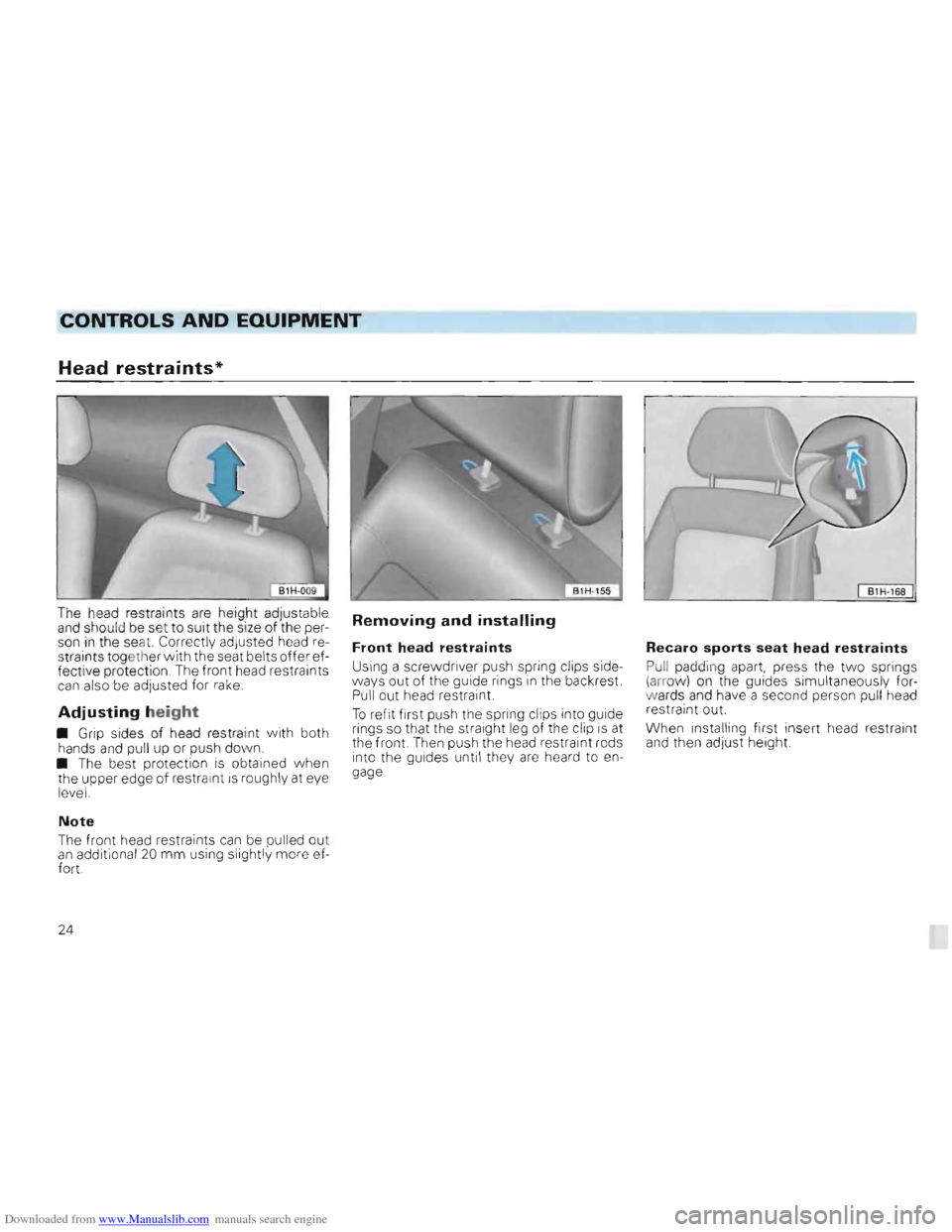
The head restraints are height adjustable and should be set to suit the size of the per
son in the seat. Correctly adjusted head re
straints togeth er with the seat belts offer ef
fective prot ection . The f
ront head restraints can also be adjuste d for rake.
Adjusting height
• Grip sides of head restraint with both
hands and pul l up or push dow n. • The best protection is obtained when
the upper edge of res traint is roughly at eye
l evel.
Note
Th e fr ont head restra ints can be pulled ou t an additional 20 mm using slightly more ef
fort.
Removing and installing
Front head restraints
Using a screwdri ver push spring clips side
ways out of the guide rings in the backrest. Pull out head restraint.
T o refit first push the spring clips into guide
rings so that the straight leg of the clip
is at
the front. Then push the head restraint rods
into the guides until they are heard to en
gage.
Recaro sports seat head restraints
Pull paddi ng apart, press the two springs (arr ow) on the guides simultaneous ly fo rw ards and have a second person pul l head
restraint out.
When installing f
irst insert head restraint and then adjust height.
24
Page 27 of 156
Downloaded from www.Manualslib.com manuals search engine CONTROLS AND EQUIPMENT
Front seats
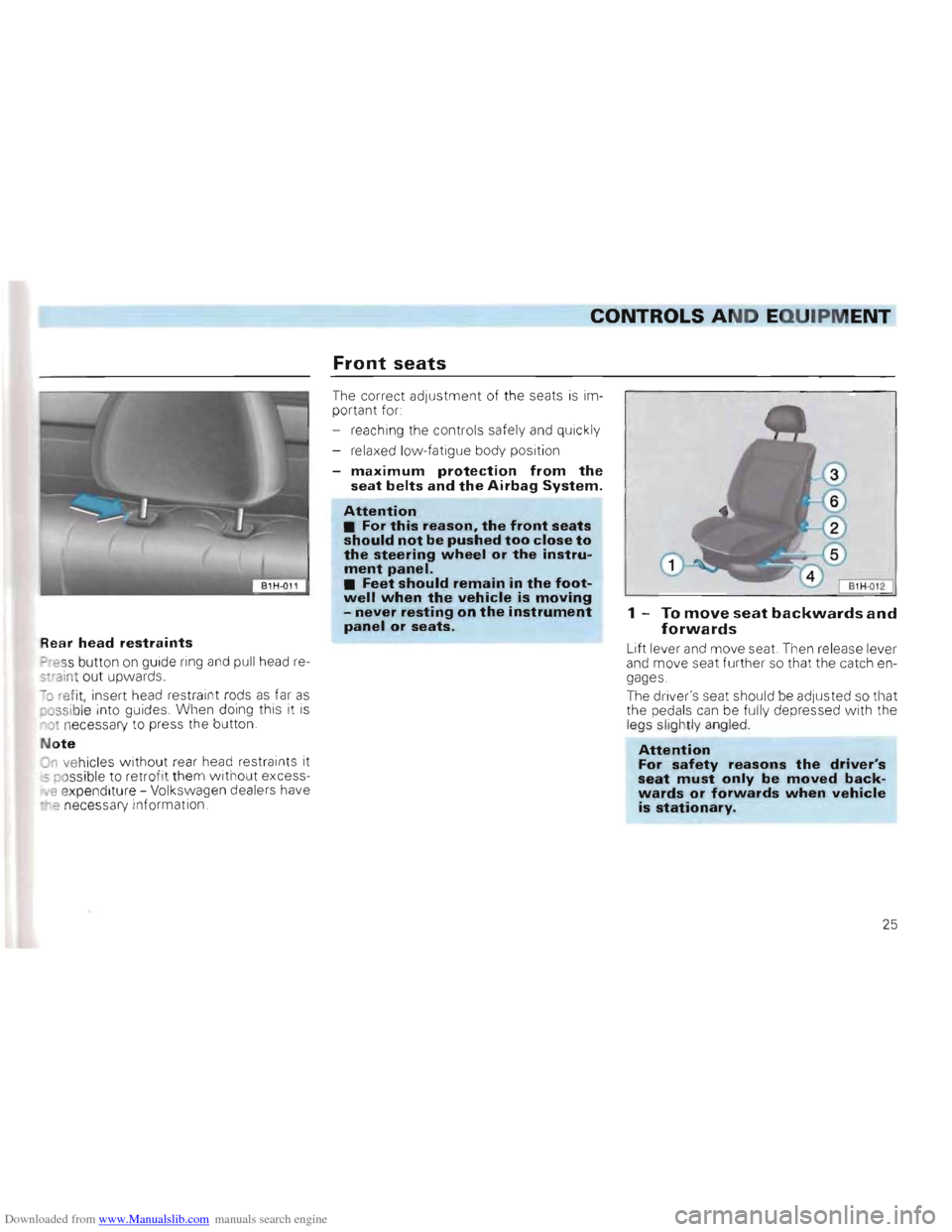
Rear hea d restraints
=>ress button on guide ring and pull head re
s-rai nt out upwards.
-0 refit, insert head restra int ro ds as far as os sible into guides. When doing this it is ~ot necessary to press the button .
N
ote
On ve hicles without rear head restra ints it 5 possibl e to r etrofit t hem without excess-
e expenditure -Vol kswagen dealers have
-'"'e n ecessary information. The
correc t adjustment of the seats
is im
portant for
- reaching the controls safely and quick
ly
- rela xed low-fatigue body po sition
-maximum protection from the seat belts and the Airbag System_
Attention • For this reason, the front seats should not be pushed too close to the steering wheel or the instrument panel. • Feet should remain in the footwell when the vehicle is moving -never resting on the instrument panel or seats_
I B1H-012 I
1 -To move seat backwards and forwards
Lift lever and move seat. Then release lever
and move seat fu rther so that the catch engages
The driver's seat
should be adjusted so that
the peda ls can be fully depr essed with the
legs slightly angled.
Attention For safety reasons the driver's seat must only be moved backwards or forwards when vehicle is stationary_
25
Page 28 of 156
Downloaded from www.Manualslib.com manuals search engine CONTROLS AND EQUIPMENT
2 -Adjusting backrest angle
Take weight off back rest and turn knob.
The backrest of the driv er's seat shou ld be adjusted so that the top of the steerin g
whee l can be reached with the arms angled slightly.
Attention
Do not lower the backrest too far
when on the move because the seat belts are then no longer fully effective.
3 -Releasing backrest
(2 door vehicl es only)
Lif t the
lever (also belt holder) and move the
back rest forward. Before releasing the
backrest pull
belt out of the belt holder (see
page 17).
Attention For safety reasons, ensure that the backrest lock is engaged when the vehicle is moving!
4 -Adjusting angle of the seat
cushion*
If the angle of the seat cushion is to be changed, pull lever up and bring seat
cushion to the desired angle by placing
mo
re or less weight on the backrest.
5 -Adjusting seat height*
Take weight off seat cushion and pull up lever. The whole seat cushion moves up
war ds. To adjust the seat cushion down
w ards, push seat downwards with body
weight.
Attention • For safety reasons the height of the driver's seat must only be adjusted when vehicle is stationary. • Be careful when adjusting the seat height! Careless and uncontrolled adjustment can cause injuries.
6 -Adjusting lumbar support
By turn ing the hand-wheel the seat padding in the lumbar area of the spine can be made
to arch forward slightly. This gives effective
support to the natura l curvatu re of the spine
so that t
he sitting position is less fatigui ng ,
particul arly on long trips
26
Page 29 of 156
Downloaded from www.Manualslib.com manuals search engine CONTROLS AND EQUIPMENT ----------------------------------~~~--
Rear seat
-ncr ease the size of the luggage area the ar seat can be folded forward; on vehi cles
- h sp li t rear seat the two parts can be ov ed separately.
~r-e rear head restraints " should be re~oved before folding the backrests downsee page 24.
-0 pr ev ent damage, the front seats must be sltio ned beforehand so that the rear seat _~s not contact the front seats w hen the -r-2 rear seat is fo lded forward.
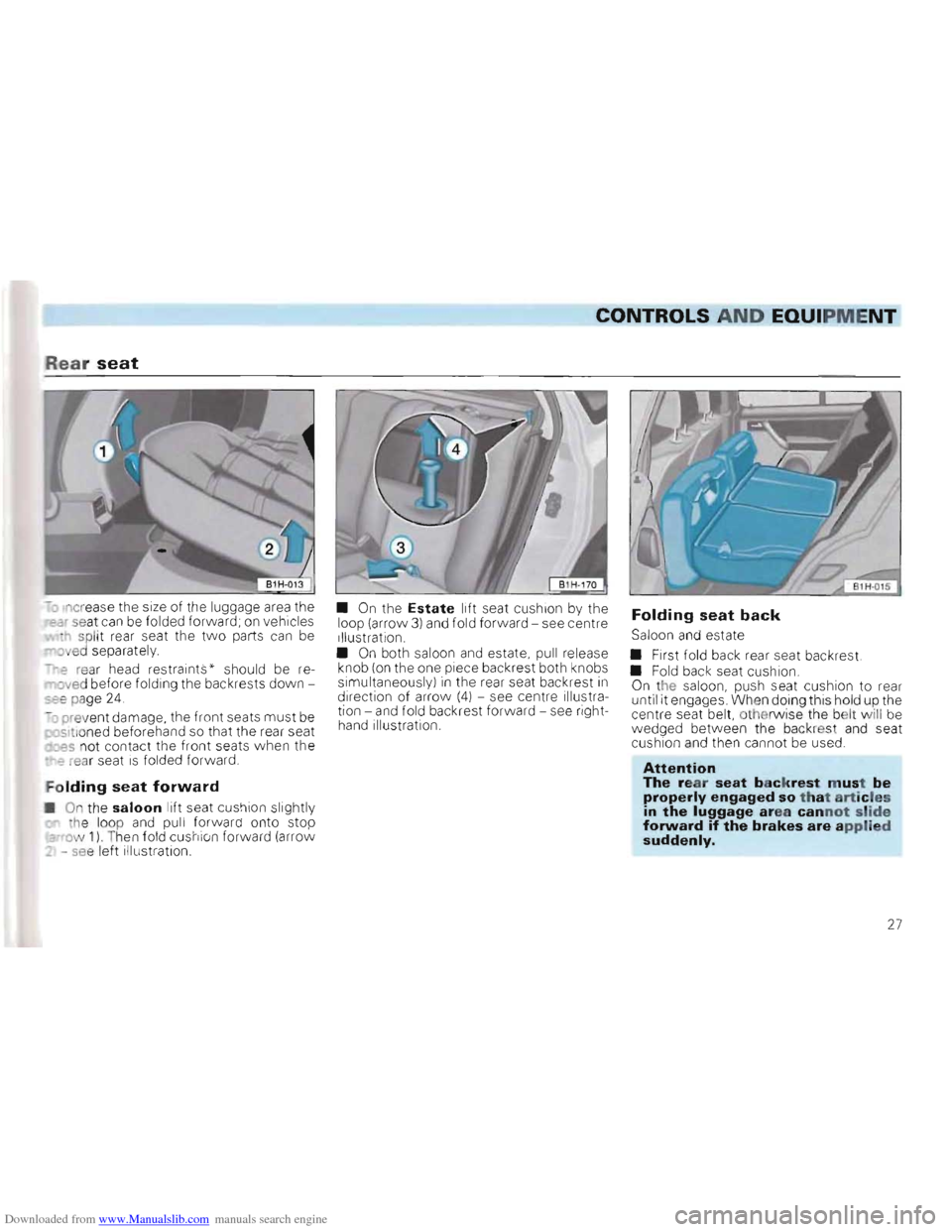
Folding seat forward
On the saloon lift seat cushion slightly
t h e loo p and pull forwar d onto stop :::-ow 1) T hen fold cushion forward (arrow
_ -se e left illust ration. •
On the Estate lift
seat cushion by the
l oop (arrow 3) and fold forward -see centre
Illustrat ion. • On both saloon and estate, pu ll release
knob (on the one piece back rest both knobs
simultaneous ly) in the rear seat back rest in direction of arrow (4) -see centre illustra
tion -and fold back rest forward -see flght
hand illustration.
Folding seat back
Sa loon and estate
• First fold back rear seat backrest.
•
Fold back seat cushion. On the saloo n, push seat cushion to rear
unti l it engages When doing this hold up the
centre seat belt, othe rwise the belt w ill b e
wedged between the backre s and seat
cushion and then cannot be used.
Attention The rear seat backrest m ust be properly engaged so tha t articles in the luggage area cannot slide forward if the brakes are applied suddenly.
27