Page 183 of 306

Problems on the Road
Engine Overheating (CONTJ
How to Add Coolant to the Coolant
Surge Tank:
If you haven’t found a problem yet, but
the coolant level isn’t at or above
FULL
COLD, add a 50/50 mixture of clean
water
(preferably distilled) and a proper
antifreeze at the coolant surge
tank, but
be sure the cooling system, including
the coolant surge
tank pressure cap, is
cool before
you do it. (See the Index
under Engine Coolant for more
information about the proper coolant
mix.)
182
L Steam and scalding liquids
L from a hot cooling system can
blow out and burn you badly. They
are under pressure, and if you turn
cap-evm a little-they can come
out at high speed. Never turn the
pressure cap when the cooliag
tank pressure cap, is hot. Wait for
the cooling system and coolant
you ever have to turn the pmsure
MP.
the coolant surge tank pressure
system, including the COoIant surge
surge tank pressure cap to cool if
Adding only plain water to
dangerous. Plain water, or some
other liquid like alcohol, can boil
before the proper coolant mix will.
Your vehicle’s coolant warning
system is set for the proper coolant
mix. With plain water or the
wrong mix, your engine could get
too hot but you wouldn’t get the overheat warning. Your engine
could catch fire and you or others
could be burned. Use a
50/50 mix
of
clean water and a proper
antifreeze.
k your cooling system can be I
ProCarManuals.com
Page 184 of 306
NOTICE
A
You can be burned if you spill
coolant on hot engine
parts.
Coolant contains ethylene glycol
and it will burn if the engine parts
are hot enough. Don’t spill coolant
on a hot engine.
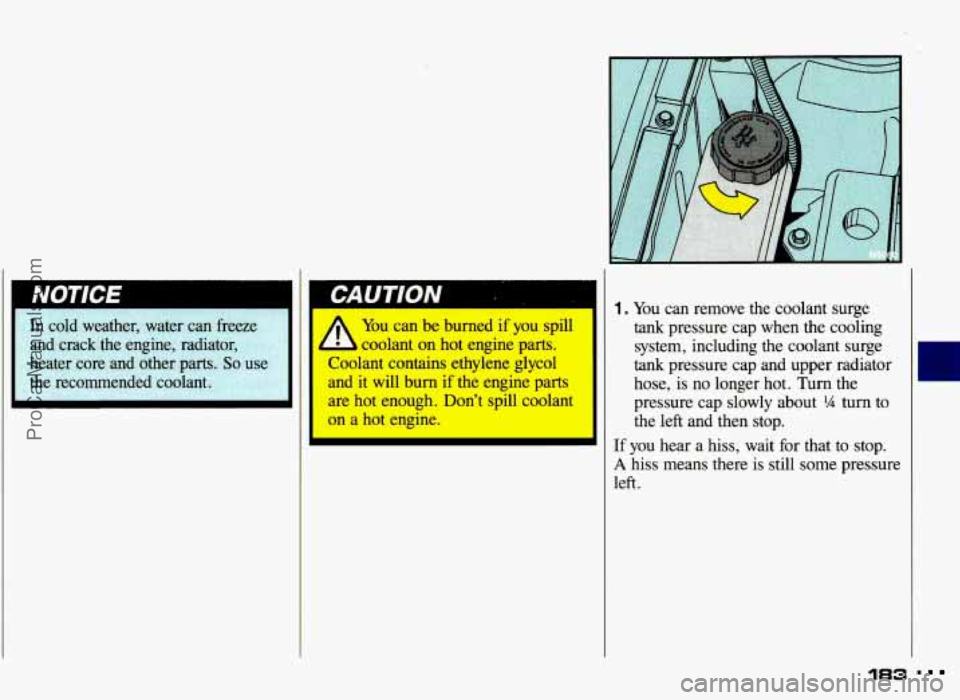
1. You can remove the coolant surge
tank pressure cap when the cooling
system, including the coolant surge
tank pressure cap and upper radiator
hose, is no longer hot. Turn the
pressure cap slowly about
?A turn to
the left and then stop.
If you hear a hiss, wait for that to stop.
A hiss means there is still some pressure
left.
183 .
ProCarManuals.com
Page 185 of 306
Problems on the Road
,
Engine Overheating (CONT.)
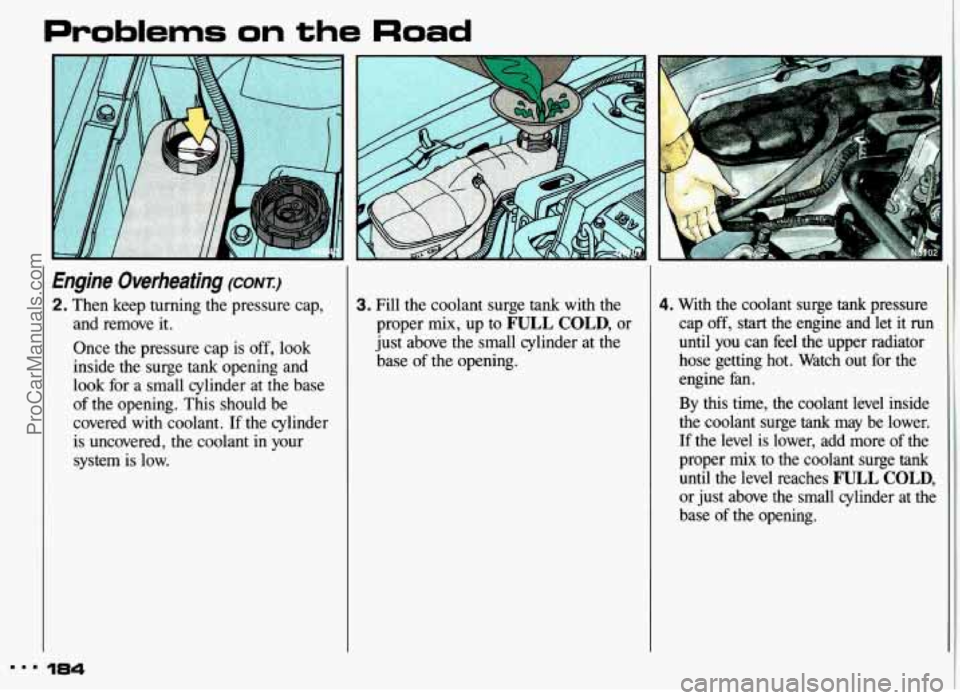
2. Then keep turning the pressure cap, and remove it.
Once the pressure cap is
off, look
inside the surge
tank opening and
look for a small cylinder at the base
of the opening. This should be
covered with coolant. If the cylinder
is uncovered, the coolant in your
system is low.
184
3. Fill the coolant surge tank with the
proper mix, up to
FULL COLD, or
just above the small cylinder at the
base of the opening.
4. With the coolant surge tank pressure
cap off,
start the engine and let it run
until you can feel the upper radiator
hose getting hot. Watch out for the
engine fan.
By this time, the coolant level inside
the coolant surge
tank may be lower.
If the level is lower, add more
of the
proper mix to
the coolant surge tank
until the level reaches F'ULL COLD,
or just above the small cylinder at the
base
of the opening.
ProCarManuals.com
Page 187 of 306
Problems on the Road
Changing a Flat lire
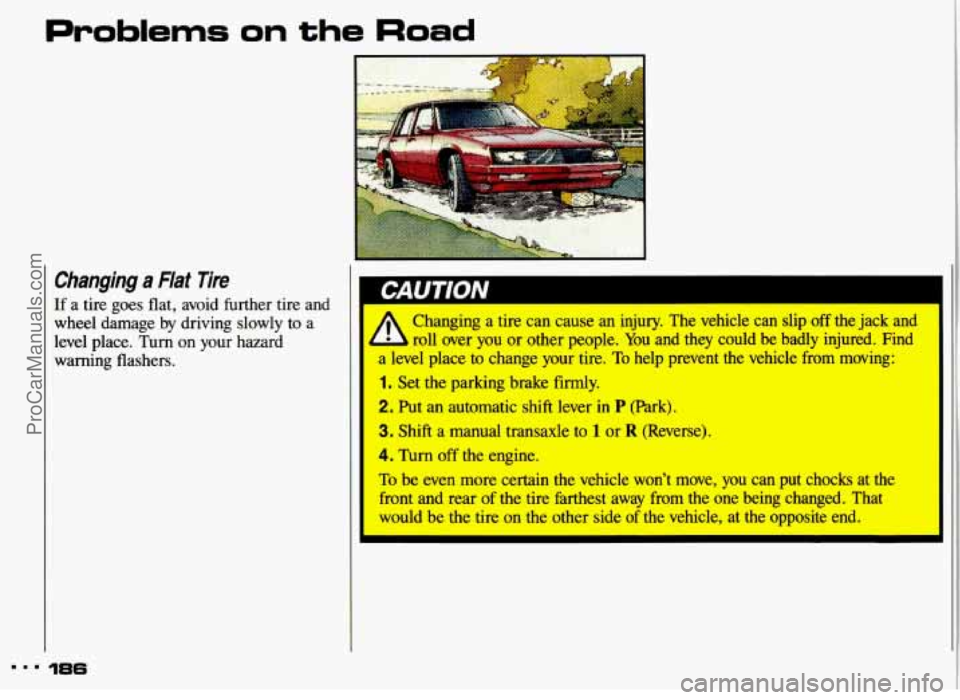
If a tire goes flat, avoid further tire and
wheel damage by driving slowly to a
level place. Turn
on your hazard
warning flashers.
186
IUII
Changing a tire can cause an injury. The vehicle can slip off the jack and
roll over you or other people. You and they could be badly injured. Find I
a level place to change your tire. To help prevent the vehicle from moving:
1. Set the parking brake firmly.
2. Put an automatic shift lever in P Wk). I
3. Shift a manual transaxle to 1 or R (Reverse).
4. Turn off the engine.
To be even more certain the vehicle won't move, you can put chocks at the
front and fear of the tire farthest away from the one being changed. That
would be the tire on the other side of the vehicle, at the opposite end.
ProCarManuals.com
Page 194 of 306
-
Tire chains won’t fit your compact
spare. Using them will damage
your vehicle and destroy the chains
too. Don’t use tire chains
on your
compact spare.
A Storing a jack, a tire, or other
- equipment in the passenger
compartment
of the vehicle could
cause injury.
In a sudden stop or
collision, loose equipment could
strike someone. Store
all these in
the proper place.
If You’re Stuck: In Sand, Mud,
Ice or Snow
What you don’t want to do when your
vehicle is stuck is to spin your wheels.
The method known as “rocking” can
help
you get out when you’re stuck, but
you must use caution.
CAUTION I
A
If you let your tires spin at high
speed, they can explode and you
or others could be injured.
And,
the transaxle or other parts of the
vehicle can overheat. That could
cause an engine compartment fire
or other damage. When you’re
stuck, spin the.wheels as little as
possible. Don’t spin the wheels
above
35 mph (56 km/h) as shown
on the speedometer.
193
ProCarManuals.com
Page 198 of 306

Part 6
... N604
Here you will find information
about the care of your Pontiac
. This
part begins with service and fuel
information. and then it shows how
to check important fluid and
lubricant levels
. There is also
technical information about your
vehicle. and a section devoted to its
appearance care
.
Service & Appearance Care
Service ................ .................................. 198
Fuel
........................................................... 199
HoodRelease .................................................... 205
Engineoil
...................................................... 209
Aircleaner
...................................................... 214
Transaxle Fluid
.................................................. 216
Engine Coolant
.................................................. 221
Power Steering Fluid
.............................................. 224
Windshield Washer Fluid
........................................... 224
Brakes
......................................................... 225
Battery
......................................................... 227
BulbReplacement
................................................ 228
Windshield Wiper Blade Replacement
................................. 230
Loading Your Vehicle
............................................. 230
Tires
.......................................................... 232
Appearancecare
................................................. 239
Vehicle Identification Number (VIN)
................................. 247
Add-on Electrical Equipment
....................................... 248
Fuses
& Circuit Breakers ........................................... 248
Capacities
& Specifications ......................................... 251
Fluids
& Lubricants ............................................... 253
Replacement Bulbs
............................................... 254
Normal Maintenance Replacement
Parts ............................. 257
197
ProCarManuals.com
Page 200 of 306
Fuel
2.3L Quad OHC and Quad 4 Engines
(Codes
3 and D) and 3300 V6 Engine
(Code
N):
The 8th digit of your Vehicle
Identification Number (VIN) shows the
code letter for your engine. You will
find the VIN at the top left
of your
instrument panel. (See the
Idex under
&hicle Identijkation Number.)
Use regular unleaded gasoline rated at
87 octane or higher. It should meet
specifications ASTM D4814
in the U.S.
and CGSB 3.5-92 in Canada. These
fuels should have the proper additives,
so you should not have to add anything
to the fuel. In the
U.S. and
Canada, it’s easy to be
sure you get the right kind
of gasoline
(unleaded). You’ll see “UNLEADED”
right on the pump. And only unleaded
nozzles will fit into your vehicle’s filler neck.
Be sure the posted octane is at least
87.
If the octane is less than 87, you may get
a heavy knocking noise when you drive.
If it’s bad enough, it can damage your
engine.
19s
ProCarManuals.com
Page 201 of 306
Service & Appearance Care
Fuel (CONT.:)
If you’re using fuel rated at 87 octane or
higher and you still hear heavy
knocking, your engine needs service.
But don’t
worry if you hear a little
pinging noise when you’re accelerating or driving up a hill. That’s normal, and
you don’t have to buy a higher octane
fuel to get rid of pinging. It’s the heavy,
constant knock that means you have a
txoblem.
2.3L High Output Quad 4 Engine
(Code
A):
The 8th digit of your Vehicle
Identification Number
(VIN) shows the
code letter for your engine. You will
find the VIN at the top left of your
instrument panel. (See the
Index under
Rhicle ldentijication Number.)
Use premium unleaded gasoline rated at
91 octane or higher. You may use middle
grade or regular unleaded gasolines, but
your vehicle may not accelerate as well.
The gasoline
you use should meet
specifications
ASTM D4814 in the U.S.
and CGSB 3.5-92 in Canada. These
fuels should have the proper additives,
so you should not have to add anything
to the fuel.
In the U.S. and Canada, it’s easy to be
sure
you get the right kind of gasoline
(unleaded).
You’ll see “UNLEADED”
right on the pump. And only unleaded
nozzles will
fit into your vehicle’s filler
neck.
Be sure the posted octane for premium
is at least 91 (at least 89 for middle
grade and
87 for regular). If the octane
is less than
87, you may get a heavy
knocking noise when you drive.
If it’s
bad enough, it can damage your engine.
888 a00
ProCarManuals.com