1993 PONTIAC GRAND-AM engine
[x] Cancel search: enginePage 99 of 306
Features tS Controls
!
-
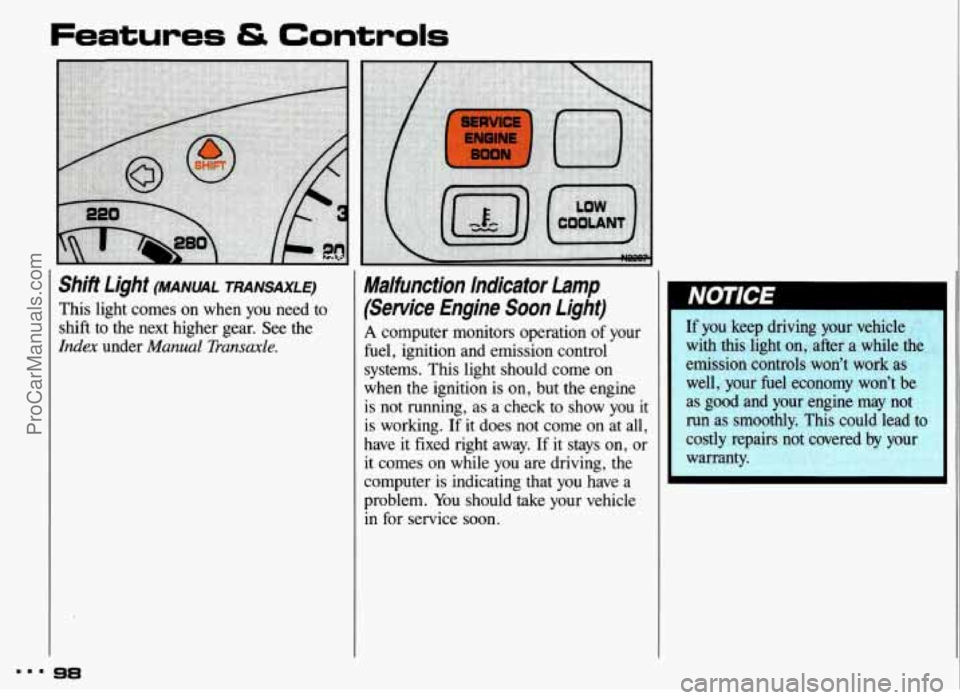
Shift Light (MANUAL TRANSAXLE)
This light comes on when you need to
shift to the next higher gear. See the
Index under Manual Transaxle.
98
Malfunction Indicator Lamp
(Service Engine Soon Light)
A computer monitors operation of your
fuel, ignition and emission control
systems. This light should come on
when the ignition is on, but the engine
is not running, as a check to show you
it
is working. If it does not come on at all,
have it fixed right away.
If it stays on, or
it comes on while you are driving, the
computer is indicating that
you have a
problem. You should take your vehicle
in for service soon.
If you keep driving your vehicle
with this light on, after a while the
emission controls won’t work as
well, your fuel economy won’t be
as good and your engine may not
run as smoothly. This could lead to
costly repairs not covered by your
warranty.
ProCarManuals.com
Page 100 of 306
. .. . ..
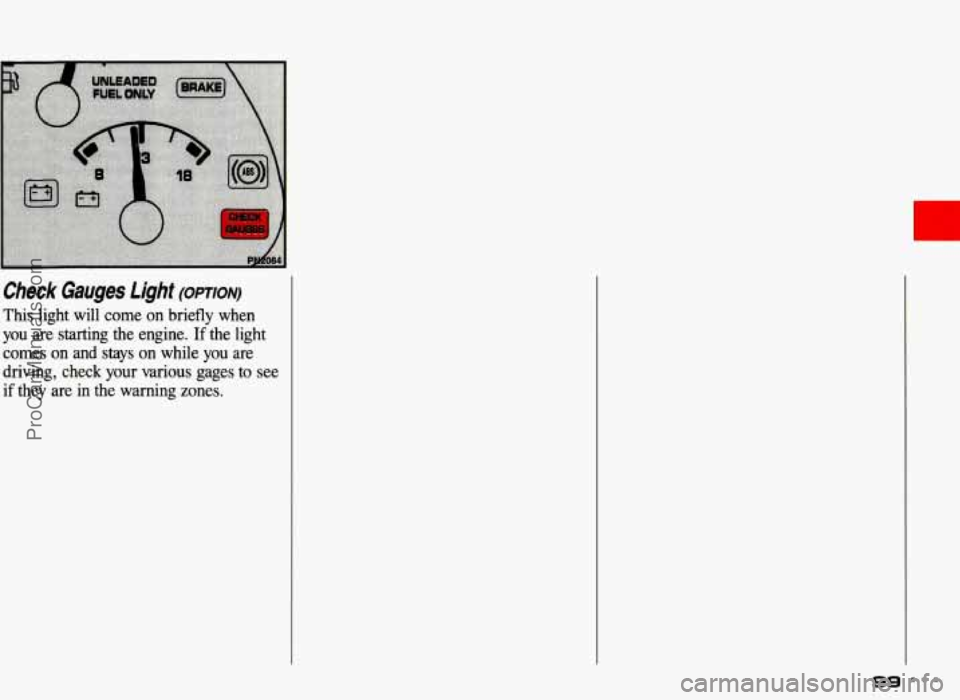
Check Gauges Light (opTIoN)
This light will come on briefly when
you are starting the engine. If the light
comes
on and stays on while you are
driving, check your various gages to see
if they are in the warning zones.
c
99 === ProCarManuals.com
Page 103 of 306
Comfort Controls & Audio Systems
Climate Control System
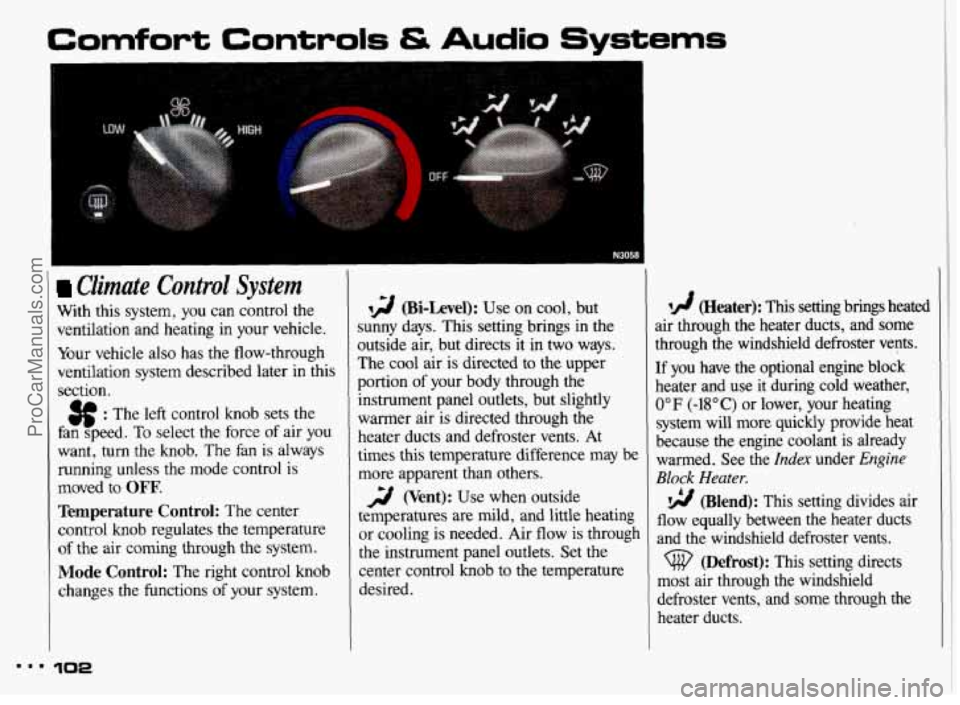
With this system, you can control the
ventilation and heating in your vehicle.
Your vehicle also has the flow-through
ventilation system described later in this
section.
$$ : The left control knob sets the
fan speed.
To select the force of air you
want, turn the knob. The fan
is always
running unless the mode control
is
moved to OFF’.
Temperature Control: The center
control knob regulates the temperature
of the air coming through the system.
Mode Control: The right control knob
changes the functions
of your system.
N3058
12 (Bi-Level): Use on cool, but
;unny days. This setting brings in the
3utside air, but directs it in two ways.
rhe cool air is directed to the upper
2ortion
of your body through the
instrument panel outlets, but slightly
warmer air
is directed through the
heater ducts and defroster vents. At
times this temperature difference may be
more apparent than others.
temperatures are mild, and little heating
or cooling is needed. Air flow is through
the instrument panel outlets. Set the
center control
knob to the temperature
desired.
2 (Vent): Use when outside
lA (Heater): This setting brings heated
air through the heater ducts, and some
through the windshield defroster vents.
[f you have the optional engine block
heater and use it during cold weather,
0°F (-18°C) or lower, your heating
system will more quickly provide heat
because the engine coolant is already
warmed. See the
Index under Engine
Block Heater.
flow equally between the heater ducts
and the windshield defroster vents.
most air through the windshield
defroster vents, and some through the
heater ducts.
(Blend): This setting divides air
(Defrost): This setting directs
m.. 102
ProCarManuals.com
Page 105 of 306

Comfort Controls & Audio Systems
Air Conditionina (CONI) -.
qg (Bi-Level): Use on cool, but
sunny days. This setting brings in the
outside air, but directs it in two ways.
The cool air is directed to the upper
portion of your body through the
instrument panel outlets, but slightly
warmer air is directed through the
heater ducts and defroster vents. At
times this temperature difference may be
more apparent than others.
The air conditioner compressor operates
in all three air conditioning positions. It
also operates in (Defrost) when
the outside temperature is higher than
about
40°F (4.5"C).
Ventilation
Use when outside temperatures are
mild, and little heating or cooling is
needed. Turn the right control knob to
2 (Vent). Air flow is directed
through the instrument panel outlets. Set
the center control knob to the
temperature desired.
Heating
Turning the right control knob to
72 (Heater) and the center control
knob clockwise will send heated air
through the heater ducts, and some
through the defroster vents.
3 (Vent) and (Heater) are
economical positions because the air
conditioner compressor doesn't run in
these two settings. This reduces engine
load, resulting in improved fuel
economy. If either setting fails to keep you
comfortable, or causes your windows
to fog up, turn the right control knob to
one of the air conditioning positions, or
to
(j@ (Defrost).
If you have the optional engine block
heater and use it during cold weather,
0°F (-18°C) or lower, your heating
system will more quickly provide heat
because the engine coolant is already
warmed. See the
Index under Engine
Block Heater.
flow equally between the heater ducts
and the windshield defroster vents.
vg (Blend): This setting divides air
Defrosting
The (@ (Defrost) setting directs most
air through the defroster vents, and
some through the heater ducts.
8.8 104
ProCarManuals.com
Page 108 of 306

Audio Systems
The following pages describe the audio systems available for your Pontiac, and how
to get the best performance from them. Please read about the system in your
vehicle.
Hearing damage from loud noise is almost undetectable until it is too
- late. Your hearing can adapt to higher volumes of sound. Sound that
I st IS normal can be loud and harmful to your hearing. Take precautio\
ns by
1
adjusting the volume control on your radio to a safe sound le\
vel before your
hearing adapts
to it.
1 To help avoid hearing loss or damage:
I
1. Adjust the volume control to the lowest setting.
2. Increase volume slowly until you hear comfortably and clearly.
Before you add any sound equipment to your vehicle-like a tape player,
CB
radio, mobile telephone or two-way radio-be sure you can add what you
want.
If you can, it's very important to do it properly. Added sound equipment
may interfere with the operation of your vehicle's engine, Delco@ radio or
other systems, and even damage them. And, your vehicle's systems may
interfere with
the operation of sound equipment that has been added
improperly.
So, before adding sound equipment, check with your dealer and be sure to
check federal rules covering mobile radio and telephone units.
Setting the Clock
No matter which audio system you have
in your vehicle, setting the clock is easy.
1 , With the ignition on and radio on or
off, press SET. The SET indicator
will appear on the digital screen for
five seconds.
2. You must begin to set the clock to the
correct hour and minute during those
five seconds.
Depress
VSEEK or 4SEEK to set
the hour.
Depress
SEEU or SEEK, to set
the minute.
107 " '
ProCarManuals.com
Page 132 of 306
“Riding” the brakes wears them
out much faster. You would need
costly brake replacement
much
sooner than normal, and it also reduces fuel economy. If you keep pace with the traffic and
allow realistic following distances,
you
will eliminate a lot of unnecessary
braking. That means better braking and
longer brake life. If your engine ever stops while you’re
driving, brake normally but don’t
pump your brakes. If you do, the pedal
may get harder to push down. If your
engine stops, you will still have some
power brake assist. But
you will use it
when you brake. Once the power
assist is used up, it may take longer
to
stop and the brake pedal will be
harder to push.
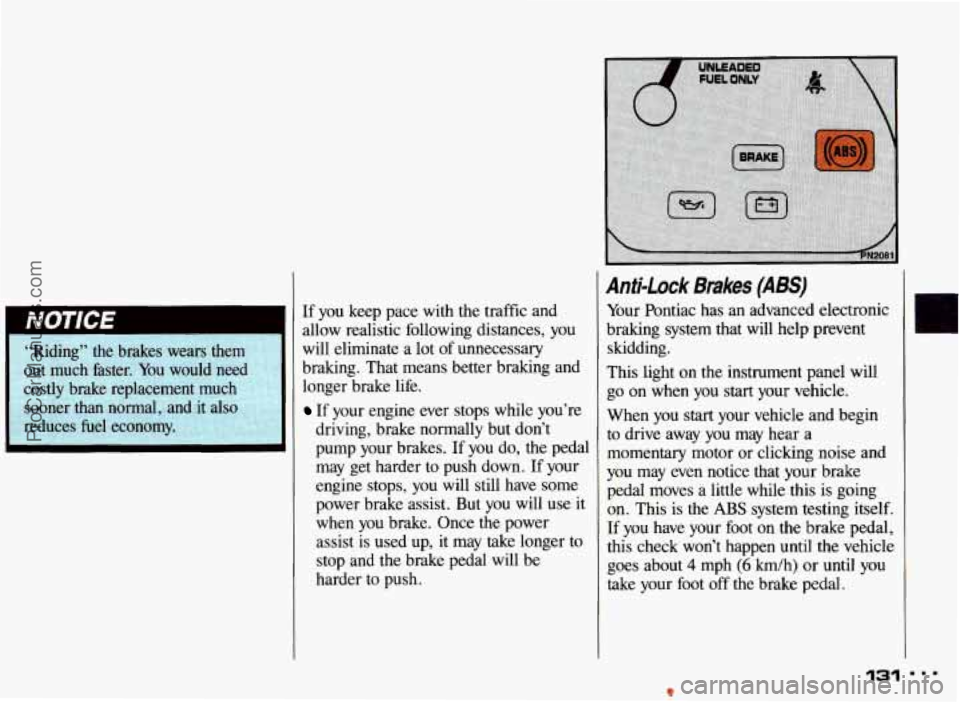
Anti-Lock Bmkes (ABS)
Your Pontiac has an advanced electronic
braking system that will help prevent
skidding.
This light on the instrument panel will
go on when you start your vehicle.
When you
start your vehicle and begin
to drive away you may hear a
momentary motor or clicking noise
and
you may even notice that your brake
pedal moves a little while this is going
on. This is the ABS system testing itself.
If you have your foot on the brake
pedal,
this check won’t happen until the vehicle
goes about
4 mph (6 km/h) or until you
take your foot off the brake pedal.
131
ProCarManuals.com
Page 136 of 306
Brake Aflustment
Every time you make a moderate reverse
brake stop, your brakes adjust for wear.
If you rarely make a moderate or
heavier stop, then your brakes might not
adjust correctly. If you drive
in that way,
then-very carefully-make a few
moderate brake stops about every
1,OOO
miles (1 600 km), so your brakes will
adjust properly.
If your brake pedal goes down farther
than
normal, your rear drum brakes may
need adjustment. Adjust them by
backing up and
firmly applying the
brakes a few times.
Braking In Emergencies
Use your anti-lock braking system when
you need to. With anti-lock, you can
steer and brake at the same time. In
many emergencies, steering can help
you more than even the very best
braking.
Power Steering -
If you lose power steering assist because
the engine stops or the system fails to
function, you can steer but it will
take
much more effort.
135
ProCarManuals.com
Page 142 of 306
Skidding
In a skid, a driver can lose control of
the vehicle. Defensive drivers avoid
most skids by taking reasonable care
suited to existing conditions, and by not
“overdriving” those conditions. But
skids are always possible.
The three types of skids correspond to
your Pontiac’s three control systems.
In
the braking skid your wheels aren’t
rolling.
In the steering or cornering
skid, too much speed or steering in a
curve causes tires to slip and lose cornering force. And in the acceleration
skid too much throttle causes the driving
wheels to spin. A
cornering skid and an acceleration
skid are best handled by easing your
foot
off the accelerator pedal. If your
vehicle starts to slide (as when you turn
a corner on a wet, snow- or ice-covered
road), ease your foot off the accelerator
pedal as soon as you feel the vehicle
start to slide. Quickly steer the way you
want the vehicle to go.
If you start
steering quickly enough, your vehicle
will straighten out. As it does, straighten
the front wheels.
Of course, traction is reduced when
water, snow, ice, gravel, or other
material is on the road. For safety, you’ll
want to slow down and adjust your
driving to these conditions. It is
important to slow down on slippery surfaces because stopping distance will
be longer and vehicle control more
limited. While driving on
a surface with reduced
traction, try your best to avoid sudden
steering, acceleration, or braking
(including engine braking by shifting to
a lower gear). Any sudden change could
cause the tires to slide.
You may not
realize the surface is slippery until your
vehicle is skidding. Learn to recognize
warning clues-such as enough water,
ice or packed snow
on the road to make
a “mirrored surface”-and slow down
when you have any doubt.
Remember: Any anti-lock braking
system
(ABS) helps avoid only the
braking skid.
141
ProCarManuals.com