Page 7 of 322
How to Use this Manual
Vehicle Symbols
These are some of the symbols you will
find on your vehicle. For example, these
symbols are used on an original battery:
Caution Possible injury A
Protect Eyes by Shielding
@
Caustic Battery Acid
Could Cause Burns
Avoid Spark or Flames
Sparks or Flame Could
Explode Battery
m.. 6
These symbols are important for you
and your passengers whenever your
vehicle is driven:
Fasten Safety Belts
Door LocWUnlock
These symbols have to do with your
lights:
Master Lighting Switch
Turn Signal Direction
Hazard Warning Flashers
Headlight High Beam Parking Lights
Fog Lights
pf
$0
ProCarManuals.com
Page 8 of 322
r
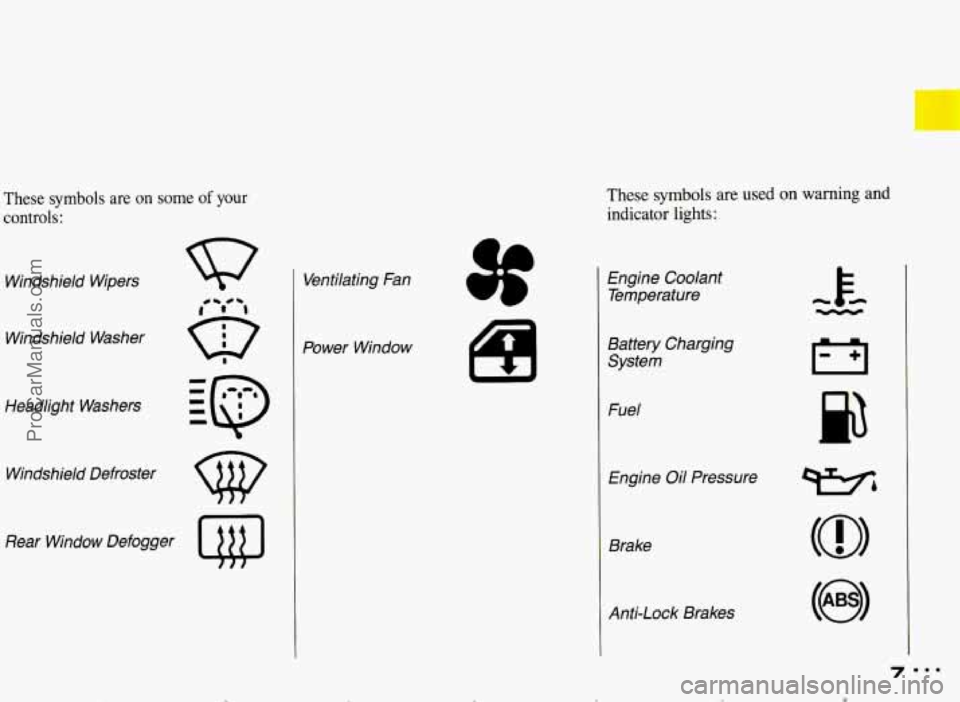
These symbols are on some of your
controls:
Windshield Wipers
Windshield Washer
Headlight Washers
Windshield Defroster
Rear Window Defogger
Q@
Ventilating Fan
Power Window
These symbols are used on warning and
indicator lights:
L
I
a
Engine Coolant Temperature
Battery Charging System
Fuel
Engine
Oil Pressure
Brake
Anti-Lock Brakes
ProCarManuals.com
Page 46 of 322
... Part 2
Features & Controls
Here you can learn about the
many standard and optional features
on your Pontiac. and information on
starting. shifting and braking
. Also
explained are the instrument panel
and the warning systems that tell
you
if everything is working
properly-and what to do
if you have
a problem
.
Keys ............................................................ 46
Locks
........................................................... 47
Remote Keyless Entry
.............................................. 48
GloveBox
....................................................... 56
Ignitionswitch ................................................... 57
StartingYourEngine
............................................... 58
Shifting the Transaxle
............................................. -61
ParkingBrake .................................................... 67
Shifting into Park
........ ...................................... 68
Windows ........................................................ 73
Turn SignaUHeadlight Beam Lever
.................................... 73
Windshield Wipers
................................................. 75
Windshield Washer
................................................ 76
CruiseControl
.................................................... 77
Lightcontrols
.................................................... 81
Interior Lights .................................................... 84
Mirrors
......................................................... 86
Sunroof ......................................................... 89
Ashtrays and Lighter
.............................................. -91
Instrument Panel ................................................... 94
Warning Lights, Gages and Indicators
.................................. 99
Gages
.......................................................... 108
Driver Information Center .......................................... 111
Electronic Compass ............................................... 113
Head-Up Display ............................................... 116
ProCarManuals.com
Page 58 of 322
New Venice bbBreak-ln”
Your modern Pontiac doesn’t need
an elaborate “break-in.” But it will
perform better
in the long run if
you follow these guidelines:
Don’t drive at any one speed-
fast or slow-for the first
500
.miles (804 km). Don’t make full-
throttle
starts.
Avoid making hard stops for the
first 200 miles (322 km) or so.
During this time your new brake
linings aren’t yet broken in. Hard
stops
with new linings can mean
premature wear and earlier
replacement. Follow this “breaking-in” guideline every
time you get
new brake linings.
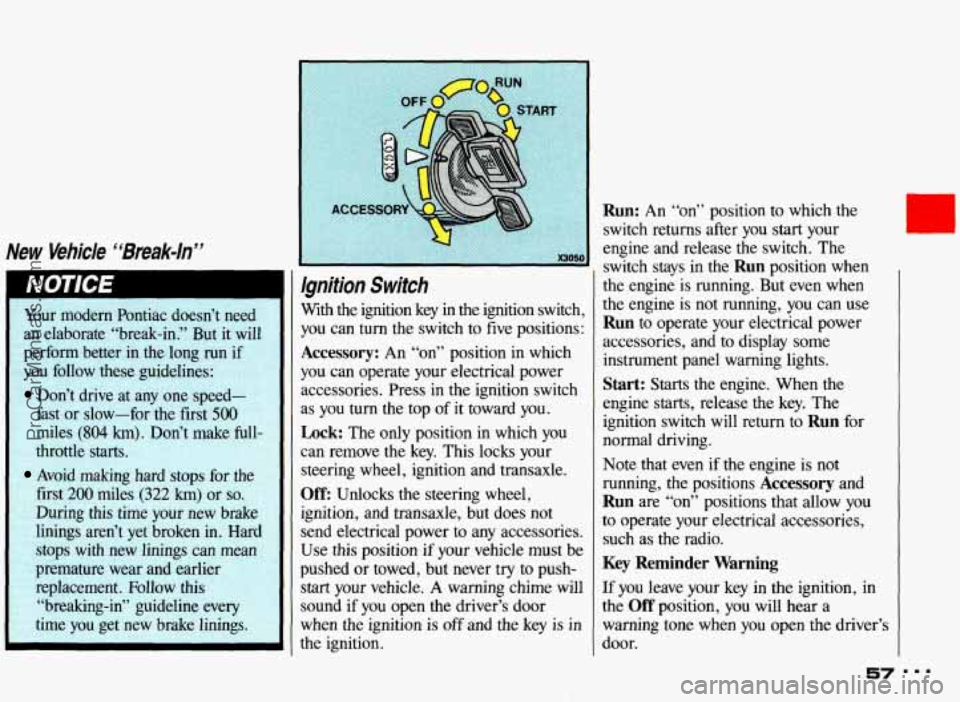
Ignition Switch
With the ignition key in the ignition switch,
you can turn the switch to five positions:
Accessory: An “on” position in which
you can operate your electrical power
accessories. Press in the ignition switch
as
you turn the top of it toward you.
Lock: The only position in which you
can remove the key. This locks your
steering wheel, ignition and transaxle.
Off: Unlocks the steering wheel,
ignition, and transaxle, but does not
send electrical power to any accessories.
Use this position if your vehicle must be
pushed or towed, but never try to push-
start your vehicle. A warning chime will
sound if you open the driver’s door
when the ignition is
off and the key is in
the ignition.
Run: An “on” position to which the
switch returns after you
start your
engine and release the switch. The
switch stays in the
Run position when
the engine is running. But even when
the engine is not running, you can use
Run to operate your electrical power
accessories, and to display some
instrument panel warning lights.
Start: Starts the engine. When the
engine starts, release the key. The
ignition switch will return to
Run for
normal driving.
Note that even if the engine
is not
running, the positions
Accessory and
Run are “on” positions that allow you
to operate your electrical accessories,
such as the radio.
Key Reminder Warning
If you leave your key in the ignition, in
the
Off position, you will hear a
warning tone when you open the driver’s
door.
57 ===
ProCarManuals.com
Page 83 of 322
...
Features & Controls
Operation of lights '
Although your vehicle's lighting system (headlamps, parking lamps, fog lamps,
side marker lamps and tail lamps) meets
all applicable federal lighting
requirements, certain states and
provinces may apply their own lighting
regulations that may require special
attention before you operate these
lamps. For example, some jurisdictions
may require that you operate your lower
beam lamps with fog lamps at all times,
62
or that headlamps be turned on
whenever you must use your windshield wipers. In addition, most jurisdictions
prohibit driving solely with parking
lamps, especially at dawn or dusk. It is
recommended that you check with your
own state or provincial highway
authority for applicable lighting
regulations.
lights On Reminder
If you open the door while leaving the
lights on, you will hear a warning tone.
ProCarManuals.com
Page 97 of 322
Features & Controls
Instrument Panel Clusters
Your Pontiac is equipped with one of these instrument panel clusters, which
includes indicator warning lights and gages that are explained on the following
pages. Be sure to read about those that apply to the instrument panel cluster for
your vehicle.
H2303
... 96
ProCarManuals.com
Page 100 of 322

c
Tachometer (OFTION)
The tachometer shows your engine speed in revolutions per minute
(rpm).
Do not run your engine at speeds in the
red area.
Warning Lights, Gages
and Indicators
This section describes the warning lights
and gages that may
be on your vehicle.
The pictures will help
you locate them.
Warning lights and gages can signal that
something
is wrong before it becomes
serious enough to cause an expensive
repair or replacement. Paying attention
to your warning lights and gages could
also save you or others from injury.
Warning lights go on when there may be
or is a problem with one of your
vehicle’s functions.
As you will see in
the details on the next few pages, some
warning lights
come on briefly when
you turn the ignition key just to let you
know they’re working.
If you are
familiar with this section,
you should
not be alarmed when this happens. Gages can
indicate when there may
be
or is a problem with one of your vehicle’s
functions. Often gages
and warning
lights work together to let
you know
when there’s a problem with your vehicle.
When one
of the warning lights comes
on and stays
an when you are driving,
or whtm one
of the gages shows there
may be a problem, check the seetion
that tells you what
to do about it. Please
follow the manual’s advice. Waiting to
do repairs can
be costly-and even
dangerous.
So please get to know your
warning lights
and gages. They’re a big
help.
Your vehicle may also have a Driver
Information Center that
works along with
the warning lights and gages. See the
Index under Driver Information Center.
9s m..
ProCarManuals.com
Page 101 of 322
...
Features & Controls
Warning Lights
Your Pontiac has some of the warning
light systems shown here. The symbols
are explained on the following pages.
100
ProCarManuals.com