1993 PONTIAC BONNEVILLE fuel cap
[x] Cancel search: fuel capPage 110 of 322
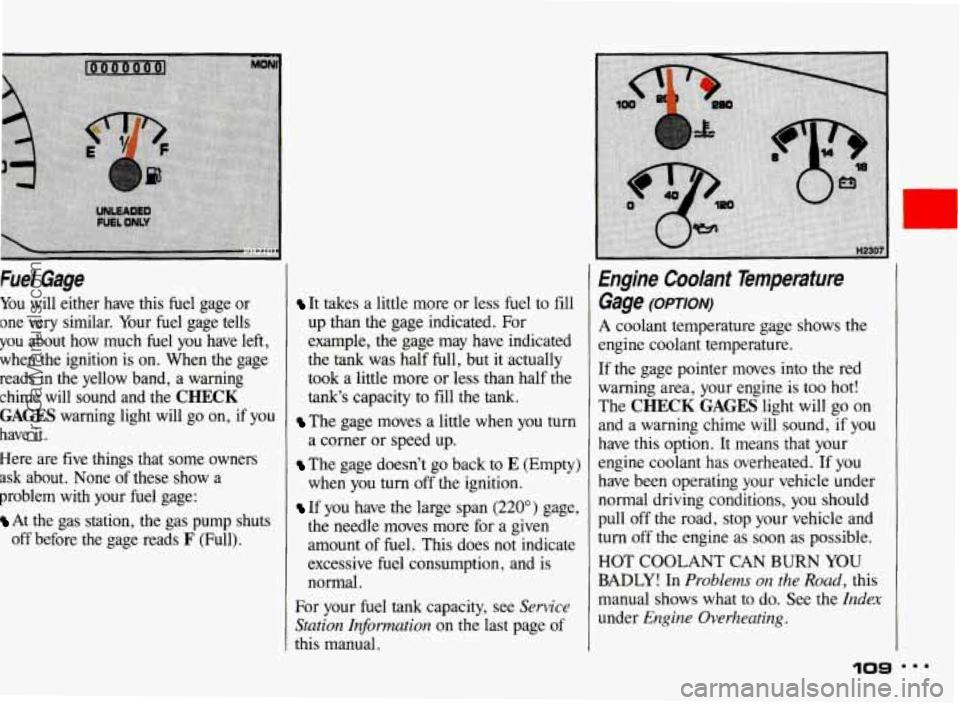
Fuel Gage
You will either have this fuel gage or
one very similar. Your fuel gage tells
you about how much fuel you have left,
when
the ignition is on. When the gage
reads in the yellow band, a warning
chime will sound and the
CHECK
GAGES warning light will go on, if you
have it.
Here are five things that some owners
ask about. None of these show a
problem with your fuel gage:
At the gas station, the gas pump shuts
off before the gage reads
F (Full).
It takes a little more or less fuel to fill
up than the gage indicated. For
example, the gage may have indicated
the
tank was half full, but it actually
took a little more or less than half the
tank's capacity to fill the tank.
The gage moves a little when you turn
a corner or speed up.
The gage doesn't go back to E (Empty)
when you turn off the ignition.
If you have the large span (220") gage,
the needle moves more for a given
amount
of fuel. This does not indicate
excessive fuel consumption, and is
normal.
For your fuel
tank capacity, see Sewice
Station Informution
on the last page of
this manual.
Engine Coolant Temperature
Gage
(OPTION)
A coolant temperature gage shows the
engine coolant temperature.
If the gage pointer moves into the red
warning area, your engine is too hot!
The
CHECK GAGES light will go on
and a warning chime will sound, if you
have this option. It means that your
engine coolant has overheated. If you
have been operating your vehicle under
normal driving conditions, you should
pull off the road, stop your vehicle and
turn off
the engine as soon as possible.
HOT COOLANT CAN
BURN YOU
BADLY! In Problems on the Road, this
manual shows what to do. See the
Index
under Engine Overheating.
10s
ProCarManuals.com
Page 121 of 322
Comfort Controls & Audio Systems ~ ~~
I
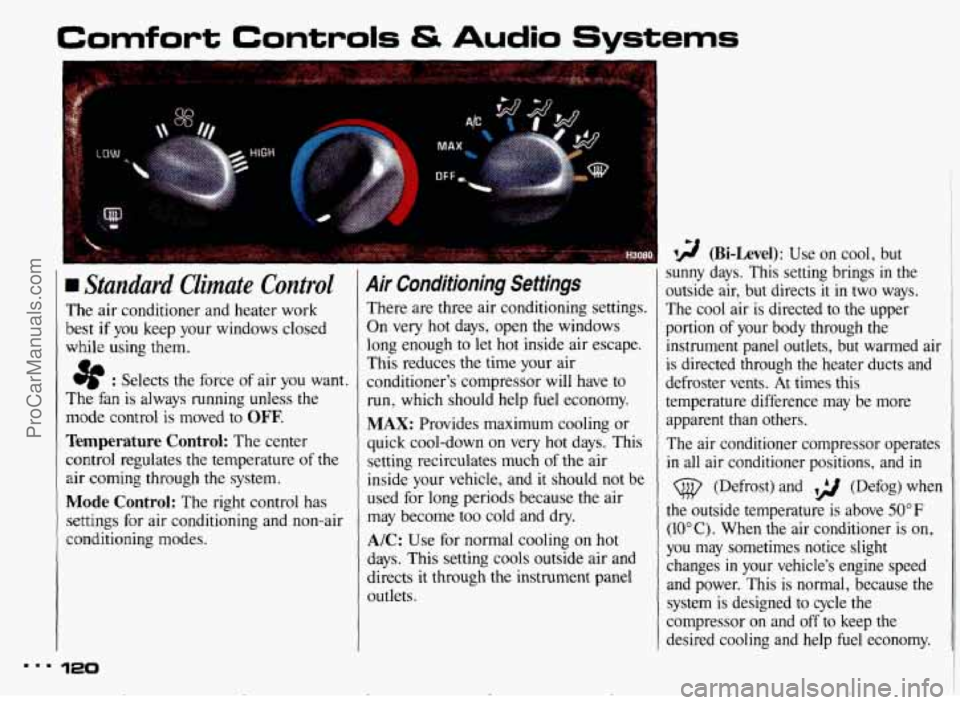
Standard Climate Control
The air conditioner and heater work
best
if you keep your windows closed
while using them.
e : Selects the force of air you want.
The fan is always running unless the
mode control
is moved to OFF.
Temperature Control: The center
control regulates the temperature
of the
air coming through the system.
Mode Control: The right control has
settings for air conditioning and non-air
conditioning modes.
120
Air Conditioning Settings
There are three air conditioning settings.
On very hot days, open the windows
long enough to let hot inside air escape.
This reduces the time your air
conditioner's compressor
will have to
run, which should help fuel economy.
MAX: Provides maximum cooling or
quick cool-down on very hot days. This
setting recirculates much
of the air
inside your vehicle, and it should not be
used for long periods because
the air
may become too cold and dry.
A/C: Use for normal cooling on hot
days. This setting cools outside air and
directs it through the instrument panel
outlets.
I 9 (Bi-Level): Use on cool, but
sunny days. This setting brings
in the
outside air, but directs
it in two ways.
The cool air
is directed to the upper
portion
of your body through the
instrument panel outlets, but warmed air
1
is directed through the heater ducts and ~
defroster vents. At times this
temperature difference may be more
apparent than others.
The air conditioner compressor operates
in all air conditioner positions, and in
(@ (Defrost) and ,> (Defog) when
the outside temperature is above 50°F
(IOOC). When the air conditioner is on,
you may sometimes notice slight
changes
in your vehicle's engine speed
and power. This is normal, because the system
is designed to cycle the
compressor on and off to keep the
desired cooling and help fuel economy.
I
c ProCarManuals.com
Page 184 of 322

Towing a Tmiler
I
If you don't use the correct
equipment and drive properly,
you can lose control when you pull
a trailer. For example, if the trailer
is too heavy, the brakes may not
work well-or even at all. You and
your passengers could be seriously injured. Pull a trailer only if you
have followed all the steps in this
section.
NOTICE
I I; Pulling a trailer improperly can : __
damage your vehicle and result in' ;'
costly repairs not covered by your
follow the advice in this section.
Your Pontiac can tow a trailer, unless it
is equipped with the
3800 Supercharged
Engine (Code
1). Do not attempt to tow
a trailer
if equipped with the 3800
Supercharged Engine (Code 1). To
identify what the vehicle trailering
capacity is for your vehicle,
you should
read the information in
Weight of the
Trailer that appears later in this section.
But trailering is different than just
driving your vehicle by itself. Trailering
means changes in handling, durability,
and fuel economy. Successful, safe trailering
takes correct equipment, and it
has to be used properly.
That's the reason for this section.
In it
are many time-tested, important
trailering tips and safety rules. Many
of
these are important for your safety and
that of your passengers.
So please read
this section carefully before you pull a
trailer.
Load-pulling components such as the
engine, transaxle, wheel assemblies, and
tires are forced to work harder against
the drag of the added weight. The engine
is required to operate at relatively higher
speeds and under greater loads, generating
extra heat. What's more, the trailer adds
considerably to wind resistance,
increasing the pulling requirements.
ProCarManuals.com
Page 222 of 322
Part 6
I .
COO25
Here you will find information
about the care of your Pontiac
. This
part begins with service and fuel
information. and then it
shows how
to check important fluid and
lubricant levels
. There is also
technical information about your
vehicle. and
a section devoted to its
appearance care
.
Service G Appearance Care
Service ............................. .................. 222
Fuel
......................................................... 222
Engineoil
...................................................... 231
HoodRelease
.................................................... 227
Aircleaner
..................................................... 233
TransaxleFluid
.................................................. 236
Enginecoolant
.................................................. 238
Power Steering Fluid
.............................................. 242
Windshield Washer Fluid
........................................... 242
Bulb Replacement
.............................................. 246
Loading Your Vehicle
............................................. 248
Appearance Care
................................................. 257
Vehicle Identification Number (VIN)
................................. 264
Add-on Electrical Equipment
....................................... 265
Fuses
& Circuit Breakers ........................................... 266
Capacities
& Specifications ......................................... 270
Normal Maintenance Replacement Parts
............................... 271
Fluids
& Lubricants ............................................... 272
Replacement Bulbs
................................................ 273
Brakes
......................................................... 243
Battery
.......................................................... 245
Windshield Wiper Blade Replacement
...................... ....... 248
Tires
.......................................................... 250
221 ...
ProCarManuals.com
Page 225 of 322

Service & Appearance Care
:#el (CONTI
Fuel that is more than 5 %
methanol is bad for your vehicle.
Don’t use it. It can corrode metal
parts
in your fuel system and also
damage plastic and rubber parts.
That damage wouldn’t be covered
under your warranty. And even at
5% or less, there must be
“cosolvents” and corrosion
preventers
in this fuel to help avoid
these problems.
bel Capacity: 18 U.S. Gallons (68 L).
Ise unleaded fuel only.
Gasolines for Cleaner Air
Your use of gasoline with detergent
additives will help prevent deposits from
forming
in your engine and fuel system.
That helps keep your engine in tune and
your emission control system working
properly. It’s good for your vehicle, and
you’ll be doing your part for cleaner air.
Many gasolines are now blended with
materials called oxygenates. General
Motors recommends that you use
gasolines with these blending materials, such as MTBE and ethanol. By doing
so, you can help clean the air, especially
in those pa@ of the country that have
high carbon monoxide levels. In
addition, some gasoline suppliers are
now producing reformulated gasolines.
These gasolines are specially designed
to reduce vehicle emissions. General
Motors recommends that you use
reformulated gasoline. By doing
so, you
can help clean the air, especially in
those parts of the country that have high
ozone levels.
You should ask your service station
operators
if their gasolines contain
detergents and oxygenates, and if they
have been reformulated to reduce
vehicle emissions.
ProCarManuals.com
Page 227 of 322

Service & Appearance Care
Filling Your Tank
The cap is behind a hinged door on the
left side of your vehicle.
Gasoline vapor is highly
flammable. It burns violently,
and that can cause very bad
I injuries. Don’t smoke if you’re
ar gasoline or refueling your
vehicle. Keep sparks, flames, and
smoking materials away from
gasoline.
I
To take off the cap, turn it slowly to the
left (counterclockwise), While refueling, hang
the cap inside the
fuel door.
I
A If you get gasoline on you and
L then something ignites it, you
L.udd be badly burned. Gasoline
can spray out on you if you open
the fuel filler cap too quickly. This
spray can happen if your tank is
nearly
full, and is more likely in
hot weather. Open the fuel filler
cap slowly and wait for any “hiss”
noise to stop. Then unscrew the
cap all the way.
When you put the cap back on, turn
it to
the right until you hear a clicking noise.
m.. 226
If you need a new cap, be sure to
get the right type. Your dealer
get one for you. If you get the
wrong type,
it may not fit or have
proper venting, and your fuel tank
and emissions system
might be
damaged.
ProCarManuals.com
Page 232 of 322

Engine Oil
It’s a good idea to check your engine oil
every time you get fuel. In order to get
an accurate reading, the oil must be
warm and the vehicle must be on level
ground. Turn off the engine and give the
oil
a few minutes to drain back into the
oil pan. If you don’t, the oil dipstick
might
not show the actual level.
To Check Engine Oil:
Pull out the dipstick and clean it with a
paper towel or cloth, then push
it back
in all the way. Remove it again, keeping
the tip lower.
When to Add Oil:
If the oil is at or below the ADD line,
then you’ll need
to add some oil. But
you must use the right kind. This section explains what kind of oil to use.
For crankcase capacity, see the
Zr.z&x
under Capacities & Specijicatiow.
Don’t add too much oil. If your
engine has
so much oil that the oil
level gets above the cross-hatched
area that shows the proper
operating range, your engine could
be damaged.
I
Just fill it enough to put the level
somewhere
in the proper operating
range. Push
the dipstick all the way
back
in when you’re through.
231
ProCarManuals.com
Page 249 of 322

Service & Appearance Care
Windshield Wiper Blade
Replacement
Replacement blades come in different
types and are removed
in different ways.
Here’s how to remove the type with a
release clip:
1. Pull the windshield wiper arm away
2. Lift the release clip with a
from
the windshield.
screwdriver and pull the blade
assembly off the wiper arm.
the wiper arm.
3. Push the new wiper blade securely on
Loading bur Vehicle
Two labels on your vehicle show how
much weight it may properly carry. The
Tire-Loading Information label found on
the rear edge of the driver’s door tells
you the proper size, speed rating and
recommended inflation pressures for the
tires on your vehicle. It also gives you
important information about the number
of people that can be in your vehicle and
the total weight that you can carry. This
weight is called the Vehicle Capacity
Weight and includes the weight of all
occupants, cargo, and all nonfactory-
installed options.
The other label is the Certification
label,
also on the rear edge of the
driver’s door. It tells you the gross
weight capacity of your vehicle, called the
GVWR (Gross Vehicle Weight
Rating). The GVWR includes the
weight of the vehicle, all occupants, fuel
and cargo. Never exceed the GVWR for
your vehicle, or
the Gross Axle Weight
Rating (GAWR) for either the front or
rear axle.
And, if you do have a heavy load,
you
should spread it out. Don’t carry more
than
176 lbs. (80 kg) in your trunk.
On vehicles equipped with electronic
level control, the rear of the vehicle
is
automatically kept level as you load or
unload your vehicle.
... 248
ProCarManuals.com