1993 PONTIAC BONNEVILLE windshield wipers
[x] Cancel search: windshield wipersPage 8 of 322
r
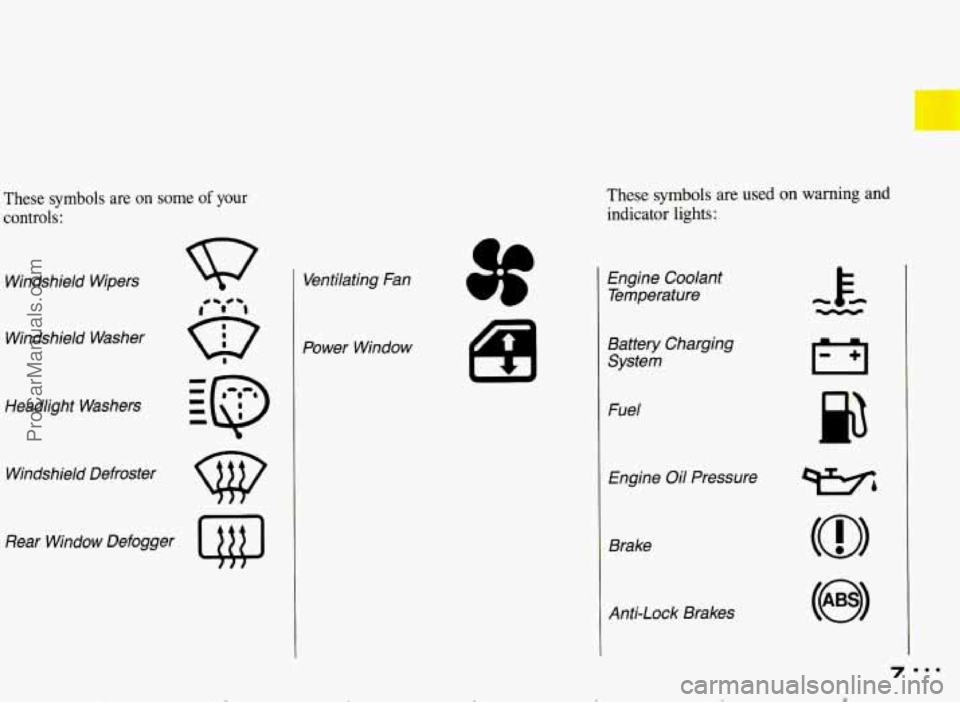
These symbols are on some of your
controls:
Windshield Wipers
Windshield Washer
Headlight Washers
Windshield Defroster
Rear Window Defogger
Q@
Ventilating Fan
Power Window
These symbols are used on warning and
indicator lights:
L
I
a
Engine Coolant Temperature
Battery Charging System
Fuel
Engine
Oil Pressure
Brake
Anti-Lock Brakes
ProCarManuals.com
Page 46 of 322
... Part 2
Features & Controls
Here you can learn about the
many standard and optional features
on your Pontiac. and information on
starting. shifting and braking
. Also
explained are the instrument panel
and the warning systems that tell
you
if everything is working
properly-and what to do
if you have
a problem
.
Keys ............................................................ 46
Locks
........................................................... 47
Remote Keyless Entry
.............................................. 48
GloveBox
....................................................... 56
Ignitionswitch ................................................... 57
StartingYourEngine
............................................... 58
Shifting the Transaxle
............................................. -61
ParkingBrake .................................................... 67
Shifting into Park
........ ...................................... 68
Windows ........................................................ 73
Turn SignaUHeadlight Beam Lever
.................................... 73
Windshield Wipers
................................................. 75
Windshield Washer
................................................ 76
CruiseControl
.................................................... 77
Lightcontrols
.................................................... 81
Interior Lights .................................................... 84
Mirrors
......................................................... 86
Sunroof ......................................................... 89
Ashtrays and Lighter
.............................................. -91
Instrument Panel ................................................... 94
Warning Lights, Gages and Indicators
.................................. 99
Gages
.......................................................... 108
Driver Information Center .......................................... 111
Electronic Compass ............................................... 113
Head-Up Display ............................................... 116
ProCarManuals.com
Page 74 of 322
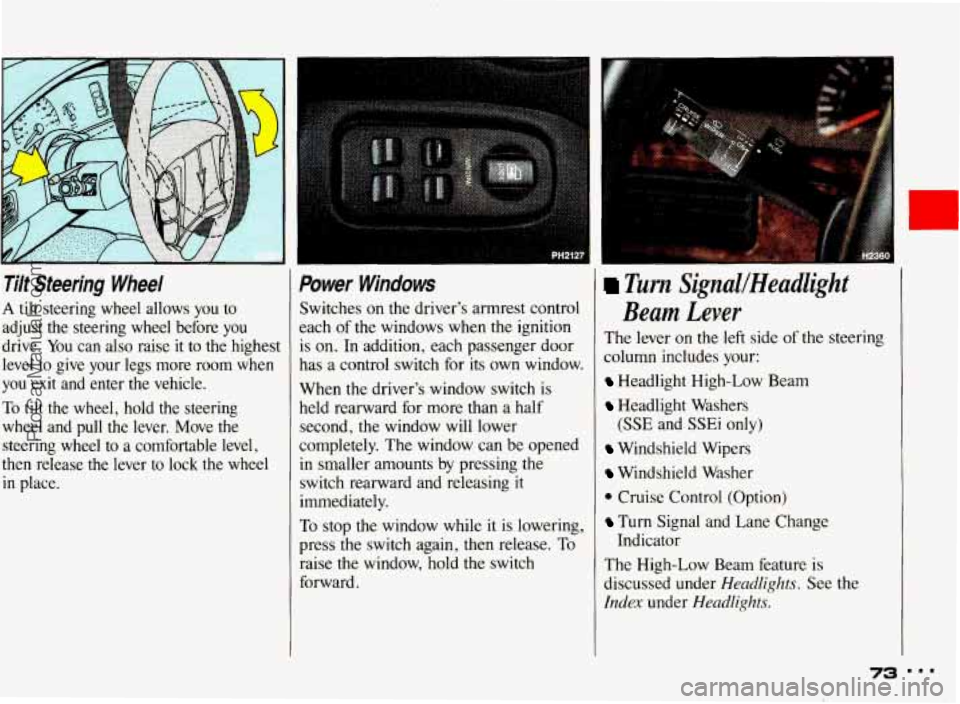
Tilt Steering Wheel
A tilt steering wheel allows you to
adjust the steering wheel before you
drive. You can
also raise it to the highest
level to give your legs more room when
you
exit and enter the vehicle.
To tilt the wheel, hold the steering
wheel and
pull the lever. Move the
steering wheel to a comfortable level,
then release the lever
to lock the wheel
in place.
Power Windows
Switches on the driver’s armrest control
each
of the windows when the ignition
is
on. In addition, each passenger door
has a control switch for its own window.
When the driver’s window switch is
held rearward for more than a half
second, the window will lower
completely. The window can be opened
in smaller amounts by pressing the
switch rearward and releasing it
immediately.
To stop the window while it is lowering,
press the switch again, then release.
To
raise the window, hold the switch
forward.
r
Turn SignallHeadlight
Beam Lever
The lever on the left side of the steering
column includes your:
Headlight High-Low Beam
Headlight Washers
Windshield Wipers
Windshield Washer
0 Cruise Control (Option)
Turn Signal and Lane Change
The High-Low Beam feature is
discussed under
Headlights. See the
Index under Headlights.
(SSE and SSEi only)
Indicator
73 ==.
t ProCarManuals.com
Page 76 of 322
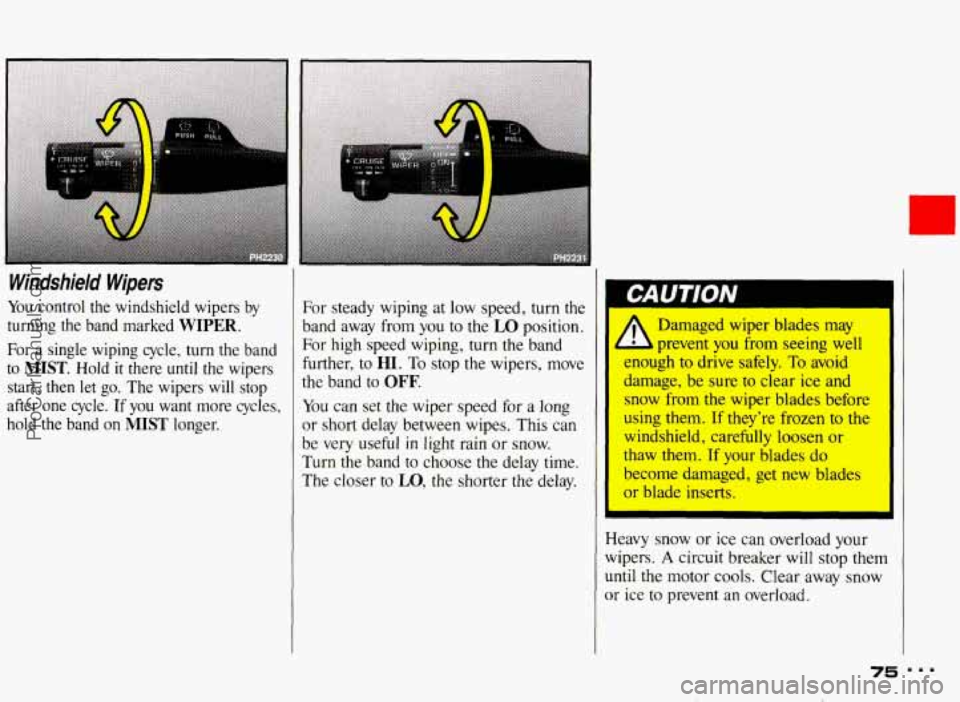
Windshield Wipers
You control the windshield wipers by
turning the band marked
WIPER.
For a single wiping cycle, turn the band
to
MIST. Hold it there until the wipers
start, then let go. The wipers will stop
after one cycle. If you want
more cycles,
hold the band on
MIST longer. For
steady wiping at low speed, turn the
band away from you
to the LO position.
For high speed wiping, turn the band
further, to
HI. To stop the wipers, move
the band to
OFF.
You can set the wiper speed for a long
or short delay between wipes. This can
be very useful in light rain or snow.
Turn the band
to choose the delay time.
The closer to
LO, the shorter the delay.
A
Damaged wiper blades may
prevent
you from seeing well
enough
to drive safely. To avoid
damage, be sure to clear ice and
snow from
the wiper blades before
using
them. If they’re frozen to the
windshield, carefully loosen
or
thaw them. If your blades do
become damaged, get new blades
or blade inserts.
Heavy snow or ice can overload your
wipers.
A circuit breaker will stop them
until the motor cools. Clear away snow
or ice to prevent an overload.
75 ...
ProCarManuals.com
Page 77 of 322
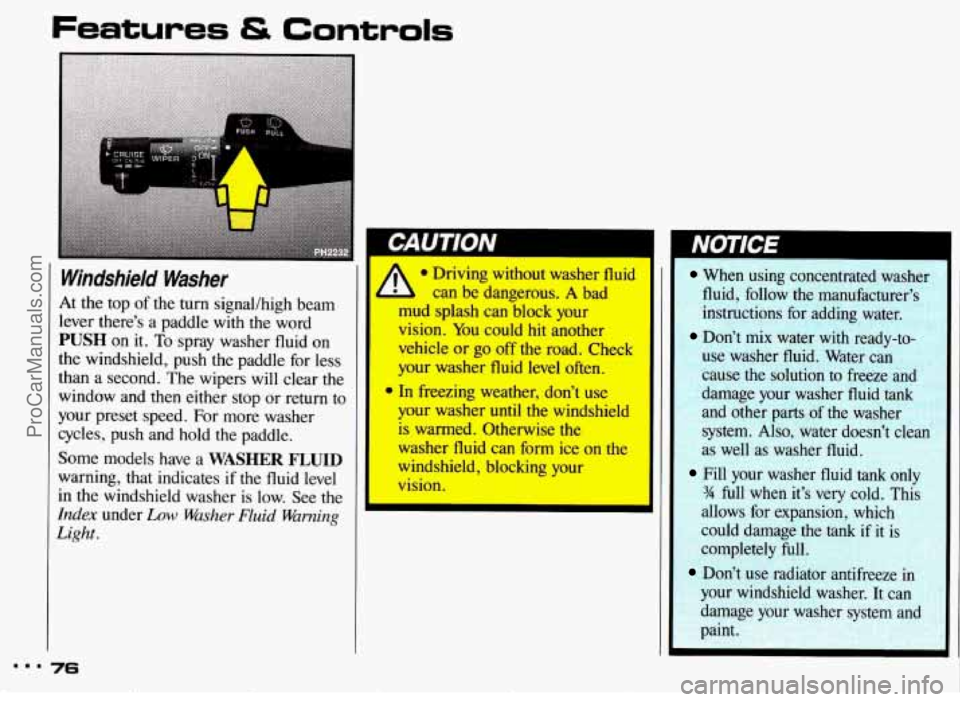
Windshield Washer
At the top of the turn signal/high beam
lever there’s a paddle with the word
PUSH on it. To spray washer fluid on
the windshield, push the paddle for less
than a second. The wipers will clear the
window and then either stop or return to
your preset speed. For more washer
cycles, push and hold the paddle.
Some models have a
WASHER FLUID
warning, that indicates if the fluid level
in the windshield washer is low. See the
Index under Low Washer Fluid Warning
Light.
When using concentrated washer
fluid, follow the manufacturer’s
instructions for adding water.
Don’t mix water with ready-to-
use washer fluid. Water can
cause the solution
to freeze an ’
damage your washer fluid tank
and other parts of the washer
system.
Also, water doesn’t clean
as well as washer fluid.
Fill your washer fluid tank only
% full when it’s very cold. This
allows for expansion, which
could damage the
tank if it is
completely full.
Don’t use radiator antifreeze in
your windshield washer. It can
damage your washer system and
paint.
Y ProCarManuals.com
Page 83 of 322
...
Features & Controls
Operation of lights '
Although your vehicle's lighting system (headlamps, parking lamps, fog lamps,
side marker lamps and tail lamps) meets
all applicable federal lighting
requirements, certain states and
provinces may apply their own lighting
regulations that may require special
attention before you operate these
lamps. For example, some jurisdictions
may require that you operate your lower
beam lamps with fog lamps at all times,
62
or that headlamps be turned on
whenever you must use your windshield wipers. In addition, most jurisdictions
prohibit driving solely with parking
lamps, especially at dawn or dusk. It is
recommended that you check with your
own state or provincial highway
authority for applicable lighting
regulations.
lights On Reminder
If you open the door while leaving the
lights on, you will hear a warning tone.
ProCarManuals.com
Page 171 of 322
Your Driving and the Road
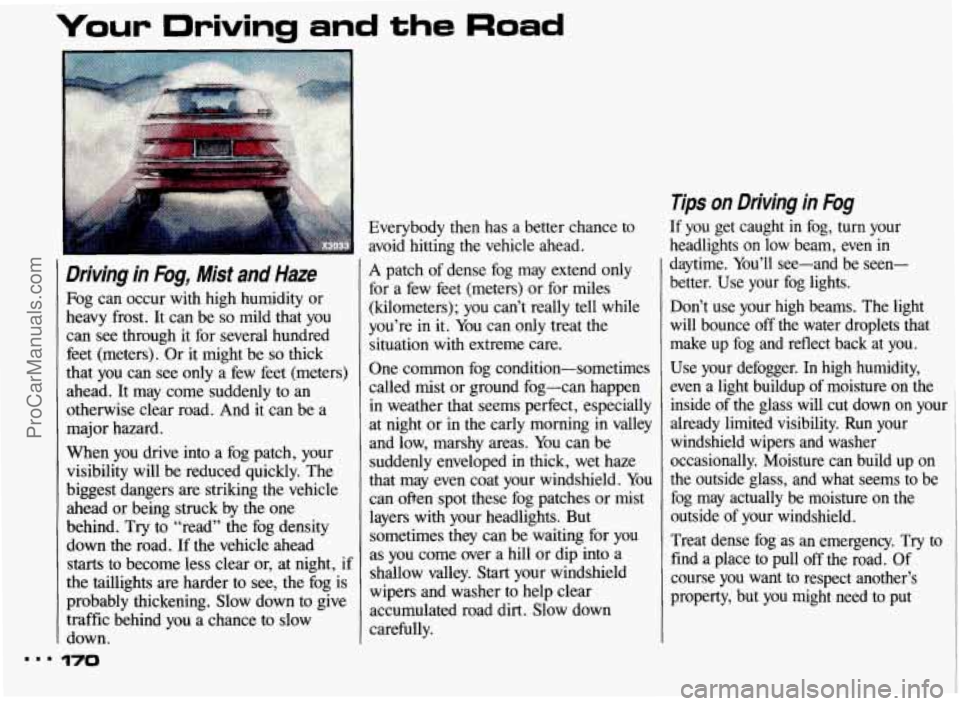
Driving in Fog, Mist and Haze
Fog can occur with high humidity or
heavy frost. It can be
so mild that you
can see through it for several hundred
feet (meters). Or it might be
so thick
that you can see only a
few feet (meters)
ahead. It may come suddenly to an
otherwise clear road. And
it can be a
major hazard.
When you drive into a fog patch, your
visibility will be reduced quickly. The
biggest dangers are striking the vehicle
ahead or being struck by the one
behind. Try to “read” the fog density
down the road. If the vehicle ahead
starts to become less clear or, at night, if
the taillights are harder to see, the fog is
probably thickening. Slow down to give
traffic behind you a chance to slow
down.
170 mm.
Everybody then has a better chance to
avoid hitting the vehicle ahead.
A patch of dense fog may extend only
for a few feet (meters) or for miles
(kilometers); you can’t really tell while
you’re
in it. You can only treat the
situation
with extreme care.
One common fog condition-sometimes
called mist or ground fog-can happen
in weather that seems perfect, especially
at night or in the early morning
in valley
and low, marshy areas. You can be
suddenly enveloped
in thick, wet haze
that may even coat your windshield. You
can often spot these fog patches or mist
layers with your headlights. But sometimes they can be waiting for you
as you come over a
hill or dip into a
shallow valley.
Start your windshield
wipers and washer to help clear
accumulated road dirt. Slow down
carefully.
Tips on Driving in Fog
If you get caught in fog, turn your
headlights on low beam, even
in
daytime. You’ll see-and be seen-
better. Use your fog lights.
Don’t use your
high beams. The light
will bounce off the water droplets that
make
up fog and reflect back at you.
Use your defogger. In
high humidity,
even a light buildup of moisture on the
inside of the glass will cut down on your
already limited visibility. Run your
windshield wipers and washer
occasionally. Moisture can build up on
the outside glass, and what seems to be
fog may actually be moisture on the
outside of your windshield.
Treat dense fog as an emergency. Try to find a place to pull off the road.
Of
course you want to respect another’s
property, but you might need to put
ProCarManuals.com
Page 270 of 322
Headlight Wiring
The headlight wiring is protected by a
circuit breaker in the light switch. An
electrical overload will cause the lights
to go on and off, or in some cases to
remain off. If this happens, have your
headlight system checked right away.
Windshield Wipers
The windshield wiper motor is protected
by a circuit breaker and a fuse. If the
motor overheats due
to heavy snow, etc.,
the wiper will stop until the motor
cools. If the overload is caused by some
electrical problem, have it fixed.
Power Windows and Other
Power Options
Circuit breakers in the fuse panel protect
the power windows and other power
accessories. When the current load is
too heavy, the circuit breaker opens and
closes, protecting the circuit until the
problem
is fixed.
ProCarManuals.com