Page 275 of 436

If You’re Stuck: In Sand,
Mud,
Ice or Snow
What you don’t want to do when your vehicle is stuck is to spin your
wheels. The method known as “rocking” can help you get o\
ut when you’re
stuck, but you must use caution.
CAUTION - --
I * If you let your tires spin at high speed, they can explode and you or
,A others could be injured. And, the transmission or other parts of the
vehicle can overheat. That could cause an engine compartment fire
or other damage. When you’re stuck, spin the wheels as little as
possible. Don’t spin the wheels above
35 mph (55 krnlh) as shown
I on the speedometer.
;pinning your wheels can destroy parts of your vehicle as well as the
res.
If you spin the wheels too fast while shifting your transmission back
.nd forth, you can destroy your transmission.
NOTICE 1
Rocking your vehicle to get it out:
First, turn your steering wheel left and right. That will clear the area around
your front wheels. Then shift back and forth between
R and a forward gear
(or with a manual transmission, between First or Second gear and Reverse),
spinning the wheels as little as possible. Release the accelerator pedal while
you shift, and press lightly on the accelerator pedal when the transmission is
in gear.
If that doesn’t get you out after a few tries, you may need to be
towed out.
Or, you can use your recovery hooks, if your vehicle has them. If
you do need to be towed out, see “Towing Your Vehicle” in the Index.
5-33
ProCarManuals.com
Page 281 of 436

Service
Your General Motors dealer knows your vehicle best and wants you to be
happy with it. We hope you’ll go to your dealer for
all your service needs.
You’ll get genuine GM parts and GM-trained and supported ser\
vice people.
We hope you’ll want to keep your GM vehicle all GM. Genuine
GM parts
have one of theqe marks:
Doing Your
If you want to
proper General
GM
Own Service Work
do some of your own service work, you’ll want to get the
.. Motors Service Manual. It tells you much more about how to
service your vehicle than this manual can.
To order the proper service
manual, see “Service Publications” in the Index.
You should keep a .record with all parts receipts and list the mileage and the
date of any service work you perform. See “Maintenance Record” \
in the
Index.
I CAUTION
AA You can be injured if you try to erv n a vehicle without
knowing enough about it.
I
Be sure you have sufficient knowledge, experience, and the
proper replacement parts and tools before you attempt any
vehicle maintenance task.
Be sure to use the proper nuts, bolts and other fasteners.
“English” and “metric” fasteners can be easily confus\
ed.
If you
use the wrong fasteners, parts can later break or fall
off. You
could be hurt.
I
6-3
ProCarManuals.com
Page 299 of 436
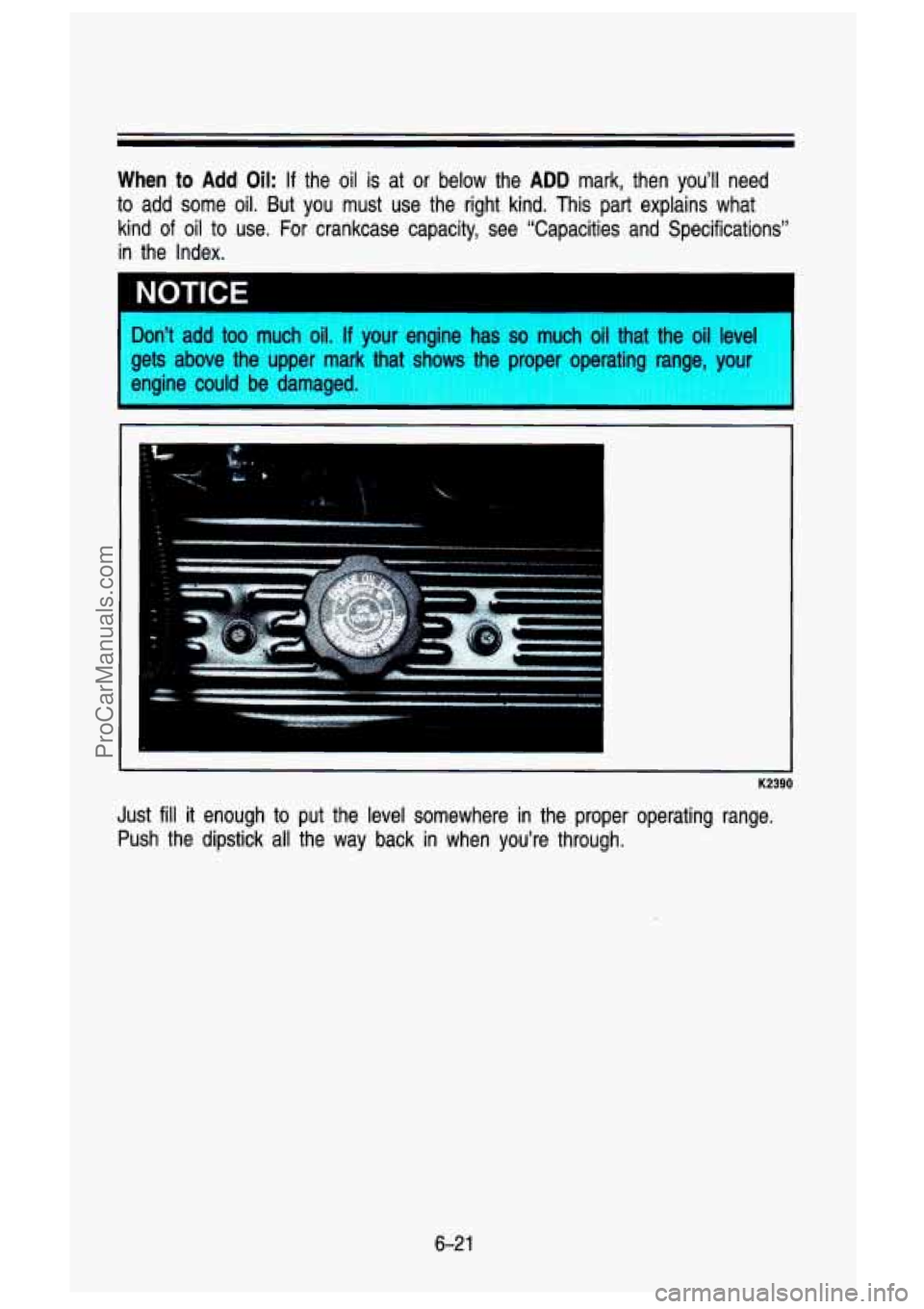
When to Add Oil: If the oil is at or below the ADD mark, then you’ll need
to add some oil. But you must use the right kind. This part explains what
kind
of oil to use. For crankcase capacity, see “Capacities and Specifications”
in the Index.
Don’t add too much
oil. If your engine has so much oil that the oil level
gets above the upper mark that shows the proper operating range, your
engine
could be damaged.
I
.I a.. ;
K2390
Just fill it enough to put the level somewhere in the proper operating range.
Push the dipstick all the way back in when you’re through.
6-2 1
ProCarManuals.com
Page 304 of 436

Service & Appearance Care
Engine Block Heater:
An engine block heater can be a big help if you have to park outside in very
cold weather,
0°F (-18°C) or colder. If your vehicle has this option, see
“Engine Block Heater” in the Index.
What to Do with Used Oil:
I CAUTION I
Used engine oil contains things that have caused skin cancer
laboratory animals. Don’t let used oil stay on your skin fo\
r very
I
Clean your skin and nails with soap and water, or a good han\
d
cleaner. Wash or properly throw away clothing or rags containin\
g
used engine oil.
Used-oil can be a real threat
to the environment. If you change your own oil,
be sure to drain all free-flowing oil from the filter before disp\
osal. Don’t ever
dispose of oil by putting it in the trash, pouring it on the ground, into sewers,
or into streams or bodies of water. Instead, recycle it by taking it to a place
that collects used
oil. If you have a problem properly disposing of your used
oil, ask your dealer, a service station or a local recycling \
center for help.
Engine Oil (Diesel Engines)
It’s a good idea to check your engine oil level every time you get fuel. In
order
to get an accurate reading, the oil must be warm and the vehicle\
must
be on level ground.
c
-
K2394
Turn off the engine and give the oil a few minutes to drain back into the oil
pan. If you don’t the
oil dipstick might not show the actual level.
6-26
ProCarManuals.com
Page 305 of 436
T-
K2613
To Check Engine Oil: Pull out the dipstick and clean it with a paper towel
or a cloth, then push it back in all the way. Remove it again, keeping the tip
lower.
When to Add Oil: If the oil is at or below the ADD line, then you’ll need to
add some oil. But you must use the right kind. This part explains what kind\
of oil to use. For crankcase capacity, see “Capacities and Spec\
ifications’’ in
the Index.
Don’t add too much oil. If your engine has so much oil that the oil level
gets above the proper operating range, your engine could
be damaged. I
I
w
ii
I
- “‘I
. ..
Ll
6 -”
i f f i
w
K2395
6-27
ProCarManuals.com
Page 309 of 436

What to Do with Used Oil:
I
I PAUTION
Used engine oil contains things that have caused skin cancer i\
n I
laboratory animals. Don’t let used oil stay on your skin fo\
r very long.
clnan your skin and nails with soap and water, or a good hand
c,,aner. Wash or properly throw away clothing or rags containing
used engine oil.
I
Used oil can be a real threat to the environment. If you change your own oil,
be sure to drain all free-flowing oil from the filter before disp\
osal. Don’t ever
dispose of
oil by putting it in the trash, pouring it on the ground, into sewers,
or into streams
or bodies of water. Instead, recycle it by taking it to a place
that collects used oil.
If you have a problem properly disposing of your used
oil, ask your dealer, a service station or a local recycling \
center for help.
Air Cleaner
I I
PO216
Refer to the Maintenance Schedule to determine when to replace \
the air
cleaner filter on diesel engines and the air cleaner filter an\
d crankcase ventilation filter on gasoline engines. See “Scheduled Mainten\
ance Services’’
in the Index.
6-3 1
ProCarManuals.com
Page 311 of 436

Automatic Transmission Fluid
When to Check and Change:
A good time to check your automatic transmission fluid level is when the
engine oil is changed. Refer
to the Maintenance Schedule to determine when
to change your fluid. See "Scheduled Maintenance Services" in the \
Index.
How to Check:
Because this operation can be a little difficult, you may choose to have this
done at a General Motors dealership Service Department.
If you
do it yourself, be sure to follow all the instructions here, or you could
get a false reading on the dipstick.
I Too much or too little fluid can damage your transmission. Too much can
nean that some of the fluid could come out and fall on hot engine parts,
itarting
a fire. Be sure to get an accurate reading if you check your
ransmission ftuid.
Wait at least
30 minutes before checking the transmission fluid level if you
have been driving:
When outside temperatures are above 90°F (32°C).
At high speed for quite a while.
In heavy traffic-especially in hot weather.
While pulling a trailer.
To get the right reading, the fluid must be at normal operating temperature,
which is 180°F
to 200°F (82°C to 93°C).
To check the transmission fluid hot: Get the vehicle warmed up by driving
about
15 miles (24 km) when outside temperatures are above 50°F (1 0°C). If
it's colder than
50°F (lO°C), drive the vehicle in D (3rd gear) until the engine
temperature gage moves and then remains steady for ten minutes. Then
follow the hot check procedures.
To check transmission fluid cold: A cold check is made after the vehicle
has been sitting for eight hours or more with the engine
off and is used only
as a reference. Let the engine run at idle for five minutes
if outside
temperatures are 50°F (10°C) or more.
If it's colder than 50°F (lO"C), you
may have
to idle the engine longer. A hot check must follow when fluid is
added during a cold check.
6-33
ProCarManuals.com
Page 313 of 436

3. Check both sides of the dipstick, and read the lower level. The fluid
level must be in the
COLD area for a cold check or in the HOT area or
cross-hatched area for a hot check.
4. If the fluid level is where it should be, push the dipstick back in all the
way; then flip the handle down to lock the dipstick in place.
How To Add Fluid:
Refer to the Maintenance Schedule to determine what kind of transmission
fluid
to use. See “Recommended Fluids and Lubricants’’ in the Index.
If the fluid level
is low, add only enough of the proper fluid to bring the level
up
to the COLD area for a cold check or the HOT area for a hot check. It
doesn’t take much fluid, generally less than a pint. Don’t overfill. We
recommend you use only fluid labeled DEXRON@IIE, because fluids \
with that
label are especially made for your automatic transmission. Damag\
e caused by
fluid other than
DEXRON@IIE is not covered by your new vehicle warranty.
After adding fluid, recheck the fluid level as described under “How To
Check”.
When the correct fluid level is obtained, push the dipstick back in all the
way; then flip the handle down
to lock the dipstick in place.
6-35
ProCarManuals.com