Page 86 of 436

CAUTION
Plugging the cord into an ungrounded outlet could cause an ele\
ctrical
shock.
Also, the wrong kind of extension cord could overheat and
cause a fire. You could be seriously injured. Plug the cord into a
properly grounded three-prong
11 0-volt outlet. If the cord won’t reach,
use a heavy-duty three-prong extension cord rated for at least \
15
amps.
1 NOTICE
1 After you’ve used the block heater, be sure to store the cord in th~~~~
manner it was, to help keep it away from moving engine parts.\
If YOU
don’t, it could be torn and damaged.
~p@&%?yl~
How long should you keep tne MOCK neater plugged in? The answer depends
on the weather, the kind
of oil ,you have, and some other things. Follow this-
chart.
,.
ENGINE BLOCK HEATER USAGE”
Viscosity . 32’ $0 0°F ’ 0’ to -10°F ‘Belaw -1 0°F
Grade Oil (0” to &I S‘C) ’ ’ (-18’ to. -23°C) (B&w -23°C)
SAE Not Two Eight Hours
I OW-30 Required Hours or Overnight
SAE . Nit ’ . Two Eight Hours
15W-40 f3equired Hours or Overnight
..
* The times listed are minimum. times. It will not harm &her
the block heater
TO1 57
or the vehicle to leave it plugged in longer than the times stated. 3
For best results in cold weather, use Number I-D diesel fuel or a “winterized”
Number
2-D fuel.
If Your Diesel Engine Won’t- Start
If you’ve run out of fuel, look -at “Running Out Of Fuel” (see ‘‘Diesel Fuel
Requirements and Fuel System”
m the Index).
If you’re not out of fuel, and your engine won’t start, do this:
Turn y6ur ignition key
to Run. .Make sure that the GLOW PLUGS light is out.
Then turn
the ignition key to Stkrt while you ‘push the accelerator pedal
down.
2-1 8
ProCarManuals.com
Page 97 of 436
Parking Brake
K2221
To set the parking brake:
Hold the regular brake pedal down with your right foot. Push down the
parking brake pedal with your left
foot. If the ignition is on, the brake system
warning light will come
on.
To release the parking brake:
Hold the regular brake pedal down. Pull the lever marked RELEASE.
Driving with the parking brake on can cause your rear brakes to overheat.
You may have to replace them, and you also da other p;
of I
your vehicle.
’ ‘
If you are on a hill:
See “Parking on Hills” in the Index. That part shows how to turn your front
wheels.
If you are towing a trailer and are parking on any hill:
See “Towing a Trailer” in the Index. That part shows what to do first to keep
the trailer from moving.
2-29
ProCarManuals.com
Page 99 of 436
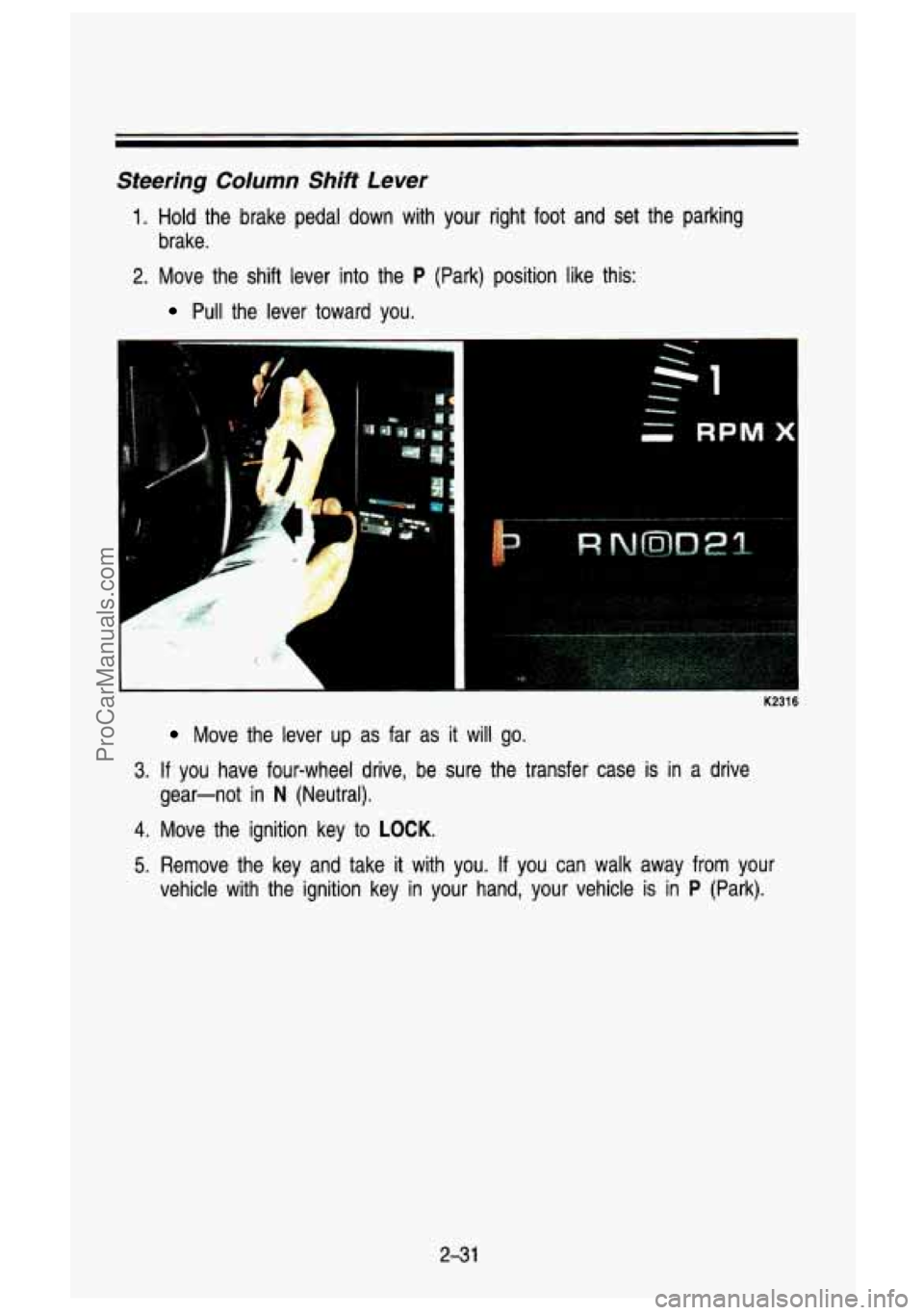
Steering Column Shift Lever
1. Hold the brake pedal down with your right foot and set the parking
brake.
2. Move the shift lever into the P (Park) position like this:
Pull the lever toward you.
~- - --
w KL" I"
Move the lever up as far as it will go.
3. If you have four-wheel drive, be sure the transfer case is in a drive
4. Move the ignition key to LOCK.
5. Remove the key and take it with you. If you can walk away from your
vehicle with the ignition key
in your hand, your vehicle is in P (Park).
gear-not
in N (Neutral).
2-31
ProCarManuals.com
Page 107 of 436
Whenever you are in four wheel-drive, the rear wheel anti-lock brake system
does not operate. The regular brake system operates normally. W\
hen you shift back into two-wheel drive, the anti-lock brake system will operate.
Windows
To open your manual windows, turn the hand crank on each door to raise or
lower your side door windows.
If you have the optional power windows, the controls are on each
of the side
doors.
The driver's door has a switch for the passenger windows as well. Your
power windows will work when the ignition has been turned to
ACC or Run.
Push the switch with the down pointing arrow to lower the window.
Push the switch with the up pointing arrow to raise the window.
2-39
ProCarManuals.com
Page 119 of 436

To Reduce Speed While Using Cruise Control
1
K2260
1. Push in the button at the end of the lever until you reach the lower
speed you want, then release it.
2. To slow down in very small amounts, push the button for less than a
half second. Each time you do this, you’ll go 1 mph (1.6 km/h) slower.
Passing Another Vehicle While Using Cruise Control
Use the accelerator pedal to increase your speed. When you take your foot
off the pedal, your vehicle will slow down to the Cruise Control speed you set
earlier.
Using Cruise Control on Hills
How well your Cruise Control will work on hills depends upon \
your speed,
load, and the steepness of the hills. When going up steep hills, you may
have to step on the accelerator pedal to maintain your speed. When going
downhill, you may have to brake or shift to a lower gear to keep your speed
down.
Of course, applying the brake takes you out of Cruise Control. Many
drivers find this to be too much trouble and don’t use Cruise Control on
steep hills.
When you turn
off the Cruise Control or the ignition, your Cruise Control set
speed memory
is erased.
2-5 1
ProCarManuals.com
Page 122 of 436

Push the right side of the switch with the 0 symbol on it to turn off your
lights.
Turn the dial at the right of the
off switch to adjust interior lights. Turning the
dial
all the way up turns on the interior lights.
You can switch your headlights from high to low beam by pulling o\
n the turn
signal/high beam lever.
A circuit breaker protects your headlights. If you have an electrical overload,
your headlights will flicker on and
off. Have your headlight wiring checked
right away
if this happens.
Headlights-On Reminder
A buzzer will sound when your headlights are turned on and your ignition is
in Off, LOCK or Acc.
Fog Lamps
Use your optional fog lamps for better vision in foggy or misty conditions.
Your fog lamps will operate with your low beam headlights or parking li\
ghts
on,
and go off when the high beam headlamps are on. Switching to low
beam headlights or parking lights will let you use the fog la\
mps again.
The fog lamp switch is on the instrument panel below the heating controls.
Press the side of the switch with the fog lamp symbol on
it to turn the fog
lamps on, and the left side of the switch
to turn them off. A light will glow in
the left side of the switch when they are on.
K2294
Remember, fog lamps alone will not give off as much light as your headlights.
Never use your fog lamps in the dark without turning on your headlights.
2-54
ProCarManuals.com
Page 123 of 436

Daytime Running Lights (DRL) Indicator Light (Canada Only)
K2318
If your vehicle was first sold, when new, in Canada, you will have this light on
the instrument panel. It goes on whenever the Daytime Running \
Lights are on.
Daytime Running Lights (Canada Only)
The Canadian Federal Government has decided that “Daytime Run\
ning
Lights” (DRL) are a useful feature, in that
DRL can make your vehicle more
visible to pedestrians and other drivers during daylight hours. DRL are
required on new vehicles sold in Canada.
The high beam headlights will come on at reduced brightness in daylight
when:
The ignition is on
The headlight switch is off, and
The parking brake is released
When you turn on your headlights, the DRL
will switch off and the exterior
lights will come on. When you turn
off the headlights, the exterior lights will
go out and the high beam lights will switch to the reduced brightness
of DRL
again. The DRL indicator light on the instrument panel will go\
on whenever
the DRL are on. This light means that only the DRL are on. When you turn
on your exterior lights, this light will go out.
Of course, you may still turn on
the headlights any time you need to.
To idle your vehicle with the DRL off, set the parking brake. The DRL will
stay
off until you release the parking brake.
2-55
ProCarManuals.com
Page 146 of 436
.
If you have the Sport Performance Model (RPO B4U), your")
Features & Controls
Tachometer
If you have a tachometer, it displays the engine speed in revolut\
ions per
minute (rpm).
If you have the Sport Performance Model (RPO B4U), your tachometer
reading will go
to 6,000 RPM.
'I I Do not operate the engine with the tachometer in the red area, your
engine
or other parts could be damagec' I
Damage to your engine or vehicle caused by operating the engine in 1
red area isn't covered by your vehicle warranty.
Warning and lndicator Lights
This section describes the warning lights and gages that are o\
n your vehicle.
The pictures
will help you locate them.
Warning lights and gages can signal that something is wrong be\
fore
it
becomes serious enough to cause expensive repair or replacement. Paying
attention
to your warning lights and gages could also save you or others from
injury.
Warning lights go on when there may be or
is a problem with one of your
vehicle's functions.
As you will see in the details on the next few pages,
some warning lights come on briefly when you turn the ignition\
key just
to let
2-78
ProCarManuals.com