Page 185 of 339

Following Distance
Stay at least twice as far behind the
vehicle ahead as you would when
driving your vehicle without a trailer.
This can help you avoid situations that
require heavy braking and sudden turns.
Passing
You’ll need more passing distance up
ahead when you’re towing a trailer.
And, because you’re a good deal longer,
you’ll need to
go much farther beyond
the passed vehicle before you can return
to your lane.
Backing Up
Hold the bottom of the steering wheel
with one hand. Then, to move the trailer
to the left, just move that hand to the
left.
To move the trailer to the right,
move your hand to the right. Always
back up slowly and, if possible, have
someone guide you.
Making Turns
When you’re turning with a trailer,
make wider turns than normal.
Do this
so your trailer won’t strike soft
shoulders, curbs, road signs, trees, or
other objects. Avoid jerky
or sudden
maneuvers. Signal well in advance.
Turn Signals When Towing a Trailer
When you tow a trailer, your vehicle
has to have a different turn signal
flasher and extra wiring. The green
arrows on your instrument panel will
flash whenever you signal
a turn or lane
change. Properly hooked up, the trailer
lights will also flash telling other drivers
you’re about
to turn, change lanes, or
stop.
When towing a trailer, the green arrows
on your instrument panel will flash for
turns even if the bulbs on the trailer are
burned out. Thus, you may think drivers
behind you are seeing your signal when
ProCarManuals.com
Page 198 of 339

Problems on the Road
10. Now start the vehicle with the good
battery and
run the engine for
awhile.
dead battery.
If it won't start after a few tries, it
probably needs service.
11. Try to start the vehicle with the
I
I-
12. Remove the cables in reverse order
to prevent electrical shorting. Take
care that they don't touch each
other or any other metal.
A. Heavy Metal Engine Part
B. Good Battery
C. Dead Battery
r
L
Towing Your Vehicle
Try to have a GM dealer or a
professional towing service tow your
Geo. The usual towing equipment is
a
sling-type (A) or a wheel-lift (B) or car
carrier
(C) tow truck.
If your vehicle has been changed or
modified since it was factory-new by
adding aftermarket items like fog lamps,
aero skirting, or special tires and
wheels, these instructions and
illustrations may not be correct.
Before you
do anything, turn on the
hazard warning flashers.
When you call, tell the towing service:
A dolly must be used when towing
from the front.
ProCarManuals.com
Page 210 of 339

Problems on the Road
Zf a Tire Goes Hut
Then replace the pressure cap. Be
sure
the ears on the pressure cap line
up like
this.
9 208
It’s unusual for a tire to “blow out’’
while you’re driving, especially
if you
maintain your tires properly. If air goes
out of a tire, it’s much more likely to
leak out slowly. But if you should ever
have a “blowout,
” here are a few tips
about what to expect and what to do:
If a front tire fails, the flat tire will
create a drag that pulls the vehicle
toward that side. Take your foot off the
accelerator pedal and grip the steering
wheel firmly. Steer to maintain lane
position, then gently brake to a stop well
out of the traffic lane.
A rear blowout, particularly on a curve,
acts much like a skid and may require
the same correction you’d use
in a skid. In any
rear blowout, remove your
foot
from the accelerator pedal. Get the
vehicle under control by steering
the
way you want the vehicle to go. It may
be
very bumpy and noisy, but you can
still steer. Gently brake to a stop, well
off the road
if possible.
If your tire goes flat, the next section
shows how to use your jacking
equipment to change a flat tire safely.
ChanginQ a Flat lire
If a tire goes flat, avoid further tire and
wheel damage by driving slowly to a
level place. Turn
on your hazard
warning flashers.
..
ProCarManuals.com
Page 211 of 339
CAUTION
A
Changing a tire can cause an injury. The vehicle can slip off the jack
and roll over you or other people. You and they could be badly injured.
Find a level place to change your tire.
To help prevent the vehicle from
moving:
1. Set the parking brake firmly.
2. Put the shift lever in P (Park).
3. Shift a manual transmission to 1 (First) or R (Reverse).
4. If you have a four-wheel-drive vehicle, be sure the transfer case is in a
5. Turn off the engine.
To be even more certain the vehicle won’t move, you can put chocks at the
front and rear of the tire farthest away from the one being changed. That
would be the tire on the other side of the vehicle, at the opposite end.
drive gear
- not in N (Neutral).
I The following steps will tell
you how to use the jack and change a tire. The
equipment you’ll need
is under the
front seats.
The jack and wheel wrench are under
the passenger’s seat.
209 =
ProCarManuals.com
Page 215 of 339
c
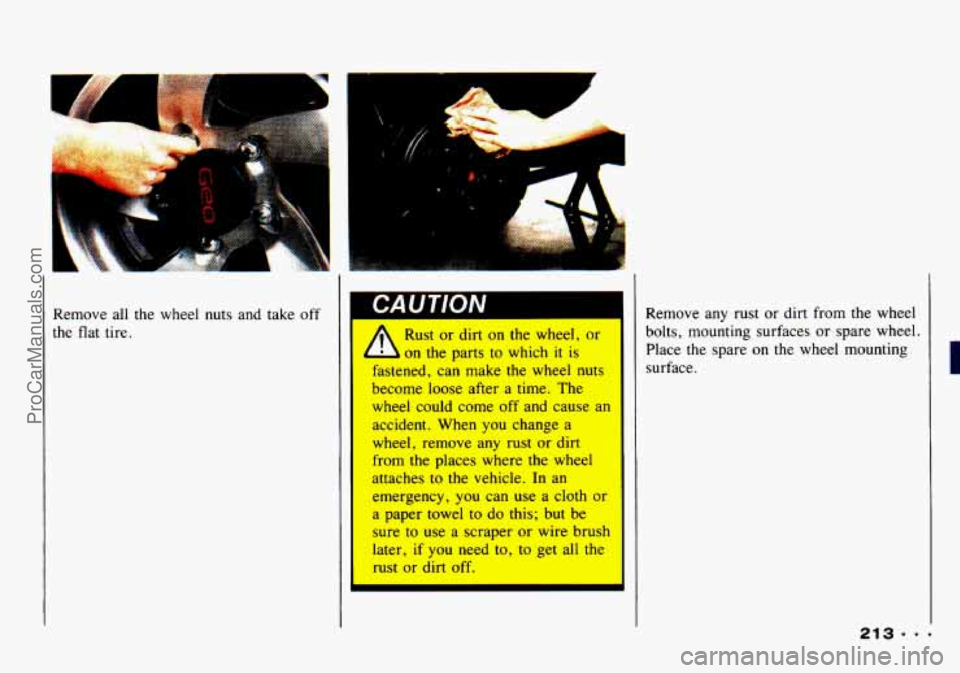
Remove all the wheel nuts and take off
the
flat tire.
r '_ .-
Rust or dirt on the wheel, or
on the parts to which it is
fastened, can make the wheel nuts
become loose after a time. The
wheel could come off and cause an
accident. When you change a
wheel, remove any rust or dirt
from the places where the wheel
attaches
to the vehicle. In an
emergency, you can use a cloth or
a paper towel to do this; but be
sure to use a scraper or wire brush
later, if you need to, to get all the
rust or dirt off.
- =
Remove any rust or dirt from the wheel
bolts, mounting surfaces or spare wheel.
Place the spare on the wheel mounting
surface.
ProCarManuals.com
Page 241 of 339

What to Use:
Refer to the Maintenance Schedule to
determine what kind of lubricant to use.
See “Recommended Fluids and
Lubricants” in the Index.
Four- Wheel Drive
Most lubricant checks in this section
also apply to four-wheel-drive vehicles.
However, they have two additional
systems that need lubrication.
Transfer Case
When to Check
and Change
Lubricant:
Refer to the Maintenance Schedule to
determine how often to check the
lubricant and when
to change it. See
‘ ‘Scheduled Maintenance Services’ ’ in
the Index.
How to Check Lubricant: If the level
is below the bottom of the filler plug
hole, you’ll need to add some lubricant.
Add enough lubricant to raise the level
to the bottom of the filler plug hole.
What to Use:
Refer to the Maintenance Schedule to
determine what kind of lubricant to use.
See “Recommended Fluids and
Lubricants” in the Index.
Front Axle
When
to Check and Change
Lubricant:
Refer to the Maintenance Schedule to
determine how often to check the
lubricant, and when to change it. See
“Periodic Maintenance Inspections” and
“Scheduled Maintenance Services”
in
the Index.
ProCarManuals.com
Page 258 of 339

Service & Appearance Care
I
- 256
If your spare wheel does not match your
other wheels, you may want to use this
pattern.
After the tires have been rotated, adjust
the front and rear inflation pressure as
shown
on the Tire-Loading Information
label. Make certain that all wheel nuts
are properly tightened. See “Wheel Nut
Torque’’ in the Index.
CA U TION
A
Rust or dirt on a wheel, or on
the parts
to which it is
fastened, can make the wheel nuts
become loose after a time. The
wheel could come off and cause an
accident. When you change a
wheel, remove any rust or dirt
from places where the wheel
attaches to the vehicle. In an
emergency, you can use
a cloth or
paper towel to
do this; but be sure
to use a scraper or wire brush
later,
if you need to, to get all the
rust or dirt
off. (See “Changing a
Flat Tire” in the Index.)
I
When It’s Time for New Tires
One way to tell when it’s time for new
tires is to check the treadwear
indicators, which will appear when your
tires have only
2/32 inch (1.6 mm) or
less of tread remaining.
You need a new tire if
You can see the indicators at three
You can see cord or fabric showing
The tread or sidewall is cracked, cut
places around
the tire.
through the tire’s rubber.
or snagged deep enough to show cord
or fabric.
ProCarManuals.com
Page 280 of 339

Service & Appearance Care
Capacities (Approximate)
The following approximate capacities are given in U.S. and metric conversions.
Automatic Transmission Air
Conditioning?.
................ .See the refrigerant information label under hood.
.............................................
................................................... Drain and Refill .3.0 qt. (2.8 L)**
Overhaul .4.9 qt. (4.6 L)
Cooling System
Automatic Transmission. ...................................... S.5 qt. (5.2 L)
I Manual Transmission. ........................................ S.6 qt. (5.3 L)
FuelT ank....................................................llgal.(42.0L) .
Crankcase
..........................................
........................................
With Filter Change. .4.5 qt. (4.2 L)*
Without Filter Change .4.2 qt. (4.0 L)*
Front Differential ............................................... 1 1 qt. (1 .O L)
Manual Transmission. .1.6 qt. (1.5 L)**
Rear Differential. .2.3 qt. (2.2 L)
Transfer Case .................................................. 1 .8 qt. (1.7 L)
..........................................
..............................................
Wheel Nuts
Wheel Nut Torque .60 lb. ft. (80 N-m)
? Not all air conditioning refrigerants are the same. If the air conditioning system in
your vehicle needs refrigerant, be sure
the proper refrigerant is used. If you’re not
sure, ask your Geo dealer.
after filling.
See “Engine Oil” in the Index.
Transmission Fluid” in the Index.
.........................................
*.When changing the oil filter, additional oil may be needed. Recheck the oil level
** Recheck fluid level after filling. See “Automatic Transmission Fluid” or “Manual
9 278
ProCarManuals.com