1993 CHEVROLET TRACKER brake
[x] Cancel search: brakePage 64 of 339

Features & Controls
1. Hold the brake pedal down with your
right foot and set the parking brake.
2. Move the shift lever into the P (Park)
position like this:
Hold in the button on the lever,
and push the lever all the way
toward the front of your vehicle.
3. If you have four-wheel drive, be sure
the transfer case is in a drive gear
-
not in N (Neutral).
4. Move the ignition key to LOCK.
5. Remove the key and take it with you.
If you can walk away from your
vehicle with the ignition key in your
hand, your vehicle is
in P (Park).
Leaving Your Vehide with the
Engine Running
(AUTOMATIC TRANSMISSION)
A It can be dangerous to leave
your vehicle with the engine
running. Your vehicle could move
suddenly if the &ifl lever is not
fully in P (Park) with the parking
brake firmly set.
If you have f0.w-wheel drive and
your -fer we is. in
N (Neutral), your vehicle will be
free to roll, even if your shift lever
is in P (Park). So be sure the
transfer case is in a drive gear -
not in N (Neutral).
And, if you leave the vehicle with
the
engine running, it could
overheat and even catch fire. You
or others could be injured. Don't
leave your vehicle with the engine
running unless you have to.
If you have to leave your vehicle with
the engine running, be sure your vehicle
is in
P (Park) and your parking brake is
firmly set before you leave
it. If you
have four-wheel drive, be sure that the
transfer case is in a drive gear
- not in
N (Neutral). After you've moved the
shift lever into the
P (Park) position,
hold the regular brake pedal down.
Then, see if you can move the shift
lever away from
P (Park) without first
pushing the button. If you can, it means
that the shift lever wasn't fully locked
into
P (Park).
ProCarManuals.com
Page 65 of 339
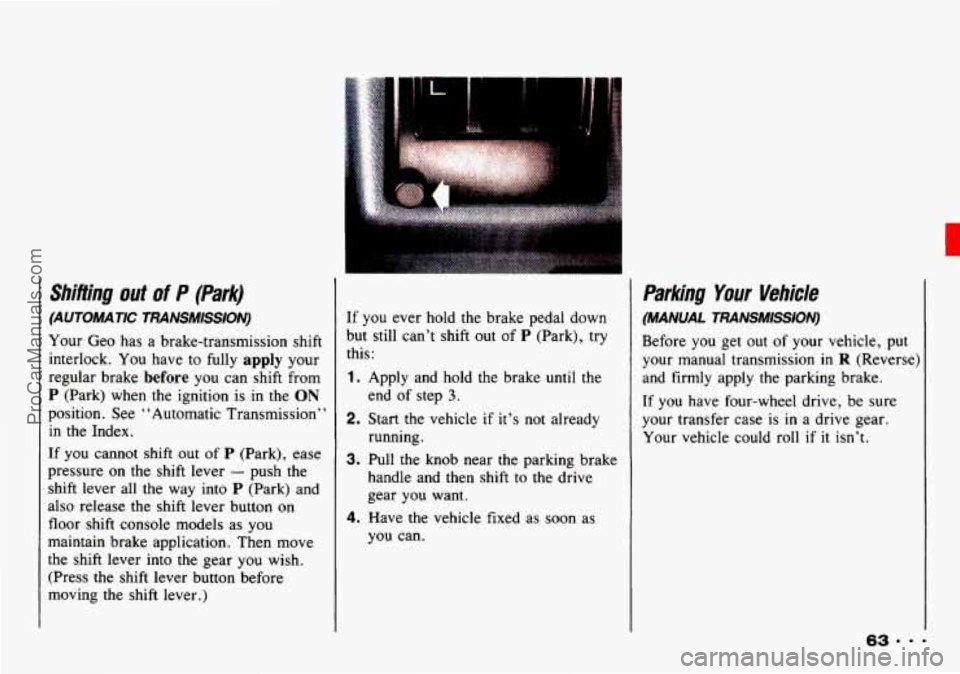
Shifling out of P (Park)
(AUTOMATIC TRANSMISSION)
Your Geo has a brake-transmission shift
interlock. You have to fully
apply your
regular brake
before you can shift from
P (Park) when the ignition is in the ON
position. See “Automatic Transmission”
in the Index.
If you cannot shift out of P (Park), ease
pressure on the shift lever
- push the
shift lever all the way into P (Park) and
also release
the shift lever button on
floor shift console models as you
maintain brake application. Then move
the shift lever into the gear you wish.
(Press
the shift lever button before
moving
the shift lever.)
I
If you ever hold the brake pedal down
but still can’t shift out of
P (Park), try
this:
1. Apply and hold the brake until the
end
of step 3.
2. Start the vehicle if it’s not already
running.
3. Pull the knob near the parking brakc
handle and then shift
to the drive
gear you want.
4. Have the vehicle fixed as soon as
you can.
Parking Your Vehicle
(MANUAL TRANSMISSION)
Before you get out of your vehicle, put
your manual transmission in
R (Reverse)
and firmly apply the parking brake.
If you have four-wheel drive, be sure
your transfer case is in a drive gear.
Your vehicle could roll
if it isn’t.
ProCarManuals.com
Page 67 of 339

Running Your Engine While
You’re Parked
(AUTOMATIC TRANSMISSION)
It’s better not to park with the engine
running. But if
you ever have to, here
are some things to
know.
CAUTION
A
Idling the engine with the air system control off could allow dangerous
exhaust into your vehicle (see
the earlier Caution under “Engine
Exhaust’
’).
Also, idling in a closed-in place can let deadly carbon monoxide (CO) into
your vehicle even if
the fan switch is at the highest setting. One place this
can happen is a garage. Exhaust - with CO - can come in easily. NEVER
park in a garage with
the engine running.
Another closed-in place can be a blizzard. (See “Blizzard”
in the Index.)
It can be dangerous to get out of your vehicle if the shift lever is not
fully in
P (Park) with the parking brake firmly set. Your vehicle can roll. Don’t
leave your vehicle when
the engine is running unless you have to. If you’ve
left the engine running, the vehicle can move suddenly. You or others could
be injured.
To be sure your vehicle won’t move, even when you’re on fairly
level ground, always set your parking brake and move the shift lever
to P
(Park).
If you have four-wheel drive and your transfer case
is in N (Neutral), your
vehicle will be free to roll, even
if your shift lever is in P (Park). So, be sure
the transfer case
is in a drive gear - not in N (Neutral). Follow the proper
steps to be sure your vehicle won’t move. See “Shifting into
P (Park)” in
the Index.
If you are parking on a hill, or if you’re pulling a trailer, also see “Parking
on Hills” or “Towing a Trailer” in the Index.
c
ProCarManuals.com
Page 72 of 339

Features & Controls
Headlight High/Low Beam
First, you must have the headlights on.
(See “Lights”
in the Index.) Then, pull
the turn signal lever toward you for low
beams. For high beams, push the lever
away from you. When the high beams
are on, a blue light on the instrument
panel also will be on. It will go off
when you switch
to low beam.
Passing Signal
With the lever in the low beam position,
pull the lever toward you to
momentarily switch to high beam (to
signal that you are going to pass). When
you release the lever, the headlights will
return to low beam operation.
Daytime Running fights (DM)
lndicator Light (Canada)
If your vehicle was first sold, when
new,
in Canada, you will have this light
on the instrument panel. It goes on whenever the Daytime Running Lights
are on.
Daytime Running f ights
(Canada)
The Canadian Federal Government has
decided that “Daytime Running Lights”
(DRL) are a useful feature, in that DRL
can make your vehicle more visible to
pedestrians and other drivers during
daylight hours. DRL are required
on
new vehicles sold in Canada.
The low beam headlights will come on
at reduced brightness
in daylight when:
The ignition is on
The headlight switch is off, and
The parking brake is released.
When you turn on your headlights, the
DRL will switch off and the exterior
lights wil come on. When you turn off
ProCarManuals.com
Page 73 of 339

the headlights, the exterior lights will go
out and the low beams will change to
the reduced brightness
of DRL again.
The DRL indicator light on the
instrument panel will
go on whenever
the DRL are on. This light means that
only the DRL are on. When you turn on
your exterior lights, this light will go
out,
Of course, you may still turn on the
headlights or passing signal any time
you need to.
To idle your vehicle with DRL
off, set
the parking brake. The DRL will stay
off until you release the parking brake.
4 Interior Lights
Dome Light
The dome light has a three position
switch.
1. The light turns on and stays on
whether or not a door
is open.
2. The light comes on when a door is
opened.
3. The light stays off even when a door
is open.
Brightness Control
This knob controls the brightness of
your instrument panel lights. Turn the
knob to the right to brighten
the lights
or
to the left to dim them.
ProCarManuals.com
Page 81 of 339

Instrument Panel
1. Air Vent
2. Side Defroster Vent
3. Turn SignaULights
4. Instrument Cluster
5. Hazard Warning Flasher
6. Windshield Wiper/Washer Lever
7. Rear Window Wiper Switch
8. Comfort Controls
9. Audio System ControVHeadlight Beam
Lever
10. Lighter
1 1. Assist Grip
12. Glove Box
13. Transmission Shift Lever
14. Coinholder and Bin
15. Transfer Case Shift Lever
16. Parking Brake Lever
17. Ashtray
18. Rear Window Washer Switch
19. Ignition Switch
20. Horn
21. Fuse Block
22. Rear Window Defogger Switch
23. Brightness Control
79. =
ProCarManuals.com
Page 86 of 339

Features & Controls
. . .a4
Brake System Warning Light
Your Geo’s hydraulic brake system is
divided into two parts.
If one part isn’t
working, the other part can still work
and stop you.
For good braking, though,
you need both parts working well.
Your vehicle also has rear wheel
anti-lock brakes. If the warning light
goes on, there could be a brake problem
with either your regular or rear wheel
anti-lock brakes,
or both. Have your
brake system inspected right away.
This light should come
on as you start
the vehicle. If it doesn’t come on then,
have
it fixed so it will be ready to warn
you if there’s a problem. This light will
also come on when you
set your parking brake, and it
will stay
on if your parking brake doesn’t release
fully. If it stays on after your parking
brake is fully released, it means you
may have a brake problem.
If the light comes on while driving, pull
off the road and stop carefully. You
may notice that the pedal is harder to
push.
Or, the pedal may go closer to the
floor. It may take longer to stop. If the
light is still on, have the vehicle towed
for service. (See “Towing
Your
Vehicle” in the Index.)
$ Your brake system may not
be working properly if the
brake warning light
is on. Driving
with the brake warning light on
can lead to an accident.
If the light
is still on after you’ve pulled off
the road and stopped carefully,
have the vehicle towed for service.
I
ProCarManuals.com
Page 124 of 339

Your Driving and the Road
Slowing down. If time allows, tap the
brake pedal once or twice in advance of
slowing or stopping. This warns the
driver behind
you.
Disabled. Your four-way flashers signal
that your vehicle is disabled or is a
hazard. See “Hazard Warning
Flashers” in the Index.
Trafilc Officer
The traffic police officer is also a source
of important information. The officer’s
signals govern, no matter what the
traffic lights or other signs say.
The next section discusses some
of the
road conditions you may encounter.
.122
Defensive Driving
The best advice anyone can give about
driving
is: Drive defensively.
Please
start with a very important safety
device
in your Geo: Buckle up. (See
“Safety Belts” in
the Index.)
Defensive driving really means “be
ready for anything.” On city streets,
rural roads, or freeways, it means
“always expect the unexpected.
”
Assume that pedestrians or other drivers
are going to be careless and make
mistakes. Anticipate what they might
do.
Be ready for their mistakes. Expect children
to dash out from behind
parked cars, often followed by other
children. Expect occupants in parked cars to open doors into traffic. Watch
for movement in parked cars
-
someone may be about to open a door.
Expect other drivers to run stop signs
when you are on a through street. Be
ready
to brake if necessary as you go
through intersections. You may not have
to use the brake, but if you do, you will
be ready.
[f you’re driving through a shopping
center parking lot where there are
well-marked lanes, directional arrows,
and designated parking areas, expect
ProCarManuals.com