1993 CHEVROLET SUBURBAN belt
[x] Cancel search: beltPage 193 of 386
Your Driving and the Road
Tune your senses to different kinds of signals. Your eyes, for example, need
to constantly sweep the terrain for unexpected obstacles. Your ears need to
listen for unusual tire or engine sounds. With your arms, hand\
s, feet, and
body you’ll need to respond
to vibrations and vehicle bounce.
Controlling your vehicle is the key to successful off-road driving. One of the
best ways to control your vehicle
is to control your speed. Here are some
things to keep in mind.
At higher speeds:
you approach things faster and you have less time to scan the\
terrain
for obstacles.
you have less time to react.
you have more vehicle bounce when you drive over obstacles.
you’ll need more distance for braking, especially since you’\
re on an
unpaved surface.
A
When you’re driving off road, bouncing and quick changes in I
direction can easily throw you out of position. This could cause you
to lose control and crash.
So, whether you are driving on or off the
road, you and your passengers should wear your safety belts.
Scanning the Terrain
Off-road driving can take you over many different kinds of terrain. You need
to be familiar with the terrain and its many different features. Here are some
things to consider.
Surface Conditions
Off-roading can take you over hard-packed dirt, gravel, rocks, grass, sand,
mud, snow or ice. Each of these surfaces affects the steering, acceleration,
and braking of your vehicle in different ways. Depending upon the kind of
surface you are on, you may experience slipping, sliding, wheel spinning,
delayed acceleration, poor traction, and longer braking distances\
.
Surface Obstacles
Unseen or hidden obstacles can be hazardous. A rock, log, hole, rut, or
bump can startle you
if you’re not prepared for them. Often these obstacles
are hidden by grass, bushes, snow
or even the rise and fall of the terrain
itself. Here are some things to consider:
Is the path ahead clear?
Will the surface texture change abruptly up ahead?
4-26
ProCarManuals.com
Page 230 of 386
. .
6. Release the regular brakes.
CAUTION
It can be dangerous to get out of your vehicle if the shift lever is no
fully in
P (Park) wi-. the parking brake firmly set. Your vehicle can
roll.
If you have left the engine running, the vehicle can move suddenl\
y.
You or others could be injured.
To be sure your vehicle won’t move,
when you’re on fairly level ground, use the steps that foll\
ow.
If you have four-wheel drive and your transfer case is in N (Neutral),
your vehicle will be free to
roll, even if your shift lever is in P (Park)
So, be sure the transfer case is in a drive gear-not in N (Neutral).
If you are parking on a hill, or if you’re pulling a trailer, also see
I “Parking On Hills” in the Index. I
When You Are Ready to Leave After Parking on a Hill
1. Apply your regular brakes and hold the pedal down while you:
Start your engine.
Shift into a gear; and
Release the parking brake.
2. Let up on the brake pedal.
3. Drive slowly until the trailer is clear of the chocks.
4. Stop and have someone pick up and stow the chocks.
Maintenance When Trailer Towing
Your vehicle will need service more often when you’re pulling a \
trailer. .See
the Maintenance Schedule for more on this. Things that are especially
important in trailer operation are automatic transmission fluid (don’t overfill),
engine oil, axle lubricant, belts, cooling system, and brake ad\
justment. Each
of these is covered in this manual, and the Index will help you find them
quickly.
If you’re trailering, it’s a good idea to review these sections before
you start your trip.
Check periodically to see that all hitch nuts and bolts are tight.
4-63
ProCarManuals.com
Page 299 of 386
Service & Appearance Care
Front Suspension and Steering Linkage
Your maintenance schedule will tell you how often to lubricate the fittings. See
“Recommended Fluids and Lubricants” in the Index for the \
proper lubricant to
use.
Front Wheel Bearings
Your vehicle has front wheel bearings that must be cleaned and repa\
cked.
Your maintenance schedule will
tell you how often this must be done.
Front Shock Absorbers
The front shock absorbers of your vehicle do many things. They help the
vehicle ride smoothly and also control the travel of the suspension system.
When the shock absorbers are serviced, any replacement shock ab\
sorbers must be the same as the original equipment shock absorbers in \
both
extended length and strength.
Wheel Nut Torque
For vehicles with dual wheels, when the vehicle, wheel or fast\
eners are new,
have the torque set at the first
100, 1,000 and 6,000 miles (160, 1600 and
9600 km). Use the torque specified in the appropriate Specification \
Chart later
in this section.
Single Belt Accessory Drive
If your new vehicle uses a serpentine belt, it is lighter, and more durable
than systems with several belts.
The belt runs over or around the pulleys on the engine.
A tensioner is used
to keep the belt tight at all times. The tensioner also makes replacing the
belt easier. If you need
to replace the belt, be sure to get the correct
replacement belt. Your dealership or parts supplier can help you with this.
The Accessory Drive Belt Routing label on your vehicle will sh\
ow you how to route the belt your vehicle uses.
6-34
ProCarManuals.com
Page 319 of 386

Service & Appearance Care
If you ever replace your tires with those not having a TPC Spec number,
make sure they are the same size, load range, speed rating an\
d construction
type (bias, bias-belted or radial) as your original tires.
I CAUTION
A
Mixing tires could cause you to lose control while driving. If you mix
tires
of different sizes or types (radial and bias-belted tires) the
vehicle may not handle properly, and you could have a crash. Be
sure
to use the same size and type tires on all wheels.
I
Uniform Tire Quarity Grading
The following information relates to the system developed by the United
States National Highway Traffic Safety Administration which grade\
s tires by
treadwear, traction and temperature performance. (This applies o\
nly to
vehicles sold in the United States.)
Treadwear
The treadwear grade is a comparative rating based on the wear \
rate of the
tire when tested under controlled conditions on a specified government test
course.
For example, a tire graded 150 would wear one and a half (1 1/2)
times as well on the government course as a tire graded 100. The relative
performance
of tires depends upon the actual conditions of their use,
however, and may depart significantly from the norm due to var\
iations
in
driving habits, service practices and differences in road characteristics and
climate.
Traction-A, B, C
The traction grades, from highest to lowesr are: A, 8, and C. They represent
the tire’s ability to stop on wet pavement as measured under controlled
conditions on specified government test surfaces of asphalt and concrete. A
tire marked
C may have poor traction performance.
Warning: The traction grade assigned to this tire is based on braking
(straight-ahead) traction tests and does not include cornering \
(turning) traction.
Temperature-A, B, C
The temperature grades are A (the highest), B, and C, representing the tire’s
resistance to the generation
of heat and its ability to dissipate heat when
tested under controlled conditions on a specified indoor laborat\
ory test wheel.
Sustained high temperature can cause the material
of the tire to degenerate
and reduce tire life, and excessive temperature can lead to sudden tire
failure. The grade
C corresponds to a level of performance which all
passenger car tires must meet under the Federal Motor Vehicle \
Safety
6-54
ProCarManuals.com
Page 325 of 386

Service & Appearance Care
Combination Stains: Like candy, ice cream, mayonnaise, chili sauce and
unknown stains,
Carefully scrape off excess stain, then clean with cool water \
and allow to
If a stain remains, clean it with solvent-type cleaner.
dry.
Cleaning Vinyl or Leather
Just use warm water and a clean cloth.
Rub with a clean, damp cloth to remove dirt. You may have to do it
more than once.
Things like tar, asphalt and shoe polish will stain if you don’t get them
off quickly. Use a clean cloth and solvent-type vinylheather cleaner\
.
Cleaning the Top of the Instrument Panel
Use only mild soap and water to clean the top surfaces of th\
e instrument
panel. Sprays containing silicones or waxes may cause annoying \
reflections in
the windshield and even make
it difficult to see through the windshield under
certain conditions.
Care of Safety Belts
Keep belts clean and dry.
Do not bleach or dye safety belts. If you do, it may severely weaken
them. In a crash they might not be able to provide adequate
protection. Clean
safety belts only with mild soap and lukewarm
I water.
Glass
Glass should be cleaned often. GM Glass Cleaner (GM Part No. 1050427) or
a liquid household glass cleaner will remove normal tobacco smoke \
and dust
films.
Don’t use abrasive cleaners
on glass, because they may cause scratches.
Avoid placing decals on the inside rear window, since they may\
have to be scraped
off later. If abrasive cleaners are used on the inside of the rear
window, an electric defogger element may be damaged. Any temporary
iicense should not be attached across the defogger grid.
6-60
ProCarManuals.com
Page 335 of 386
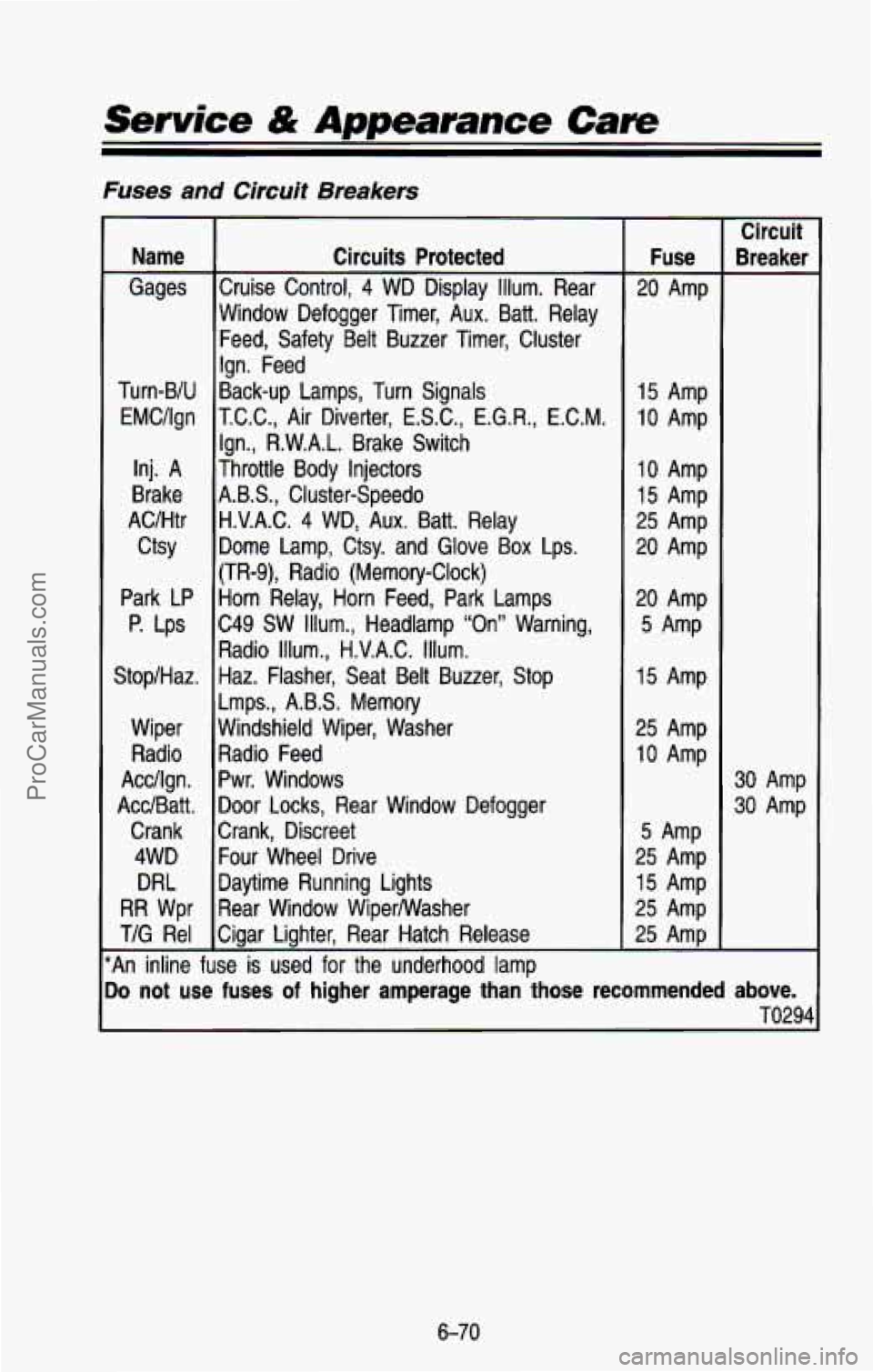
Fuses and Circuit Breakers
Name
Gages
Turn-BIU EMCIIgn
Inj.
A
Brake
AC/Htr
ctsy
Park LP
P. Lps
StopiHaz.
Wiper Radio
Acc/lgn.
AcdBatt. Crank 4WD
DRL
RR Wpr
TIG Re1
Circuits Protected
Cruise Control, 4 WD Display Illum. Rear
Window Defogger Timer, Aux. Batt. Relay Feed, Safety Belt Buzzer Timer, Cluster
Ign. Feed
Back-up Lamps, Turn Signals
T.C.C., Air Diverter, E.S.C.,
E.G.R., E.C.M.
Ign., R.W.A.L. Brake Switch
Throttle Body Injectors
A.B.S., Cluster-Speed0
H.V.A.C.
4 WD, Aux. Batt. Relay
Dome Lamp, Ctsy. and Glove Box Lps.
(TR-9), Radio (Memory-Clock)
Horn Relay, Horn Feed, Park Lamps C49 SW Illum., Headlamp
“On” Warning,
Radio Illum., H.V.A.C. Illum.
Haz. Flasher, Seat Belt Buzzer, Stop
Lmps., A.B.S. Memory
Windshield Wiper, Washer
Radio Feed
Pwr. Windows
Door Locks, Rear Window Defogger Crank, Discreet
Four Wheel Drive
Daytime Running Lights
Rear Window Wiperwasher
Cigar Lighter, Rear Hatch Release
Fuse
20 Amp
15 Amp
10 Amp
10 Amp
15 Amp
25
Amp
20 Amp
20 Amp
5 Amp
15 Amp
25 Amp
10 Amp
5 Amp
25 Amp
15 Amp
25 Amp
25 Amp
Circuit
Breaker
30 Amp
30 Amp
An inline fuse is used for the underhood lamp
Jo not use fuses of higher amperage than those recommended above.
TO291
6-70
ProCarManuals.com
Page 357 of 386
Scheduled Maintenance Services
13. EGR SYSTEM INSPECTION* -Conduct EGR SYSl /l CHECK as
described in the Service Manual.
14. ELECTRONIC VACUUM REGULATOR VALVE (EVRV) INSPECTION*
-Inspect filter for excessive contamination or plugging. If required, clean
element with a solution of biodegradable soap and water, let
dry and
reinstall element.
MODELS)* -Adjust timing to underhood label specifications. Inspect the
inside and outside of the distributor cap and rotor for cracks, carbon
tracking and corrosion. Clean or replace as needed.
15. ENGINE TIMING CHECK AND DISTRIBUTOR CHECK (SOME
16. FUEL TANK, CAP AND LINES INSPECTION* -Inspect the fuel tank,
cap and lines
for damage or leaks. Remove fuel cap, inspect gasket for
an even filler neck imprint, and any damage, Replace parts as needed.
17.
THERMOSTATICALLY CONTROLLED AIR CLEANER INSPECTION*
A-(If so equipped.) Inspect all hoses and ducts for proper hookup.
Make sure valve works properly.
Look for cracks, fraying, wear, and proper tension. Adjust or replace as
needed.
19. EVAPORATIVE CONTROL SYSTEM (ECS) INSPECTION* -Check all
fuel and vapor lines and hoses for proper hookup, routing, and\
condition.
Check that the purge valve works properly, if equipped. Replace\
as needed.
20.
SHIELDS AND UNDERHOOD INSULATION INSPECTION Awlnspect
shields and underhood insulation for damage or looseness. Adjust
or
replace as required.
installation to see that gaskets are seated properly and all hose
connections, fasteners, and other components are tight.
Also check to be
sure that the air cleaner housing is properly seated, that the\
cover
fits
tightly, and the wing nuts are tight. Tighten connections and \
fasteners or
replace damaged parts as required.
18. ENGINE ACCESSORY DRIVE BELT(S) INSPECTION* --Inspect belts.
21.
AIR INTAKE SYSTEM INSPECTlONAWCheck the air intake system
22. THERMOSTATICALLY CONTROLLED ENGINE COOLING FAN INSPECTIONAB-(If
so equipped.) With the engine off and below
normal operating temperature, check
to see that the fan can be rotated
by hand on fluid coupling or viscous drives. Replace as necessary.
*An Emission Control Service
A Also a Noise Emission Control Service
Applicable only to vehicles sold in the United States
7-20
ProCarManuals.com
Page 360 of 386
On manual transmission vehicles, put the shift lever in N (Neutral), push the
clutch down halfway, and try
to start the engine. The starter should work only
when the clutch is pushed down all the way to the floor.
Steering column lock operation -While parked, try to turn the key to Lock
in each gear shift position.
With an automatic transmission, the key should turn to
Lock only when the
gear shift is in
P (Park).
On vehicles with a key release lever,
try to turn the key to Lock without
pressing the lever. The key should turn to
Lock only with the key lever
depressed.
On all vehicles, the key should come out only in
Lock.
Parking brake and transmission
P (PARK) mechanism operation -
A
When you are doing this check, your vehicle could begin to move.
You
or others could be injured and property could be damaged.
Make sure there
is room in front of your vehicle in case you begin
to roll. Be ready to apply the regular brake at once should the
vehicle begin to move.
Park on a fairly steep hill, with the vehicle facing downhill. Keeping yo\
ur foot
on the regular brake, set the manual parking brake.
CAUTION
To check the parking brake: With the engine running and the
transmission in
N (Neutral), slowly remove foot pressure from the regular
brake pedal.
Do this until the vehicle is held by the parking brake only.
To check the “Park” mechanism’s holding ability: Apply the \
regular brake
and shift to
P (Park). Release the manual parking brake, then slowly
release the regular brake.
Lap and shoulder belts condition and operation -Inspect belt system,
including: webbing, buckles, latch plates, retractors, guide loop\
s and anchors.
Have a belt assembly replaced if the webbing has been cut or otherwise
damaged.
Body Lubrication Service -Lubricate all body door hinges with engine oil.
Also lubricate the tailgate, tailgate handle pivot points, and \
tailgate mounted
spare tire carrier
(if equipped). Lubricate the body hood, fuel door and rear
compartment hinges, latches and locks including interior glove b\
ox and
console doors, and any folding seat hardware. Lubricate the hoo\
d safety lever
pivot and prop rod pivot.
More frequent lubrication may be required when
exposed to a corrosive environment.
7-23
ProCarManuals.com