1993 CHEVROLET S10 trailer
[x] Cancel search: trailerPage 215 of 356

Downloaded from www.Manualslib.com manuals search engine Parking on Hills
You really should not park your vehicle, with a trailer attached, \
on a hill. If
something goes wrong, your rig could start to move. People can be injured,
and both your vehicle and the trailer can be damaged.
But
if you ever have to park your rig on a hill, here’s how to \
do it:
1. Apply your regular brakes, but don’t shift into P (Park) yet, or into gear
2. Have someone place chocks under the trailer wheels.
3. When the wheel chocks are in place, release the regular brakes until the
chocks absorb the load.
4. Reapply the regular brakes. Then apply your parking brake, and \
then
shift to
P (Park), or R (Reverse) for a manual transmission.
5. If you have a four-wheel-drive vehicle with a manual transfer case\
shift
lever, be sure the transfer case is in a drive gear-not in
N (Neutral).
6. Release the regular brakes.
for a manual transmission.
A
It can be dangerous to get out of your vehicle if the shift lever is not
fully in
P (Park) with the parking brake firmly set. Your vehicle can
roll.
If you have left the engine running, the vehicle can move suddenl\
y.
You
or others could be injured. To be sure your vehicle won’t move,
even when you’re on fairly level ground, use the steps that\
follow.
If you have four-wheel drive with a manual transfer case shift le\
ver
and your transfer case is in
N (Neutral), your vehicle will be free to
roll, even if your shift lever is in
P (Park). So be sure the transfer
case is in a drive gear-not in
N (Neutral). If you are parking on a
hill, or if you’re pulling a trailer, see also “Parking On Hills” in the
Index.
When You Are Ready to Leave After Parking on a Hill
1. Apply your regular brakes and hold the pedal down while you:
Start your engine.
Shift into a gear; and
Release the parking brake.
4-61
Page 216 of 356

Downloaded from www.Manualslib.com manuals search engine Your Driving and the Road
2. Let up on the brake pedal.
3. Drive slowly until the trailer is clear of the chocks.
4. Stop and have someone pick up and store the chocks.
Maintenance When Trailer Towing
Your vehicle will need service more often when you’re pulling a \
trailer. See
the Maintenance Schedule for more on this. Things that are esp\
ecially important in trailer operation are automatic transmission fluid (don’t ove\
rfill),
engine oil, axle lubricant, belt, cooling system, and brake adj\
ustment. Each of
these is covered in this manual, and the Index will help you find them
quickly.
If you’re trailering, it’s a good idea to review these sections before
you start your trip.
Check periodically to see that all hitch nuts and bolts are tight.
Trailer Light Wiring
See “Trailer Wiring Harness” in the Index.
Power Winches
If you wish to use a power winch on your vehicle, only use it when your
vehicle is stationary or anchored.
NOTICE
Use the regular brakes, set the parking brake Or UIWK ihe wheels IW keep
your vehicle from rolling.
4-62
Page 226 of 356
Downloaded from www.Manualslib.com manuals search engine Problems on the Road
If No Steam Is Coming From Your Engine:
If you get the overheat warning but see or hear no steam, the problem may
not be too serious. Sometimes the engine can get a little
too hot when you:
Climb a long hill on a hot day.
Stop after high speed driving.
Idle for long periods in traffic.
Tow a trailer.
If you get the overheat warning with no sign of steam, try this for a minute
or so:
1. If you have an air conditioner, turn it off.
2. Turn your heater to full hot at the highest fan speed and open the
3. If you're in a traffic jam, shift to N (Neutral).
window as necessary.
If you no longer have the overheat warning, you can drive. Just to
be safe,
drive slower for about ten minutes. If the warning doesn't com\
e back on, you
can drive normally.
If the warning continues, pull over, stop, and park your vehicle \
right away.
If there's still no sign of steam, push the accelerator until the engine speed is
about twice as fast as normal idle speed. Bring the engine sp\
eed back to
normal idle speed after
two or three minutes. Now see if the warning stops.
But then,
if you still have the warning, TURN OFF THE ENGINE AND GET
EVERYONE
OUT OF THE VEHICLE until it cools down.
You may decide
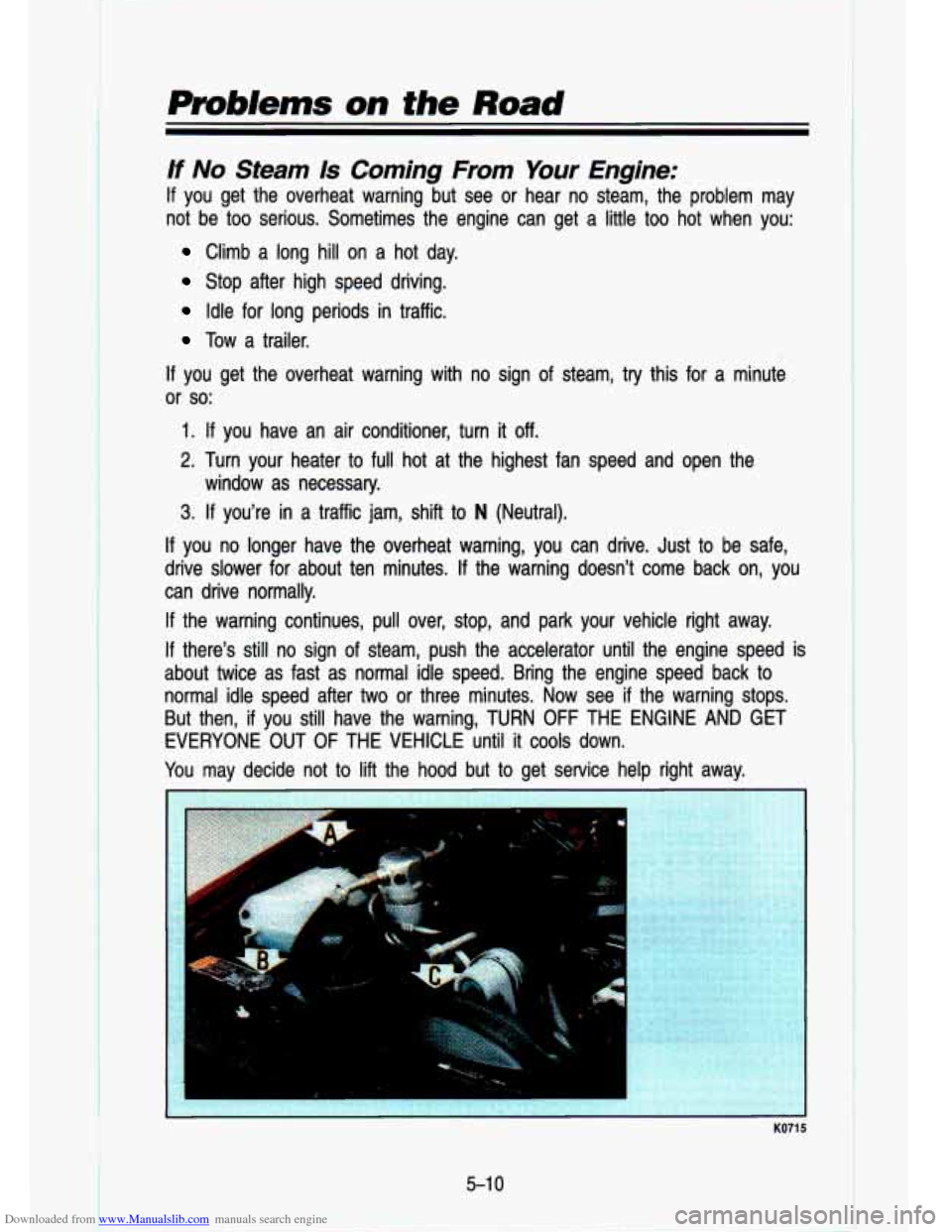
not to lift the hood but to get service help right away.
KO71 5
5-1 0
I
Page 231 of 356

Downloaded from www.Manualslib.com manuals search engine KO721
8. Then replace the pressure cap. Be sure the arrows on the pres\
sure cap line up like this.
Engine Fan Noise
This vehicle has a clutched engine cooling fan. When the clutch is engaged,
the fan spins faster to provide more air to cool the engine. In most every day
driving conditions the clutch is not engaged. This improves fue\
l economy and
reduces fan noise. Under heavy vehicle loading, trailer towing andlor high
outside temperatures, the fan speed increases when the clutch e\
ngages.
So
you may hear an increase in fan noise. This is normal and should not be
mistaken as the transmission slipping or making extra shifts.
It is merely the
cooling system functioning properly. The fan will slow down whe\
n additional
cooling is not required and the clutch disengages.
You may also hear this fan noise when you start the engine. It will go away
as the fan clutch disengages.
If a Tire Goes Flat
It’s unusual for a tire to “blowout” while you’re d\
riving, especially if you
maintain your tires properly.
If air goes out of a tire, it’s much more likely to
leak out slowly. But if you should ever have a “blowout,”\
here are a few tips
about what to expect and what to do:
If a front tire fails, the flat tire will create a drag that pu\
lls the vehicle toward
that side. Take your foot off the accelerator pedal and grip the steering wheel
firmly. Steer to maintain lane position, then gently brake to \
a stop well out of
the traffic lane.
5-1 5
Page 261 of 356
Downloaded from www.Manualslib.com manuals search engine Energy Conserving II
Oils with these words on the container will help you save fuel.
This doughnut-shaped logo (symbol) is used
on most oil containers to help
you select the correct oil.
You should look for this on the oil container, and use
only those oils that
display the logo.
GM Goodwrench@ oil (in Canada, GM Engine Oil) meets all the requirements
for your vehicle.
Engine Oil Additives:
Don’t add anything to your oil. Your GM dealer is ready to advise if you think
something should be added.
When to Change Engine c)k
See if any one of these is true for you:
Most trips are less than 4 miles (6 km).
It’s below freezing outside and most trips are less than 10 miles
(16 km).
The engine is at low speed most of the time (as in door-to-door delivery,
You tow a trailer often.
or in stop-and-go traffic).
Most trips are through dusty places.
The vehicle is frequently operated off-road.
If any one of these is true for your vehicle, you need to chang\
e your oil and
filter every 3,000 miles (5000 km) or 3 months-whichever comes first.
If none of them are true, change the oil every 7,500 miles (12 500 km) or
12 months-whichever comes first. Change the filter at the first oil change
and at every other oil change after that.
If your vehicle has 4-wheel drive, you ,will have a remote oil filter located
under the hood.
It is mounted to the front left inner fender, behind the
headlights.
Engine Block Heater:
An engine block heater can be a big help if you have to park outside in very
cold weather,
-0°F (-18°C) or colder. If your vehicle has this option, see
“Engine Block Heater” in the Index.
6-1 3
Page 264 of 356
Downloaded from www.Manualslib.com manuals search engine Service & Appearance Care
Automatic Transmission Fluid
When to Check and Change:
A good time to check your automatic transmission fluid level is when the
engine oil is changed. Refer to the Maintenance Schedule to de\
termine when
to change your fluid. See “Scheduled Maintenance Services” \
in the Index.
How to Check:
Because this operation can be a little difficult, you may choo\
se to have this
done at a dealership Service Department.
If you
do it yourself, be sure to follow all the instructions here, or \
you could
get a false reading on the dipstick.
I NOTICE
Wait at least 30 minutes before checking the transmission fluid level if you
have been driving:
When outside temperatures are above 90°F (32°C).
At high speed for quite a while.
In heavy traffic-especially in hot weather.
While pulling a trailer.
To get the right reading, the fluid must be at normal operating \
temperature,
which is 180°F to 200°F (82°C to 93°C).
To check transmission fluid hot: Get the vehicle warmed up by driving
about
15 miles (24 km) when outside temperatures are above 50°F (10°C). If
it’s colder then 50°F (IO’C), drive the vehicle in D (3rd gear) until the
temperature gage moves and then remains steady for ten minutes.\
Then
follow the hot check procedures.
To check transmission fluid cold: A cold check is made after the vehicle
has been sitting for eight hours or more with the engine off and is used
only
as a reference. Let the engine run at idle for five minutes if outside
temperatures are
50°F (10°C) or more. If it’s colder than 50°F (lO°C), you
may have to idle the engine longer. A hot check must follow when fluid is
added during a cold check.
6-1 6
I
Page 288 of 356
Downloaded from www.Manualslib.com manuals search engine .-
.. .. -. .- -. -. .
Service & Appearance Care
Trailering Package
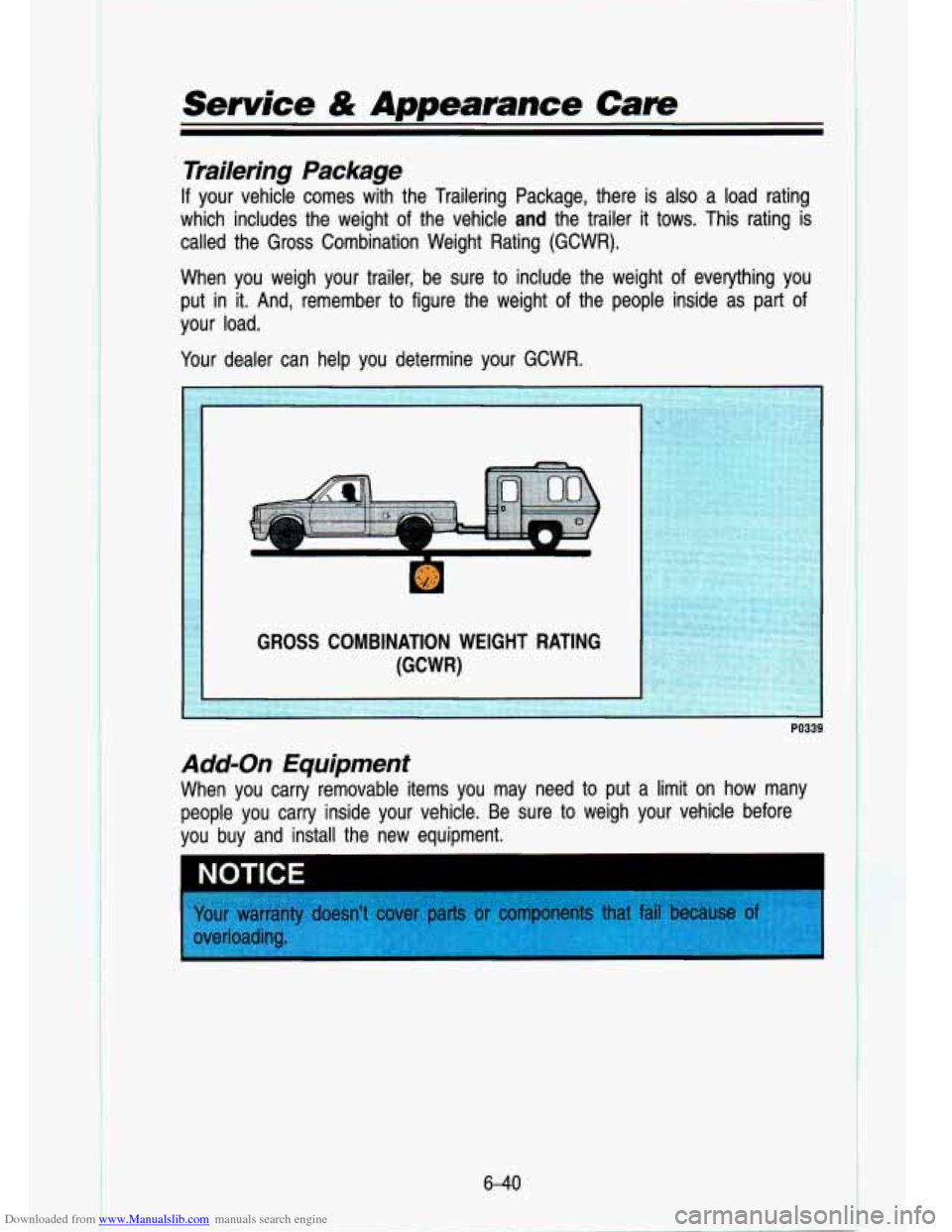
If your vehicle comes with the Trailering Package, there is also a load rating
which includes the weight of the vehicle
and the trailer it tows. This rating is
called the Gross Combination Weight Rating (GCWR).
When you weigh your trailer, be sure to include the weight of everything you
put in it. And, remember to figure the weight
of the people inside as part of
your load.
Your dealer can help you ?-‘ermine your GCWR.
Page 290 of 356
Downloaded from www.Manualslib.com manuals search engine I
Service & Appearance Care
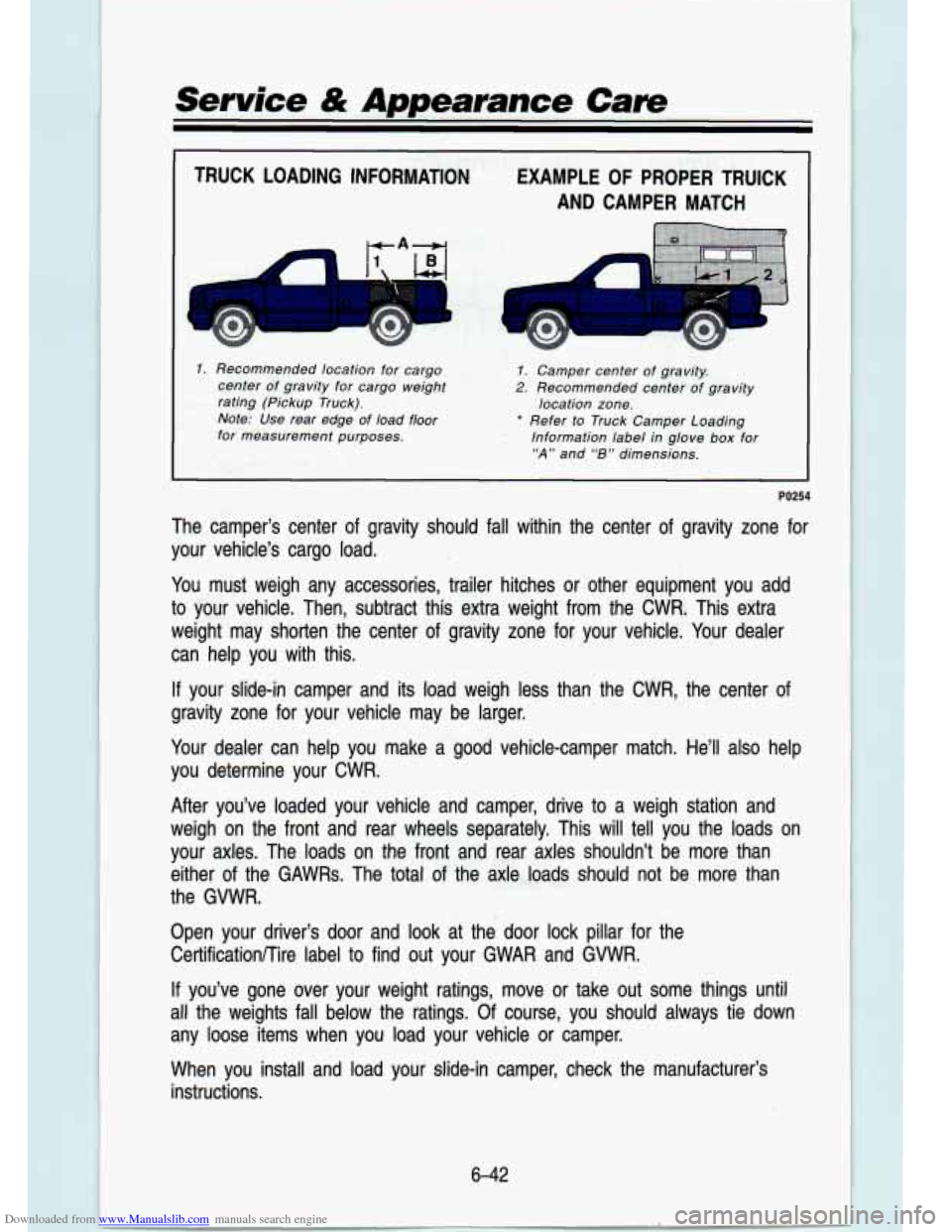
TRUCK LOADING INFORMATION EXAMPLE OF PROPER TRUICK
AND CAMPER MATCH
1. Recommended location for cargo 7. Camper center of gravity.
center
of gravity for cargo weight 2. Recommended center of gravity
rating (Pickup Truck).
K-L.<:- location zone.
Note: Use rear edge of load floor : .‘$Ti: * .Refer to Truck Camper Loading
for measurement purposes.
- - Information label in glove box for
“A” and “B” dimensions.
.Y %!, -
PO254
The camper’s center of gravity should fall within the center of gravity zone for
your vehicle’s cargo load.
You must weigh any accessories, trailer hitches or other equipment you add
to your vehicle. Then, subtract this extra weight from the CWR,
This extra
weight may shotten the center of gravity zone for your vehicle. Your dealer
can help you with this.
If your slide-in camper and its load weigh less than the CWR, the center of
gravity zone for your vehicle may be larger.
Your dealer can help you make
a good vehicle-camper match. He’ll also help
you determine your CWR.
After you’ve loaded your vehicle and camper, drive to a weigh station and
weigh on the front and rear wheels separately. This will tell you the loads on
your
axles. The loads on the front and rear axles shouldn’t be more th\
an
either
of the GAWRs. The total of the axie..loads should not be more than
the GVWR.
Open your driver’s door and look at the door lock pillar f\
or the CertificationKire label to find out your GWAR and GWVR.
If you’ve gone over your weight ratings, move or take out some\
things until
all the weights fall below the ratings. Of course, you should always tie down
any loose items when you load your vehicle or camper.
When you install and load your slide-in camper, check the manufacturer’s
instructions.
6-42