1993 CHEVROLET S10 steering wheel
[x] Cancel search: steering wheelPage 187 of 356
 your tires will tend to sink into \
the sand. This has an effect on steering, accelerating, and")
Downloaded from www.Manualslib.com manuals search engine on beaches or sand dunes) your tires will tend to sink into \
the sand. This has an effect on steering, accelerating, and braking. You may want to reduce
the air pressure in your tires slightly when driving on sand. \
This will improve
traction.
Hard packed snow and ice offer the worst tire traction. On these surfaces, it’s
very easy to lose control. On wet ice, for example, the tract\
ion
is so poor
that you will have difficulty accelerating. And
if you do get moving, poor
steering and difficult braking can cause you to slide out of control.
nds or rivers can be dangerous.
~;~:.cx :. 2’’
nderwater springs, currents under the ice, or sudden thaws can \
25
weaken the ice. Your vehicle could fall through the ice and you ad.
. your passengers could drown. Drive your vehicle on safe surface\
s
~~ : . I’ .: . :j/-
,. ,/ ., ‘!...,I:, I -
Driving In Water
Light rain causes no special off-road driving problems. But hea\
vy rain can
mean flash flooding, and flood waters demand extreme caution.
Find out how deep the water is before you drive through
it. If it’s deep
enough to cover your wheel hubs, axles, or exhaust pipe, don’t
try it-you
probably won’t get through. Also, water that deep can damage\
your axle and
other vehicle parts.
If the water isn’t too deep, then drive through it slowly. At fast speeds, water
splashes on your ignition system and your vehicle can stall. S\
talling can also
occur
if you get your tailpipe under water. And, as long as your tailp\
ipe is
under water, you’ll never be able to start your engine. Whe\
n you go through
water, remember that when your brakes get wet,
it may take you longer to
stop.
A
Driving through rushing water can be dangerous. Deep water can
sweep your vehilcle downstream and you and your passengers could
drown.
If it’s only inches deep, it can still wash away the ground
from under your tires, and you could lose traction and roll the vehicle
over.
Don’t drive through rushing water.
4-33
Page 188 of 356

Downloaded from www.Manualslib.com manuals search engine Your Driving and the Road
After Off-Road Driving
Remove any brush or debris that has collected on the underbodv\
. chassis, or
under the hood. These accumulations can be a fire hazard.
After operation in mud or sand, have the brake linings cleaned\
and checked.
These substances can cause glazing and uneven braking. Check th\
e body
structure, steering, suspension, wheels, tires, and exhaust syste\
m for damage.
Also, check the fuel lines and cooling system for any leakage.\
Your vehicle will require more frequent service due to off-road use.\
Refer to
the Maintenance Schedule for additional information.
Driving at Night
AN450005
Night driving is more dangerous than day driving. One reason is that some
drivers are likely
to be impaired-by alcohol or drugs, with night vision
problems, or by fatigue.
Here are some tips on night driving.
Drive defensively. Remember, this is the most dangerous time.
Don’t drink and drive (See “Drunken Driving” in the Index for more on
this problem.)
Adjust your inside rearview mirror to reduce the glare from headlights
behind you.
4-34
Page 206 of 356

Downloaded from www.Manualslib.com manuals search engine Your Driving and the Road
r-
AM480016
What’s the worst time for this? “Wet ice.” Very cold \
snow or ice can be slick
and hard
to drive on. But wet ice can be even more trouble because it ma\
y
offer the least traction of all. You can get “wet ice” when it’s about freezing
(32°F; 0°C) and freezing rain begins to fall. Try to avoid driving on wet ice
until salt and sand crews can get there.
Whatever the condition-smooth ice, packed, blowing or loose snow\
-drive
with caution. Accelerate gently. Try not
to break the fragile traction. If you
accelerate
too fast, the drive wheels will spin and polish the surface under \
the tires even more.
Your antilock brakes improve your ability
to make a hard stop on a slippery
road. Even though you have the antilock braking system, you’\
ll want
to begin
stopping sooner than you would on dry pavement. See “Antiloc\
k” in the
Index.
Allow greater following distance on any slippery road.
Watch for slippery spots. The road might be fine until you hit a spot
that’s covered with ice. On an otherwise clear road, ice pa\
tches may appear in shaded areas where the sun can’t reach: around clumps of
trees, behind buildings, or under bridges. Sometimes the surface\
of
a
curve or an overpass may remain icy when the surrounding roads\
are
clear.
If you see a patch of ice ahead of you, brake before you are on
it. Try not to brake while you’re actually on the ice, and avoid sudden
steering maneuvers.
4-52
I i
Page 209 of 356
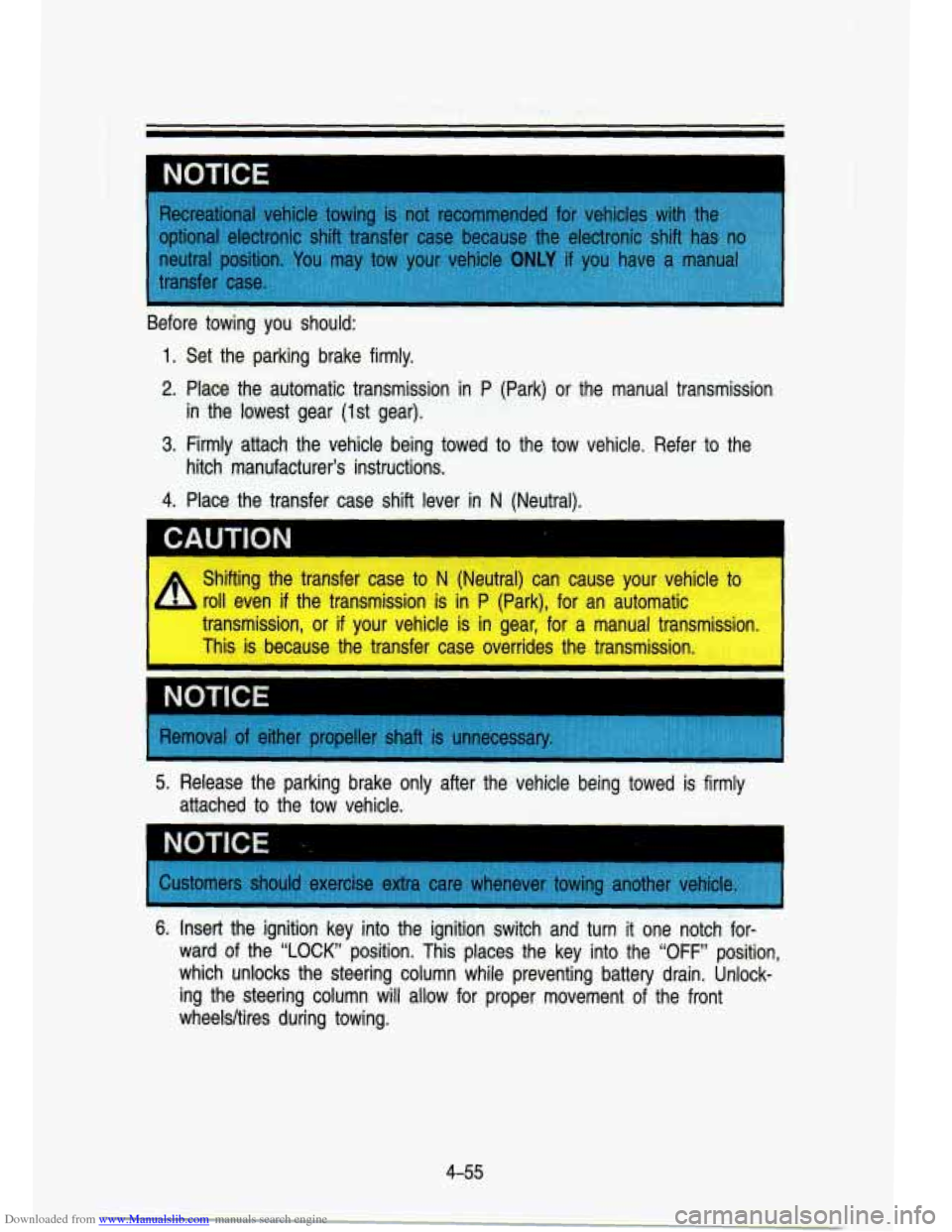
Downloaded from www.Manualslib.com manuals search engine Before towing you should:
1. Set the parking brake firmly.
2. Place the auto’matic transmission in P (Park) or the manual transmission
in th:e lowest gear
(1 st gear).
3. Firmly attach the vehicle being towed to the tow vehicle. Refer to the
hitch manufacturer’s instructions.
Shifting the transfer case to N (Neutral) can cause your veh\
icle
to
roll even if the transmission is in P (Park), for an automatic
transmission, or
if your vehicle is in gear, for a manual transmission.
This is because the transfer case overrides the transmission.
I
1 NOTICE
6. Insert the ignition key into the iginition switch and turn it one notch .for-
ward of the “LOCK’ position. This places the key into the “OFF” position,
which unlocks the steering column while preventing battery drain\
. Unlock-
ing the steering column will allow for proper movement of the front
wheelshires during towing.
4-55
Page 214 of 356

Downloaded from www.Manualslib.com manuals search engine Your Driving and the Road
Following Distance
Stay at least twice as far behind the vehicle ahead as you w\
ould when
driving your vehicle without a trailer. This can help you avoi\
d situations that require heavy braking and sudden turns.
Passing
You’ll need more passing distance up ahead when you’re to\
wing a trailer.
And, because you’re a good deal longer, you’ll need
to go much farther
beyond the passed vehicle before you can return
to your lane.
Backing Up
Hold the bottom of the steering wheel with one hand. Then, to move the
trailer left, just move your hand to the left. To move the trailer to the right,
move your hand
to the right. Always back up slowly and, if possible, have
someone guide you.
Making Turns
When you’re turning with a trailer, make wider turns than n\
ormal. Do this so
your trailer wheels won’t strike soft shoulders, curbs, road \
signs, trees, or
other objects. Avoid jerky or sudden maneuvers. Signal well in advance.
Turn Signals When Towing a Trailer
When you tow a trailer, your vehicle has to have a different turn signal
flasher and extra wiring. The green arrows on your instrument \
panel will flash
whenever you signal a turn or lane change. Properly hooked up,\
the trailer lights will also flash, telling other drivers you’re about
to turn, change lanes,
or stop.
When towing a trailer, the green arrows on your instrument pan\
el will flash for
turns even
if the bulbs on the trailer are burned out. Thus, you may think \
drivers behind you are seeing your signal when they are not.
It’s important to
check occasionally to be sure the trailer bulbs are still work\
ing.
Driving on Grades
Reduce speed and shift to a lower gear before you start down a long or
steep downgrade.
If you don’t shift down, you might have to use your brakes
so much that they would get hot and no longer work well.
On a long uphill grade, shift down and reduce your speed to \
around
45 mph
(70 km/h) to reduce the possibility of engine and transmission ove\
rheating.
If you have an automatic transmission, you should use D when towing a
trailer. Operating your vehicle in
D when towing a trailer will minimize heat
buildup and extend the life of your transmission. Or, if you have a manual
transmission with fifth gear, it’s better not to use fifth \
gear, just drive in fourth
gear (or, as you need
to, a lower gear).
4-60
Page 224 of 356
Downloaded from www.Manualslib.com manuals search engine , vr
KO51 9
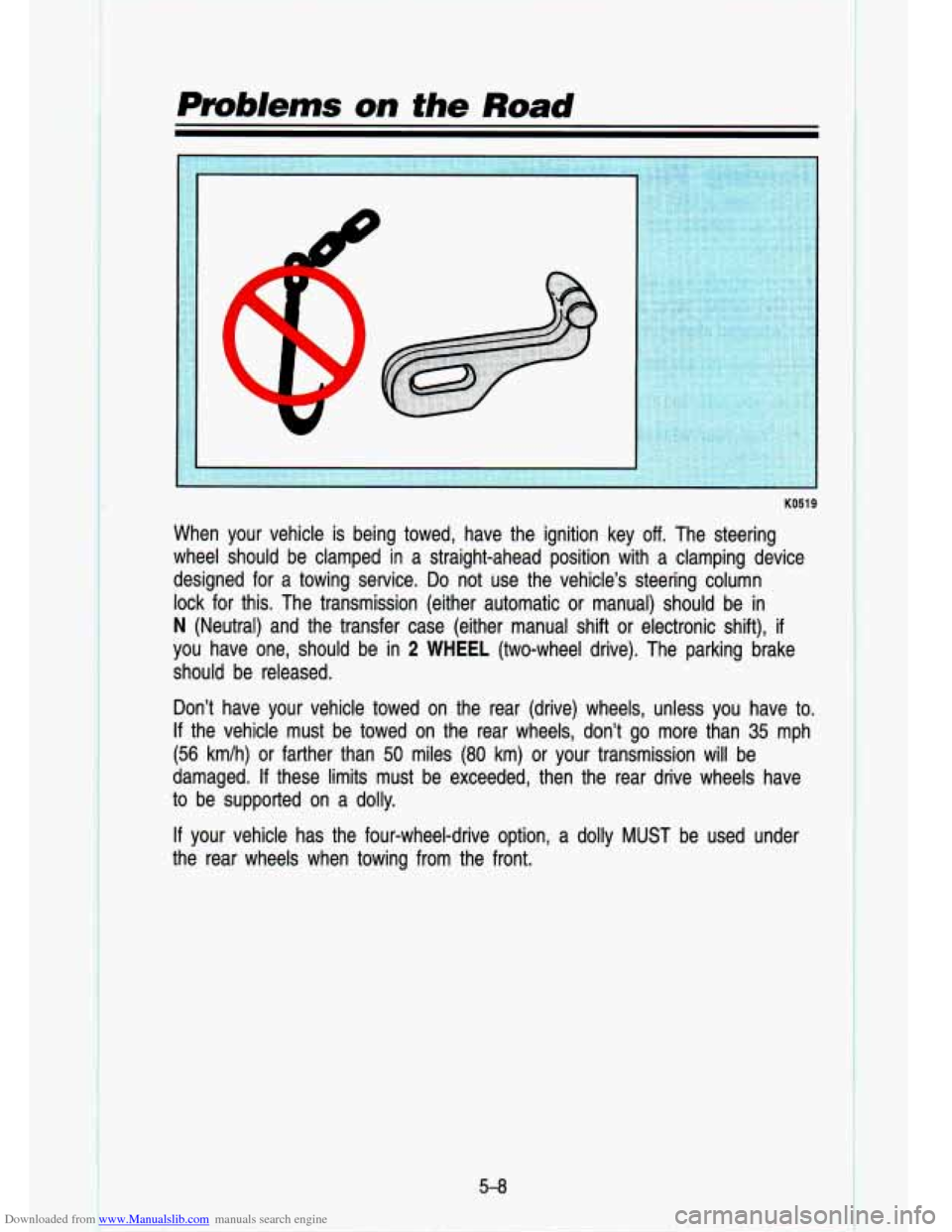
When your vehicle is being towed, have the ignition key off. The steering
wheel should be clamped in a straight-ahead position with a clamping device
designed for a towing service. Do not use the vehicle's steeri\
ng column
lock for this. The transmission (either automatic or manual) should\
be in
N (Neutral) and the transfer case (either manual shift or elec\
tronic shift), if
you have one, should be in 2 WHEEL (two-wheel drive). The parking brake
should be released.
Don't have your vehicle towed on the rear (drive) wheels, un\
less you have
to,
If the vehicle must be towed on the rear wheels, don't go more than 35 mph
(56 km/h) or farther than 50 miles (80 km) or your transmission will be
damaged.
If these limits must be exceeded, then the rear drive wheels have\
to be supported on a dolly.
If your vehicle has the four-wheel-drive option, a dolly
MUST be used under
the rear wheels when towing from the front.
5-8
Page 231 of 356

Downloaded from www.Manualslib.com manuals search engine KO721
8. Then replace the pressure cap. Be sure the arrows on the pres\
sure cap line up like this.
Engine Fan Noise
This vehicle has a clutched engine cooling fan. When the clutch is engaged,
the fan spins faster to provide more air to cool the engine. In most every day
driving conditions the clutch is not engaged. This improves fue\
l economy and
reduces fan noise. Under heavy vehicle loading, trailer towing andlor high
outside temperatures, the fan speed increases when the clutch e\
ngages.
So
you may hear an increase in fan noise. This is normal and should not be
mistaken as the transmission slipping or making extra shifts.
It is merely the
cooling system functioning properly. The fan will slow down whe\
n additional
cooling is not required and the clutch disengages.
You may also hear this fan noise when you start the engine. It will go away
as the fan clutch disengages.
If a Tire Goes Flat
It’s unusual for a tire to “blowout” while you’re d\
riving, especially if you
maintain your tires properly.
If air goes out of a tire, it’s much more likely to
leak out slowly. But if you should ever have a “blowout,”\
here are a few tips
about what to expect and what to do:
If a front tire fails, the flat tire will create a drag that pu\
lls the vehicle toward
that side. Take your foot off the accelerator pedal and grip the steering wheel
firmly. Steer to maintain lane position, then gently brake to \
a stop well out of
the traffic lane.
5-1 5
Page 232 of 356
Downloaded from www.Manualslib.com manuals search engine Problems on the Road
A rear blowout, particularly on a curve, acts much like a skid and may,
require the same correction you'd use in a skid. In any rear blowout, remove
your foot from the accelerator pedal. Get the vehicle under co\
ntrol by steering
the way you want the vehicle
to go. It may be very bumpy and noisy, but
you can still steer. Gently brake
to a stop, well off the road if possible.
If your tire goes flat, the next part shows how to use your jac\
king equipment
to change a flat tire safely.
Changing a Flat Tire
If a tire goes flat, avoid further tire and wheel damage by driving slowly to a
level place. Turn on your hazard warning flashers.
I CAUTION I
A Changing a tire can cause an injury. The vehicle can slip off the jack
A and roll over you or other people. You and they coulld be badly
injured. Fin'd a level place to change your tire. To help prevent the
vehicle from moving:
I. Set the parking brake firmly.
2. Put the shift lever in P (Park).
3. Shift a manual transmission to 1 (First) or R (Reverse).
4. If you have a four-wheel-drive vehicle with a manu'al transfer
case
shift lever, be sure the transfer case is in a drive
gear-not
in ' N (Neutral).
5- Turn off the engine.
To be even more certain the. vehick won't move, you can put blocks
at
the front and rear of the tire farthest away from the one being
changed. That would be the tire
on the other side of the vehicle, at
the opposite end.
5-1 6