1993 CHEVROLET S10 brake
[x] Cancel search: brakePage 118 of 356

Downloaded from www.Manualslib.com manuals search engine i
Features & Controls
Gages can indicate when there may be or is a problem with one of your
vehicle’s functions. Often gages and warning lights work toge\
ther
to let you
know when there’s a problem with your vehicle.
When one of the warning lights comes on and stays on when you are
driving, or when one of the gages shows there may be a probl\
em, check the
section that tells you what to do about
it. Please follow the manual’s advice.
Waiting to do repairs can be costly-and even dangerous.
So please get to
know your warning lights and gages. They’re a big help.
Brake System Warning Light
Standard Cluster Digital Cluster
Pol 59
Your vehicle’s hydraulic brake system is divided into two parts. If one part
isn’t working, the other part can still work and stop you. \
For good braking,
though, you need both parts working well. Your vehicle also ha\
s rear wheel anti-lock brakes. If the warning light goes on, there could be a brake problem
with either your regular or rear wheel anti-lock brakes, or both. Have you\
r
brake system inspected right away.
This light should come on as you start the vehicle. If it do\
esn’t come on
then, have it fixed
so it will be ready to warn you if there’s a problem.
This light will also come on when you set your parking brake, and will stay
on if your parking brake doesn’t release fully. If it stays on after your parking
brake is fully released,
it means you may have a brake problem. If the light
comes on while driving, pull
off the road and stop carefully. You may notice
that the pedal is harder
to push. Or, the pedal may go closer to the floor. It
may take longer to stop. If the light is still on, have the vehicle towed for
service. (See “Towing Your Vehicle” in the Index.)
2-66
I
Page 119 of 356
Downloaded from www.Manualslib.com manuals search engine I
1 CAUTION
1 A Your brake system may not be working properly if the brake warning
light is on. Driving with the brake warning light on can lead\
to an
accident.
If the light is still on after you’ve pulled off ? road and
stopped carefully, have the vehicle towed for servirn
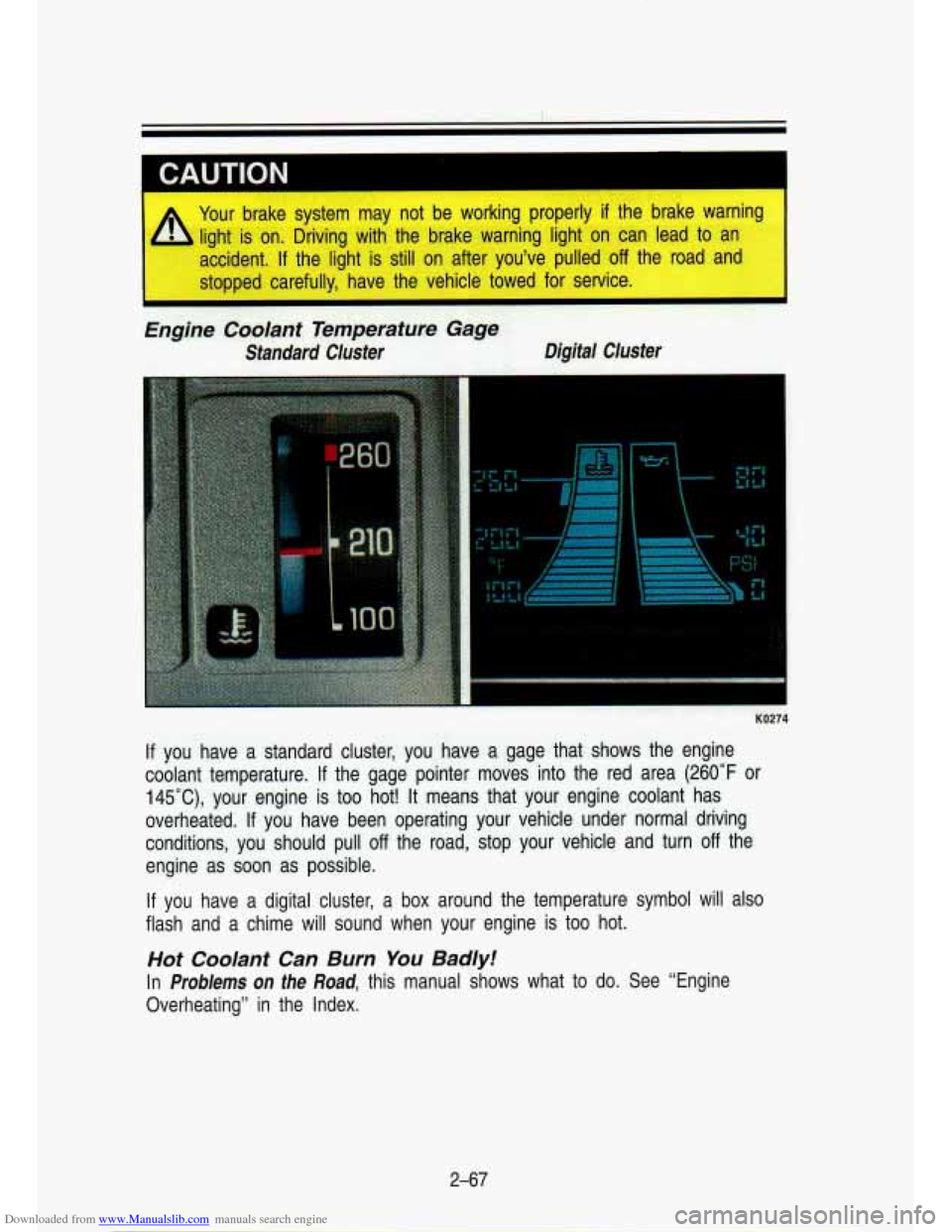
Engjne _Gaolant Temperature Gage
Standard Cluster Digital Cluster
KO274
2-67
Page 123 of 356

Downloaded from www.Manualslib.com manuals search engine CHECK GAGES Light
KO281
If you have the standard instrument cluster, this light will come \
on briefly
when you are starting the engine.
If the light comes on and stays on while
you are driving, check your various gages to see
if they are in the warning
zones.
Daytime Running Lights (DRL) Indicator Light (Canada Only)
KO242
This green light with the DRL symbol is on the lower left of the instrument
cluster. The DRL indicator is on whenever the ignition is on \
and the headlight
switch and parking brake are
off. For more details about DRL, see "Lights" in
this section.
2-71
Page 162 of 356

Downloaded from www.Manualslib.com manuals search engine c. -. .. .
Your Driving and the Road
Turn and lane change signals: Always signal when you plan to \
turn or
change lanes.
If necessary, you can use hand signals out the window: Left arm \
straight out
for a left turn, down for slow or about-to-stop, and up for a right turn.
Slowing down:
If time allows, tap the brake pedal once or twice in advance
of slowing or stopping. This warns the driver behind you.
Disabled: Your four-way flashers signal that your vehicle is disabled or is a
hazard. See “Hazard Warning Flasher’’ in the Index.
Traffic Officer
The traffic police officer is also a source of important information. The officer’s
signals govern, no matter what the traffic lights or other sig\
ns say.
The next part discusses some of the road conditions you may encounter.
Defensive Driving
The best advice anyone can give about driving is: Drive defens\
ively.
Please
start with a very important safety device in your vehicle: Buckle up.
(See “Safety Belts” in the Index.)
Defensive driving really means “be ready for anything.” On\
city streets, rural
roads, or freeways, it means “always expect the unexpected.”
Assume that pedestrians or other drivers are going to be careless and make
mistakes. Anticipate what they might
do. Be ready for their mistakes.
Expect children to dash out from behind parked cars, often followed by other
children. Expect occupants in parked cars to open doors into traffic. Watch for
movement in parked cars-someone may be about to open a door.
Expect other drivers to run stop signs .when you are on a through street. Be
ready to brake
if necessary as you go through intersections. You may not
have to use the brake, but if you
do, you will be ready.
If you’re driving through a shopping center parking lot where there are
well-marked lanes, directional arrows, and designated parking are\
as, expect
some drivers to ignore all these markings and dash straight toward one part
of the lot.
Pedestrians can be careless. Watch for them. In general, you m\
ust give way
to pedestrians even
if you know you have the right of way.
Rear-end collisions are about the most preventable of accidents. Yet they are
common. Allow enough following distance. It’s the best defens\
ive driving
4-8
Page 163 of 356

Downloaded from www.Manualslib.com manuals search engine maneuver, in both city and rural driving. You never know when \
the vehicle in
front of you is going to brake or turn suddenly.
Here’s a final bit of information about defensive driving. T\
he most dangerous
time for driving in the
U.S. is very early on Sunday morning. In fact, GM
Research studies show that the most and the least dangerous ti\
mes for
driving, every week, fall on the same day. That day is Sunday. The most
dangerous time is Sunday from 3 a.m. to 4 a.m. The safest time is Sunday
from
10 a.m. to 11 a.m. Driving the same distance on a Sunday at 3 a.m.
isn’t just a little more dangerous than
it is at 10 a.m. It’s about 134 times
more dangerous! That leads to the next part.
Drunken Driving
Death and injury associated with drinking and driving is a nat\
ional tragedy. It’s
the number one contributor to the highway death toll, claiming \
thousands of
victims every year. Alcohol takes away three things that anyone\
needs to
drive a vehicle:
Judgment
0 Muscular Coordination
Vision
Police records show that half of all motor vehicle-related deaths involve
alcohol-a driver, a passenger or someone else, such as a pedestrian, had
been drinking. In most cases, these deaths are the result of someone who
was drinking and driving. Over
25,000 motor vehicle-related deaths occur
each year because of alcohol, and thousands
of people are injured.
Just how much alcohol is too much
if a person plans to drive? Ideally, no
one should drink alcohol and then drive. But
if one does, then what’s “too
much’’ can be a lot less than many might think. Although
it depends on each
person and situation, here is some general information on the \
problem.
The Blood Alcohol Content (BAC) of someone who is drinking d\
epends upon
four things:
How much alcohol is in the drink.
The drinker’s body weight.
The amount of food that is consumed before and during drinking\
.
The length of time it has taken the drinker to consume the alcohol.
4-9
Page 166 of 356
Downloaded from www.Manualslib.com manuals search engine Your Driving and the Road
Control of a Vehicle
AM409005
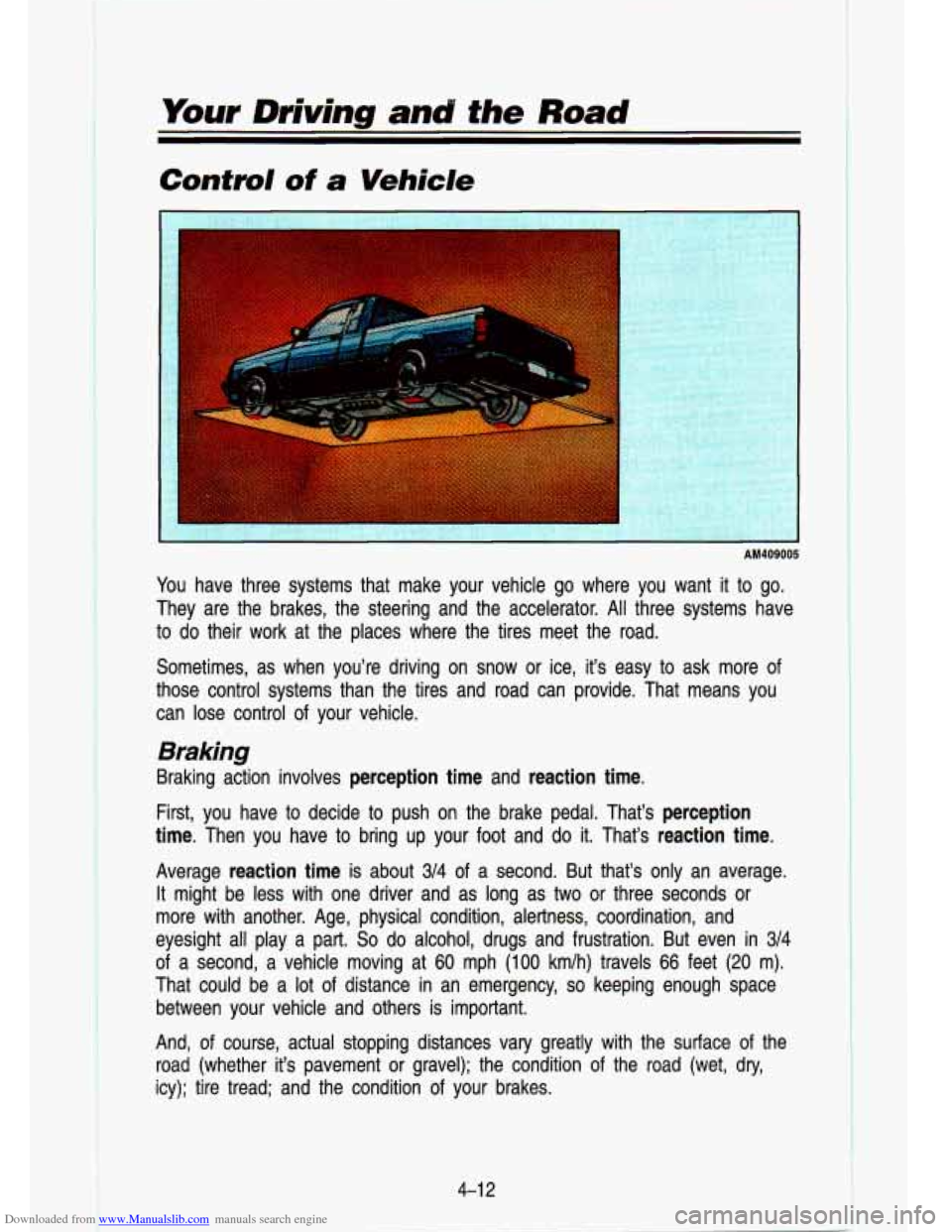
You have three systems that make your vehicle go where you want it to go.
They are the brakes, the steering and the accelerator. All thr\
ee systems have
to do their work at the places where the tires meet the road.
Sometimes, as when you’re driving on snow or ice, it’s e\
asy
to ask more of
those control systems than the tires and road can provide. Tha\
t means you
can lose control
of your vehicle.
Braking
Braking action involves perception time and reaction time.
First, you have
to decide to push on the brake pedal. That’s perception
time. Then you have to bring up your foot and do it. That’\
s reaction time.
Average reaction time is about
314 of a second. But that’s only an average.
It might be less with one driver and as long as two or three seconds or
more with another. Age, physical condition, alertness, coordinati\
on, and
eyesight all play a part.
So do alcohol, drugs and frustration. But even in 3/4
of a second, a vehicle moving at 60 mph (100 km/h) travels 66 feet (20 m).
That could be a
lot of distance in an emergency, so keeping enough space
between your vehicle and others is important.
And,
of course, actual stopping distances vary greatly with the surface of the
road (whether it’s pavement or gravel); the condition of t\
he road (wet,
dry,
icy); tire tread; and the condition of your brakes.
Page 167 of 356

Downloaded from www.Manualslib.com manuals search engine Most drivers treat their brakes with care. Some, however, overw\
ork the
braking system with poor driving habits.
Avoid needless heavy braking. Some people drive in spurts-heavy
acceleration followed by heavy braking-rather than keeping pace with
traffic. This is a mistake. Your brakes may not have time
to cool
between hard stops. Your brakes will wear out much faster
if you do a
lot of heavy braking.
Don’t “ride” the brakes by letting your left foot rest lightly on the brake
pedal while driving.
I
“Riding” your brakes can cause them to overheat to the point that
they won’t work well. You might not be able to stop your vehicle in
time
to avoid an accident. If you “ride” your brakes, they will get so
hot they will require a lot of pedal force to slow you down. Avoid
“riding” the brakes.
NOTICE
4-1 3
-
Page 168 of 356

Downloaded from www.Manualslib.com manuals search engine Your Driving and the Road
If you keep pace with the traffic and allow realistic followin\
g distances, you
will eliminate a
lot of unnecessary braking. That means better braking and
longer brake life.
a If your engine ever stops while you’re driving, brake normally but don’t
pump your brakes. If you
do, the pedal may get harder to push down. If
your engine stops, you will still have some power brake assist\
. But you
will use
it when you brake. Once the power assist is used up, it may
take longer
to stop and the brake pedal will be harder to push.
E
Antilock Brakes (ABS)
Your vehicle has an advanced electronic braking sysrem that can help\
you
keep
it under control.
I
t AM415003
Here’s how antilock works. Let’s say the road is wet. You’re driving safely.
Suddenly an animal jumps out in front of you.
You slam on the brakes. Here’s what happens with
ABS.
A computer senses that a rear wheel is slowing down. The computer works
the brakes at the rear wheels.
It is programmed to make the most of
available tire and road conditions.
4-1 4