1993 CHEVROLET S10 traction
[x] Cancel search: tractionPage 179 of 356

Downloaded from www.Manualslib.com manuals search engine Controlling your vehicle is the key to successful off-road driving. One of the
best ways to control your vehicle is to control your speed. Here are some
things to keep in mind. At higher speeds:
you approach things faster and you have less time to scan the terrain
for obstacles.
you have less time to react.
you have more vehicle bounce when you drive over obstacles.
you’ll need more distance for braking, especially since you’\
re on an
unpaved surface.
I CAUTION
A When you’re driving off road, bouncing and quick changes in direc-
1 tion can easily throw you out of position. This could cause you to
lose control and crash. So, whether you’re driving on or off the road,
you and your passengers should wear safety belts.
Scanning the Terrain
Off-road driving can take you over many different kinds of terrain. You need
to be familiar with the terrain and its many different features. \
Here are some
things
to consider.
Surface Conditions
Off-roading can take you over hard-packed dirt, gravel, rocks, grass, sand,
mud, snow or ice. Each of these surfaces affects the steering, acceleration,
and braking of your truck in different ways. Depending upon the kind of
surface you are on, you may experience slipping, sliding, wheel spinning,
delayed acceleration, poor traction, and longer braking distances\
.
Surface Obstacles
Unseen or hidden obstacles can be hazardous. A rock, log, hole, rut, or
bump can startle you
if you’re not prepared for them. Often these obstacles
are hidden by grass, bushes, snow or even the rise and fall of the terrain
itself. Here are some things to consider:
Is the path ahead clear?
Will the surface texture change abruptly up ahead?
Does the travel take you uphill or downhill? (There’s more discussion of
Will you have to stop suddenly or change direction quickly?
these subjects
later.)
4-25
Page 181 of 356

Downloaded from www.Manualslib.com manuals search engine with only a small change in elevation where you can easily see all the wa\
y
to
the top. On a large hill, the incline may get steeper as you near the top,
but you may not see this because the crest of the hill is hidden by bushes,
grass, or shrubs.
Here are some other things to consider as you approach a hill.
0
0
0
e
0
0
Is there a constant incline, or does the hill get sharply steeper in
places?
Is there good traction on the hillside, or will the surface cause tire
slipping?
Is there a straight path up or down the hill so you won’t have to make
turning maneuvers?
Are there obstructions on the hill than can block your path (\
boulders,
trees, logs or ruts)?
What’s beyond the hill?
Is there a cliff, an embankment, a drop-off, a
fence? Get out and walk the hill if you don’t know. It’s the smart way to
find out.
Is the hill simply too rough? Steep hills often have ruts, gullies, troughs
and exposed rocks because they are more susceptible to the effects of
erosion.
Driving Uphill
Once you decide you can safely drive up the hill, you need t\
o take some
special steps.
Use a lower gear and get a firm grip on the steering wheel.
Get a smooth start up the hill and try to maintain your speed. Don’t use
more power than you need, because you don’t want your wheel\
s to
start
spinning or sliding.
Try to drive straight up the hill if at all possible. If the path twists and
turns, you might want to find another route.
3 CAUTION
Turning or driving across steep hills can lbe dangerous. You could
b lose traction, slide sideways, and possibly roll over. You could be
seriously injured or killed. When driving
up hills, always try to go
straight up. I
Ease up on your speed as you approach the top of the hill.
4-27
Page 187 of 356
 your tires will tend to sink into \
the sand. This has an effect on steering, accelerating, and")
Downloaded from www.Manualslib.com manuals search engine on beaches or sand dunes) your tires will tend to sink into \
the sand. This has an effect on steering, accelerating, and braking. You may want to reduce
the air pressure in your tires slightly when driving on sand. \
This will improve
traction.
Hard packed snow and ice offer the worst tire traction. On these surfaces, it’s
very easy to lose control. On wet ice, for example, the tract\
ion
is so poor
that you will have difficulty accelerating. And
if you do get moving, poor
steering and difficult braking can cause you to slide out of control.
nds or rivers can be dangerous.
~;~:.cx :. 2’’
nderwater springs, currents under the ice, or sudden thaws can \
25
weaken the ice. Your vehicle could fall through the ice and you ad.
. your passengers could drown. Drive your vehicle on safe surface\
s
~~ : . I’ .: . :j/-
,. ,/ ., ‘!...,I:, I -
Driving In Water
Light rain causes no special off-road driving problems. But hea\
vy rain can
mean flash flooding, and flood waters demand extreme caution.
Find out how deep the water is before you drive through
it. If it’s deep
enough to cover your wheel hubs, axles, or exhaust pipe, don’t
try it-you
probably won’t get through. Also, water that deep can damage\
your axle and
other vehicle parts.
If the water isn’t too deep, then drive through it slowly. At fast speeds, water
splashes on your ignition system and your vehicle can stall. S\
talling can also
occur
if you get your tailpipe under water. And, as long as your tailp\
ipe is
under water, you’ll never be able to start your engine. Whe\
n you go through
water, remember that when your brakes get wet,
it may take you longer to
stop.
A
Driving through rushing water can be dangerous. Deep water can
sweep your vehilcle downstream and you and your passengers could
drown.
If it’s only inches deep, it can still wash away the ground
from under your tires, and you could lose traction and roll the vehicle
over.
Don’t drive through rushing water.
4-33
Page 191 of 356

Downloaded from www.Manualslib.com manuals search engine Driving in &ye Rain
I
AM455004
Rain and wet roads can mean driving trouble. On a wet road y\
ou can’t stop,
accelerate or turn as well because your tire-to-road traction isn’t as good as
on dry roads. And,
if your tires don’t have much tread left, you’ll get even
less traction.
It’s always wise to go slower and be cautious
if rain starts to fall while you
are driving. The surface may get wet suddenly when your reflexes are tuned
for driving on dry pavement.
The heavier the rain, the harder it is to see. Even
if your windshield wiper
blades are in good shape, a heavy rain can make it harder to see road signs
and traffic signals, pavement markings, the edge of the road, and even
people walking. Road spray can often be worse for vision than rain,
especially
if it comes from a dirty road.
So it is wise to keep your wiping equipment in good shape and keep your
windshield washer tank filled. Replace your windshield wiper ins\
erts when they show signs of streaking or missing areas on the windshield, or when strips of
rubber start to separate from the inserts.
4-37
Page 205 of 356
Downloaded from www.Manualslib.com manuals search engine Winter Driving
AN480001
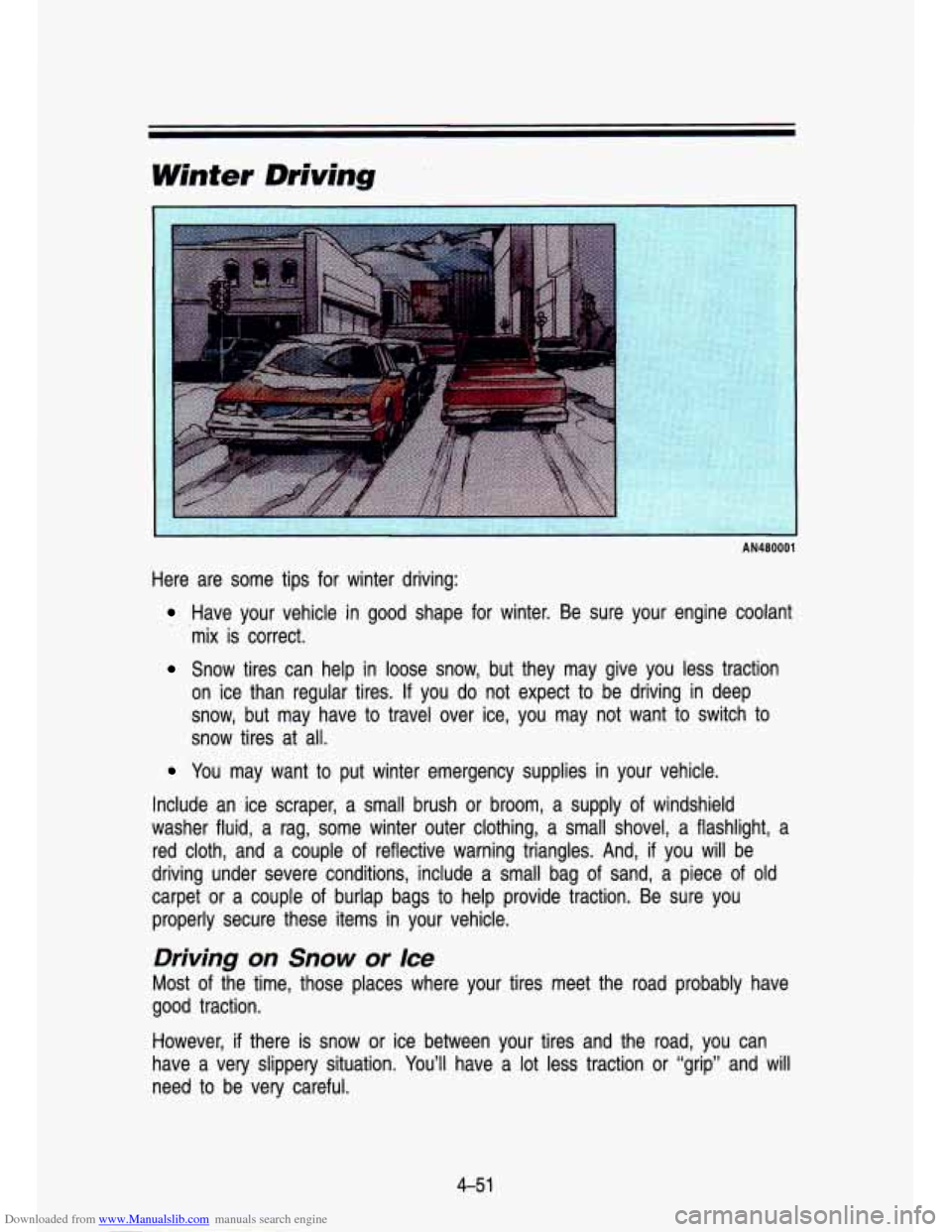
Here are some tips for winter driving:
Have your vehicle in good shape for winter. Be sure your engine coolant
mix is correct.
Snow tires can help in loose snow, but they may give you less traction
on ice than regular tires.
If you do not expect to be driving in deep
snow, but may have to travel over ice, you may not want to switch to
snow tires at all.
You may want to put winter emergency supplies in your vehicle.
Include an ice scraper, a small brush or broom, a supply of windshield
washer fluid, a rag, some winter outer clothing, a small shove\
l, a flashlight, a red cloth, and a couple of reflective warning triangles. And,
if you will be
driving under severe conditions, include a small bag of sand, a piece of old
carpet or a couple of burlap bags to help provide traction. Be sure you
properly secure these items in your vehicle.
Driving on Snow or Ice
Most of the time, those places where your tires meet the road probably\
have
good traction.
However,
if there is snow or ice between your tires and the road, you can
have a very slippery situation. You’ll have a lot less traction or “grip” and will
need to be very careful.
4-51
Page 206 of 356

Downloaded from www.Manualslib.com manuals search engine Your Driving and the Road
r-
AM480016
What’s the worst time for this? “Wet ice.” Very cold \
snow or ice can be slick
and hard
to drive on. But wet ice can be even more trouble because it ma\
y
offer the least traction of all. You can get “wet ice” when it’s about freezing
(32°F; 0°C) and freezing rain begins to fall. Try to avoid driving on wet ice
until salt and sand crews can get there.
Whatever the condition-smooth ice, packed, blowing or loose snow\
-drive
with caution. Accelerate gently. Try not
to break the fragile traction. If you
accelerate
too fast, the drive wheels will spin and polish the surface under \
the tires even more.
Your antilock brakes improve your ability
to make a hard stop on a slippery
road. Even though you have the antilock braking system, you’\
ll want
to begin
stopping sooner than you would on dry pavement. See “Antiloc\
k” in the
Index.
Allow greater following distance on any slippery road.
Watch for slippery spots. The road might be fine until you hit a spot
that’s covered with ice. On an otherwise clear road, ice pa\
tches may appear in shaded areas where the sun can’t reach: around clumps of
trees, behind buildings, or under bridges. Sometimes the surface\
of
a
curve or an overpass may remain icy when the surrounding roads\
are
clear.
If you see a patch of ice ahead of you, brake before you are on
it. Try not to brake while you’re actually on the ice, and avoid sudden
steering maneuvers.
4-52
I i
Page 294 of 356
Downloaded from www.Manualslib.com manuals search engine Service & Appearance Care
When It’s Time for New Tires
K1656
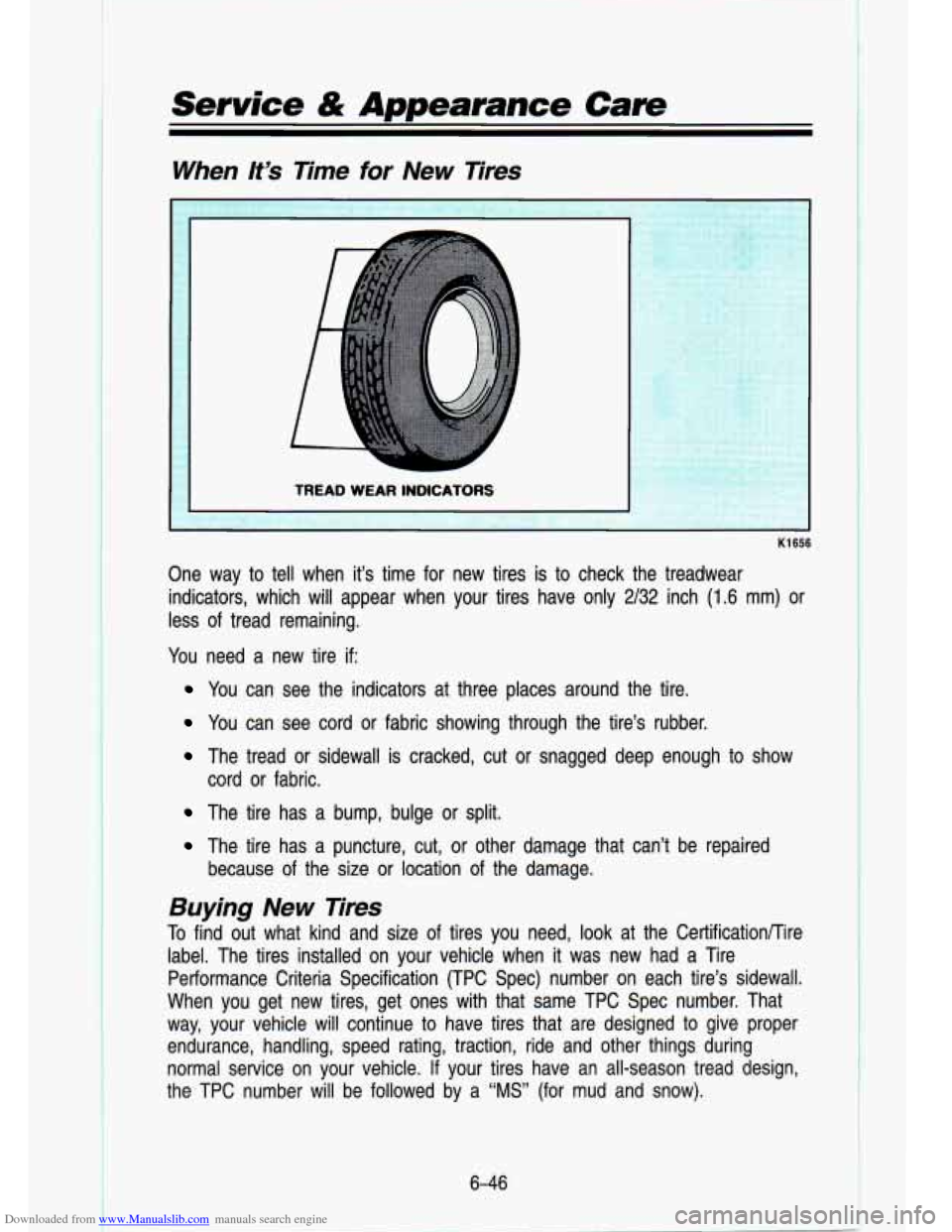
One way to tell when it’s time for new tires is to check the treadwear
indicators, which will appear when your tires have only
2/32 inch (1.6 mm) or
less of tread remaining.
You need a new tire
if:
You can see the indicators at three places around the tire.
You can see cord or fabric showing through the tire’s rubber.
The tread or sidewall is cracked, cut or snagged deep enough to show
cord or fabric.
The tire has a bump, bulge or split.
The tire has a puncture, cut, or other damage that can’t b\
e repaired
because of the size
or location of the damage.
Buying New Eres
To find out what kind and size of tires you need, look at the CertificationRire
label. The tires installed on your vehicle when it was mew had a Tire
Performance Criteria Specification (TPC Spec) number on each t\
ire’s sidewall.
When you get new tires, get ones with that same TPC Spec num\
ber. That
way, your vehicle will continue to have tires that are designed to give proper
endurance, handling, speed rating, traction, ride and other thin\
gs during
normal service on your vehicle.
If your tires have an all-season tread design,
the TPC number
will be followed by a “MS” (for mud and snow).
6-46
Page 295 of 356
Downloaded from www.Manualslib.com manuals search engine If you ever replace your tires with those not having a TPC Spec number,
make sure they are the same size, load range, speed rating an\
d construction
type (bias, bias-belted or radial) as your original tires.
Mixing tires
could cause you to lose control while driving. If you mix
tires of different types (like radial and bias-belted tires) the vehicl\
e
may nlot handle properly, an'd you could have a cras'h. Be sure to
use the same size 'and type tires on all four wheels.
It's all right to drive with your compact spare (if you have one). It
I was developed for use on your vehicle.
Uniform Tire Quality Grading
The following information relates to the system developed by th\
e United
States National Highway Traffic Safety Administration which grade\
s tires by
treadwear, traction and temperature performance. (This applies o\
nly to
vehicles
sold in the United States.)
Treadwear
The treadwear grade is a comparative rating based on the wear rate of the
tire when tested under controlled conditions on a specified government test
course. For example, a tire graded
150 would wear one and a half (1 -1/2)
times as well on the government course as a tire graded 100. The relative
performance of tires depends upon the actual conditions of their use,
however, and may depart significantly from the norm due to var\
iations in
driving habits, service practices and differences in road charac\
teristics and
climate.
Traction-A, B, C
The traction grades, from highest to lowest are: A, B, and C. They represent
the tire's ability to stop on wet pavement as measured under controlled
conditions on specified government test surfaces of asphalt and concrete.
A
tire marked C may have poor traction performance.
Warning: The traction grade assigned to this tire is based on braking
(straight-ahead) traction tests and does not include cornering \
(turning) traction.
Temperature-A, B, C
The temperature grades are A (the highest), B, and C, representing the tire's
resistance
to the generation of heat and its ability to dissipate heat when
tested under controlled conditions on a specified indoor laboratory test wheel,
Sustained high temperature can cause the material of the tire
to degenerate
and reduce tire life, and excessive temperature can lead to sudden tire
6-47