Page 162 of 324

Downloaded from www.Manualslib.com manuals search engine Your Driving and the Road
Driving with a Trailer (CONT.)
Making Turns
When you’re turning with a trailer, make wider turns than normal. Do this
so your trailer won’t strike soft
shoulders, curbs, road signs, trees, or
other objects. Avoid jerky or sudden
maneuvers. Signal well in advance.
Turn Signals When Towing a Trailer
When you tow a trailer, your vehicle has
to have a different turn signal flasher
and extra wiring. The green arrows on
your instrument panel will flash
whenever you signal a turn or lane
change. Properly hooked up, the trailer
lights will also flash, telling other
drivers you’re about to turn, change
lanes or stop.
I60
When towing a trailer, the green arrows
on your instrument panel will flash for
turns even if the bulbs on the trailer are
burned out. Thus, you may think
drivers behind you are seeing your
signal when they are not. It’s important
to check occasionally to be sure the
trailer bulbs are still working.
Your vehicle has bulb warning .lights.
When you plug trailer lights into your
vehicle’s lighting system, its bulb
warning lights may not let you know if
one
of your lights goes out. So, when
you have trailer lights plugged in, be
sure to check your vehicle and trailer
lights from time to time to be sure
they’re all working. Once you disconnect the trailer lights, the bulb
warning lights again can tell you if one
of your vehicle lights
is out.
Driving On Grades
Reduce speed and shift to a lower gear
before you start down a long or steep
downgrade. If you don’t shift down,
you
might have to use your brakes so much
that they would get hot and no longer
work well.
On a long uphill grade, shift down and
reduce your speed to around
45 mph
(70 Wh) to reduce the possibility of
engine and transaxle overheating.
If you are towing a trailer and you have
an automatic transaxle with Overdrive,
it’s best to drive in
D instead of (or,
as you need to, a lower gear). This will
minimize heat build-up and extend the
life of your transaxle.
Page 166 of 324
Downloaded from www.Manualslib.com manuals search engine Problems on the Road
.L
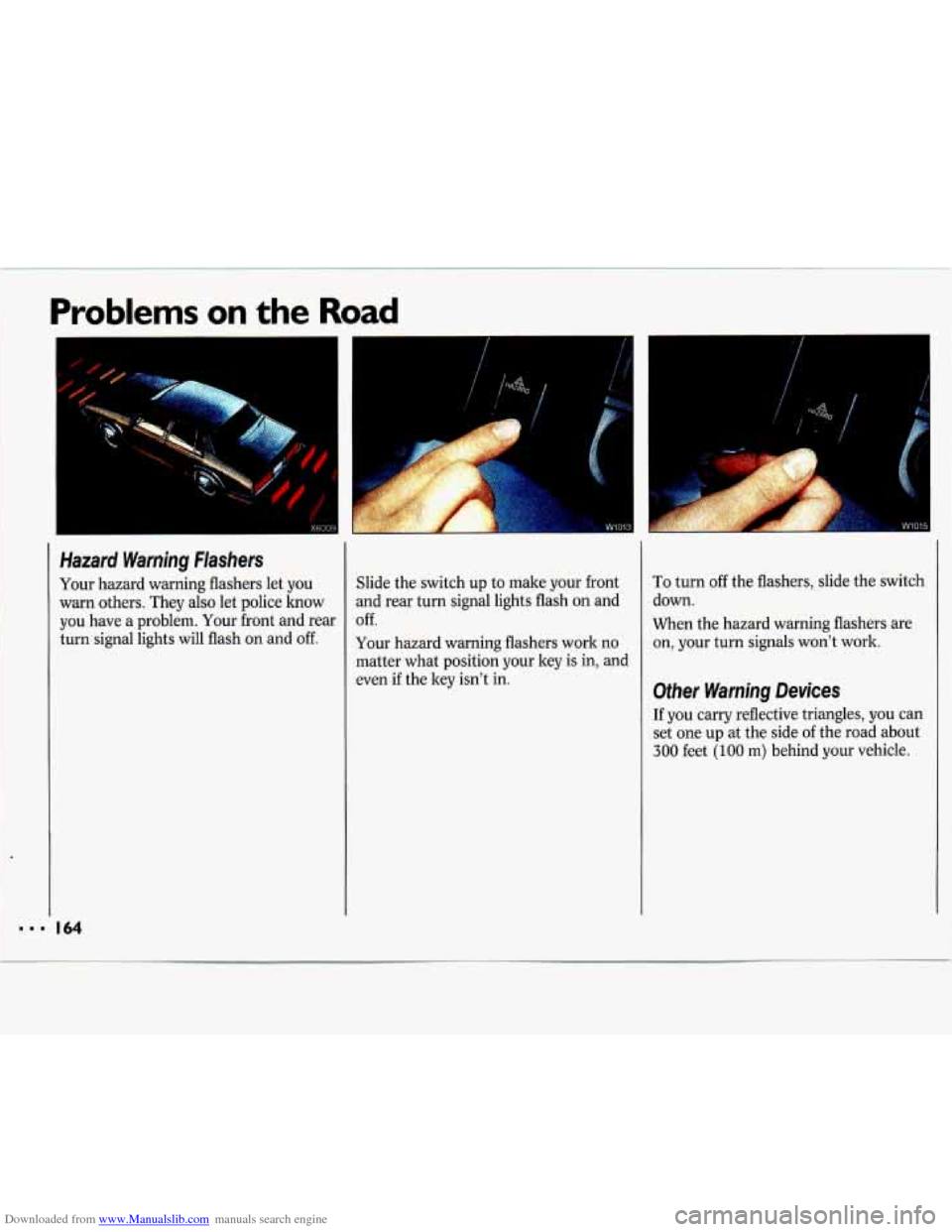
Hazard Warning Flashers
Your hazard warning flashers let you warn others. They also let police know you have a problem. Your front and rear
turn signal lights will flash on and off.
I I
Slide the switch up to make your front
and rear turn signal lights flash on and
off.
Your hazard warning flashers work no
matter what position your key
is in, and
even if the key isn't in.
... w101.5
To turn off the flashers, slide the switch
down.
When the hazard warning flashers are
on, your turn signals won't work.
Other Warning Devices
If you carry reflective triangles, you can
set one up at the side of the road about
300 feet (100 rn) behind your vehicle.
Page 168 of 324
Downloaded from www.Manualslib.com manuals search engine I
, “ >,
1 -. i,
Problems on the Road
Jump Starting (CONT.)
2. Get the vehicles close enough so the
jumper cables can reach, but be sure
the vehicles aren’t touching each
other.
If they are, it could cause a
ground connection you don’t want.
You wouldn’t be able to start your
Chevrolet, and the bad grounding
could damage the electrical systems.
You could be injured if the
vehicles roll. Set the parking
brake firmly
on each vehicle. Put an
automatic transaxle in
P (Park) or
3. Turn off the ignition on both
vehicles. Turn
off all lights that aren’t
needed, and radios. This will avoid
sparks and help save both batteries.
And it could save your radio!
If you leave your radio on, it
be badly damaged. The repairs
:,’
wouldn’t be covered by your
warranty.
4. Open the hoods and locate the
batteries.
r-
An electric fan can start up
- L even when the engine is not
running and can injure
you. Keep
hands, clothing and tools away
from any underhood electric fan.
Find the positive
(+) and negative (-)
terminals on each battery. Your
Chevrolet has a remote positive
(+)
jump starting terminal. The terminal is
on the same side of the engine
compartment as your battery.
You should always use the remote
positive
(+) terminal instead of the
positive
(+) terminal on your battery.
To uncover the remote positive
(+)
terminal, lift the red plastic cap.
Page 213 of 324

Downloaded from www.Manualslib.com manuals search engine How to Check
The proper fluid should be added if the
level does not reach the bottom of the
diaphragm when it’s
in place in the
reservoir. See the instructions on the
reservoir cap.
Engine Coolant
The following explains your cooling
system and how to add coolant when it
is low. If you have a problem with
engine overheating or
if you need to add
coolant to your radiator, see the
Index
under Engine Overheating.
The proper coolant for you1 ~ ~ ~ _et
will:
Give freezing protection c, .m to
Give boiling protection up to 262°F
Protect against rust and corrosion.
Help keep the proper engine
Let the warning lights work as they
What to Use:
Use a mixture of one-half clean water
(preferably distilled) and one-half
antifreeze that meets
“GM Specification
1825-M,” which won’t damage ,
-34°F (-37°C).
(128°C).
temperature. should. aluminum
parts. You can
also use a
recycled coolant conforming to
GM
Specification 1825-M with a complete
coolant flush and refill. If you use this
mixture, you don’t need to add anything
else.
I
9
Adding only plain water to
your cooling system can be
dangerous. Plain water, or some
other liquid like alcohol, can boil
before the proper coolant mix will.
Your vehicle’s coolant warning
system is set for the proper coolant
mix. With plain water or the wrong
mix, your engine could get too hot
but you wouldn’t get the overheat
warning. Your engine could catch fire and you or others could be
burned. Use a
50/50 mix of clean
water and a proper antifreeze.
Page 220 of 324
Downloaded from www.Manualslib.com manuals search engine Service & Appearance Care
I
Battery
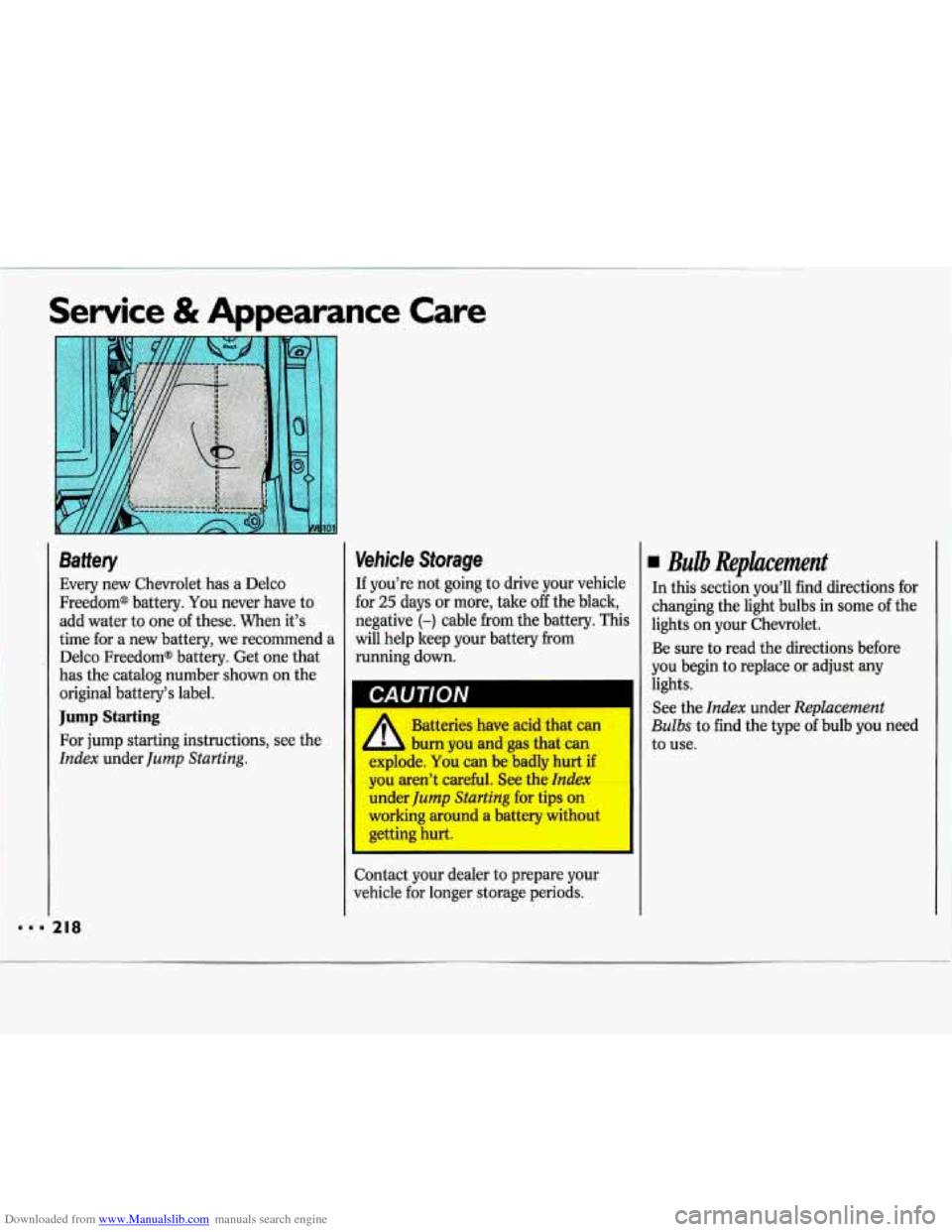
Every new Chevrolet has a Delco
Freedom@ battery. You never have to
add water to one of these. When it’s
time for a new battery, we recommend a
Delco Freedom@ battery. Get one that
has the catalog number shown on the
original battery’s label.
Jump Starting
For jump starting instructions, see the
Index under Jump Starting.
Vehicle Storage
If you’re not going to drive your vehicle
for
25 days or more, take off the black,
negative
(-) cable from the battery. This
will help keep your battery from
running down.
x Batteries have acid that can
L burn you and gas that can
explode. You can be badly hurt if
you aren’t careful. See the Index
under Jump Starting for tips on
working around
a battery without
getting hurt.
Contact your dealer to prepare your
vehicle for longer storage periods.
Bulb Rephcement
In this section you’ll find directions for
changing the light bulbs in some of the
lights on your Chevrolet.
Be sure to read the directions before
you begin to replace or adjust any
lights.
See the
Index under Replacement
Bulbs to find the type of bulb you need
to use.
Page 221 of 324
Downloaded from www.Manualslib.com manuals search engine Halogen Bulbs I Headlight Bulb Replacement
Halogen bulbs have
pressurized
gas inside and
can burst if you drop or scratch the
bulb.
You or others could be
injured. Take special care when
handling and disposing
of halogen
bulbs.
Bulbs to check the type-of bulb to use.
To Replace a Bulb:
1. Open the hood. Open the protective
panel above the headlights.
2. Reach behind the headlights and turn
the socket counterclockwise until it
pops loose
from the housing.
3. Pull the socket and bulb free.
Page 223 of 324
Downloaded from www.Manualslib.com manuals search engine Front Side Marker Bulb
Replacement
See the Index under Replacement
Bulbs to check the type of bulb to use.
To Replace a Bulb:
1. Open the hood. Open the panel
2. Unscrew the bolt behind the front
above
the headlights.
side marker
light assembly.
3. Turn the socket counterclockwise
until
it stops. Then pull the socket
and bulb from the side marker light
assembly.
4. Pull the bulb out of the socket. Do
not twist the bulb.
5. Plug the new bulb in the socket.
6. Replace the bulb and socket in the
7. Replace the assembly in the vehicle.
side marker light assembly.
Replace the bolt.
Center High-Mounted Stoplight
Bulb Repkcememt
See the Index under Replacement
BuZbs to check the type of bulb to use.
If you would like to clean the inside
surface
of the rear window or need to
replace a bulb, you can remove the
stoplight housing by following these
steps:
1. Remove the screws and pull the cover
down.
Page 244 of 324
Downloaded from www.Manualslib.com manuals search engine Service & Appearance Care
Glove Box Fuse Block
I-
. . . 242
W61561
Fuse
3
4
5
6
7
8
9
10
11
12
13
14
15
16
17
18
15
25
10
15
15
20
15
10 5
25
10 10
Rating Circuitry
1 10 Radio & Clock
2 15 Radio & Clock; Passive Restraint Lockout; Delcom
Bose Amplifier
Door Lock; Courtesy, Glove
Box, Underhood, Trunk,
Modular Dim Lights; Lighted Visor Mirror
Windshield Wiper
& Washer
Temp Door Motor; HVAC
& Rear Defogger; DRL
Module (Canada)
Brake Lights; ABS Control Module
ECM
Taillights; Radio
& Clock HVAC; Chime Module;
DRL Module (Canada)
Hazard Warning Flasher
Rear Defogger Timer Relay; Instrument Cluster;
Chime Module; Cruise Control; DIU Module (Canada);
ABS Lamp Driver
Instrument Panel and Switch Lights
HVAC
Turn Signals/Flasher
Not Used
ABS Control Module
Not Used
Not Used
Not Used
(AMP.)