Page 87 of 324
Downloaded from www.Manualslib.com manuals search engine The Instrument Panel-
Your Information System
Your instrument panel is designed to let
you know at
a glance how your vehicle
is running. You’ll know how fast you’re
going, how much. fuel you’re using, and
many other things you’ll need to drive
safely and economically.
The main components
of your
instrument panel are:
1. Vents
2. Turn SignaVHeadlight Beam Lever
3. Tilt Steering Wheel Lever
4. Instrument Cluster
5. Hazard Warning Flashers Switch
6. Vents
7. Climate ControWRear Window
8. Vents
9. Vents Defogger
10. Glove
BodFuse Panel
11. Audio System
12. Gearshift Lever
13. Ashtray and Lighter
14. Ignition Switch
15. Horn
16. Remote Trunk Release (Option)
17. Brake Release
18. Light Controls
19. Hood Release (on floor by driver’s
door)
Page 88 of 324
Downloaded from www.Manualslib.com manuals search engine Features & Controls
Instrument Panel Clusters
Your Chevrolet is equipped with one of these instrument panel clusters, which
includes indicator warning lights and gages that are explained
on the following
pages. Be sure to read about those that apply to the instrument panel cluster for
your Chevrolet
.
STANDARD CLUSTER
cw2054
OPTIONAL CLUSTER
W2173
Page 89 of 324

Downloaded from www.Manualslib.com manuals search engine Warning Lights, Gages and
Indicators
This section describes the warning lights
and gages that may be on your vehicle.
The pictures will help you locate them.
Warning lights and gages can signal that
something is wrong before it becomes
serious enough to cause an expensive
repair or replacement. Paying attention
to your warning lights and gages could
also save you or others
from injury.
Warning lights go on when there may
be or is a problem with one of your
vehicle’s functions.
As you will see in the
details on the next few pages, some
warning lights come on briefly when
you turn the ignition key just to let you
lmow they’re working. If you are
familiar with this section, you should
not be alarmed when this happens.
Gages can indicate when there may be
or is a problem with one
of your
vehicle’s functions. Often gages and
warning lights work together to let you
know when there’s a problem with your
vehicle. When
one of the warning lights comes
on and stays on when you are driving,
or when one of the gages shows there
may be a problem, check the section
that tells you what to do about it. Please
follow the manual’s advice. Waiting to
do repairs can be costly-and even
dangerous, So please get to how your
warning lights and gages. They’re a big
help.
87
Page 92 of 324

Downloaded from www.Manualslib.com manuals search engine Features & Controls
Engine Coolant Temperature Warning Light
This light tells you that your engine
coolant has overheated or your radiator
cooling fan is not working. If you have
been operating your vehicle under normal driving conditions, you should
pull
off the road, stop your vehicle and
turn the engine
off as soon as possible.
HOT COOLANT CAN BURN YOU
BADLY!
In
Problems on the Road, this manual
shows what to
do. See the Index under
Engine Overheating.
Engine Coolant Temperature
Gage
(OPTION)
If you have the gage cluster, you have a
gage that shows the engine coolant
temperature. If the gage pointer moves
into the red area, your engine is too hot!
That reading means the same thing as
the warning light. It means that your
engine coolant has overheated. If you
have been operating your vehicle under
normal driving conditions, you should
pull
off the road, stop your vehicle and
turn off the engine as soon as possible.
HOT COOLANT CAN BURN
YOU
BADLY!
In
Problems on the Road, this manual
shows what to do. See the
Index under
Engine Overheating.
Low Coolant Warning Light
(v6 ENGINES)
If this light comes on, your system is
low on coolant and the engine may
overheat. See the
Index under Engine
Coolant and have your vehicle serviced
as soon as you can.
Page 94 of 324

Downloaded from www.Manualslib.com manuals search engine Features & Controls
Voltmeter (OPTION)
When the engine is running, the gage
shows the condition of the charging
system. Readings between the red
warning zones indicate the normal
operating range.
Readings in either red warning zone
indicate
a possible problem in the
electrical system. Have your vehicle
serviced immediately.
When your engine is not running, but
the ignition is on (in
the Run position),
the gage shows your battery’s state of
charge.
Battery Warning Light
The charging system light will come on
briefly when you turn on the ignition as
a check to show you it is working. Then
it should
go out. If it stays on, or comes
on while you are driving, you may have
a problem with the electrical charging
system. It could indicate that you have
a loose generator drive belt or another
electrical problem. Have it checked
right away. Driving while this light is on could drain your battery.
If you must drive a short distance with
the light
on, be certain to turn off all
your accessories, such as the radio and
air conditioner.
Brake System Warning Light
Your Chevrolet’s hydraulic brake
system
is divided into two parts. If one
part isn’t working, the other part can
still work and stop you.
For good
braking, though, you need both parts
working well.
If the warning light goes
on, there could be a brake problem.
Have your brake system inspected right
away.
This light should come on as you start
the vehicle. If it doesn’t come on then,
have it fixed
so it will be ready to warn
you
if there’s a problem.
Page 95 of 324
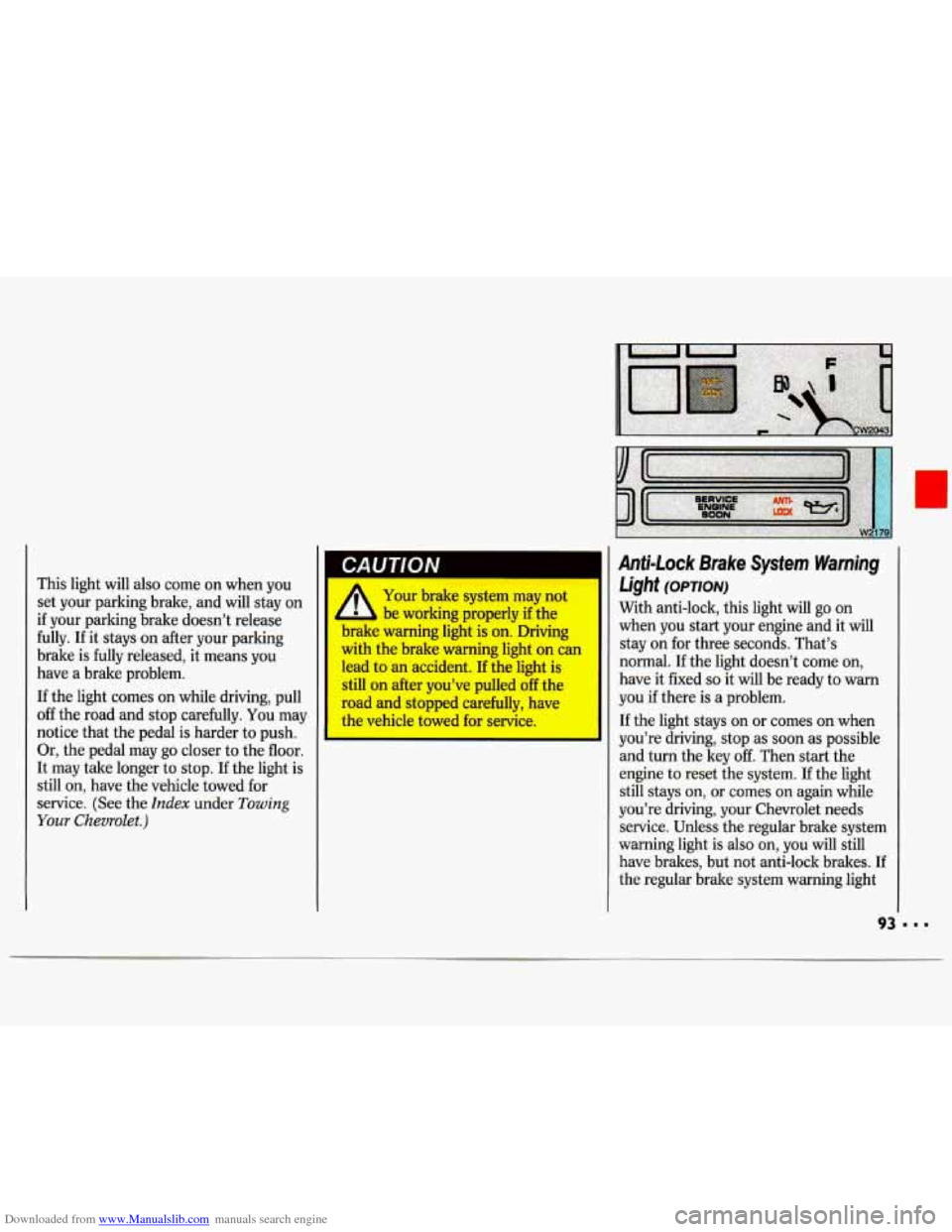
Downloaded from www.Manualslib.com manuals search engine This light will also come on when you
set your parking brake, and
will stay on
if your parking brake doesn’t release
fully. If it stays on after your parking
brake is fully released, it means you
have a brake problem.
If the light comes on while driving, pull
off the road and stop carefully. You may
notice that the pedal is harder to push.
Or, the pedal may go closer to the floor.
It may take longer to stop.
If the light is
still on, have the vehicle towed for
service. (See the
Index under Towing
Your Chevrolet.)
-
gu1/QIv ,1
A Your brake system may not ’ ‘ be working properly if the
LJlimt; warning light is on. Driving
with the brake warning light on can
lead to an accident. If the light is
still on after you’ve pulled off the
road and stopped carefully, have
the vehicle towed for service.
I I
Anti-Lock Brake System Warning
Light
(OPTION)
With anti-lock, this light will go on
when you start your engine and it will
stay on for three seconds. That’s
normal.
If the light doesn’t come on,
have it fixed
so it will be ready to warn
you
if there is a problem.
If the light stays on or comes on when
you’re driving, stop as soon
as possible
and turn the key
off. Then start the
engine to reset the system. If the light
still stays on, or comes
on again while
you’re driving, your Chevrolet needs service. Unless the regular brake system
warning light is also on, you will still
have brakes, but not anti-lock brakes. If
the regular brake system warning light
Page 96 of 324
Downloaded from www.Manualslib.com manuals search engine Features & Controls
Anti-Lock Brake System Warning Light
(CONT.)
is also on, see Brake System Warning
Light
earlier in this section.
If the anti-lock brake system warning
light ever flashes, your anti-lock brake system is still working but needs service
as
soon as possible.
Upshift lndicafor Light
(MANUAL TRANSAXLE)
This light comes on when you need to
shift to the next higher gear. See the
Index under Shift Light.
Malfunction lndicafor Lamp
(Service Engine Soon Light)
A computer monitors operation of your
fuel, ignition and emission control
systems. This light should come
on
when the ignition is on, but the engine
is not running, as a check to show you
it is working. If it does not come on at
all, have it fixed right away. If it stays
on, or it comes
on while you are driving,
the computer is indicating that you
have a problem.
You should take your
vehicle in for service soon.
94
Page 120 of 324
Downloaded from www.Manualslib.com manuals search engine Your Driving and the Road
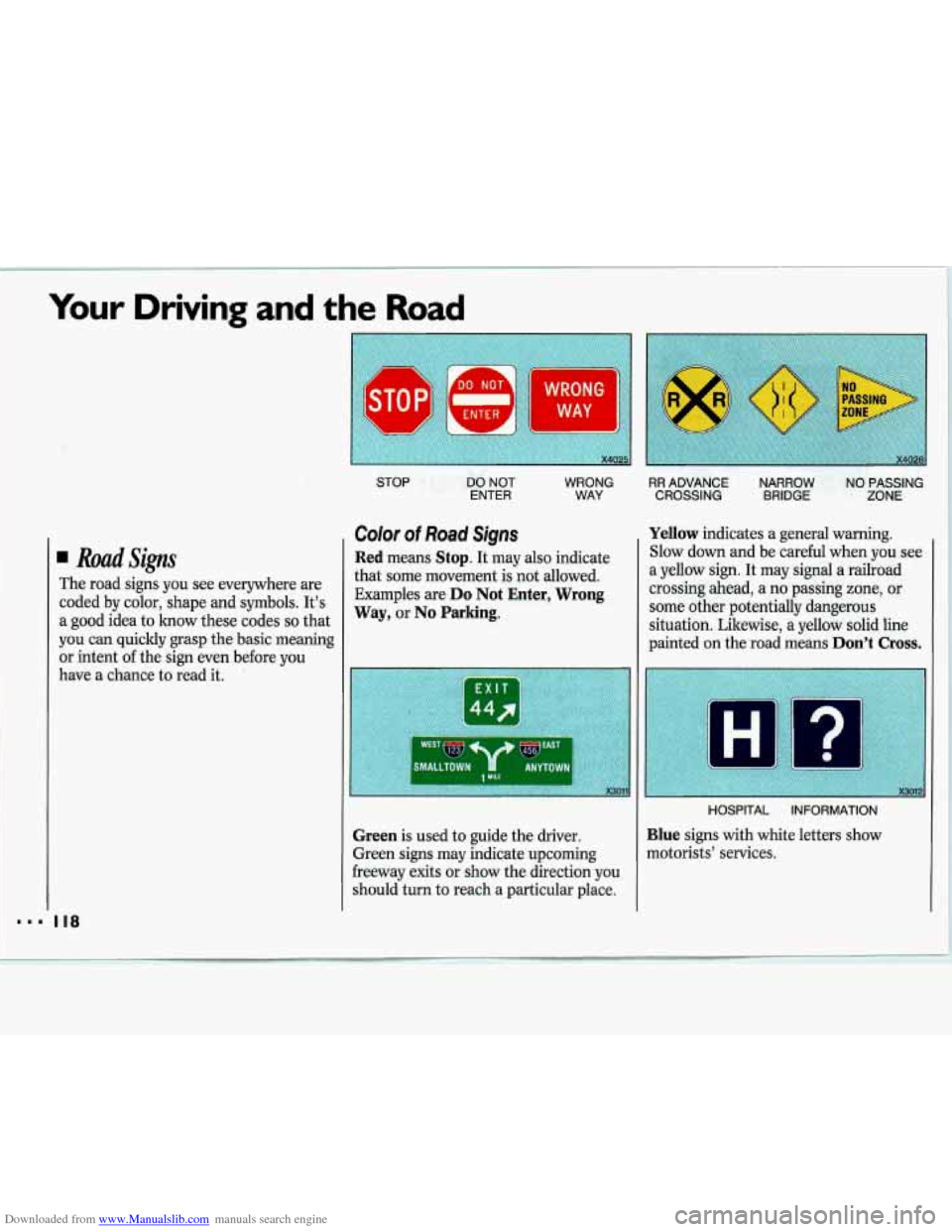
Road Signs
The road signs you see everywhere are coded by color, shape and symbols. It’s
a good idea to lmow these codes
so that
you can quickly grasp the basic meaning
or intent
of the sign even before you
have a chance to read it.
Color of Road Signs
Red means Stop. It may also indicate
that some movement is not allowed.
Examples are
Do Not Enter, Wrong
Way,
or No Parking.
Green
is used to guide the driver.
Green signs may indicate upcoming
freeway exits or show the direction you
should turn to reach a particular place.
RR ADVANCE NARROW NO PASSING
CROSSING BRIDGE ZONE
Yellow indicates a general warning.
Slow down and be careful when you see
a yellow sign. It may signal a railroad
crossing ahead, a no passing zone, or
some other potentially dangerous
situation. Likewise, a yellow solid line
painted on the road means
Don’t Cross.
HOSPITAL INFORMATION
Blue signs with white letters show
motorists’ services.


