1993 CHEVROLET DYNASTY engine
[x] Cancel search: enginePage 218 of 2438
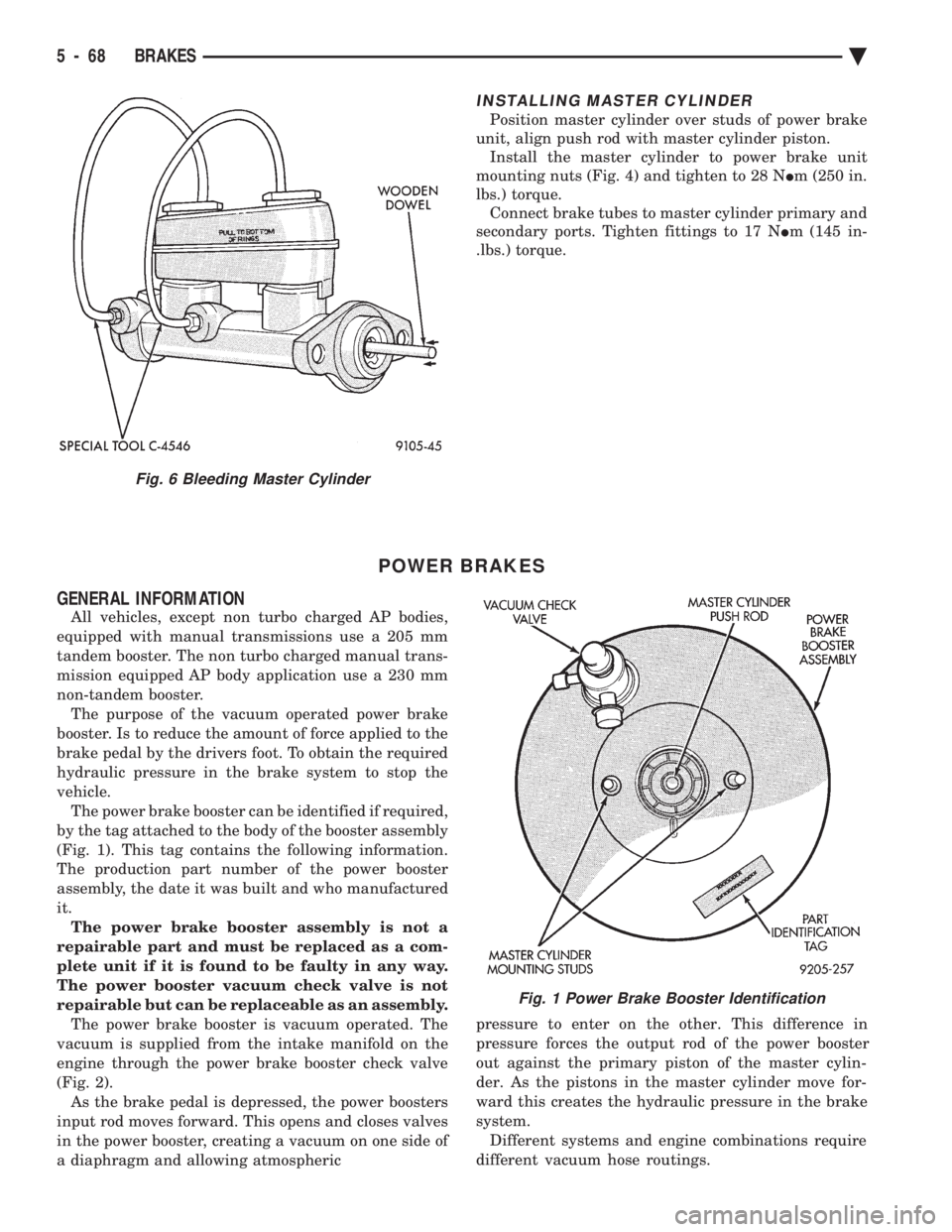
INSTALLING MASTER CYLINDER
Position master cylinder over studs of power brake
unit, align push rod with master cylinder piston. Install the master cylinder to power brake unit
mounting nuts (Fig. 4) and tighten to 28 N Im (250 in.
lbs.) torque. Connect brake tubes to master cylinder primary and
secondary ports. Tighten fittings to 17 N Im (145 in-
.lbs.) torque.
POWER BRAKES
GENERAL INFORMATION
All vehicles, except non turbo charged AP bodies,
equipped with manual transmissions use a 205 mm
tandem booster. The non turbo charged manual trans-
mission equipped AP body application use a 230 mm
non-tandem booster. The purpose of the vacuum operated power brake
booster. Is to reduce the amount of force applied to the
brake pedal by the drivers foot. To obtain the required
hydraulic pressure in the brake system to stop the
vehicle. The power brake booster can be identified if required,
by the tag attached to the body of the booster assembly
(Fig. 1). This tag contains the following information.
The production part number of the power booster
assembly, the date it was built and who manufactured
it. The power brake booster assembly is not a
repairable part and must be replaced as a com-
plete unit if it is found to be faulty in any way.
The power booster vacuum check valve is not
repairable but can be replaceable as an assembly. The power brake booster is vacuum operated. The
vacuum is supplied from the intake manifold on the
engine through the power brake booster check valve
(Fig. 2). As the brake pedal is depressed, the power boosters
input rod moves forward. This opens and closes valves
in the power booster, creating a vacuum on one side of
a diaphragm and allowing atmospheric pressure to enter on the other. This difference in
pressure forces the output rod of the power booster
out against the primary piston of the master cylin-
der. As the pistons in the master cylinder move for-
ward this creates the hydraulic pressure in the brake
system. Different systems and engine combinations require
different vacuum hose routings.
Fig. 6 Bleeding Master Cylinder
Fig. 1 Power Brake Booster Identification
5 - 68 BRAKES Ä
Page 219 of 2438
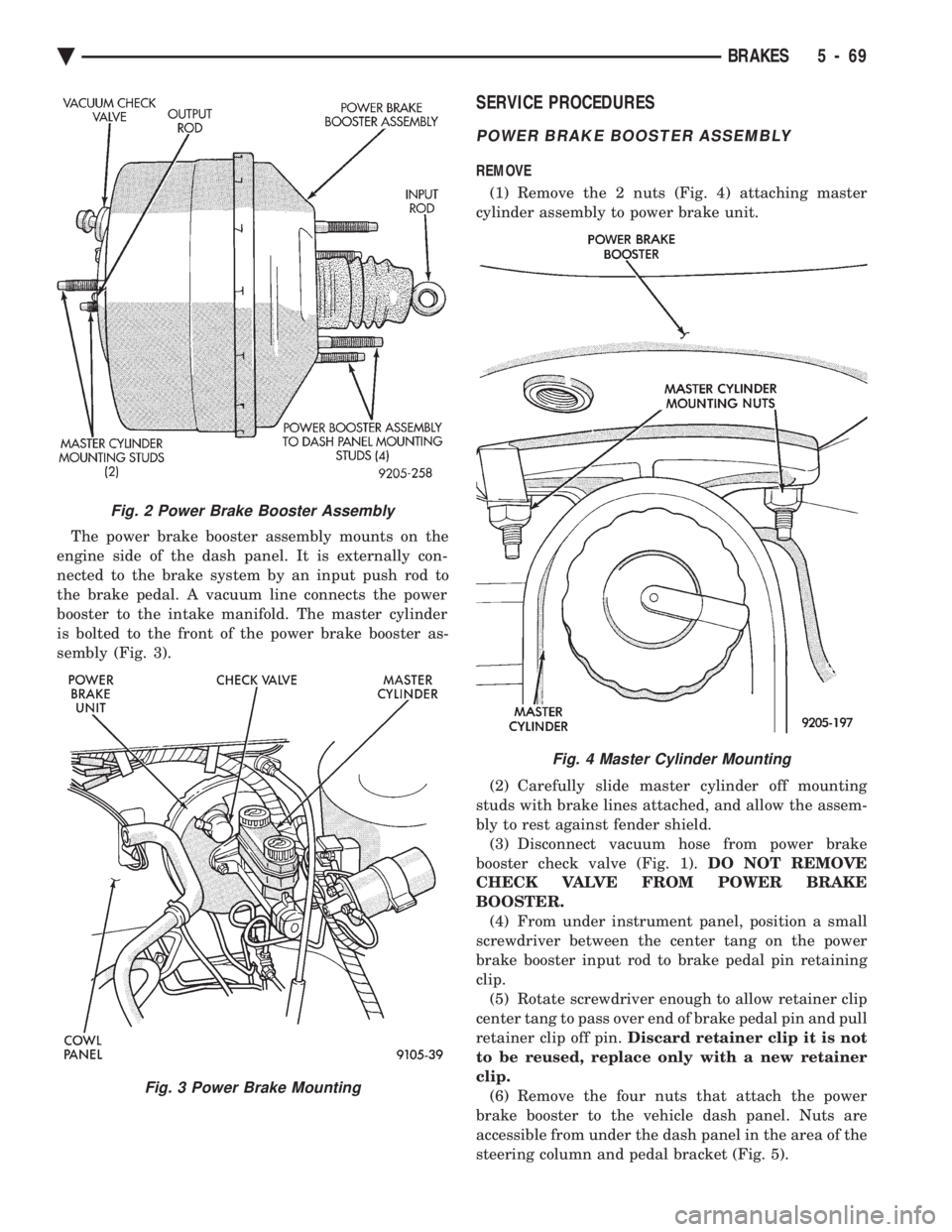
The power brake booster assembly mounts on the
engine side of the dash panel. It is externally con-
nected to the brake system by an input push rod to
the brake pedal. A vacuum line connects the power
booster to the intake manifold. The master cylinder
is bolted to the front of the power brake booster as-
sembly (Fig. 3).
SERVICE PROCEDURES
POWER BRAKE BOOSTER ASSEMBLY
REMOVE
(1) Remove the 2 nuts (Fig. 4) attaching master
cylinder assembly to power brake unit.
(2) Carefully slide master cylinder off mounting
studs with brake lines attached, and allow the assem-
bly to rest against fender shield. (3) Disconnect vacuum hose from power brake
booster check valve (Fig. 1). DO NOT REMOVE
CHECK VALVE FROM POWER BRAKE
BOOSTER. (4) From under instrument panel, position a small
screwdriver between the center tang on the power
brake booster input rod to brake pedal pin retaining
clip. (5) Rotate screwdriver enough to allow retainer clip
center tang to pass over end of brake pedal pin and pull
retainer clip off pin. Discard retainer clip it is not
to be reused, replace only with a new retainer
clip. (6) Remove the four nuts that attach the power
brake booster to the vehicle dash panel. Nuts are
accessible from under the dash panel in the area of the
steering column and pedal bracket (Fig. 5).
Fig. 2 Power Brake Booster Assembly
Fig. 3 Power Brake Mounting
Fig. 4 Master Cylinder Mounting
Ä BRAKES 5 - 69
Page 221 of 2438
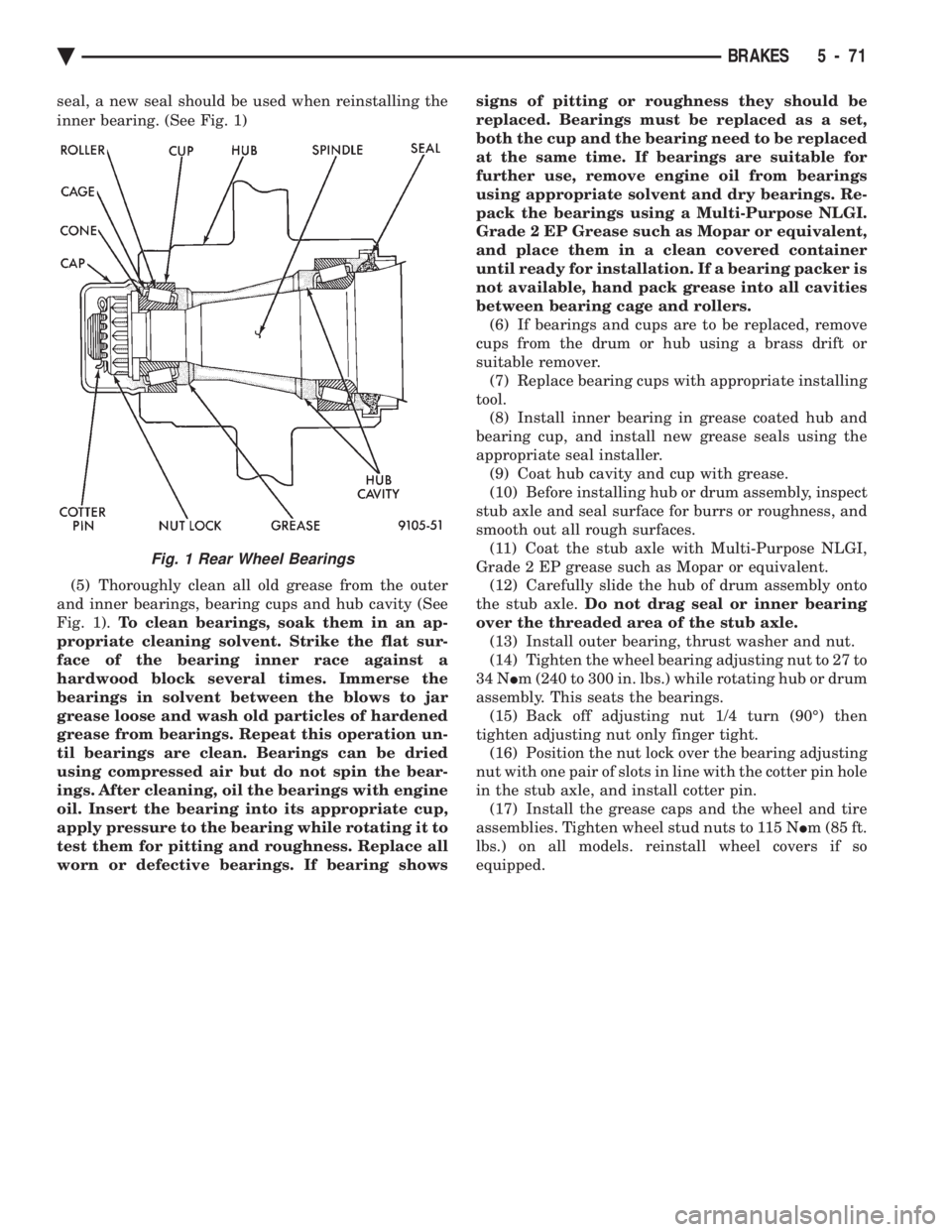
seal, a new seal should be used when reinstalling the
inner bearing. (See Fig. 1) (5) Thoroughly clean all old grease from the outer
and inner bearings, bearing cups and hub cavity (See
Fig. 1). To clean bearings, soak them in an ap-
propriate cleaning solvent. Strike the flat sur-
face of the bearing inner race against a
hardwood block several times. Immerse the
bearings in solvent between the blows to jar
grease loose and wash old particles of hardened
grease from bearings. Repeat this operation un-
til bearings are clean. Bearings can be dried
using compressed air but do not spin the bear-
ings. After cleaning, oil the bearings with engine
oil. Insert the bearing into its appropriate cup,
apply pressure to the bearing while rotating it to
test them for pitting and roughness. Replace all
worn or defective bearings. If bearing shows signs of pitting or roughness they should be
replaced. Bearings must be replaced as a set,
both the cup and the bearing need to be replaced
at the same time. If bearings are suitable for
further use, remove engine oil from bearings
using appropriate solvent and dry bearings. Re-
pack the bearings using a Multi-Purpose NLGI.
Grade 2 EP Grease such as Mopar or equivalent,
and place them in a clean covered container
until ready for installation. If a bearing packer is
not available, hand pack grease into all cavities
between bearing cage and rollers. (6) If bearings and cups are to be replaced, remove
cups from the drum or hub using a brass drift or
suitable remover. (7) Replace bearing cups with appropriate installing
tool. (8) Install inner bearing in grease coated hub and
bearing cup, and install new grease seals using the
appropriate seal installer. (9) Coat hub cavity and cup with grease.
(10) Before installing hub or drum assembly, inspect
stub axle and seal surface for burrs or roughness, and
smooth out all rough surfaces. (11) Coat the stub axle with Multi-Purpose NLGI,
Grade 2 EP grease such as Mopar or equivalent. (12) Carefully slide the hub of drum assembly onto
the stub axle. Do not drag seal or inner bearing
over the threaded area of the stub axle. (13) Install outer bearing, thrust washer and nut.
(14) Tighten the wheel bearing adjusting nut to 27 to
34 N Im (240 to 300 in. lbs.) while rotating hub or drum
assembly. This seats the bearings. (15) Back off adjusting nut 1/4 turn (90É) then
tighten adjusting nut only finger tight. (16) Position the nut lock over the bearing adjusting
nut with one pair of slots in line with the cotter pin hole
in the stub axle, and install cotter pin. (17) Install the grease caps and the wheel and tire
assemblies. Tighten wheel stud nuts to 115 N Im (85 ft.
lbs.) on all models. reinstall wheel covers if so
equipped.
Fig. 1 Rear Wheel Bearings
Ä BRAKES 5 - 71
Page 246 of 2438
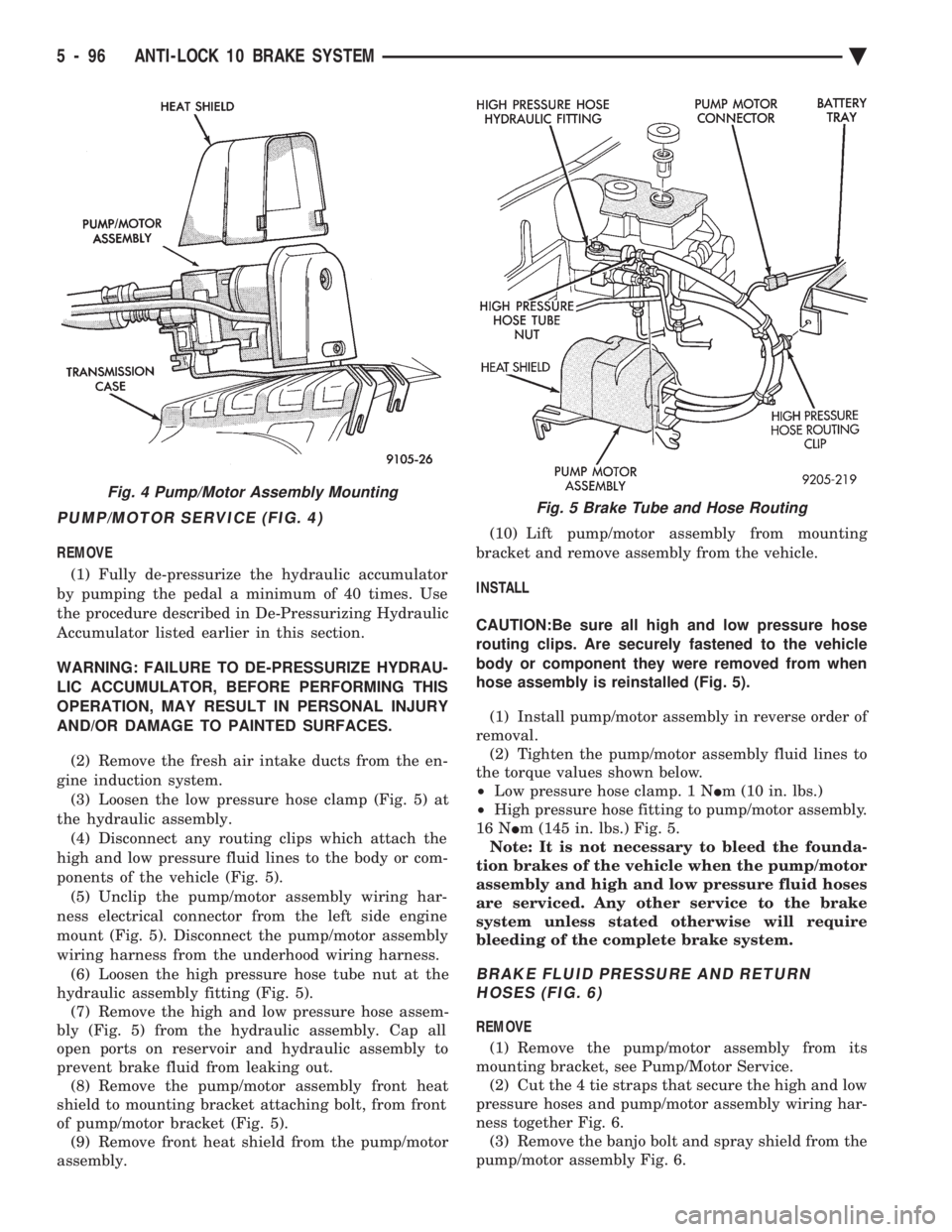
PUMP/MOTOR SERVICE (FIG. 4)
REMOVE (1) Fully de-pressurize the hydraulic accumulator
by pumping the pedal a minimum of 40 times. Use
the procedure described in De-Pressurizing Hydraulic
Accumulator listed earlier in this section.
WARNING: FAILURE TO DE-PRESSURIZE HYDRAU-
LIC ACCUMULATOR, BEFORE PERFORMING THIS
OPERATION, MAY RESULT IN PERSONAL INJURY
AND/OR DAMAGE TO PAINTED SURFACES.
(2) Remove the fresh air intake ducts from the en-
gine induction system. (3) Loosen the low pressure hose clamp (Fig. 5) at
the hydraulic assembly. (4) Disconnect any routing clips which attach the
high and low pressure fluid lines to the body or com-
ponents of the vehicle (Fig. 5). (5) Unclip the pump/motor assembly wiring har-
ness electrical connector from the left side engine
mount (Fig. 5). Disconnect the pump/motor assembly
wiring harness from the underhood wiring harness. (6) Loosen the high pressure hose tube nut at the
hydraulic assembly fitting (Fig. 5). (7) Remove the high and low pressure hose assem-
bly (Fig. 5) from the hydraulic assembly. Cap all
open ports on reservoir and hydraulic assembly to
prevent brake fluid from leaking out. (8) Remove the pump/motor assembly front heat
shield to mounting bracket attaching bolt, from front
of pump/motor bracket (Fig. 5). (9) Remove front heat shield from the pump/motor
assembly. (10) Lift pump/motor assembly from mounting
bracket and remove assembly from the vehicle.
INSTALL
CAUTION:Be sure all high and low pressure hose
routing clips. Are securely fastened to the vehicle
body or component they were removed from when
hose assembly is reinstalled (Fig. 5).
(1) Install pump/motor assembly in reverse order of
removal. (2) Tighten the pump/motor assembly fluid lines to
the torque values shown below.
² Low pressure hose clamp. 1 N Im (10 in. lbs.)
² High pressure hose fitting to pump/motor assembly.
16 N Im (145 in. lbs.) Fig. 5.
Note: It is not necessary to bleed the founda-
tion brakes of the vehicle when the pump/motor
assembly and high and low pressure fluid hoses
are serviced. Any other service to the brake
system unless stated otherwise will require
bleeding of the complete brake system.
BRAKE FLUID PRESSURE AND RETURN HOSES (FIG. 6)
REMOVE
(1) Remove the pump/motor assembly from its
mounting bracket, see Pump/Motor Service. (2) Cut the 4 tie straps that secure the high and low
pressure hoses and pump/motor assembly wiring har-
ness together Fig. 6. (3) Remove the banjo bolt and spray shield from the
pump/motor assembly Fig. 6.
Fig. 4 Pump/Motor Assembly MountingFig. 5 Brake Tube and Hose Routing
5 - 96 ANTI-LOCK 10 BRAKE SYSTEM Ä
Page 298 of 2438
BENDIX ANTILOCK 4 BRAKE SYSTEM INDEX
page page
ABS Brake System Diagnostic Features ....... 24
ABS Computer System Service Precautions .... 23
ABS General Service Precautions ............ 23
Antilock Brake System Components .......... 16
Antilock Brake System Definitions ............ 14
Antilock Brakes Operation and Performance .... 15
Antilock System Relays and Warning Lamps .... 19
Bendix Antilock 4 Brake System Diagnostics .... 22
Bleeding Bendix Antilock 4 Brake System ...... 25
Controller Antilock Brake Cab ............... 18
Diagnostic Connector ..................... 19 Electronic Components
.................... 41
General Information ....................... 12
Hydraulic Circuits and Valve Operation ........ 20
Major Components ....................... 14
Mechanical Diagnostics and Service Procedures . 24
Normal Brake System Function .............. 14
On-Car ABS Brake System Service ........... 25
Specifications ........................... 46
System Self-Diagnostics ................... 15
Vehicle Performance ...................... 15
Warning Systems Operation ................ 16
GENERAL INFORMATION
The purpose of an Anti-Lock Brake System is to
prevent wheel lock-up under heavy braking condi-
tions on virtually any type of road surface. Antilock
Braking is desirable because a vehicle which is
stopped without locking its wheels will retain direc-
tional stability and some steering capability. This al-
lows a driver to retain greater control of the vehicle
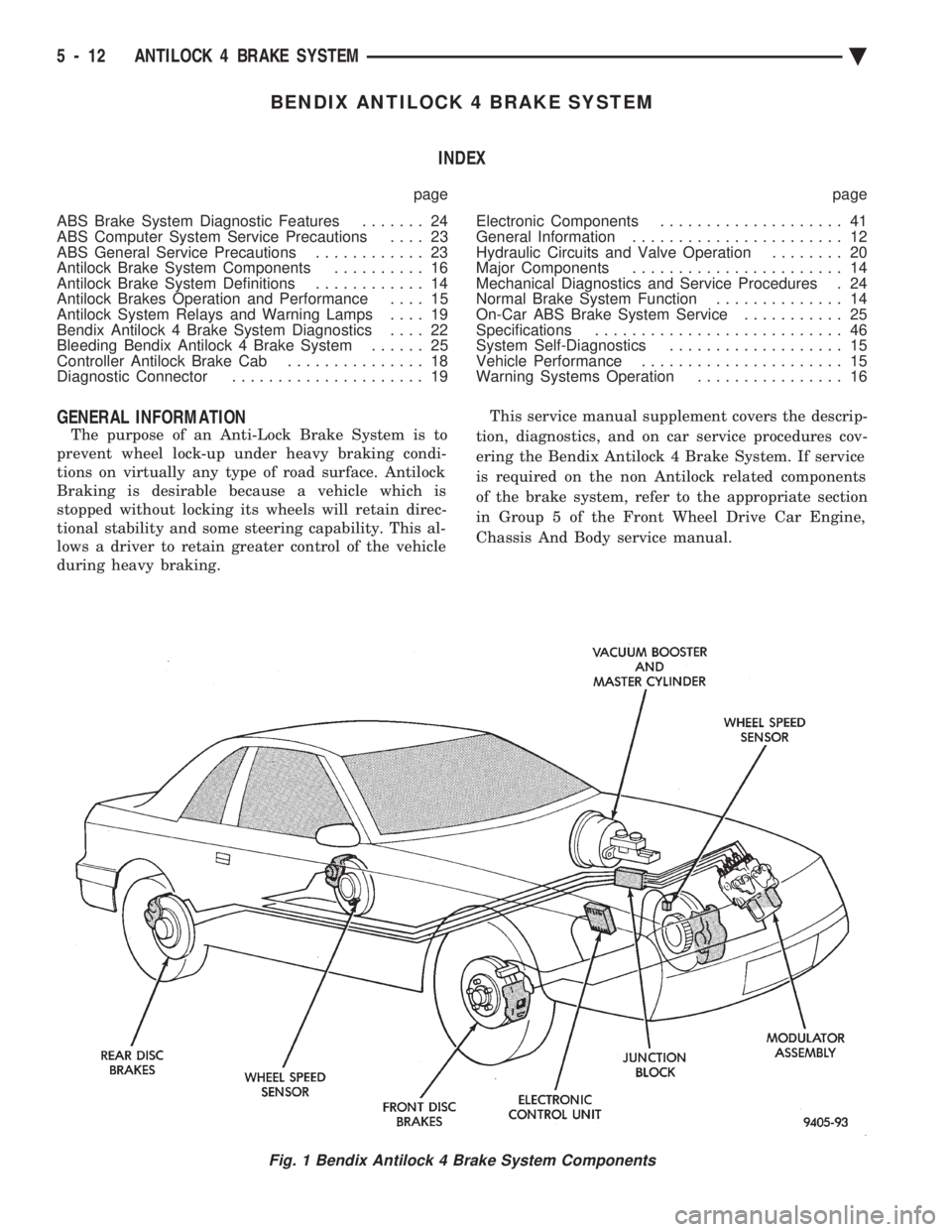
during heavy braking. This service manual supplement covers the descrip-
tion, diagnostics, and on car service procedures cov-
ering the Bendix Antilock 4 Brake System. If service
is required on the non Antilock related components
of the brake system, refer to the appropriate section
in Group 5 of the Front Wheel Drive Car Engine,
Chassis And Body service manual.
Fig. 1 Bendix Antilock 4 Brake System Components
5 - 12 ANTILOCK 4 BRAKE SYSTEM Ä
Page 322 of 2438
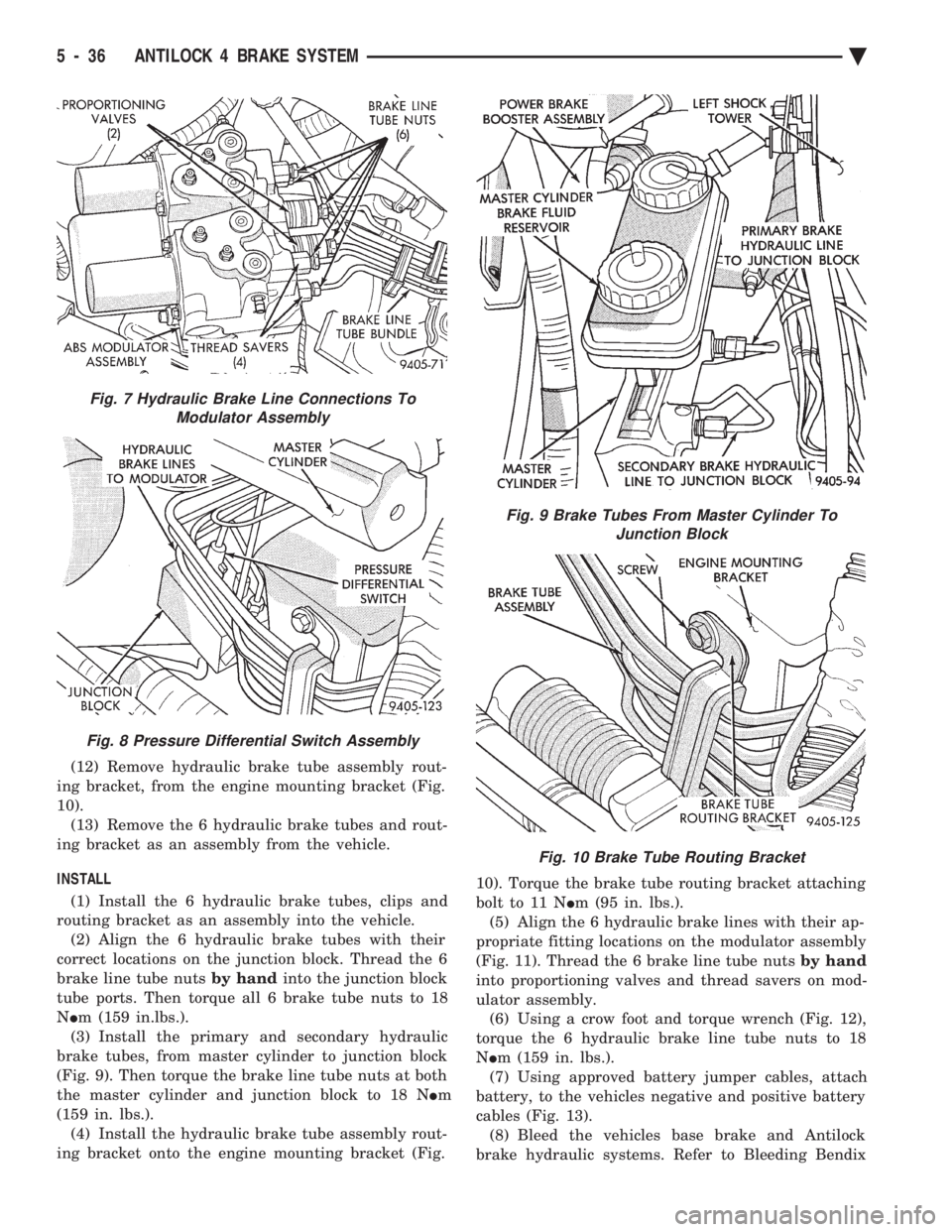
(12) Remove hydraulic brake tube assembly rout-
ing bracket, from the engine mounting bracket (Fig.
10). (13) Remove the 6 hydraulic brake tubes and rout-
ing bracket as an assembly from the vehicle.
INSTALL (1) Install the 6 hydraulic brake tubes, clips and
routing bracket as an assembly into the vehicle. (2) Align the 6 hydraulic brake tubes with their
correct locations on the junction block. Thread the 6
brake line tube nuts by handinto the junction block
tube ports. Then torque all 6 brake tube nuts to 18
N Im (159 in.lbs.).
(3) Install the primary and secondary hydraulic
brake tubes, from master cylinder to junction block
(Fig. 9). Then torque the brake line tube nuts at both
the master cylinder and junction block to 18 N Im
(159 in. lbs.). (4) Install the hydraulic brake tube assembly rout-
ing bracket onto the engine mounting bracket (Fig. 10). Torque the brake tube routing bracket attaching
bolt to 11 N
Im (95 in. lbs.).
(5) Align the 6 hydraulic brake lines with their ap-
propriate fitting locations on the modulator assembly
(Fig. 11). Thread the 6 brake line tube nuts by hand
into proportioning valves and thread savers on mod-
ulator assembly. (6) Using a crow foot and torque wrench (Fig. 12),
torque the 6 hydraulic brake line tube nuts to 18
N Im (159 in. lbs.).
(7) Using approved battery jumper cables, attach
battery, to the vehicles negative and positive battery
cables (Fig. 13). (8) Bleed the vehicles base brake and Antilock
brake hydraulic systems. Refer to Bleeding Bendix
Fig. 7 Hydraulic Brake Line Connections To Modulator Assembly
Fig. 8 Pressure Differential Switch Assembly
Fig. 9 Brake Tubes From Master Cylinder To Junction Block
Fig. 10 Brake Tube Routing Bracket
5 - 36 ANTILOCK 4 BRAKE SYSTEM Ä
Page 333 of 2438
MANUAL TRANSAXLE CLUTCH
CONTENTS
page page
CLEANING PRECAUTIONS ................. 6
CLUTCH CABLE MECHANISM .............. 1
CLUTCH CABLE REPLACEMENT ............ 2
CLUTCH CHATTER COMPLAINTS ........... 1
CLUTCH DISC REPLACEMENT ............. 5
CLUTCH PEDAL NOISE/POP ............... 2 CLUTCH PEDAL POSITION SWITCH
......... 4
EXCESSIVE CLUTCH SPIN TIME/CLASH INTO REVERSE COMPLAINTS ............ 1
GENERAL INFORMATION .................. 1
RELEASE BEARING AND FORK ............. 6
GENERAL INFORMATION
Throughout this group, references may be made to
a particular vehicle by letter or number designation.
A chart showing the breakdown of these designations
is included in the Introduction Section at the front of
this service manual. The clutch used in all models are a single, dry disc
type with no adjustment for wear being provided in
the clutch itself. The clutch pedal is connected to the release shaft
through a cable and lever. The upper end of the clutch pedal pivots in the
pedal bracket on two nylon bushings. These bushings
do not require periodic lubrication.
CLUTCH CHATTER COMPLAINTS
For all clutch chatter complaints, do the following:
(1) Check for loose, misaligned, or broken engine
and transmission mounts. If present, they should be
corrected at this time. Test vehicle for chatter. If
chatter is gone, there is no need to go any further. If
chatter persists: (2) Check to see if clutch cable routing is correct
and operates smoothly. (3) Check for loose connections in drive train. Cor-
rect any problems and determine if clutch chatter
complaints has been satisfied. If not, (4) Remove transaxle. See Group 21, Manual Tran-
saxle, for procedure. (5) Check to see if the release bearing is sticky or
binding. Replace bearing, if needed. (6) Check linkage for excessive wear on bushings.
Replace all worn parts. A small amount of bearing
grease between the release shaft bushings and the
shaft is beneficial, but not required. (7) Check flywheel and clutch pressure plate for
contamination (dirt, oil) or scored. Replace flywheel
and/or pressure plate, if required. (8) Check to see if the clutch disc hub splines are
damaged. Replace with new disc. (9) Check input shaft splines for damage. Replace
if necessary. (10) Check for uneven wear on clutch fingers.
EXCESSIVE CLUTCH SPIN TIME/CLASH INTO
REVERSE COMPLAINTS
For all excessive clutch spin time/clash into reverse
complaints, do the following: (1) Depress clutch pedal to floor and hold. After
three seconds, shift to reverse. If clash is present,
clutch has excessive spin time. (2) Remove transaxle. See Group 21, Manual Tran-
saxle, for procedure. (3) Check the input shaft spline, clutch disc splines
and release bearing for dry rust. If present, clean
rust off and apply a light coat of bearing grease to
the input shaft splines. Apply grease on the input
shaft splines only where the clutch disc slides. (4) Check to see if the clutch disc hub splines are
damaged, replace with new disc if required. (5) Check the input shaft for damaged splines. Re-
place as necessary. (6) Check for excessive clutch disc runout or
warpage. (7) Install clutch assembly and transaxle.
CLUTCH CABLE MECHANISM
The manual transaxle clutch release system has a
unique self-adjusting mechanism to compensate for
clutch disc wear. This adjuster mechanism is located
within the clutch pedal. The preload spring main-
tains tension on the cable. This tension keeps the
clutch release bearing continuously loaded against
the fingers of the clutch cover assembly. When the pedal is depressed, teeth on the adjuster
and the positioner engage and pull the release cable.
A spring located behind the adjuster ensures proper
tooth engagement. When the pedal is released, the adjuster contacts
the bumper. This separates the adjuster and posi-
tioner teeth, allowing the preload spring to function.
Ä MANUAL TRANSAXLE CLUTCH 6 - 1
Page 336 of 2438
CLUTCH PEDAL POSITION SWITCH
The clutch pedal position switch functions as a
safety interlock device. It prevents possible engine
cranking with the clutch engaged. The clutch pedal position switch is wired in series
between the starter relay coil and the ignition
switch. The clutch pedal position switch is mounted to a
bracket located next to the clutch pedal. The switch
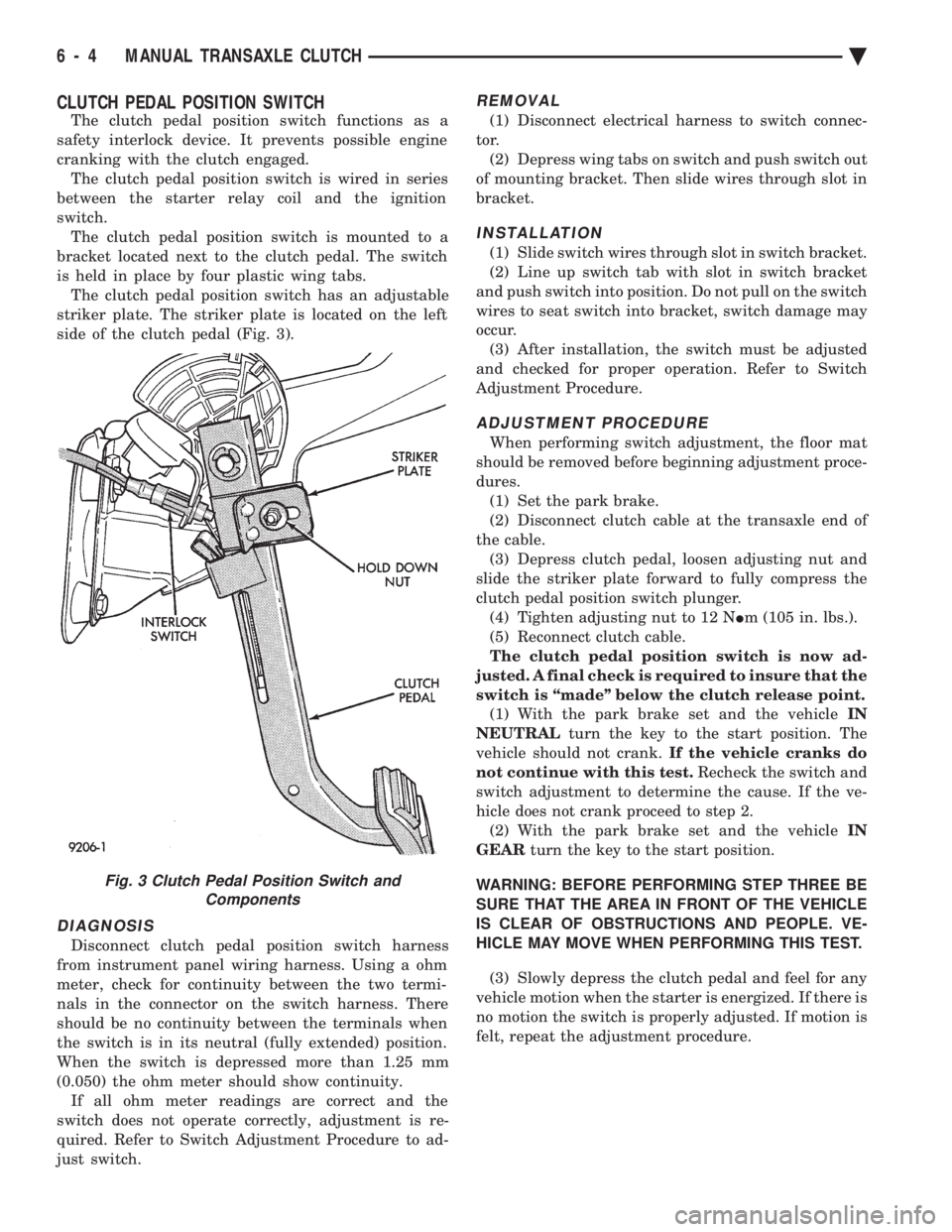
is held in place by four plastic wing tabs. The clutch pedal position switch has an adjustable
striker plate. The striker plate is located on the left
side of the clutch pedal (Fig. 3).
DIAGNOSIS
Disconnect clutch pedal position switch harness
from instrument panel wiring harness. Using a ohm
meter, check for continuity between the two termi-
nals in the connector on the switch harness. There
should be no continuity between the terminals when
the switch is in its neutral (fully extended) position.
When the switch is depressed more than 1.25 mm
(0.050) the ohm meter should show continuity. If all ohm meter readings are correct and the
switch does not operate correctly, adjustment is re-
quired. Refer to Switch Adjustment Procedure to ad-
just switch.
REMOVAL
(1) Disconnect electrical harness to switch connec-
tor. (2) Depress wing tabs on switch and push switch out
of mounting bracket. Then slide wires through slot in
bracket.
INSTALLATION
(1) Slide switch wires through slot in switch bracket.
(2) Line up switch tab with slot in switch bracket
and push switch into position. Do not pull on the switch
wires to seat switch into bracket, switch damage may
occur. (3) After installation, the switch must be adjusted
and checked for proper operation. Refer to Switch
Adjustment Procedure.
ADJUSTMENT PROCEDURE
When performing switch adjustment, the floor mat
should be removed before beginning adjustment proce-
dures. (1) Set the park brake.
(2) Disconnect clutch cable at the transaxle end of
the cable. (3) Depress clutch pedal, loosen adjusting nut and
slide the striker plate forward to fully compress the
clutch pedal position switch plunger. (4) Tighten adjusting nut to 12 N Im (105 in. lbs.).
(5) Reconnect clutch cable.
The clutch pedal position switch is now ad-
justed. A final check is required to insure that the
switch is ``made'' below the clutch release point. (1) With the park brake set and the vehicle IN
NEUTRAL turn the key to the start position. The
vehicle should not crank. If the vehicle cranks do
not continue with this test. Recheck the switch and
switch adjustment to determine the cause. If the ve-
hicle does not crank proceed to step 2. (2) With the park brake set and the vehicle IN
GEAR turn the key to the start position.
WARNING: BEFORE PERFORMING STEP THREE BE
SURE THAT THE AREA IN FRONT OF THE VEHICLE
IS CLEAR OF OBSTRUCTIONS AND PEOPLE. VE-
HICLE MAY MOVE WHEN PERFORMING THIS TEST.
(3) Slowly depress the clutch pedal and feel for any
vehicle motion when the starter is energized. If there is
no motion the switch is properly adjusted. If motion is
felt, repeat the adjustment procedure.
Fig. 3 Clutch Pedal Position Switch and Components
6 - 4 MANUAL TRANSAXLE CLUTCH Ä