Page 264 of 370
Downloaded from www.Manualslib.com manuals search engine PR
Adding Coolant-LTI Engine
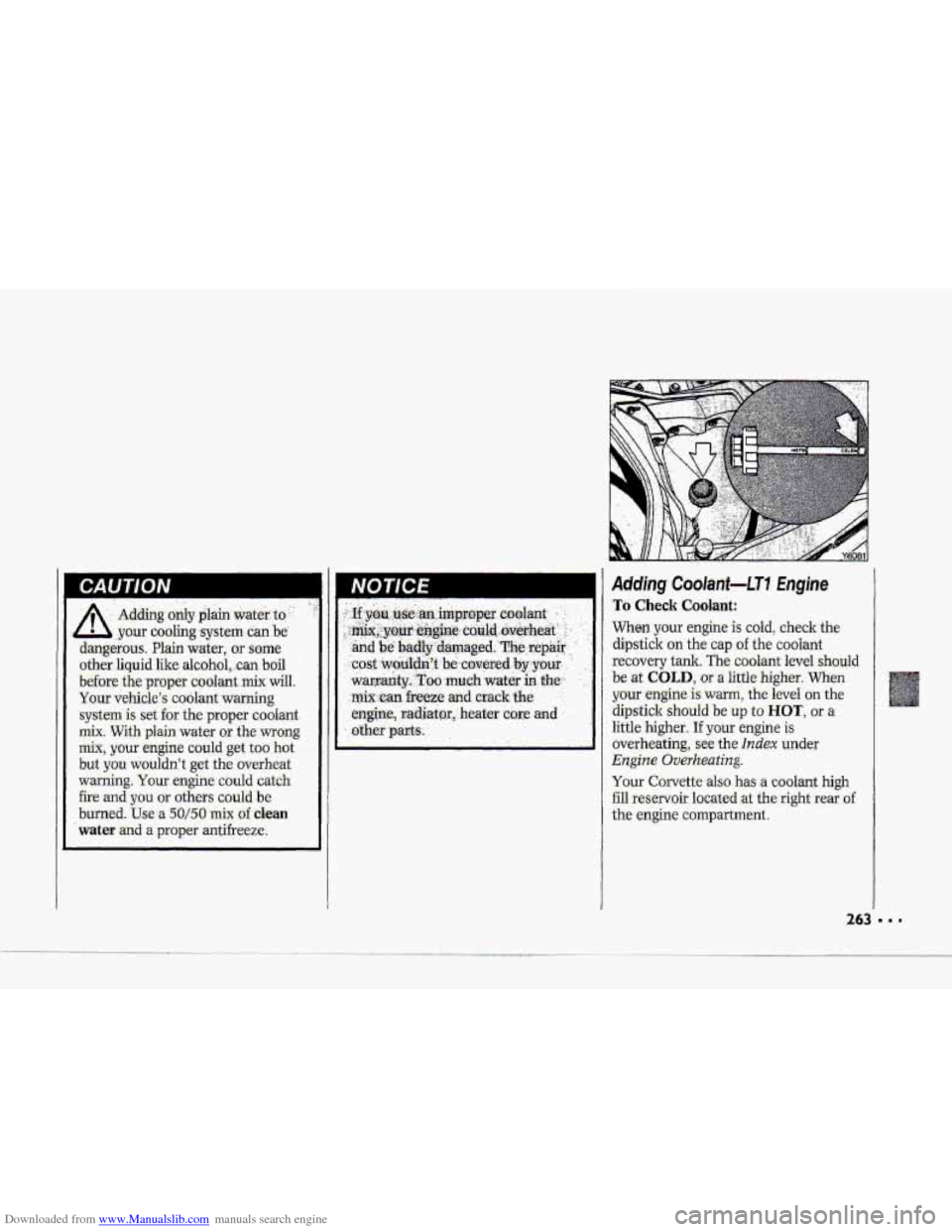
Tb Check Coolant:
Wh& your engine is cold, :che.ck the
dipstick on the cap of the coolant-
recovery .tank. The. coolant level should
be at C.OLD, orst little higher. When
your engine-is wm, the level on the
dips’tiik should be up to HOT, or a
little higher. If your engine is
overheating, see the Index under
Engine Overheating.
Your Corvette als:o- has .a coolant high
fill res.Crvoir lgcated at the-right re,ar of
the engine compartment.
Page 267 of 370
Downloaded from www.Manualslib.com manuals search engine Service 81 Appearance Care
Adding Coolant-LT1 Engine
(CONT,)
the coolant high fill resekvoir will be
lower.
Add more of the proper mix
through the filler neck until the level
reaches the
base of the filler .neck.
8. Replace the pressure cap. When it's
tight, the arrows on the cap should
line up
with the overflow tube on the
reservoir filler neck. Shut the engine
Off.
9. Then fill the coolant .recovery t,mk to
the proper level.
For complete drain, flush and refill,
contact your Chevrolet dealer
or the
procedure
may be found in a Chevrolet
Corvette Service Manual. To purchase a
Service Manual, see the-Index under
Service Publications.
Adding GooCant-LT5 hgine
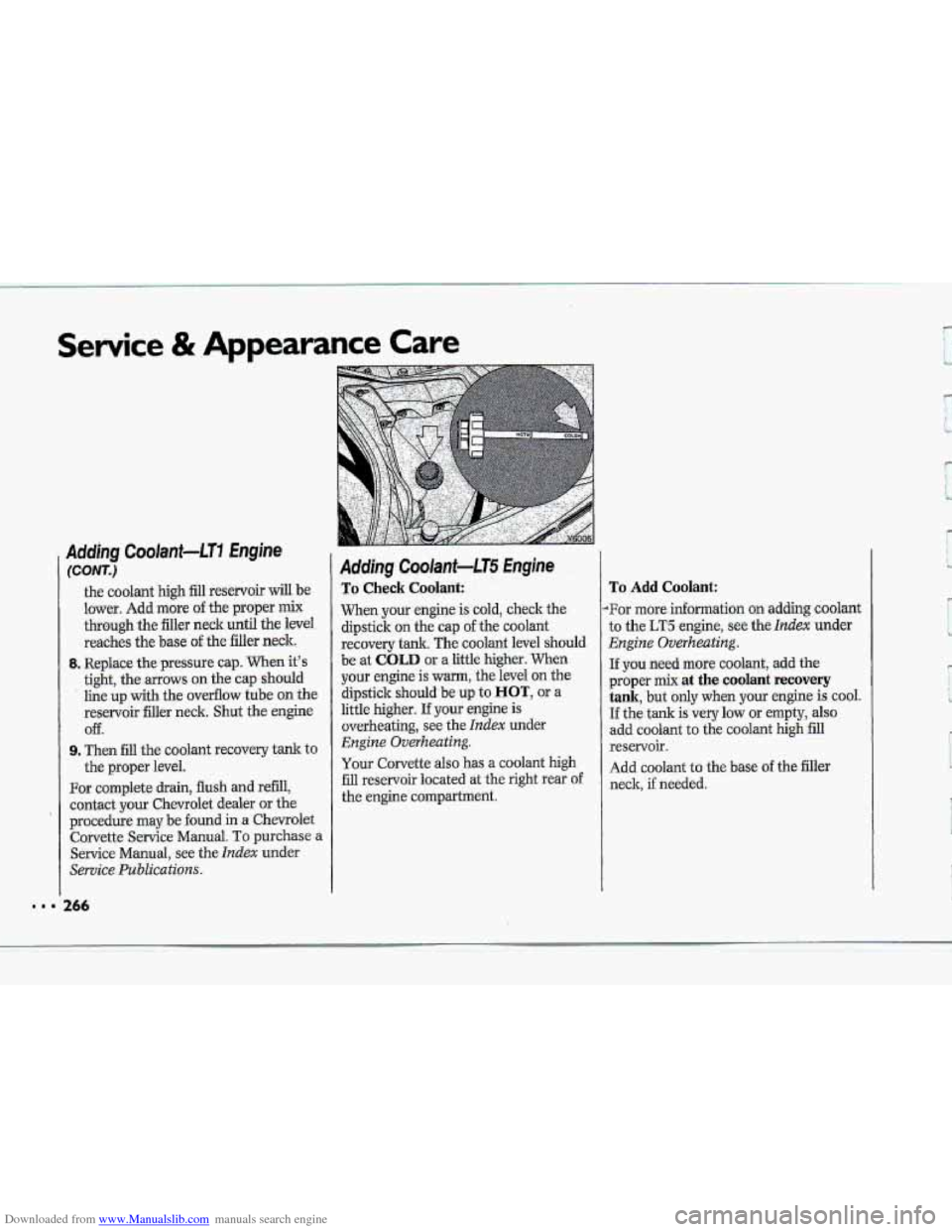
To Check Coolant:
When your engine is cold, check the-
dipstick on the cap of the coolant
recovery
tanfr. The coolant level should
be at COLD or a little higher. When
your engine is warm, the level on the
dipstick
should be up to HDT, or a
little higher. If your engine is
overheating, see the
Index under
Evlgirze Overheating.
Your Corvette also has a coolant high
fill reservoir located at the right rear of
the engine'compartrnent.
To Add Coolant:
For more .information on ,adding coolant
to the LT5 engine, see the Index u.nder
Engine Overheating.
If you need more coolant, add the
proper mix at the coolant recovery
tank, but ,only when your engine is cool.
If the tank isvery low or empty, also
add coolant to the coolant high fill
reservoir.
Add coolant to the base of the filler
neck, if needed.
Page 270 of 370
Downloaded from www.Manualslib.com manuals search engine Power Steering Fluid
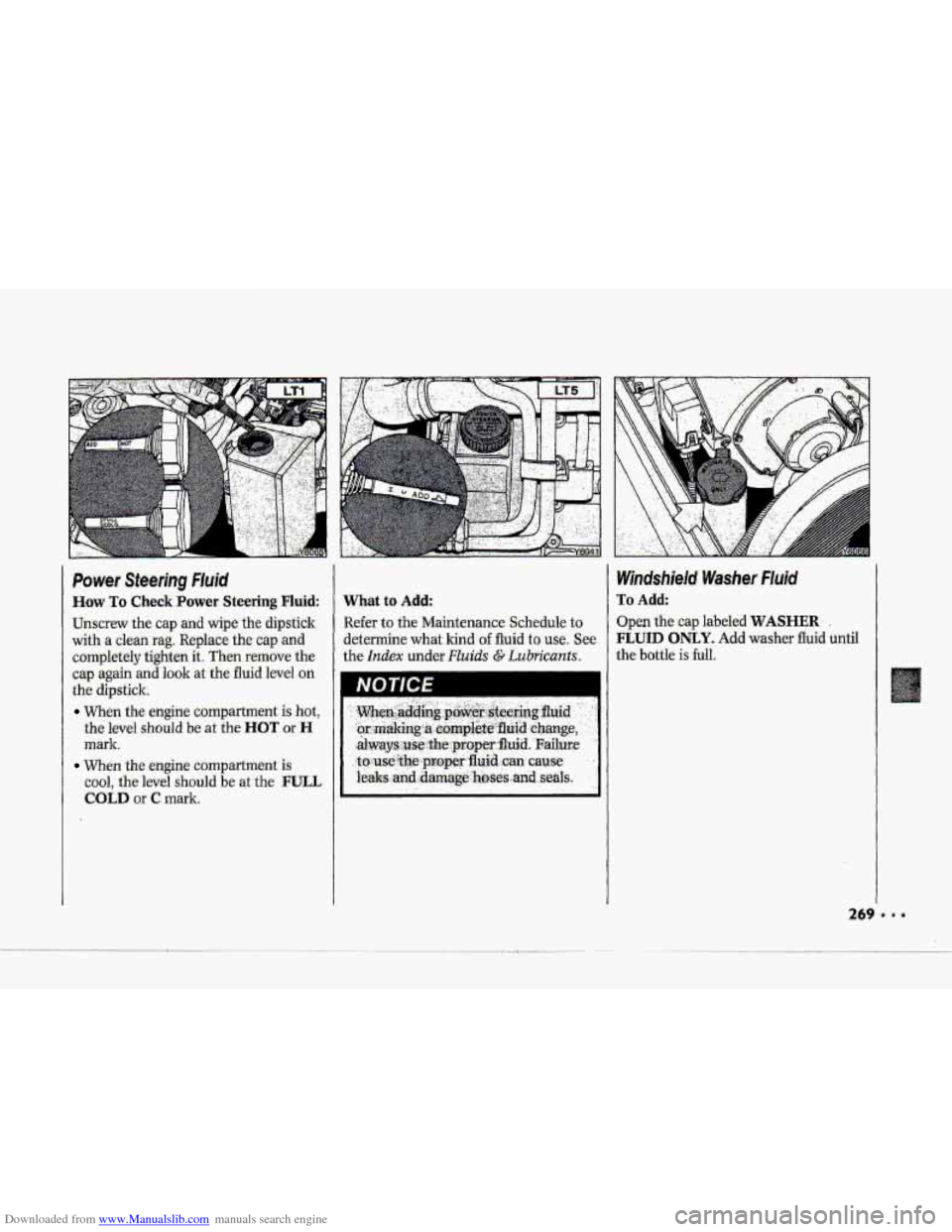
How To Check Power Steering Fluid
Unscrew the cap and wipe the dipstick
with a clean-rag. Replace the cap and
completely tighten
it. Then remove the
cap again and look
at- the fluid level on
the dipstick,
When .the engine imnpartrnent is hot,
the level should be at the HOT or H
mark.
cool, the level should be atthe FULL
COLD or C mark.
When the engine compartment is
What t,o Add:
Refer to the Maintenance Schedule- to
determine what.kind
of fluid to use. 'See.
the
Index under Fluids G Lubricants.
II NOflCE
Windshield Washer Fluid
To Add:
Open t,he.cap labeled WASHER .
FLUID ONLY. Add washer fluid until
the^ bottle is full.
.
Page 276 of 370
Downloaded from www.Manualslib.com manuals search engine Headlight Aiming
Improperly aimed headlights can be
dangerous. Periodic headlight. checks
for proper aiming and adjustment are
strongly recommended. Your Chevroket
dealer is well. equip,ped to
provide such
service.
Fog Ught Bulb Replacement
The fog lights can be reached from
under the- front bumper.
1 Remove the hex-head screw using a
7 m hex-head socket.
2. Open the door. Then reach up into
the fog light assembly €or the bulb.
3. Rotate the bulb base eounter-
doclm&e l/s turn. Then pull the bulb
bise out.
from the wiring harness.
reconnect the
wiring h-mess. Cluse
and secure the door.
4. &refully disconnect the bulb base
5. Insert the neq7 bulb -and then
If your fog 'lights become improperly
aimed,
have your Chwrokt dealer aim
tka QQr YOU.
Page 283 of 370
Downloaded from www.Manualslib.com manuals search engine Senrice & Appearance Care
CAUTION
Inflation-Tire Pressure
The Tire-Loading Information label
! which is on the rear edge of the driver’s
door
shows the correct inflation
pressures for your tires, when they’re
cold. “Cold” means your vehicle has
been sitting for at least three hours or
driven no more than a mile.
If you have to check tires when they’re
not cold,
add 4 psi (28 kPa) to the
numbers on the sticker.
. 282
Page 284 of 370
Downloaded from www.Manualslib.com manuals search engine When to Check:
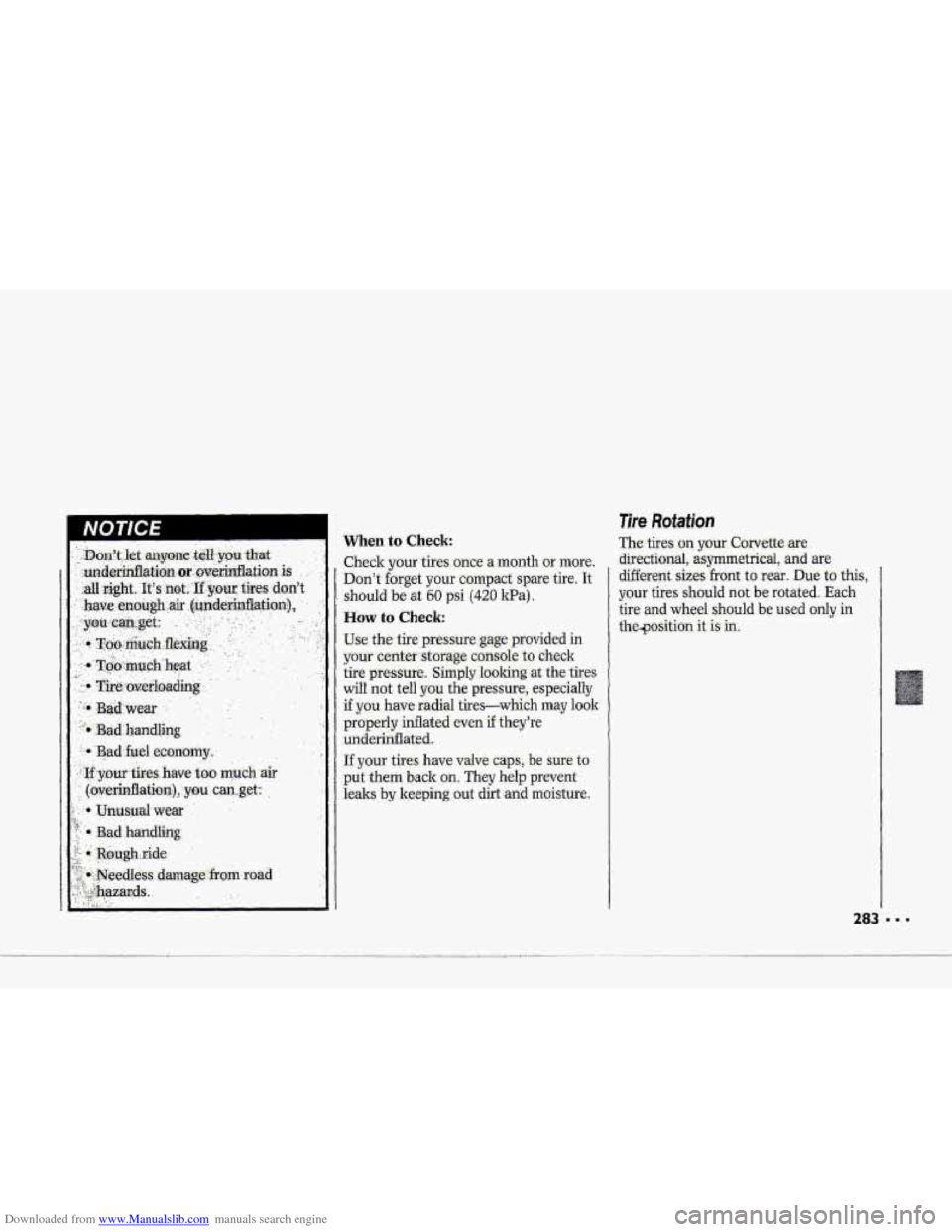
Check your tires once a month or more.
Don’t forget your compact spare tire. It
should be at 60 psi (420 1tPa).
How to Check:
Use the tire pressure gage provided in
your center storage console to check
tire pressure. Simply looking
at the tires
will not tell you the pressure, especially
if you have radial tires-which may look
properly inflated even if they’re
underinflated.
If your tires have valve caps, be sure to
put them back
on. They help prevent
leaks
by keeping out dirt and moisture.
Tire Rotation
The tires on your Corvette are
directional, asymmetrical, and are
different sizes
front tu rear. Due to this,
your tires should not be rotated. Each
tire
and wheel should be used only in
theqosition it
is in.
Page 285 of 370
Downloaded from www.Manualslib.com manuals search engine Sewice & Appearance Care
When It’s Time.for New Tires
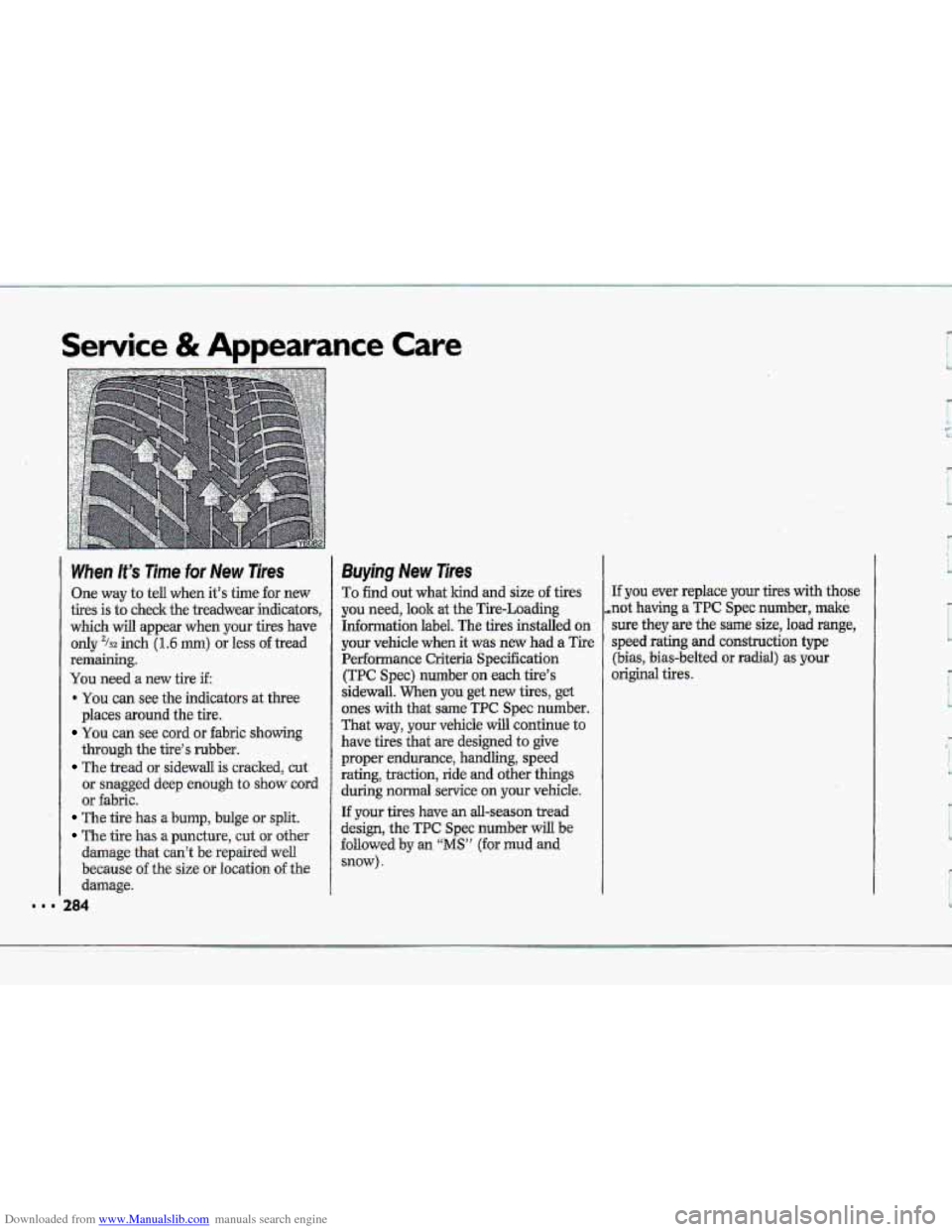
One way to tell when it’s time for new
tires is to check the treadwear indicators,
which will appear when your tires have
only%2 inch (1.6 mm) or less of tread
remaining.
You need a new tire if:
* You can see the indicators at three
You can see cord or fabric showing
The tread or sidewall is cracked, cut
places around the tire.
through the
tire’s rubber.
or snagggd deep enough to show cord
or fabric.
The tire has a bump, bulge or split.
The tire has a puncture, cut or other
damage that can’t he repaired well
because
of the size or location of the
damage.
Buying New Tires
To find out what kind and size of tires
you need, look at the Tire-Loading
Information label. The
tires installed on
your vehicle when it was new had a Tire
Per€omance
Criteria Specification
(TPC Spec) number on each tire’s
sidewall. When
you get new tires, get
ones with that sme TPC Spec number.
That way, your vehicle will continue to
have
tires that are designed to give
proper endurance, handling, speed
rating, traction, ride and other things
during normal service on your vehicle.
If your tires have an all-season tread
design, the TPC Spec number will be
followed by an “MS” (for mud and
snow).
. ... r .: ;.- - .
If yuu ever replace your tires with those
,not having a TPC Spec number, make
SLUT they are the same size, load range,
speed rating and construction
type
(bias, bias-belted or radial) as your
original tires.
G
Page 296 of 370
Downloaded from www.Manualslib.com manuals search engine p"
i
E" P !
?" 1
!
Care of Safety Belts
Keep belts clean and dry.
Glass
Glass should be cleaned often. GM
GIass Cleaner (GM Part No. 1050427)
or a liquid household glass cleaner will
remove normal tobacco smoke and dust
films.
Don't use abrasive cleaners .on glass,
because they
may cause scratches.
Avoid placing decals
on the inside rear
window, since they may have to be
scraped
off later.
If abrasive cleaners are used on the
inside
of the rear window, m electric
defogger element
may be damaged. Any
temporary license should not be
attached across the defogger grid.
Cleaning the Outside. of the
Windshield and Wiper Blades
If the windshield is not clear after using
the windshield
washer, or if the wiper
blade chatters when
rmnirxg, wax or
other material may be on the blade or
windshield.
Clean the
outside of the windshield
with
GM Windshield Cleaner, Bon-Ami
Powder@ (GM Part No. lO5OOll). The
windshield is clean if beads do not form
when you rinse it with water.
Clean the
blade by wiping vigorously
with a cloth soaked
in full strength
windshield washer solvent. Then
rinse
the blade with water.
Wiper blades should
be checked on a
regular basis and replaced when worn.
295