1993 CHEVROLET CORVETTE check engine
[x] Cancel search: check enginePage 183 of 370
Downloaded from www.Manualslib.com manuals search engine row urlvrng ana tne noaa
‘I
PaSShg (COW.)
Watch for traffic signs, pavement
markings,
-and lines. If you can see a
sign
up ahead that might indicate a
turn
or an intersection, delay your
pass. A broken center line usually
indicates -it’s all right
to pass,
(providing the road ahead
is clear).
Never cross a solid line on.your side
of the lane or a double solid line, even
if the road seems empty of
approaching traffic.
* If you suspect that the- driver of the
vehicle
you want to. pass isn’t .aware
of-your presence, tap the horn a
couple of times before. passing.
Do not.get too close- to the vehicle
you want
to pass while you’re
awaiting an opportunity. For one
thing, following tQo closely reduces
your area
of vision, especi-ally if you’re
following
a larger vehicle. Also, you
won’t have adequate space if the
vehicle
,ahead suddenly slows dr
stops. Keep back a- reasonable
distance.
I 82
When it 1cr.oks like a chance to:pass is
.doming up, start to-accelerate but stay
in the- right lane and don’t -get- too
close. Time your move so, you will be
increasing speed as’the time comes to
move into the other
lane.3 the. way is
clear to pass, you will have a “running
start’” that
more than makes up fix
the distance you would lose by
dropping back. And
if something
happens to Cause you to cancel your
pass, you need only slow down and
drop back again and wait for another
opportunity.
If other vehicles .are lined up to pass a
slow vehicle, wait your turn. But: take
care that someone- isn’t trying to pass
you as you pull out to pass the slow
vehicle. Remember to glance, over
your shoulder andxheck the blind
spot.
Check your mirr-ors, glance over your
shoulder, aad start your left lane
change-,signal before
,moving aut of
the right lane to pass. When you are
far enough ahead of the. passed
vehicle to see-its front in your inside
mirror, activate.your right lane ,change
signal
and move back into the right
lane; (Remember that-your right
0-utside mirror is-convex. The vehicle
you just passed ‘may seem to be
farther away+from you than it redly
is.)
Try n0t.t.o pass more than one vehicle
at a time on two-lane roads.
Reconsider before passing the next
vehicle.
.vehicle too rapidly. Even though the
brake lights. are not flashing, it may be
slowing dawn or starting to turn.
If you’re- being passed, make it easy
for the following. driver to get ahead
of
you. Perhaps you can ease. a little to
the right;
Don’t overtake a slowly .m,oving
Page 187 of 370
Downloaded from www.Manualslib.com manuals search engine Your Driving and the Road
Remember that your hedlights light up
€arless of a roadway when you are .in a
turn or cuwe.
Keep your eyes: moving; that way, it's
easier to pick aut d.imly lighted objects.
Just as sour headlights should be
checked regulaily-far proper aim, so;
should your .eyes be mmined regularly.
Some drivers suffer from night
blindness-the inabiIity to
see in dim
light-and
wen? even aware .of it,
b '
c..
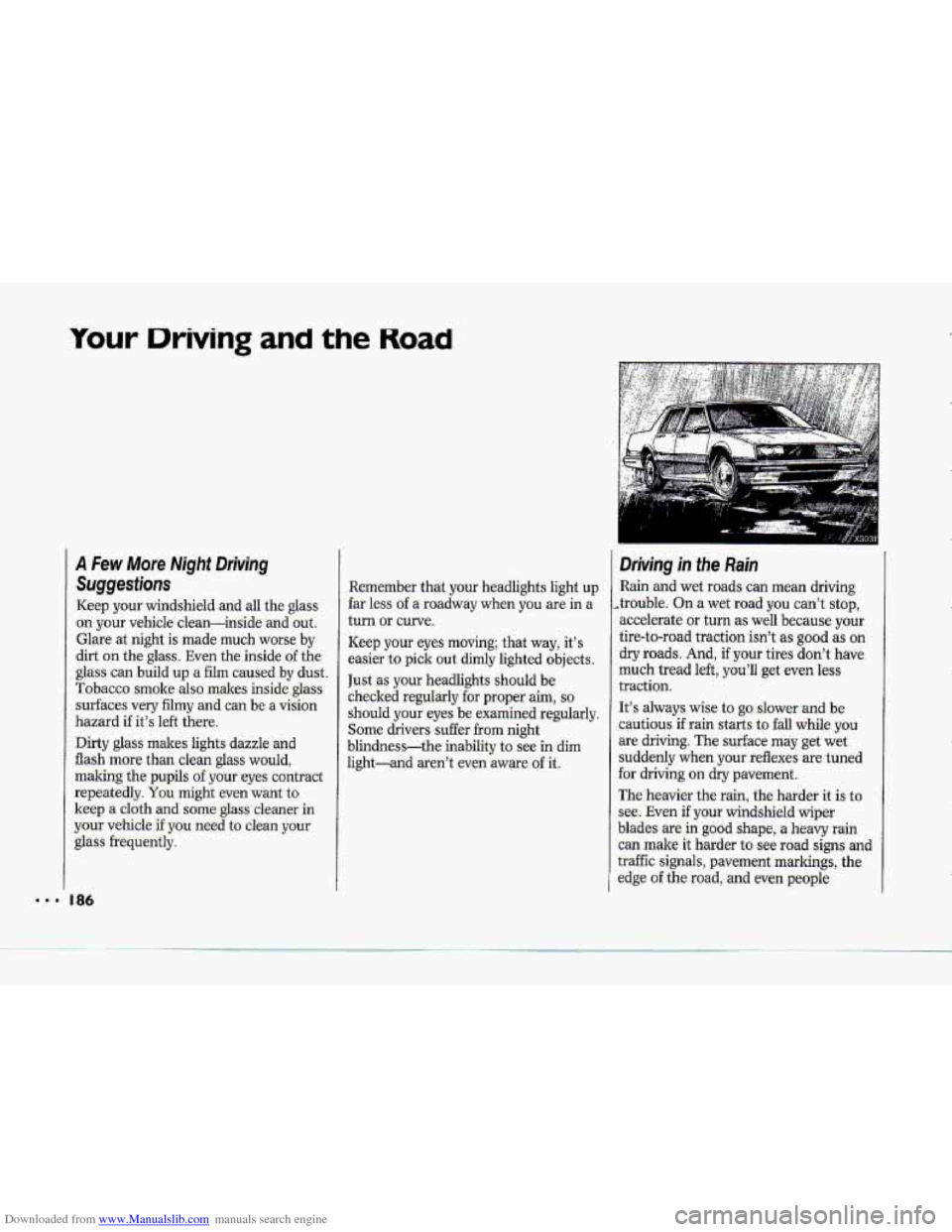
Driving in the.Rain
-Rainiand wet roads can mestll dtiving
,.trouble. On a wet road you can'-t stop.,
accelerate
or turn as well because your
tire-to-roacl traction.
isn't as good as on
dry roads. And, if your tires don't have
traction.
It% always wise t;p g~ slower and be
cautious'if rai.n starts to fall While ybir
are driving. The surface may get wet
suddenly when. your:reflexes are. tuned
far driving CI~ dry pavement.
Thei;he.avier. the rain,
the hatdef it is to-
see. Eveh if your windshield wiper
blades are in good shape, a heavy rain
can male it harder to see road signs and
traffic signals, pavement markings, the
edge of the road, and even pegple
much tread left, youl~ get even less
Page 191 of 370
Downloaded from www.Manualslib.com manuals search engine Your Driving and the Road
Tips on Driving in Fog (CONT.)
something between you and moving
vehicles-space, trees, telephone poles,
a private driveway, anything that
removes you
from other trafic.
If visibility is near zero and you must
stop but are unsure whether you are
away
from the road, turn your lights on,
start your hazard warning flashers, and
sound your horn at intervals or when
you hear approaching traffic.
Pass other vehicles in fog only if you
can see far enough ahead to pass safely.
Even then, be prepared to delay your
pass if you suspect the fog is worse up
ahead. If other vehicles try to pass you,
make it easy for them.
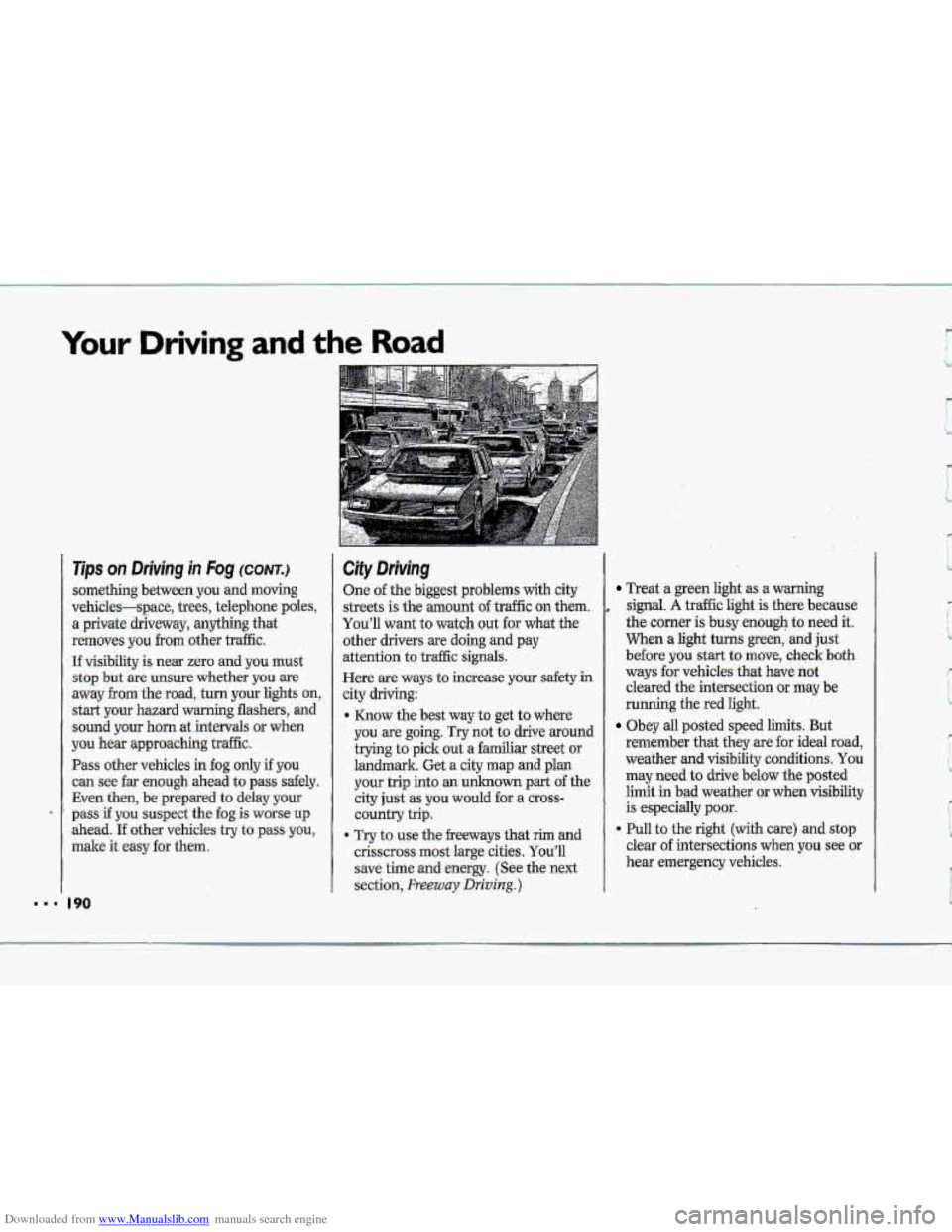
City Driving
One of the biggest problems with city.
streets
is the amount o€ traffic on them.
You’ll want to watch
out for what the
other drivers are doing
and pay
attention
to traffic signals.
Here are ways to increase your safety in
city driving:
* Know the best way to get to where
you-are going.
Try not to drive around
trying to pick out a familiar street or
landmark. Get a city map
and plan
your trip into an unknown part of the
city
just .as you would for a cross-
country trip.
9 Try to use the freeways that rim and
crisscross
most large cities. You’ll
save time
and energy. (See the next
section,
Freeway Driving.)
Treat a green light as a warning
.signal, A traffic light is there because
the corner
is busy .enough to need it.
When a light turns green, and just
before you start to move, check both
ways for vehicles. that have not
cleared
the intersection or may be
running the red light.
Obey all posted speed limits. But
remenher that they are
for ideal road,
weather
and visibility conditions. You
may need to drive bglow the .posted
limit
.in b.ad weather or when visibility
is especially poor,
clear
of intersections when you see or
hear emergency vehicles.
9 Pull to the right (with care) and stop
c
Page 192 of 370
Downloaded from www.Manualslib.com manuals search engine f' " '" ,
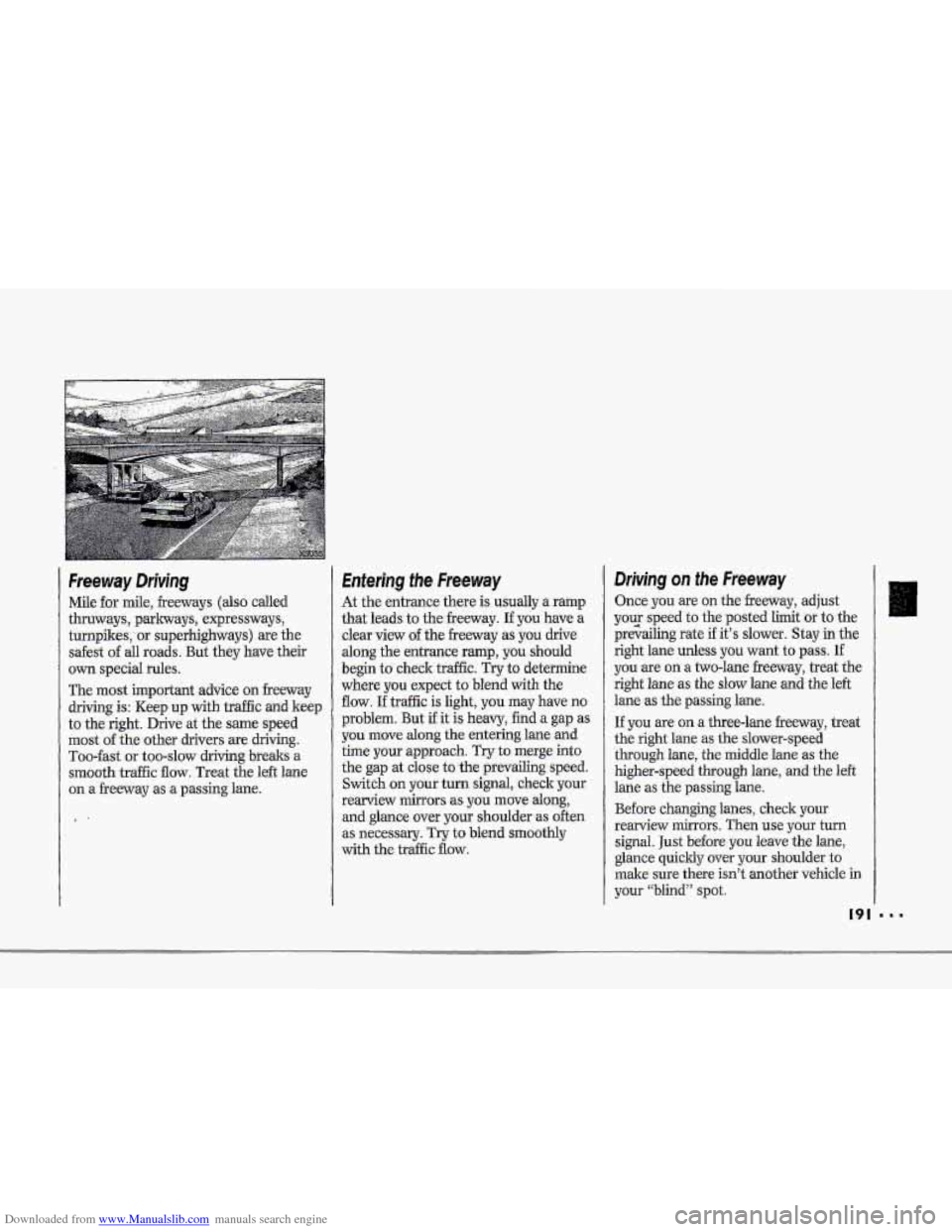
Freeway Driviing
Mile--for mile, .freeways (also called
thruways,
parkways, -expressways,
turnpikes,'
or superhighways) are the
safest of all roads. But they have their
own specid rules.
The most important advice on freeway
driving is: Heep.up with tretffic and keep
to the right. Drive at the same speed
most of the ,ot.her drivers are driving-.
Too-fast :or too-slow driving breaks a
mo'oth traffic flow. Treat the left €me
on a :freeway as :a passing lane.
.1-
Entering the Freeway
At the entrance 'there' is usually a ramp
that l;md$ to the freeway. .If you' have a
clear view of the h.my as you drive
along thr: entrance ramp, you .shmild
begin to c.heclr. trdfic. Try to determine
where. you expect to- blend with the
flav. If traffic is light, you may have no
problem. But if it -is heavy, hd.a gap as
you move dong the entering lane &id
time pur qpmach. Tryto merge into
the gap at close to ,the prevailing speed.
Switch on yow: turn signal, check your
rearview mirrors .as you move along,
and.glmce .over your shoulder as often
as necessary. 'Try to blend smoothly
with the. traffic fluw.
DrJvfng on the Freeway
Once you are on the freeway, adjust
your speed
to the posted limit or to,the
prekbg rate if it's slower. Stay in
right fane unless you want to pass. If
you are ma two-lme freeway; treat the
right lane as the sbw lane and the,left
lane the passing lane.
If you are on a thee-lane freeway, treat
the right-
lane as the. slower-speed
through lane, the middle €ane as the
higherdpeed through lane, and the left
lane -as the passing .. lane.
Before changing lanes, check your
rearview minors. Then use YOU turn
signal. Just before you I-cave-the lane,
glance
quickly over pw shoulder to
make sure there isn't another vehicle in
your "blind" spot.
Page 194 of 370
Downloaded from www.Manualslib.com manuals search engine I 9 II
!-
i
Driving a Long Distance
Although most long trips today are
made on freeways, there are still many
made
on regular highways.
Long-distance driving
on freeways and
regular highways is the same in some
ways. The trip has to be planned and
the vehicle prepared, you drive at
higher-than-city speeds, and there are
longer turns behhd the wheel. You’ll
enjoy your
trip more if you and your
vehicle
are in good shape. Here are
some.fips for
a successful long trip.
Before Leaving on a Long Trip
Make sure you’re ready. Try to be well
rested.
If you must start when you’re
not fresh-such as after
a day’s work-
don’t plan to
make too many miles that
first part of the journey. Wear
comfortable clothing and shoes you
can
easily drive in.
Is your vehicle ready for a long trip? If
you keep it serviced and maintained, it’s
ready to
go. If it needs service, have it
done before starting
out. Of course,
you’ll find experienced and able service
experts in Chevrolet dealerships all
across North America. They’ll be ready
and willing to help if you need it. Here
&e some
things you can check
before
a trip:
Windshield Washer Fluid: .Is the
reservoir full? Are ,all windows
clean
inside and outside?
shape?
you checked all levels?
lenses clean?
safe, trouble-hee trip. Is the tread
good enough for lofig-distance
drivhg? Are the tires all inflated to
the recammended pressure?
weather outlook
along your route?
Should you delay your trip a
short
time to avoid a major storm system?
0 Maps: Do you have up-to-date maps?
Wiper Blades: Are they in good
Fuel,, Enme Oil, Other Fluids: Have
Lights: Are they all working? Are the
Tires: They are vitally important to a
Weather Forecasts: What’s the
193
Page 195 of 370
Downloaded from www.Manualslib.com manuals search engine Your Driving and the Road
On She Road
Uidess you are the -only driver, it is good
to share the driving task with others.
Limit turns behind
the wheel to about
100 miles (160 km) Or two hours at a
sitting.-Then, either change drivers ar
stop for some rdreshment like coffee,
tea or
soft drinks and some limbering
up.
But do stop and move around. Eat
lightly along the way. Heavier meals
tend to
mdke some people sleepy.
On two-lane highways or
undivided
multilane highways that do not have
controlled .access,.you’ll
wmt to watch
for some situations :not usustlly found
on freeways. Examples: are: stop signs
and signals, shopping tenters with
direct access
to the highway, no passing
zones and school zones, vehicles
turning
le& and- right off the-road,
pedestrians, cyclists, parked vehicles, and even a&&.
Highway Hypnosis
Is thete-actually such a condition as
“highway hypnosis”? Or
is it just plain
falling asleep at the wheel? Call it
highway hypnosis, lack
of awareness, or
whatever.
There is
something about an easy
stretch
of road with the same scenery,
along with the
hum of the tires on the
road, the drone of the engine; and the
rush of the wind against the vehicle that
can make you sleepy. Don’t let it
happen
to you! If it does, your vehicle
can leave the road in less than a
second, and you could crash and be
injured.
What can you do about highway
hypnosis? First, be aware that it can
happen.
Then here
are some tips:
4 Make sure your vehicle is well
ventilated,
with a comfortably cool
interior.
Keep your eyes moving. Sca.n the road
ahead and
-to the sides. Check your
rearview mirrors frequently and your
instruments from time to time. This
can help you avoid
a fixed stare.
Wear good sunglasses in bright light.
Glare can cause drowsiness. But
don’t
wear sunglasses at night. They will.
drastically reduce-your,overall.~sion
at the very time you need all the.
seeing power
you have.
If you get sleepy, pull off the road into
a rest, service, &‘parking area and
take a nap, get so.me exercise, or both.
For safety, treat drowsiness on the
highway
as an emergency.
As in any driving situation, keep pace
with traffic and allow adequate
foIlowing distances.
Page 196 of 370
Downloaded from www.Manualslib.com manuals search engine f
F"
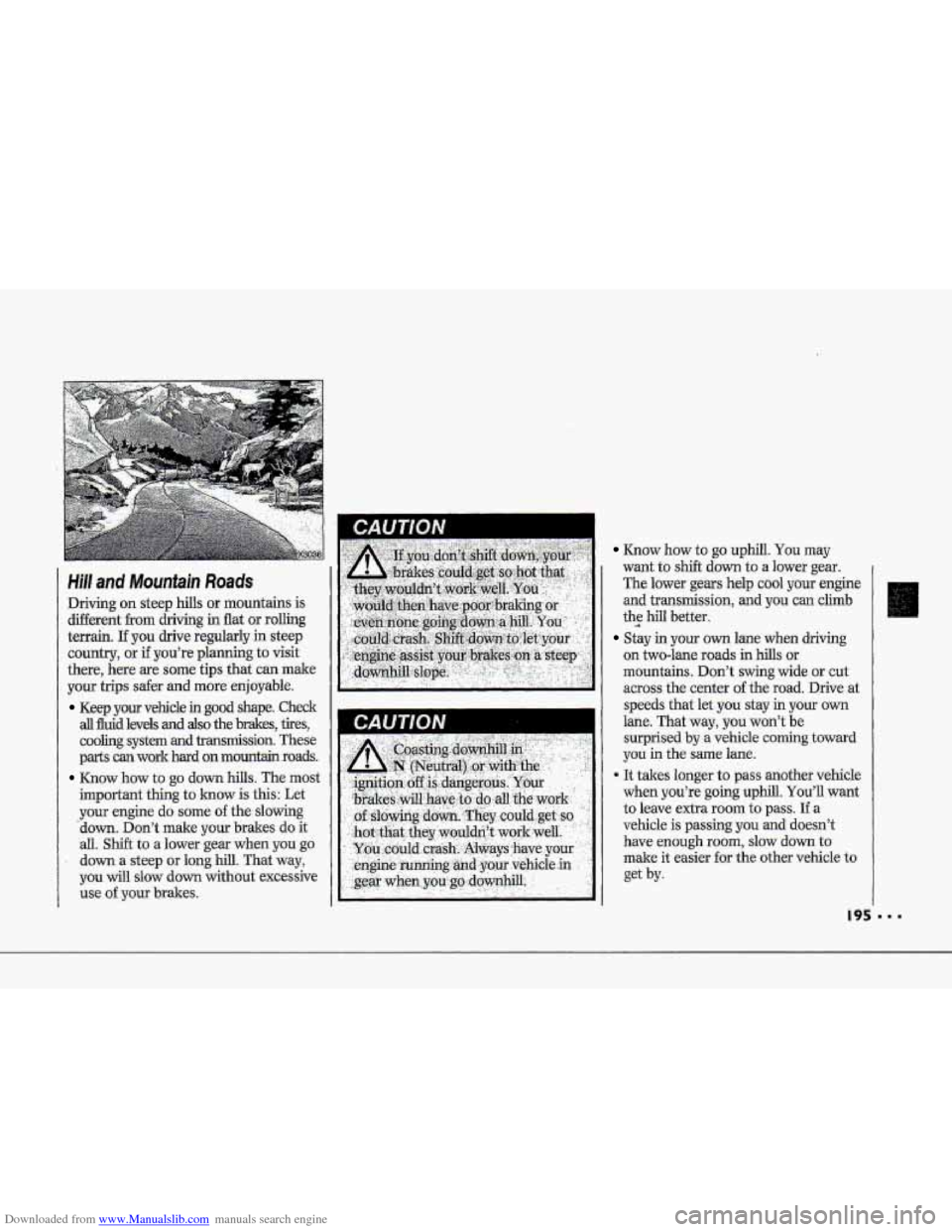
Hin and Mounfain Roads
Driving on steep hills or mountains is
dif€erent fram driving in flat or rolling
terrain. If you drive regularly in steep
country,
or if you're planning to visit
there, here are -some tips that can make
your trips safer and.more enjoyable.
Keep your vehicle in good shape. Check
all fluid levels and also the brakes, tires,
cooling system and transmission. These
parts can work hard on mountain roads.
Know how to go down hills. The most
important thing to how is this: Let
your engine do. some of the slowing
'down. Don't make your brakes do it
all. Shift to a lower gear when you go
down .a steep or long hill. That way,
you will slow down without excessive
use of your brake-s.
Know how to go uphill. You may
want to shift dawn to a lower gear.
The lower gems help cool your engine
and transmission, and you can clin-ib
the *f hiU better.
Stay in your own lane when driving
on two-lane roads in hills or
mountains. Don't swing wide .or cut-
across. the .center of the road. Drive at
speeds that-let-you stay 'in your own
lae. That way, you won't be
surprised by,a vehicle- coming toward
you
in the same lane.
* It takes longer to pass another vehicle-
when you're going uphill. You'll want
to leave extra room to pass. If a
vehicle is passing you and doesn't
have enough room, slow down to
make it easier for the other vehicle to
get by.
Page 201 of 370
Downloaded from www.Manualslib.com manuals search engine ..I
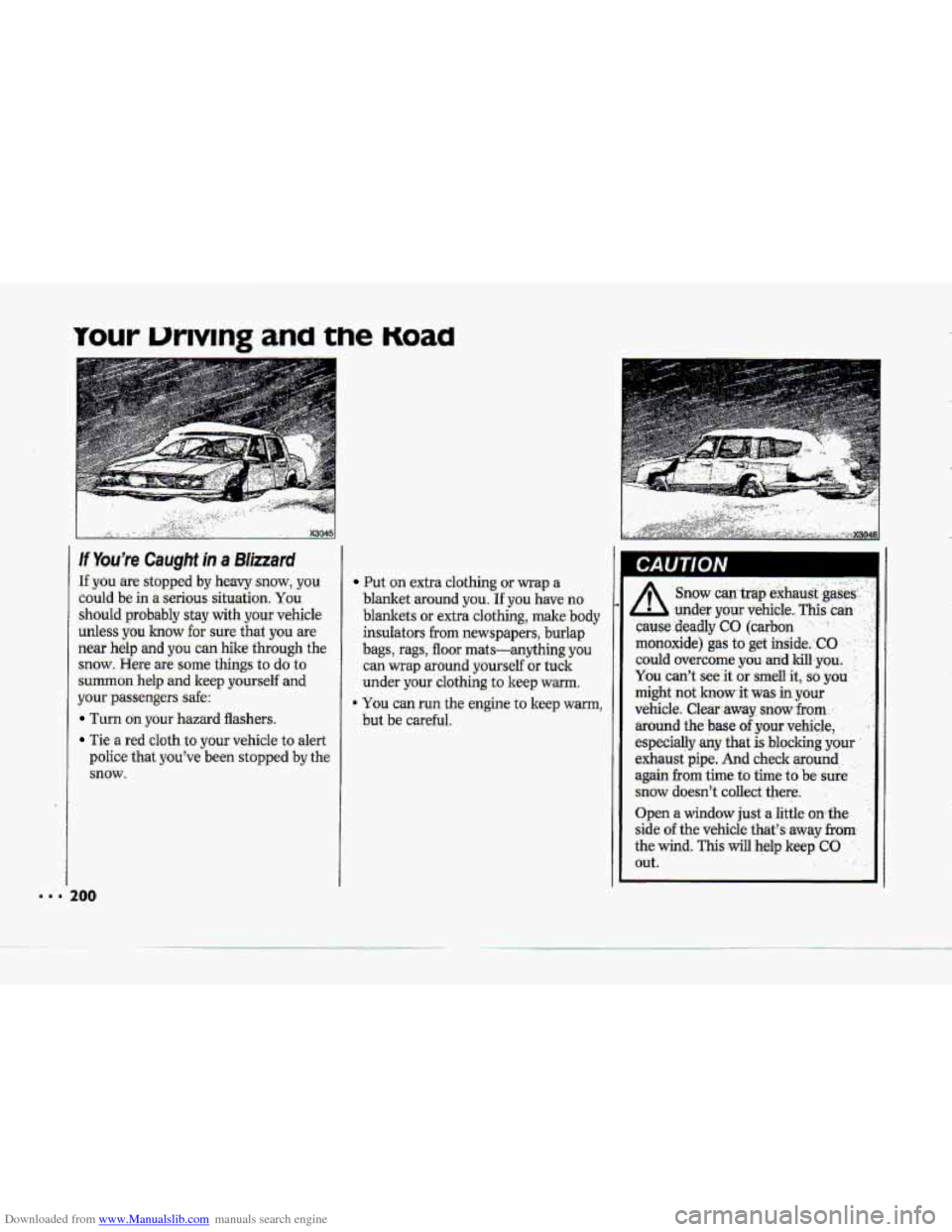
If You're Caught in a Blizzard
If you are stopped by heavy snow, you
could be in
a serious situation. You
should probably stay with your vehicle
unless you
know for sure that you are
near help and you can hike through the
snow. Here are some things
to do to
summon help and keep yourself and
your passengers
safe:
Turn on your hazard flashers.
Tie a red cloth to your vehicle to alert
police that you've been stopped
by the
snow.
!OO
Put on extra clothing or wrap a
blanket around you. If you have no
blankets or extra clothing, make body
insulators
from newspapers, burlap
bags, rags, floor mats-anything you
can wrap around yourself or tuck
under
your clothing tu keep warm.
but be careful.
4 You can run the engine to keep warm,
CAUTION ~
~~
A
Snow can trap exhaust gases:
under your vehicle..
This can.
cause :deadly CO (carbon '
monoxide) gas to get inside. ..CO . '
could overcome you and kill .you;
You can't see
it or smell it, so you
might not know it was in your
vehicle. Clear away. snow.from
around the'.base
of your vehicle,
especially any that
is blocking your
exhaust pipe.
And check around.
again
from time to time to be sure
snow doesn't collect there.
Open
a window just a little on-the
side
of the vehicle that's. away from
the wind. This will help keep CO
out.
..