Page 118 of 370
Downloaded from www.Manualslib.com manuals search engine NOTICE i I 1 ABS Active Light
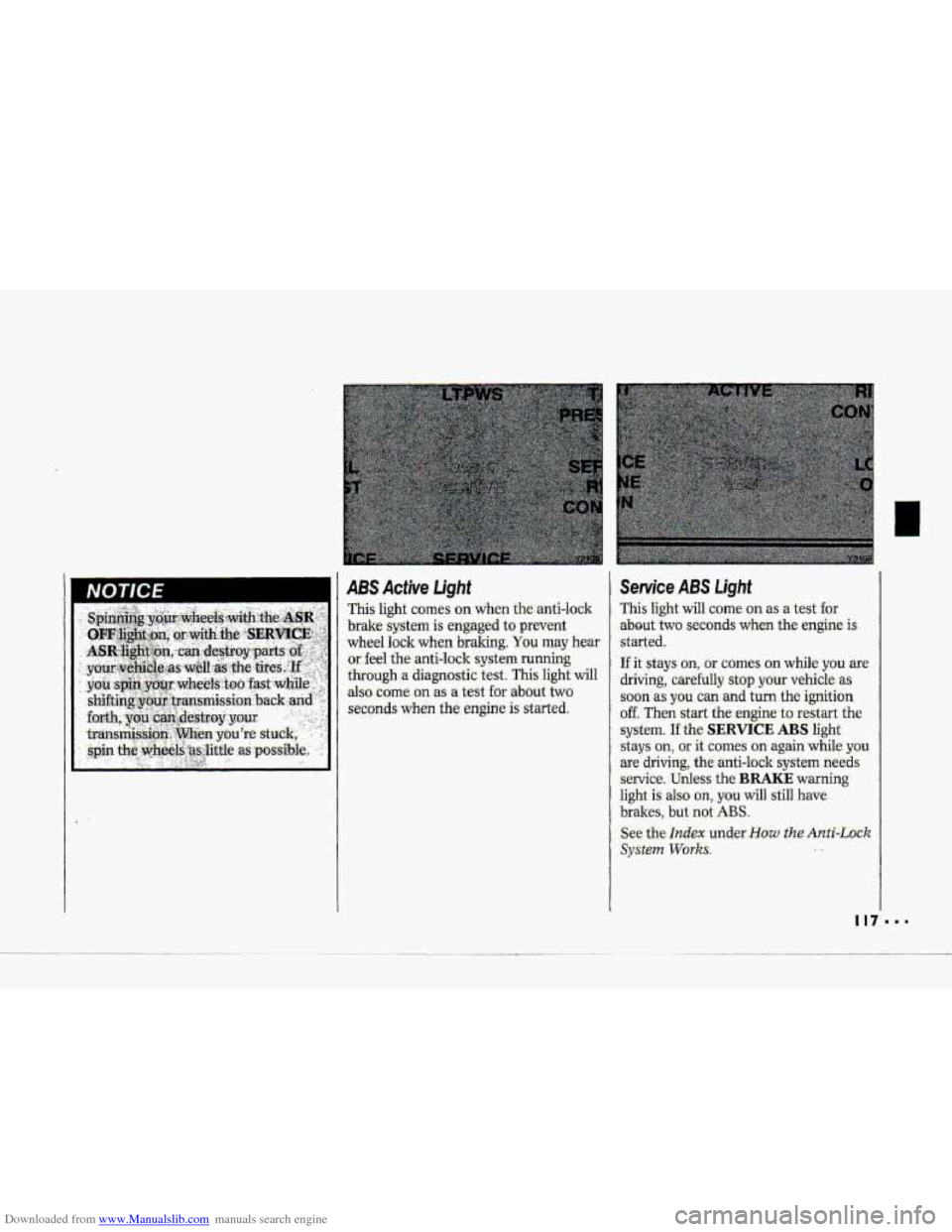
This light c0me.s on when the-anti-lo-clr
brake system is engaged to prevent
wheel lock when
braking. You may hear
or. feel the-anti-lock system running
through a diagnostic test. This light will
also
come on as a test for .about two
seconds
when the engine is ‘started.
Service ABS Light
This light will come on as a test for
.about- two seconds when the engine is
.started.
If it stays on, - or comes an while you are
driving, carefully stop your vehicle as
.soon as you can and turn the ignition
off. Then start the engine to restart the
system.
If the SERVICE ABS light
stays
on, or it comes on again while you
are driving; the anti-lock system needs
service. Unless the BRAKE warning
light is also on,. you will still have
brakes, but not ABS.
See the Index under-How the Anti-Lock
SyStePn Works. ..
Page 165 of 370
Downloaded from www.Manualslib.com manuals search engine Your Driving and the Road
. Road Signs
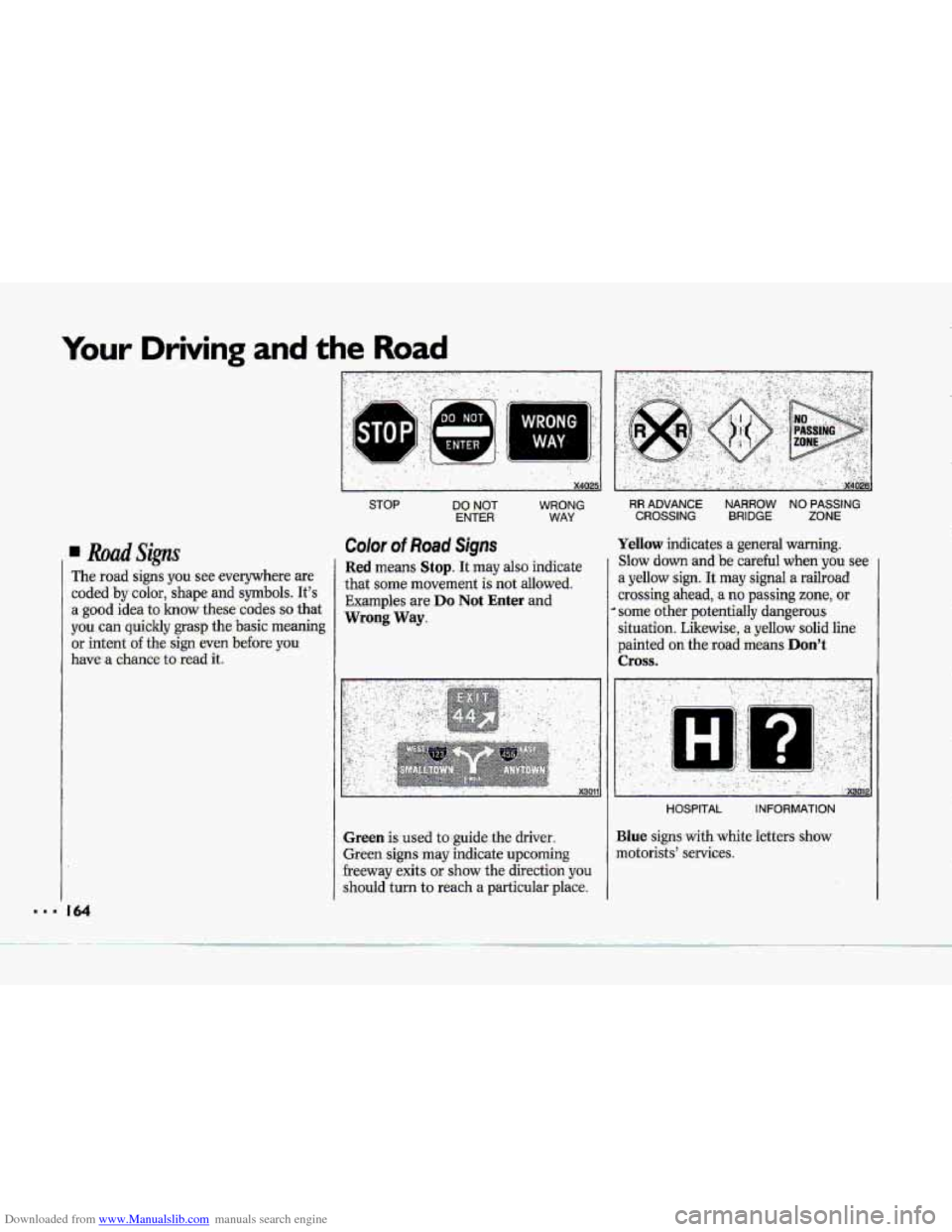
The road signs you see everywhere are
coded
by color, shape and symbols. It's
a good idea to know these codes so that
you can quickly
grasp the basic meaning
or intent
of the sign even before you
have a chance to
read it.
Color of Road Signs
WRONG
WAY,
Red means Stop. It may also indicate
that some movement
is not allowed.
Examples are
Do Not Enter and
Wrong Way.
Green is used to guide the driver.
Green signs
may indicate upcoming
freeway exits or show the direction you
should turn to reach a particular place.
Yellow indicates a general warning.
Slow down and be careful when you see
a yellow sign. It may signal a railroad
crossing ahead, a no passing zone, or
* some other potentially dangerous
situation. Likewise,
a yellow solid line
painted
on the road means Don't
Cross.
........... I ... .,. ...
.... .. ..
I .. ."XWlP
HOSPITAL INFORMATION
Blue signs with white letters show
motorists' services.
Page 166 of 370
Downloaded from www.Manualslib.com manuals search engine c
LOW WORKERS FLAGGER SHOULDER AHEAD AHEAD
Shape of-Road Signs
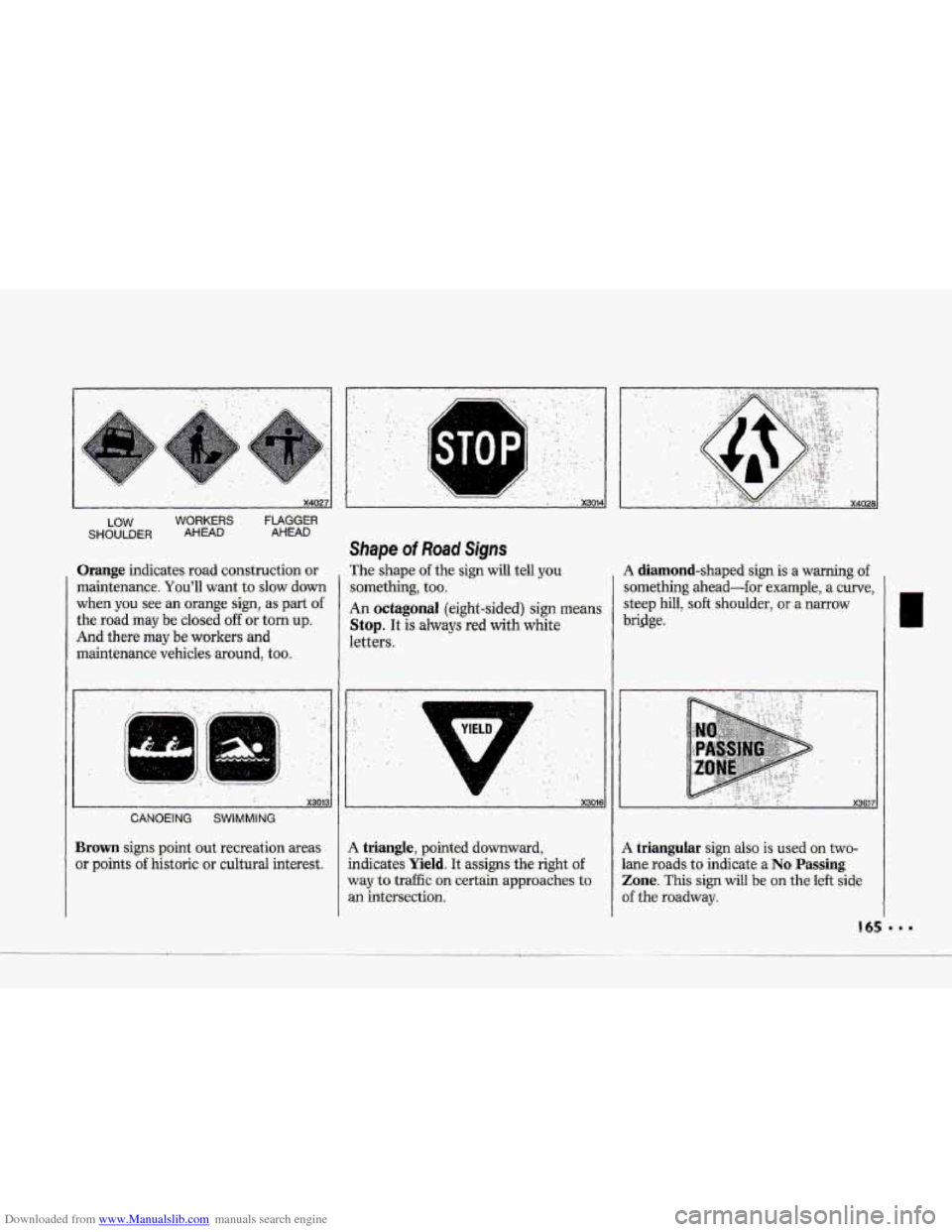
. Orange indicates road 'construction or , The shape of the sign will tell you
mainienance. You'll want to slow down
when
you see an orange sign, as part of
the road may be closed of€ or torn up.
And theie may be workers and
maintenance
vehicles around, too.
I X30181
CANOEING SWlMMtNG
Bmm signs point out recreation areas
0.r points of historic or cultural interest.
sornethiig, too.
An octagorral (eight-sides) sign means
Stop. It is always red with white
letters.
-
A triangle, pointed downward,
indicates Yield. It assigns the- right of
way to traffic on certain approaches to
an intersecti~on.
, A diamond-shaped sign is a warning of
sorne~ing ahead-for example, a curve,
steep hill, soft shoulder, or-,a.narrow
bridge..
A triangular sign also is used on. two-
iane roads to indicate a No Passing
Zone. This sign will be on the left side
of the roadway.
Page 168 of 370
Downloaded from www.Manualslib.com manuals search engine c
R
II
I
1 .---
I I
1
,, -' , . x3022
REVERSIBLE LANE ON MUlTIIANE ROADWAY
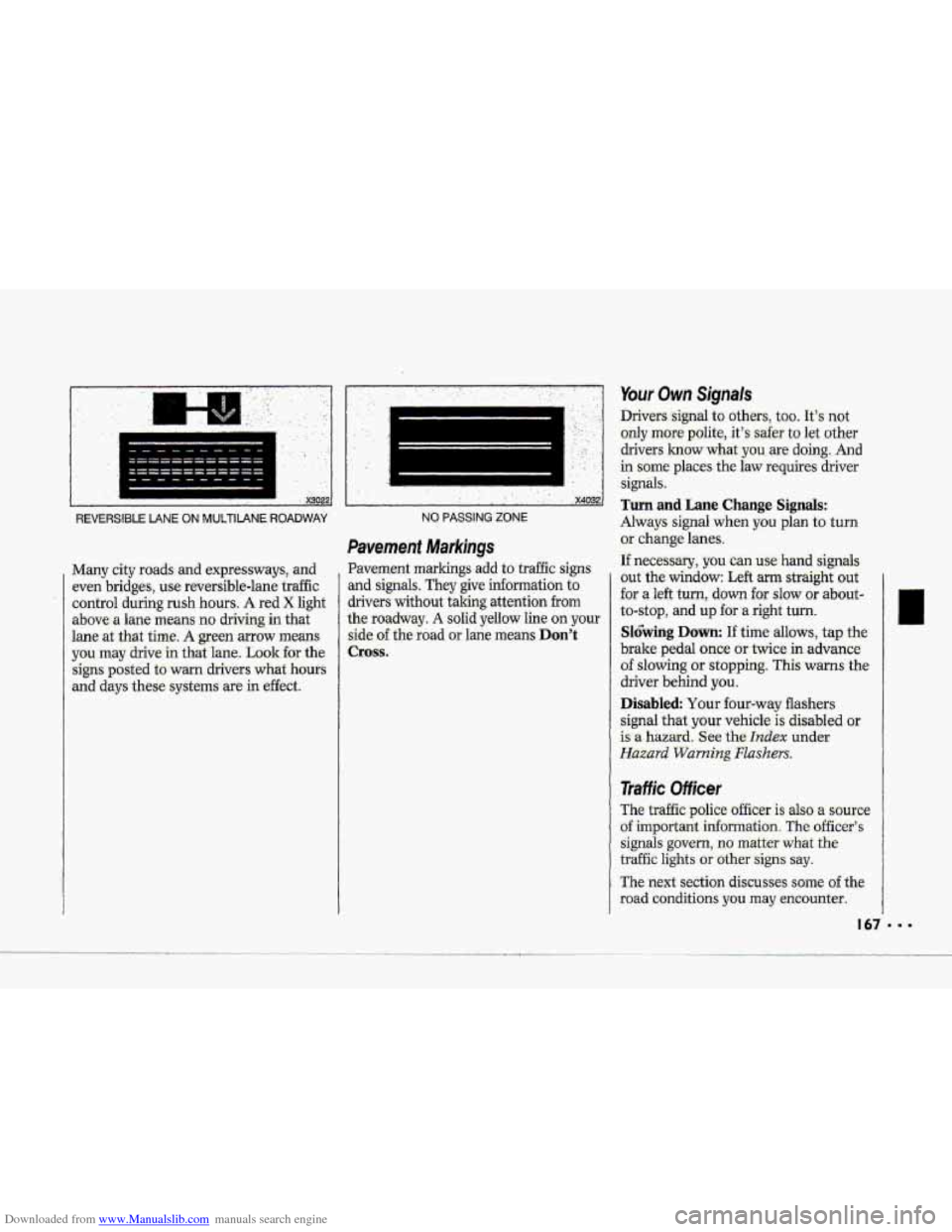
Many city roads: and expressways, and
even bridges, use reuersible-lane traffic
control during
rush hours. A red X light
above- a lane means no driving in that
lane
at .that time. A green mow means
you may drive in that lane. Look €or the
signs posted to warn drivers
what hours
and days these = ,-.. systems are in effect.
.. ........... ........................ ... ,. ., ,. . ... . ' .' '. , ..
! ' x4032
NO PASSING ZONE
Pavement Markings
Pavement markings add to traffic signs
and signals. They give information to
drivers without iaking attention
from
the roadway. A solid yellow line on your
side of the road or lane means Don't
Cross.
Your Own Signals
Drivers -signal to other.s, too. It's not
only more polite.,. it's safer to let other
drivers
1mow what-you are doing-. And
in some' places the law requires driver
signals:
Turn and Lane Change Signals:
Always signal when you plan to turn
or .change lanes.
If neces-ssary, you can use hand signals
out the window: Left arm straight out
'for a left turn, down for slow :or about-
to-stop, and up for .a right turn.
Sl6bing Down: If time allows, tap the
brake pedal once or twice in advance.
of slowing or stopping. This warns the
driver behind
you.
Disabled Your four-wtiy flashers
signal
that. your vehicle is disabled or
is a hazard. See the hdex under
Hazard Warning Flashers.
Traffic Officer
The traffic police officer is also a source
of important information The officer's
signals govern, no matter what the
traffic lights or othersigns say.
The next section discusses some of the
road conditions you may encounter.
Page 177 of 370
Downloaded from www.Manualslib.com manuals search engine Your Driving and the Road
Corvette ASR System (CONT.)
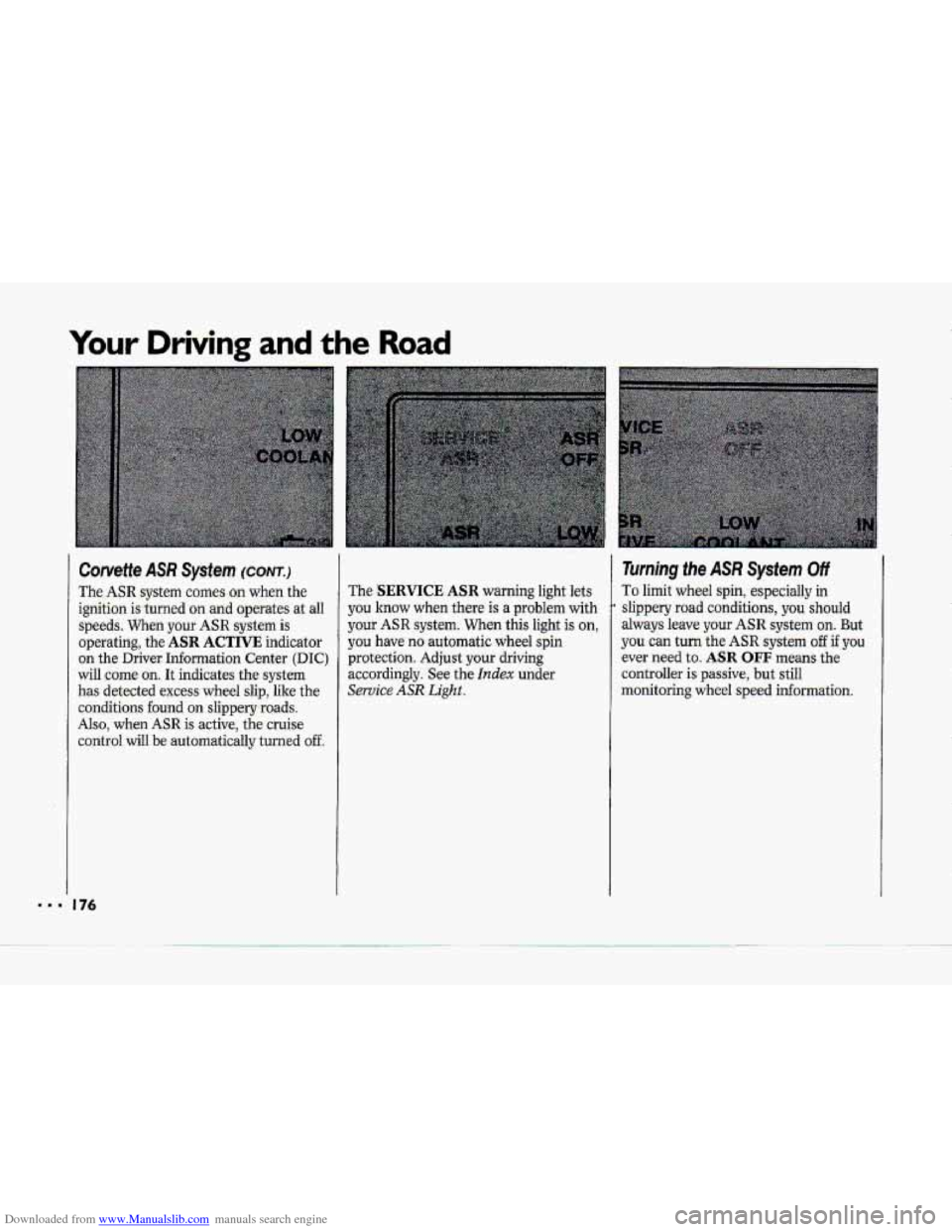
The ASR system comes on when the
ignition is -turned
on and operates at all
speeds. When your ASR system is
operating, the
ASR ACTIVE indicator
on the Driver Information Center
(DIC)
will come on. It indicates the system
has detected excess wheel slip, like the
conditions found on slippery-roads.
Also, when ASR is active, the cruise
control
will be automaticaIly turned off
The SERVICE ASR warning light lets
you know
when there is a problem with
your ASR system. When this light is on,
you have no-automatic wheel spin
protection. Adjust your driving
accordingly, See the
Index under
Service ASR Light..
Turning the ASR System Off
To limit wheel spin, especially in
slippery road conditions, you should
always leave your ASR. system on. But
you can turn the ASR system off if you
ever need to. ASR OFF means the
controller is passive, but still
monitoring wheel
speed informauon.
Page 178 of 370
Downloaded from www.Manualslib.com manuals search engine i
T"
$"'
I
r
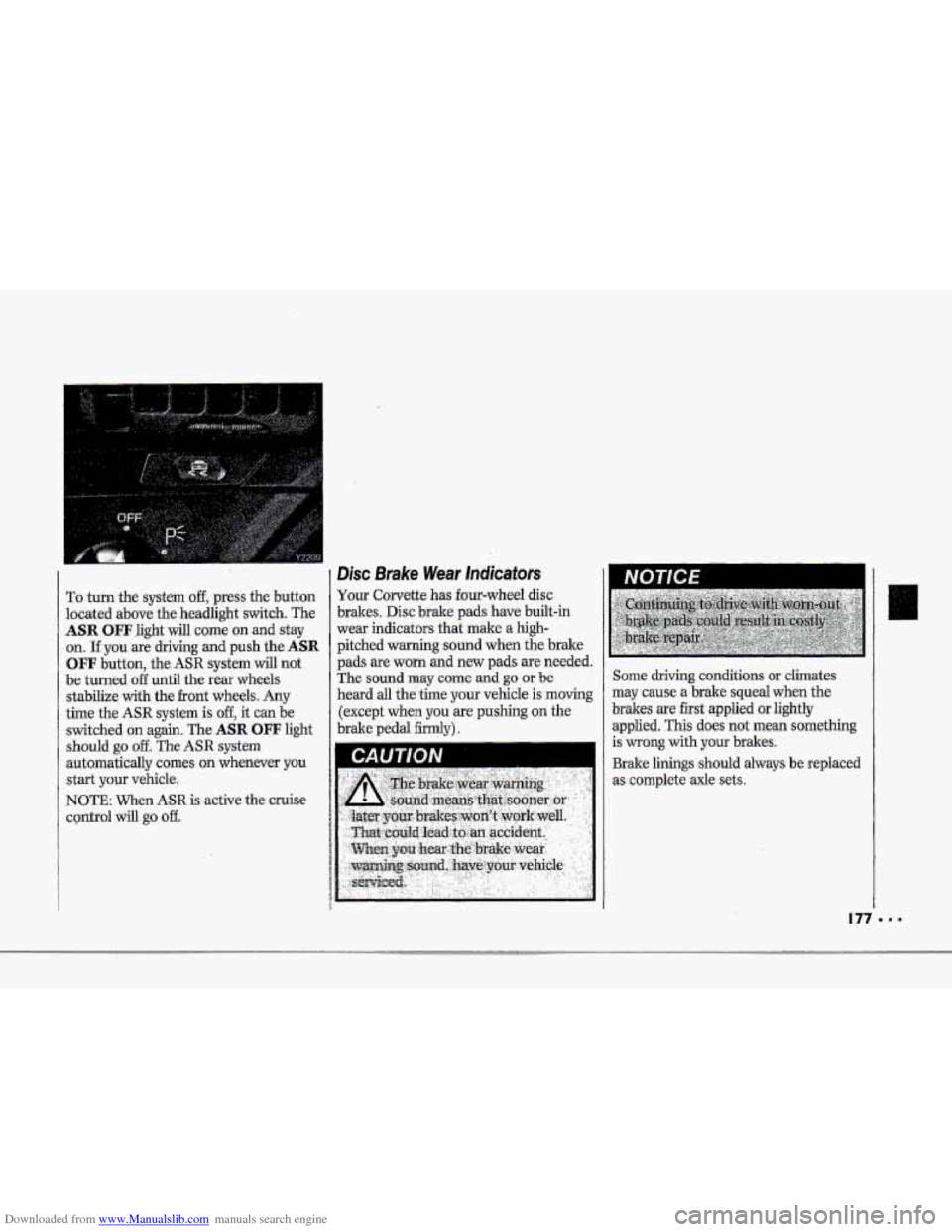
To turn the system off, press the button
located above the headlight switch. The
ASR OFFlight will come on and stay
on. If you are driving and push the ASR
OFF button, the ASR system will not
be turned off until the rear wheels
stabilize with the front wheels.
Any
time the ASR system is off, it can be
switched.
on again. The ASR OFF light
should
go off. The ASR system
automatically comes
on whenever you
start your vehicle.
NOTE: When ASR is active the cruise
CQntrOl will go off.
Disc Brake Wear lndicators
Your Corvette has four-wheel disc
brakes. Disc brake pads have built-in
wear indicators that make
a high-
pitched warning sound when the brake
pads are worn and new pads are needed.
The sound may come and
go or be
heard
aIl the time your vehicle is moving
(except when you
are pushing on the
brake pedal firmly). Some
driving conditions or climates
may cause a brake squeal when
the
brakes are first applied or lightly
applied. This does not mean
something
is wrong with your brakes.
Brake linings should always be replaced
as complete axle sets.
Page 185 of 370
Downloaded from www.Manualslib.com manuals search engine Your Driving and the Road
Skidding (CONT.)
(including engine braking by shifting to
a lower gear). Any sudden change could
cause the tires
to slide. You may not
realize
the surface is slippery until your
vehicle
is skidding. Learn to recognize
warning clues-such as enough water,
ice or packed snow
on the road to make
a ‘‘mirrored surface”-and slow down
when you have any doubt.
Remember: Any anti-lock braking
system
(ABS) helps avoid only the
bralung skid.
Steer the way you want
the vehicle to
go.
Driving at Night
Night driving is more dangerous than.
day driving. One reason is that some
drivers are likely
to be impaired-by
alcohol or drugs, with night vision
problems, or by fatigue.
Here are some tips
on night driving.
Drive defensively. Remember, this is
the most dangerous time.
Don’t drink and drive. (See the Index
under Drunken Dn’ving for mure on
this problem.)
Adjust your inside rearview mirror to
reduce
the glare from headlights
behind you.
Since you can’t see as well, you may
need
to slow down and keep more
space between you and other vehicles.
It’s hard to teil how fast the vehicle
ahead
is going just by looking at its
taillights.
speed roads. Your headlights can light
up only so much road ahead.
Slow down, especially on higher
In remote areas, watch for animals.
If you’re tired, pull off the road in a
safe place and rest.
Page 191 of 370
Downloaded from www.Manualslib.com manuals search engine Your Driving and the Road
Tips on Driving in Fog (CONT.)
something between you and moving
vehicles-space, trees, telephone poles,
a private driveway, anything that
removes you
from other trafic.
If visibility is near zero and you must
stop but are unsure whether you are
away
from the road, turn your lights on,
start your hazard warning flashers, and
sound your horn at intervals or when
you hear approaching traffic.
Pass other vehicles in fog only if you
can see far enough ahead to pass safely.
Even then, be prepared to delay your
pass if you suspect the fog is worse up
ahead. If other vehicles try to pass you,
make it easy for them.
City Driving
One of the biggest problems with city.
streets
is the amount o€ traffic on them.
You’ll want to watch
out for what the
other drivers are doing
and pay
attention
to traffic signals.
Here are ways to increase your safety in
city driving:
* Know the best way to get to where
you-are going.
Try not to drive around
trying to pick out a familiar street or
landmark. Get a city map
and plan
your trip into an unknown part of the
city
just .as you would for a cross-
country trip.
9 Try to use the freeways that rim and
crisscross
most large cities. You’ll
save time
and energy. (See the next
section,
Freeway Driving.)
Treat a green light as a warning
.signal, A traffic light is there because
the corner
is busy .enough to need it.
When a light turns green, and just
before you start to move, check both
ways for vehicles. that have not
cleared
the intersection or may be
running the red light.
Obey all posted speed limits. But
remenher that they are
for ideal road,
weather
and visibility conditions. You
may need to drive bglow the .posted
limit
.in b.ad weather or when visibility
is especially poor,
clear
of intersections when you see or
hear emergency vehicles.
9 Pull to the right (with care) and stop
c