Page 193 of 370
Downloaded from www.Manualslib.com manuals search engine Your Driving and the Road
Driving on the Freeway (CONTJ
~fyou are moving from an outside to a
center lane. on a freeway having more
than two lanes, make sure another
vehic1e;isn't about to move
into the
same spot. Look at the 'vehicles two
lanes over and watch for telltale signs:
turn
signals flashing? an increase in
speed, or
moving toward the edge-of the
lane. Be prepared to delay
your move.
Once you are moving on the freeway,
make certain you allow a reasonable
following distance. Expect
to move
slightly slower at night.
Leaving the Freeway
When you want to leave the freeway,
move to the proper lane well in
advance. Dashing across lanes at the
last minute is dangerous.
If you miss
your exit do not,.under any circum-
stances,
stop and back up. Drive on to
the next
exit.
At each exit point is a deceleration lane.
Ideally it
should be long enough for you
to enter it at freeway speed
(after
signaling, of course) and then do your
braking before
moving onto the ,exit
ramp. Unfortunately, not all deceleration lanes are
long enough-
.some are too short for all the braking.
Decide when
to start braking. If you
must brake on the.through lane, and if
there is traffic close behind you, yau can
allow a little extra tirrie and flash your
brake lights (in addition to your turn
signal)
as extra warning that you are
about to slow down and exit.
The exit ramp
can be curved, sometimes
quite sharply. The exit speed
is usually
posted. Reduce
your speed according to
your speedometer, not-to your sense of
motion. After driving.for any distance at
higher speeds,
you may tend to- think.
you -we going slower than you actually
are. For example,
40 mph (65 I&)
might seem like only 20 mph (32 Wh) .
Obviously, this could lead to serious
trouble on a
ramp designed for 20 rnph
(32 W)!
P
be
Page 199 of 370
Downloaded from www.Manualslib.com manuals search engine your urlvlng ana tne Koaa
Torque Lock
(AUTQMATIC TRANSMISSION)
If you are parking on a hill and you
don’t shift your transmissian into
P (Park) properly, the weight of the
vehicle may put
too much force on the
parking pawl in the transmission. You
may find it difficult to pull the shift
lever out of
P (Ihrlr). This is called
“torque
lock.” To prevent torqu’e lock,
always
be sure to shift into P (Park)
properly before you leave the driver’s
seat.
To find out how, see the Index
under Shifting Into P (Park).
When you are ready to drive, move the
shift lever out
of P (Park) before you
release the parking brake.
If torque lock does occur, you may need
to. have another vehicle push yours a
little uphill to take some of-the pressure
from the transmiss.ion, ‘so you can pull
the
shifi lever out of P (Park).
I98
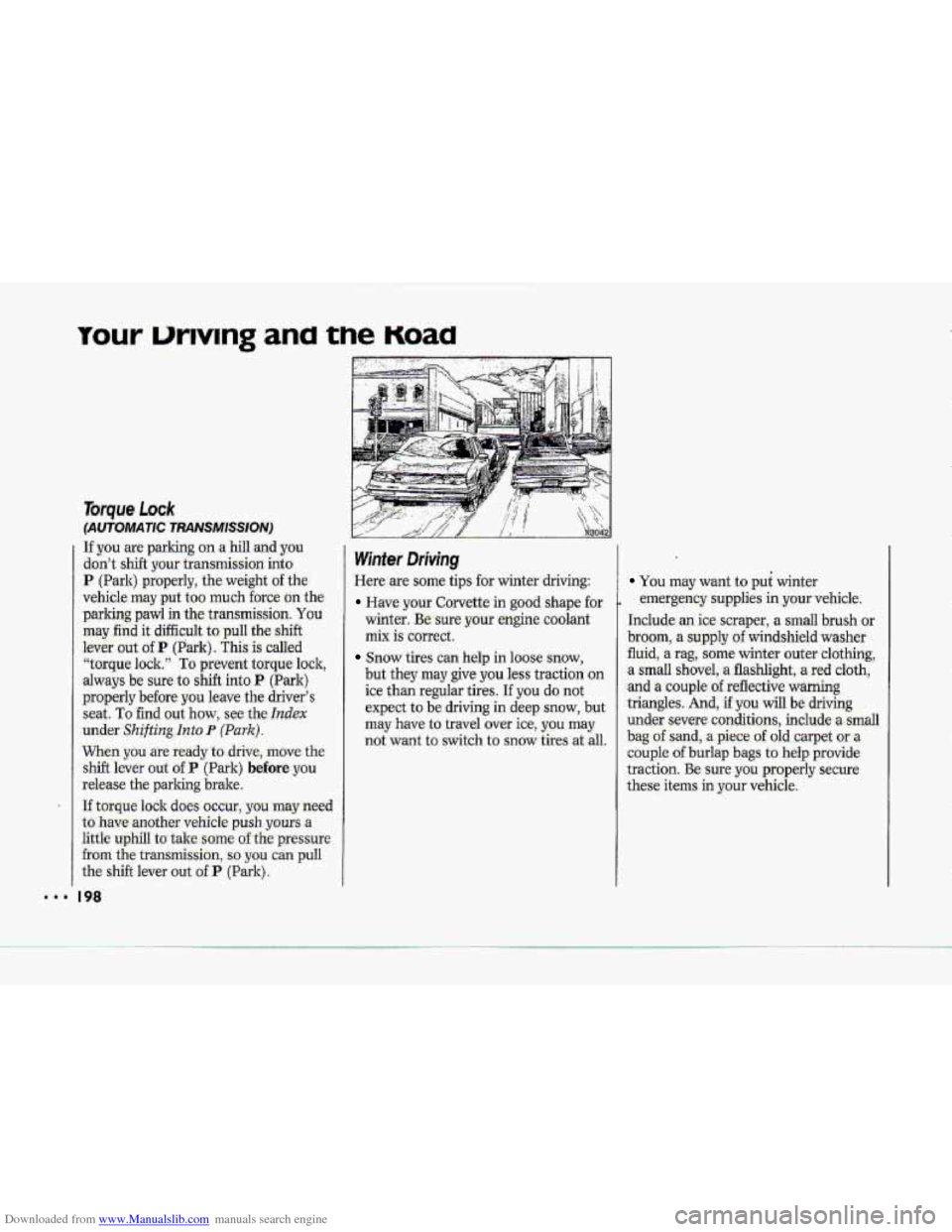
Winter Driving
Here are some tips for winter driving:
Have your Corvette in good shape for
winter.
Be sure your engine coolant
mix is correct.
Snow tires can help in loose snow,
but they may give you less traction on
ice than regular tires. If you do not
expect to be driving
in deep snow, but
may have
to travel over ice, you may
not want to switch to
snow tires at .all.
YOU may want to put winter
emergency supplies in your vehicle.
Include
an ice scraper, a small brush or
broom, a supply of windshield washer
fluid, a rag, some winter outer clothing,
a small shovel, a flashlight, .a red cloth,
and a couple of reflective warning
triangles. And, if-you will be driving
under severe conditions,
include a small
bag of sand, a piece of old carpet or a
couple of burlap bags to help provide
traction. Be sure you properly secure
these items in your vehicle.
Page 204 of 370
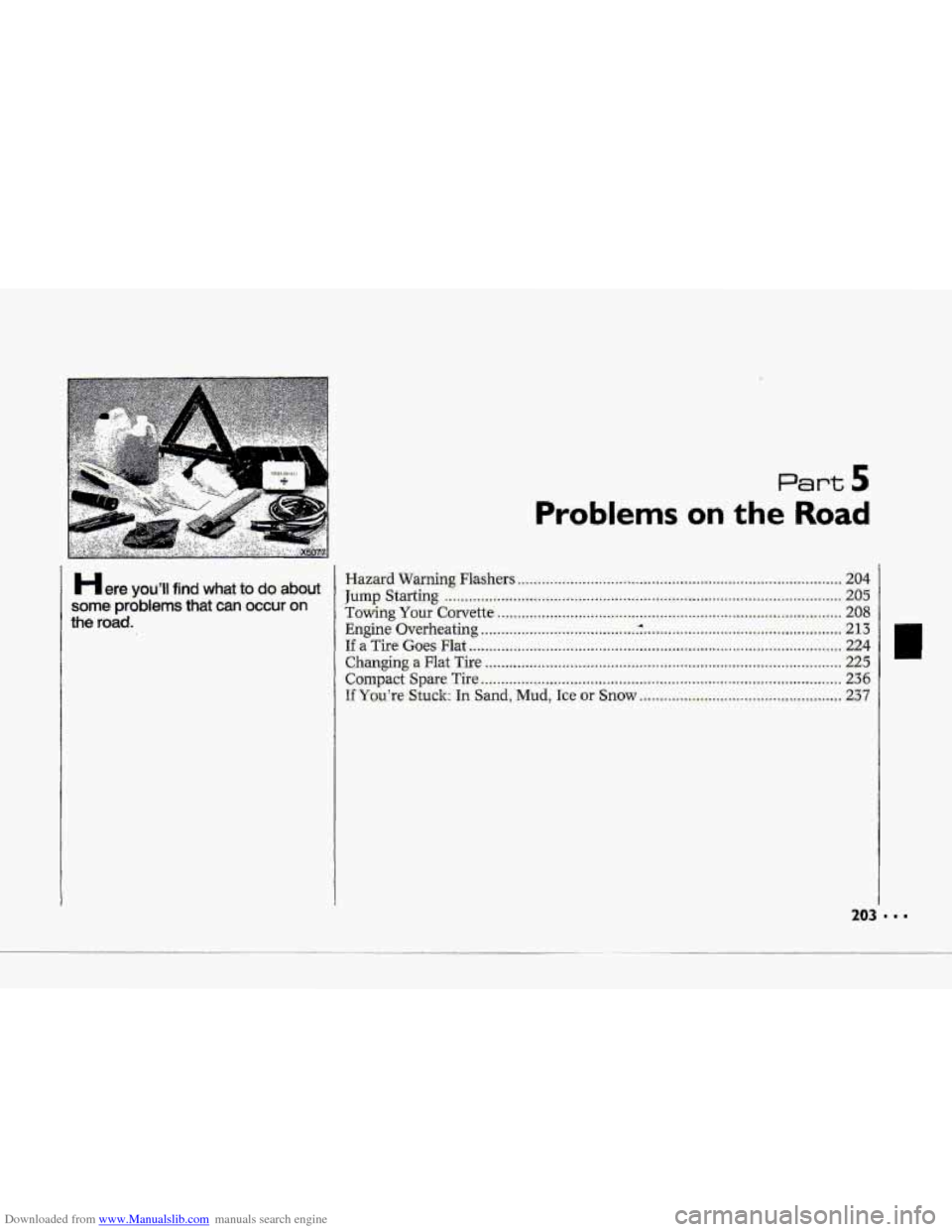
Downloaded from www.Manualslib.com manuals search engine H ere ~OU’II find What to do about:
same problems that can occur on
the road.
Part 5
Problems on the Road
Hazard Warning: Flashers +.. ........................................................................\
.... 204
Jump Starting ............ $. ..... (.. ............................ .,. ............................................... .-. 205
Towing Your Corvette ........................................................................\
................ 208
Engine:Overheating 21 3
If a Tire Gdes Flat ........................................................................\
........................ 224
Changing a Flat Tire ........................................................................\
.................... 225
C.ompact Spare Tire ..;.. ........................................................................\
................. 236
”4 ........................................................................\
.................
If You‘re Stuck: In. S.md, Mud, Tce or Snow .................................................... .. 237
LJ
203 . =
Page 205 of 370
Downloaded from www.Manualslib.com manuals search engine Problems on the Road
‘A
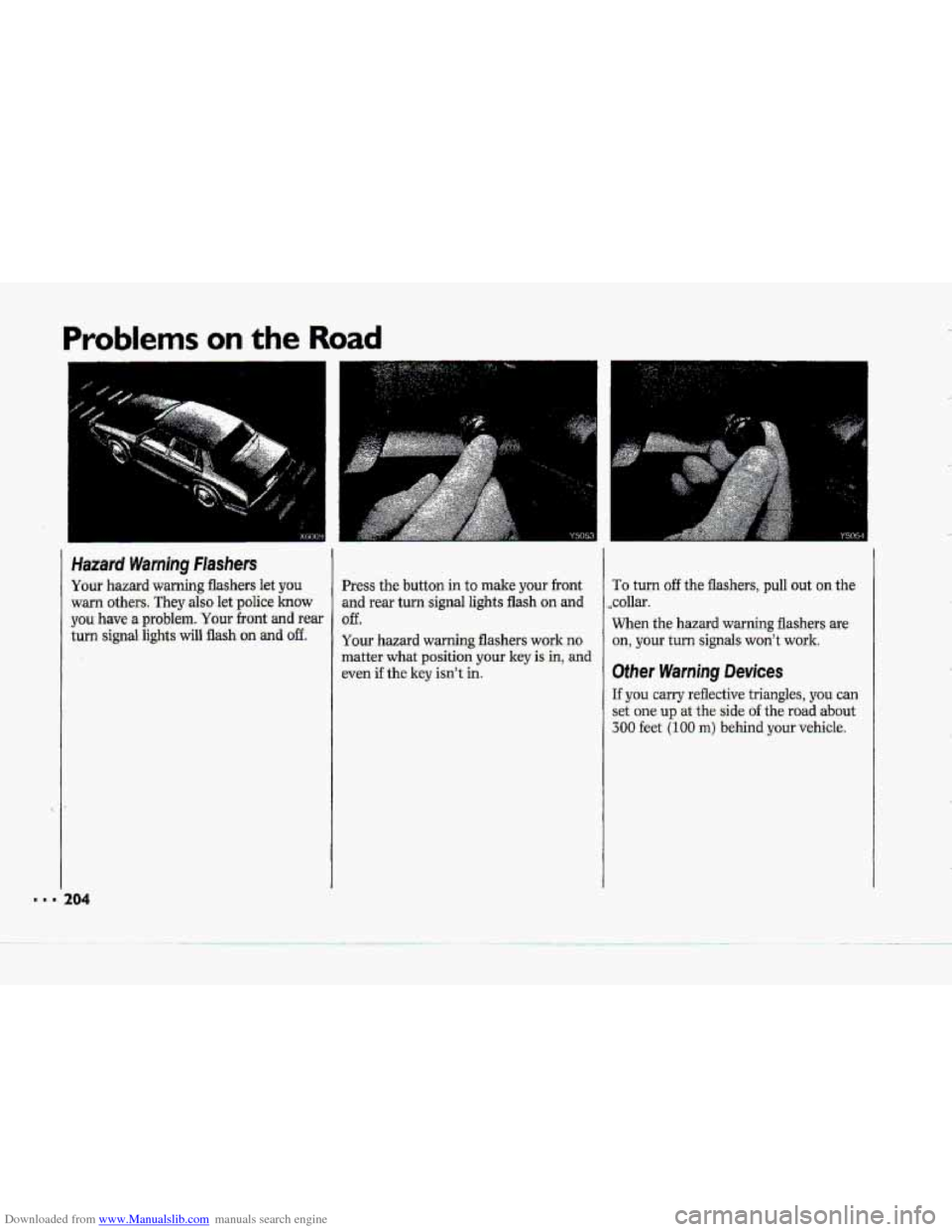
Hazard Warning Flashers
Your hazard warning flashers let you
warn others. They also let police know
you have a problem. Your front and rear
turn signal lights will flash on and off.
204
Press the button in to make your front
and rear turn signal lights flash on and
Off.
Your hazard warning flashers work no
matter what position your key is in, and
even if the key isn’t in.
To turn off the flashers, pull out on the
.*collar.
When the hazard
warning flashers are
on, your turn signals won’t work.
1 Other warning Devices
If you carry reflective triangles, you can
set one up at the side of the road about
300 feet (100 m) behind your vehicle.
Page 209 of 370
Downloaded from www.Manualslib.com manuals search engine Problems on the Road
Jump Siaithg (C0;NT.)
9. Attach the cable at least 18 inches
(45 em> away from the dead battery,
but -not near engine
parts that move.
The dectrical cowection is just as
good there, but the chance of sparks
getting back to., the batt-ery is much
less.
10. Now start the vehicle with the go0.d
battery and run the engine
for a
while.
11. Try’to start the vehicle with the
dead battery.
If it won’t start after a>few tries, it
probably needs service.
108
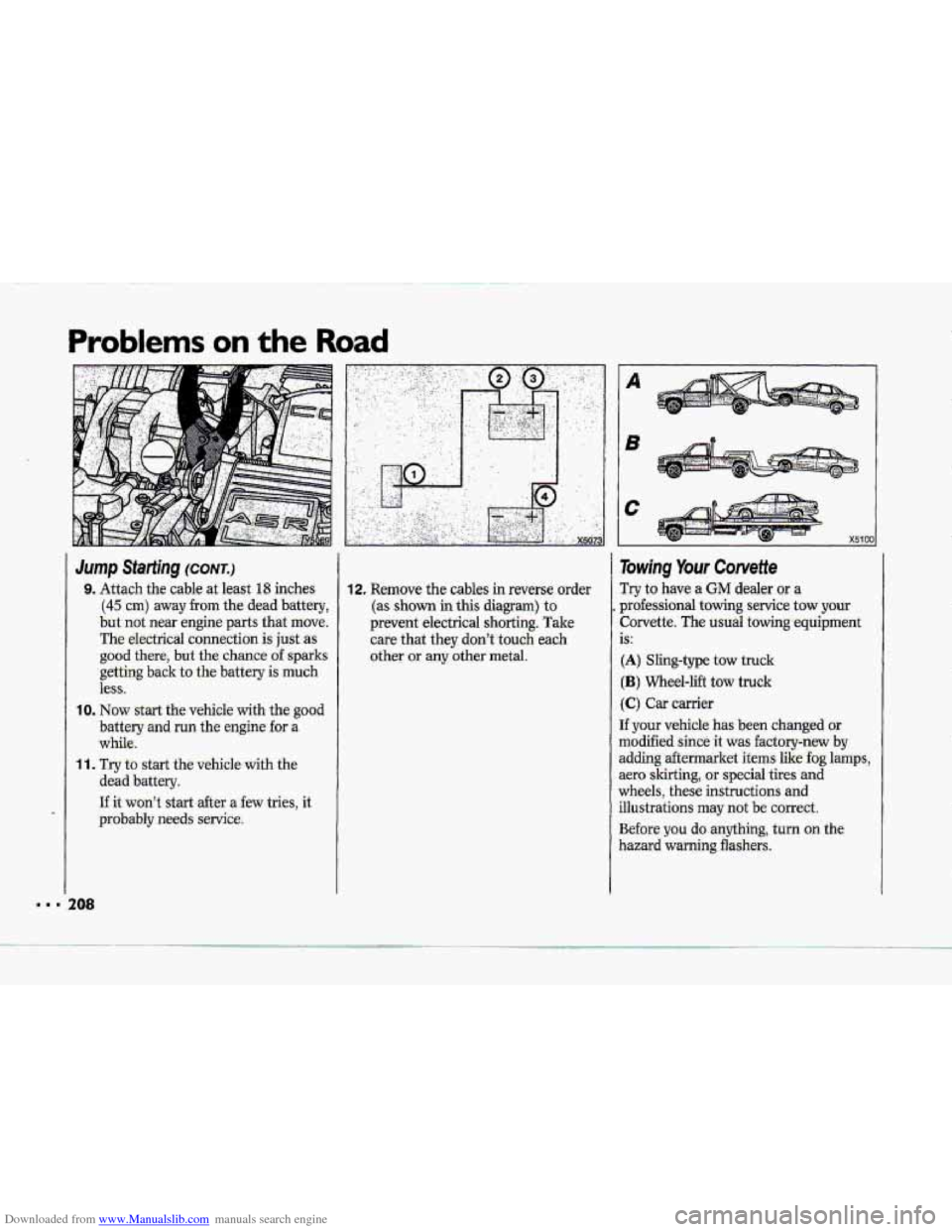
12, Remove the cables in reverse order
(as shown in this diagram) to
prevent electrical shorting. Take
care that they don’ttouch each
other or any other m&al.
Towing Your Corvette
Try to have a GM dealer or a
professional towing service tow your
Corvette, The usual towing equipment
is
:
(A) Sling-twe tow truck
(B) Wheel-lift tow truck
(C) Car carrier
If your vehicle has-been changed or
modified since it was factory-new by
adding aftermarket items like fog lamps,
aero skirting, or special-tires and
wheels, these instructions and
illustrations may not be correct.
Before
you do anything, turn on the
hazard warning
flashers.
Page 214 of 370
Downloaded from www.Manualslib.com manuals search engine F"
!
L
r
i
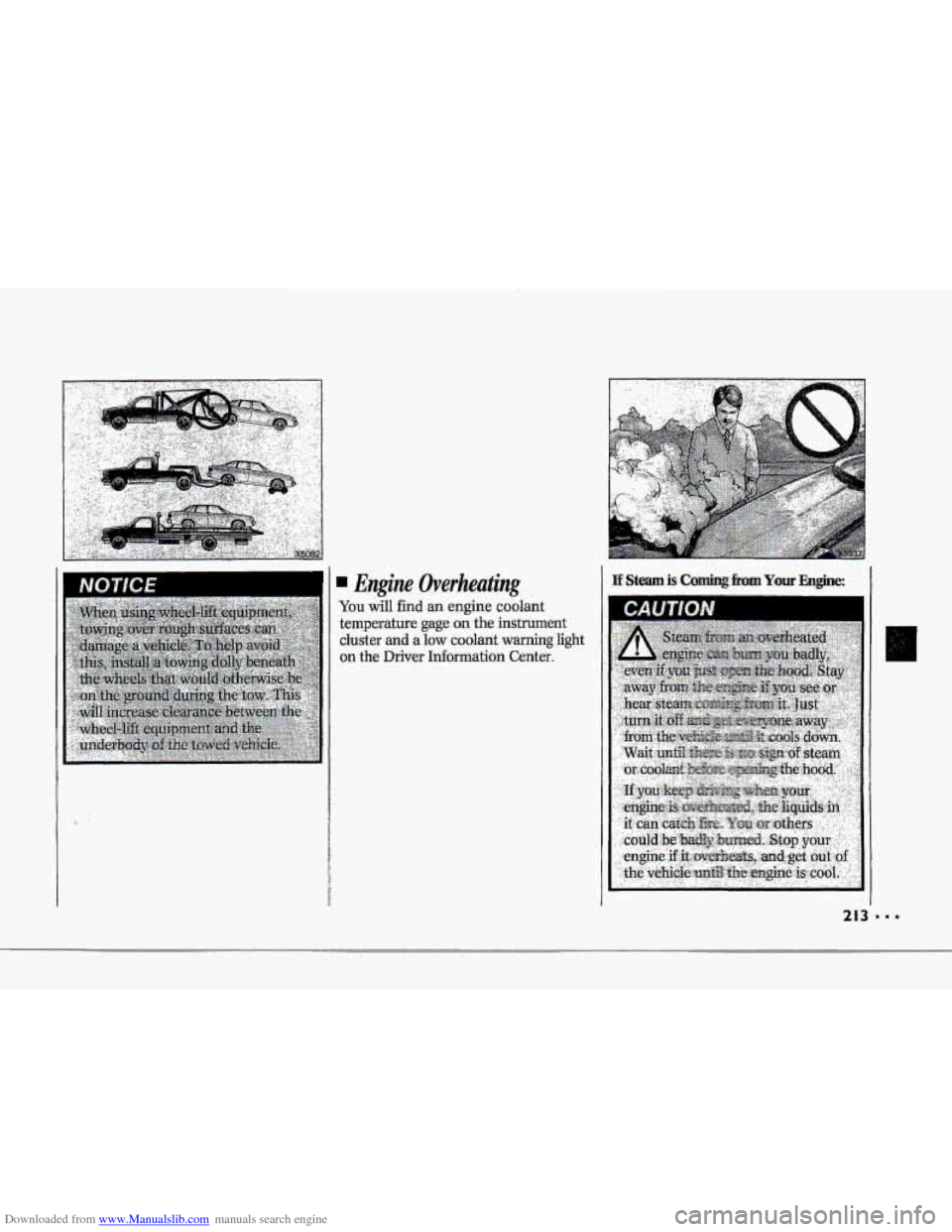
Engine Overheating
Y0.u will find an engine coolant
temperature gage. on. the instrument
cluster and a low coolant warning light
on the Drives In€orrnation Centkr.
Ifsteamis
Page 215 of 370
Downloaded from www.Manualslib.com manuals search engine Problems on the Road
If No Steam is Coming from Your
Engine:
If you get the overheat warning but see
or hear no steam, the problem may not
be too serious. Sometimes the engine
can get .a Me too hot when you:
9 Climb a long hill on a hot day.
4 Stop after high speed driving.
Idle for long periods in traffic.
If you get the overheat warning with no
sign of steam, try this for a minute or so:
1 I Turn off your air conditioner.
2. Turn on your heater to €ull hot at the
highest
fan speed and open the
window as necessary.
3. Try to keep your engine under load
(in
a -drive gear where the engine
runs slower).
If you no longer have the overheat
warning,.you
cm drive. Just to be safe,
drive slower for about ten minutes., If
the warning doesn't co~e back on, you'
can drive normally.
I€ the warning continues, pull over,
stop, and park your vehicle right away.
If there's still no sign of steam, you can
idle the engine for two or three minutes
while you're parked, to see jfthe
warning
stops. But then, if you still
have
the warning, TURN OFF THE
ENGINE AND GET EVERYONE OUT
OF THE VEHICLE until it cools down.
You- may decide not to l.23 the ho0.d but
to get service help right away.
r
e
Page 218 of 370
Downloaded from www.Manualslib.com manuals search engine .-
Adding only plain:water.to
yam cooling system can be
dangerous. Plain water, or some
other .liquid like alcohol, can boil
before the proper coolant mix will.
Your vehicle's coolant warning
system is set for the proper coolant
mix. With plain water or the wrong
mix, your engine could get too hot
but
you wouldn't get the overheat
warning. Your engine could catch
fire and you or others could be
burned. Use a 50/50 mix of clean
water and a proper antifreeze.
You can'bebumed if you
. -spiU"CoolaZit hot engine '
parts. Coolant contains'ethylene
glycol and it will burn .if the engine
parts are hot enough. Don't spill
coolant on a hot engine.
When the coolant in the coolant
recovery
tank is at or above COLD,
start your vehicle.
If the overheat warning continues,
there's one more thing you can try. You
can add the proper coolant mix directly
to the coolant high fill reservoir, but be
sure the cooling system is cool before you
do it.
3