Page 193 of 370
Downloaded from www.Manualslib.com manuals search engine Your Driving and the Road
Driving on the Freeway (CONTJ
~fyou are moving from an outside to a
center lane. on a freeway having more
than two lanes, make sure another
vehic1e;isn't about to move
into the
same spot. Look at the 'vehicles two
lanes over and watch for telltale signs:
turn
signals flashing? an increase in
speed, or
moving toward the edge-of the
lane. Be prepared to delay
your move.
Once you are moving on the freeway,
make certain you allow a reasonable
following distance. Expect
to move
slightly slower at night.
Leaving the Freeway
When you want to leave the freeway,
move to the proper lane well in
advance. Dashing across lanes at the
last minute is dangerous.
If you miss
your exit do not,.under any circum-
stances,
stop and back up. Drive on to
the next
exit.
At each exit point is a deceleration lane.
Ideally it
should be long enough for you
to enter it at freeway speed
(after
signaling, of course) and then do your
braking before
moving onto the ,exit
ramp. Unfortunately, not all deceleration lanes are
long enough-
.some are too short for all the braking.
Decide when
to start braking. If you
must brake on the.through lane, and if
there is traffic close behind you, yau can
allow a little extra tirrie and flash your
brake lights (in addition to your turn
signal)
as extra warning that you are
about to slow down and exit.
The exit ramp
can be curved, sometimes
quite sharply. The exit speed
is usually
posted. Reduce
your speed according to
your speedometer, not-to your sense of
motion. After driving.for any distance at
higher speeds,
you may tend to- think.
you -we going slower than you actually
are. For example,
40 mph (65 I&)
might seem like only 20 mph (32 Wh) .
Obviously, this could lead to serious
trouble on a
ramp designed for 20 rnph
(32 W)!
P
be
Page 196 of 370
Downloaded from www.Manualslib.com manuals search engine f
F"
Hin and Mounfain Roads
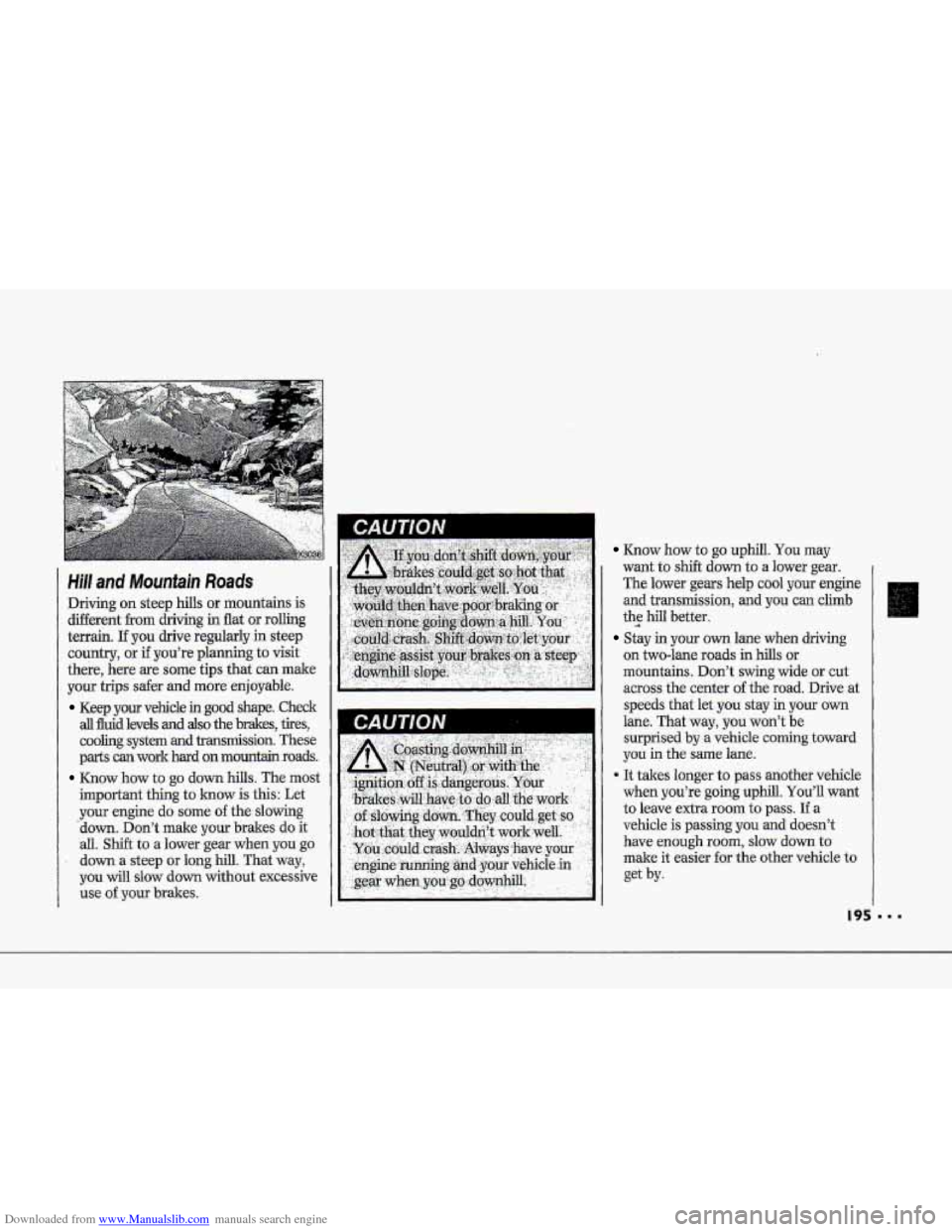
Driving on steep hills or mountains is
dif€erent fram driving in flat or rolling
terrain. If you drive regularly in steep
country,
or if you're planning to visit
there, here are -some tips that can make
your trips safer and.more enjoyable.
Keep your vehicle in good shape. Check
all fluid levels and also the brakes, tires,
cooling system and transmission. These
parts can work hard on mountain roads.
Know how to go down hills. The most
important thing to how is this: Let
your engine do. some of the slowing
'down. Don't make your brakes do it
all. Shift to a lower gear when you go
down .a steep or long hill. That way,
you will slow down without excessive
use of your brake-s.
Know how to go uphill. You may
want to shift dawn to a lower gear.
The lower gems help cool your engine
and transmission, and you can clin-ib
the *f hiU better.
Stay in your own lane when driving
on two-lane roads in hills or
mountains. Don't swing wide .or cut-
across. the .center of the road. Drive at
speeds that-let-you stay 'in your own
lae. That way, you won't be
surprised by,a vehicle- coming toward
you
in the same lane.
* It takes longer to pass another vehicle-
when you're going uphill. You'll want
to leave extra room to pass. If a
vehicle is passing you and doesn't
have enough room, slow down to
make it easier for the other vehicle to
get by.
Page 202 of 370
Downloaded from www.Manualslib.com manuals search engine fi
p" , '7
i Y
F"
Run your engbe only as. long -as you
must. This saves fuel. When you run the
engine,
make it go a little faster than
just idle. That is, push the accelerator
slightly. This uses less fuel for the heat
that you get and it keeps the battery
charged. You will need a well-charged
battery
to restart the vehicle, and
possibly €or signaling later on with your
headlights. Let the
heater mn €or a
while.
Then> shut the engine off and close the
window almost all the way to preserve
the heat. Start the engine again and
repeat this only when you feel really
qncomfortable
from the cold. But do it
as little as possible. Preserve the fuel as
long as you can. To help keep warm,
you can get out of the vehicle and do
some fairly vigorous exercises every
haK-hour or so until help comes.
If You're Stuck in Deep Snow
You should twn your ASR system off if
you're stuck in deep snow. See the
Index under Accelerafion Slip
Regulation (ASR) Sysleem. This manual
explains how to get the vehicle out
of
deep snow without damaging it. See the
Index under Rocking Your Vehicle.
Towing a Trailer
Your Corvette is neither designed nor
intended to tow a trailer.
20 I
Page 204 of 370
Downloaded from www.Manualslib.com manuals search engine H ere ~OU’II find What to do about:
same problems that can occur on
the road.
Part 5
Problems on the Road
Hazard Warning: Flashers +.. ........................................................................\
.... 204
Jump Starting ............ $. ..... (.. ............................ .,. ............................................... .-. 205
Towing Your Corvette ........................................................................\
................ 208
Engine:Overheating 21 3
If a Tire Gdes Flat ........................................................................\
........................ 224
Changing a Flat Tire ........................................................................\
.................... 225
C.ompact Spare Tire ..;.. ........................................................................\
................. 236
”4 ........................................................................\
.................
If You‘re Stuck: In. S.md, Mud, Tce or Snow .................................................... .. 237
LJ
203 . =
Page 209 of 370
Downloaded from www.Manualslib.com manuals search engine Problems on the Road
Jump Siaithg (C0;NT.)
9. Attach the cable at least 18 inches
(45 em> away from the dead battery,
but -not near engine
parts that move.
The dectrical cowection is just as
good there, but the chance of sparks
getting back to., the batt-ery is much
less.
10. Now start the vehicle with the go0.d
battery and run the engine
for a
while.
11. Try’to start the vehicle with the
dead battery.
If it won’t start after a>few tries, it
probably needs service.
108
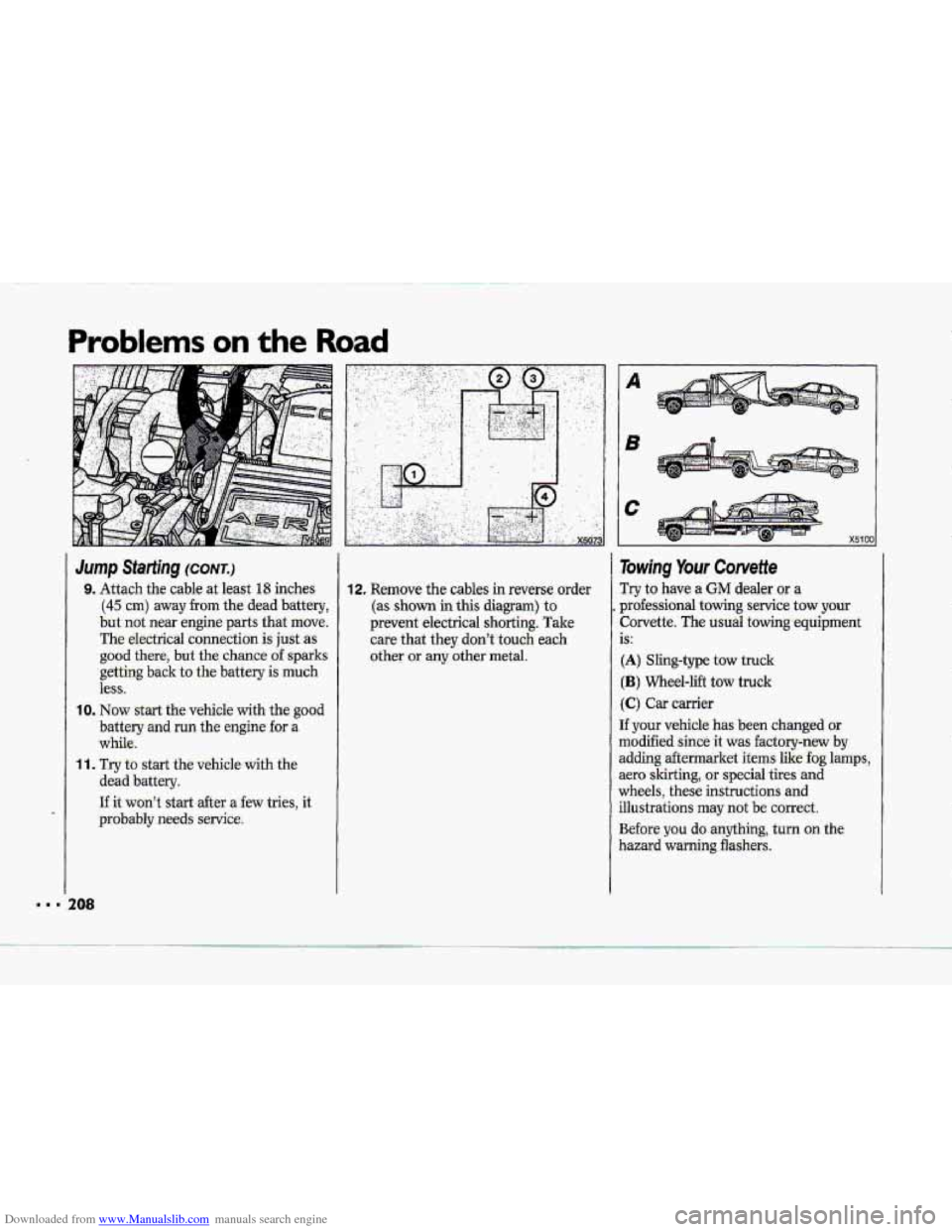
12, Remove the cables in reverse order
(as shown in this diagram) to
prevent electrical shorting. Take
care that they don’ttouch each
other or any other m&al.
Towing Your Corvette
Try to have a GM dealer or a
professional towing service tow your
Corvette, The usual towing equipment
is
:
(A) Sling-twe tow truck
(B) Wheel-lift tow truck
(C) Car carrier
If your vehicle has-been changed or
modified since it was factory-new by
adding aftermarket items like fog lamps,
aero skirting, or special-tires and
wheels, these instructions and
illustrations may not be correct.
Before
you do anything, turn on the
hazard warning
flashers.
Page 210 of 370
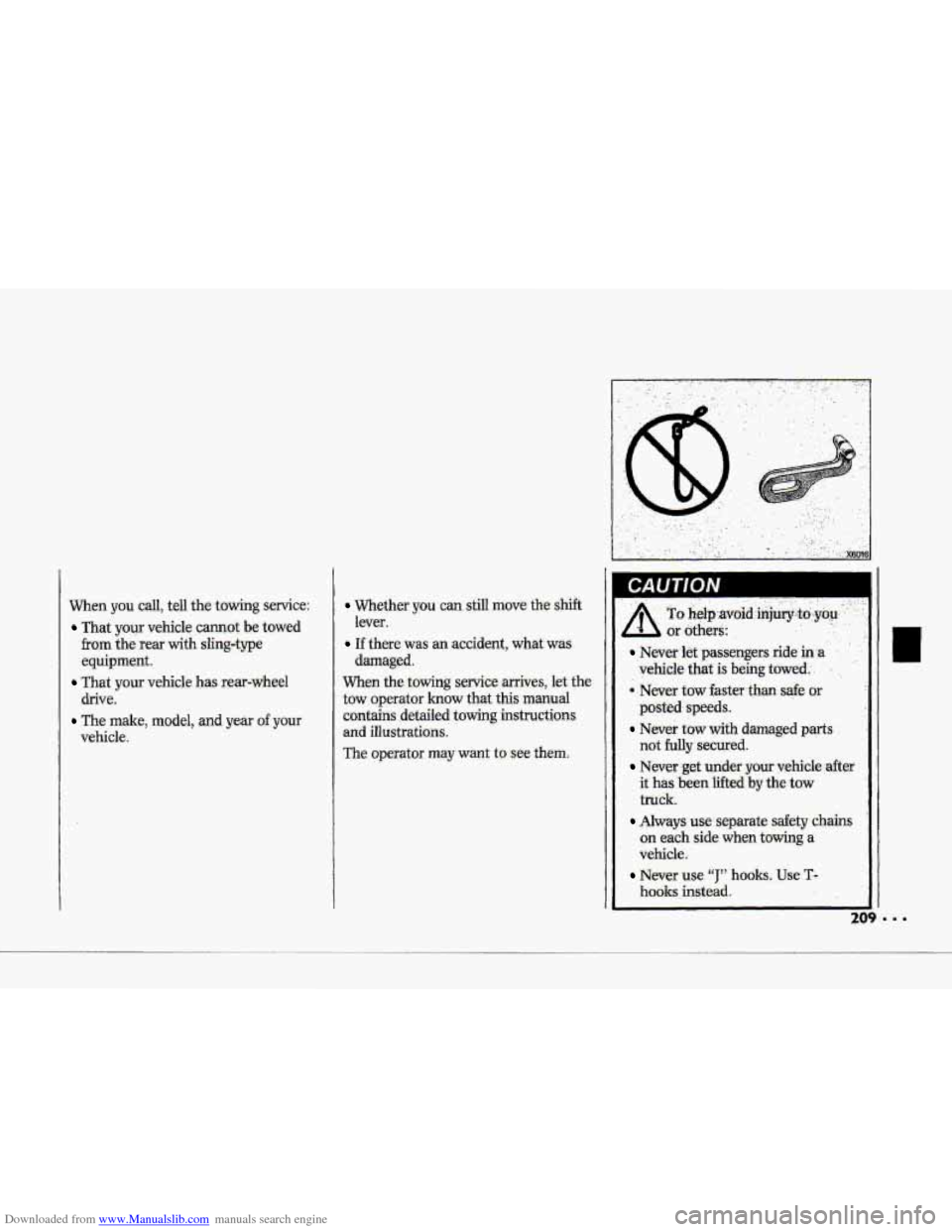
Downloaded from www.Manualslib.com manuals search engine When you cdI, tell the towing service:
That your vehicle cannot be towed
-horn the rear with sling-type
equipment.
That your vehicle has rear-wheel
The make, model, and year of your
drivei
vehicle.
Whether you can still movethe shift
If there was an accident, what was
When the towing service arrives, let the
tow.operator know that this manual
contains detailed. t,owing instructions
and illustrations.
The operator may want to see them.
lever.
damaged.
A.
I
..
Never.&t .passengers ride in:a .. ’ .
vghiele that is being towed:: . . .
0. N&er tow fasterthan safe or
.posted: speeds.
Never &w with damaged parts
not fully secmed.
Never -get under your vehicle:&er
if has-been Wed by the tow
truck.
on each side when towing a
vehicle.
Never .use “r’ hrioks. Use T-
ho-o€cs.instead.
Always we separate sa€ety,chahs
2
Page 211 of 370
Downloaded from www.Manualslib.com manuals search engine Towhg Your Corvette (CONT.)
When your vehicle is being towed, have
the ignition key
off. The steering wheel
should-be.
clamp,ed in a straight-ahead
position, with a clamping device
designed fur towing s-ervice. DO not use
the vehicle's stewing column iock for
this. The transmission shoLild be in
N [Neutral), and the.parlepg brake
released.
Don't have your vehicle tqwed on the
rear wheels,. unless you must. If the
vehicle
must. be t0we.d on the rear
wheels, dan't go more than 3mph
I
(56 km/h) or farther than 50 miles
(80.h) or your transmission will be
-damaged. Go slow over rough ground,
and position one wheel at a time
(angled 450j if you have- to go over
eurbs.and
rises. .Wheels &the lifted end
should be-
at. least 4 inches (10 cm)
above the ground. If these limits must
be
exceeded, then the rear wheels have
to be supported .on-a dolly.
I
.,
A
A vehicle can faH~~~m~a:c~
carrier if ,it isn't propgilp '
secured., This can cause a.colii$ion,
serious. pelrsonal injury .and:.vehicle.
damage.
The vehicle..shou[d be
t-ightly secured with chains or--sted -'
cables before it is transported-'
Don't use substitutes '(ropes,
leather straps, canvas webbing,
etc:.) that- can be cut by sharp edges
underneath the t.owed vehicle,
Page 213 of 370
Downloaded from www.Manualslib.com manuals search engine Pro-blems on the Road
I
Towing from the Front-
Vehicle Hook-Up (corvr.)
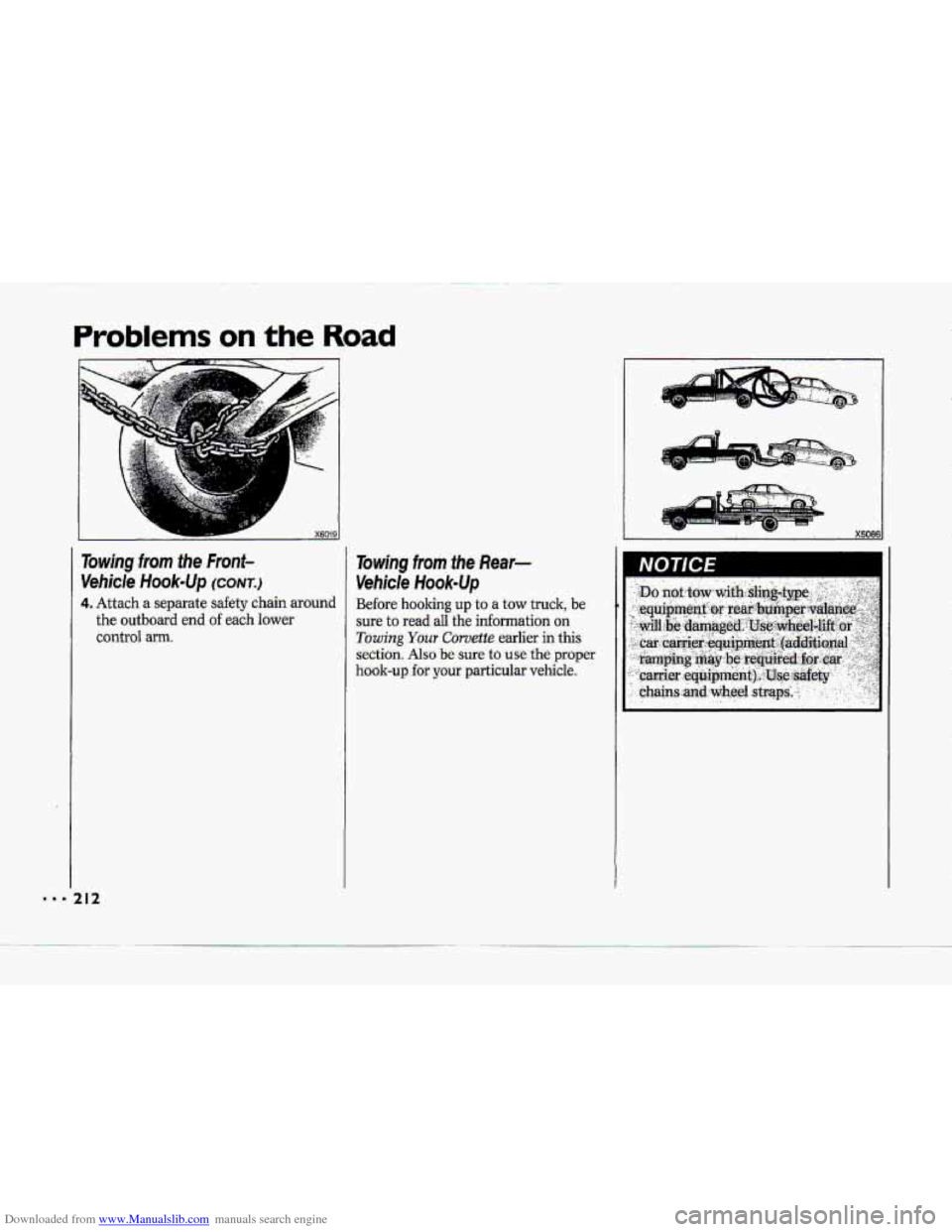
4. Attach a separate safety chain around
the outboard end. of each lower
control arm.
Towing fro-m fhe Rear-
Vehicle Hook-Up
.Before hooking up to a tow truck, be
sure to read all the information on
Towing Your Corvette earlier in this
sectim. Also be sure to use the proper
hook-up for your particular vehicle.