Page 80 of 370
Downloaded from www.Manualslib.com manuals search engine Engine Exhaust
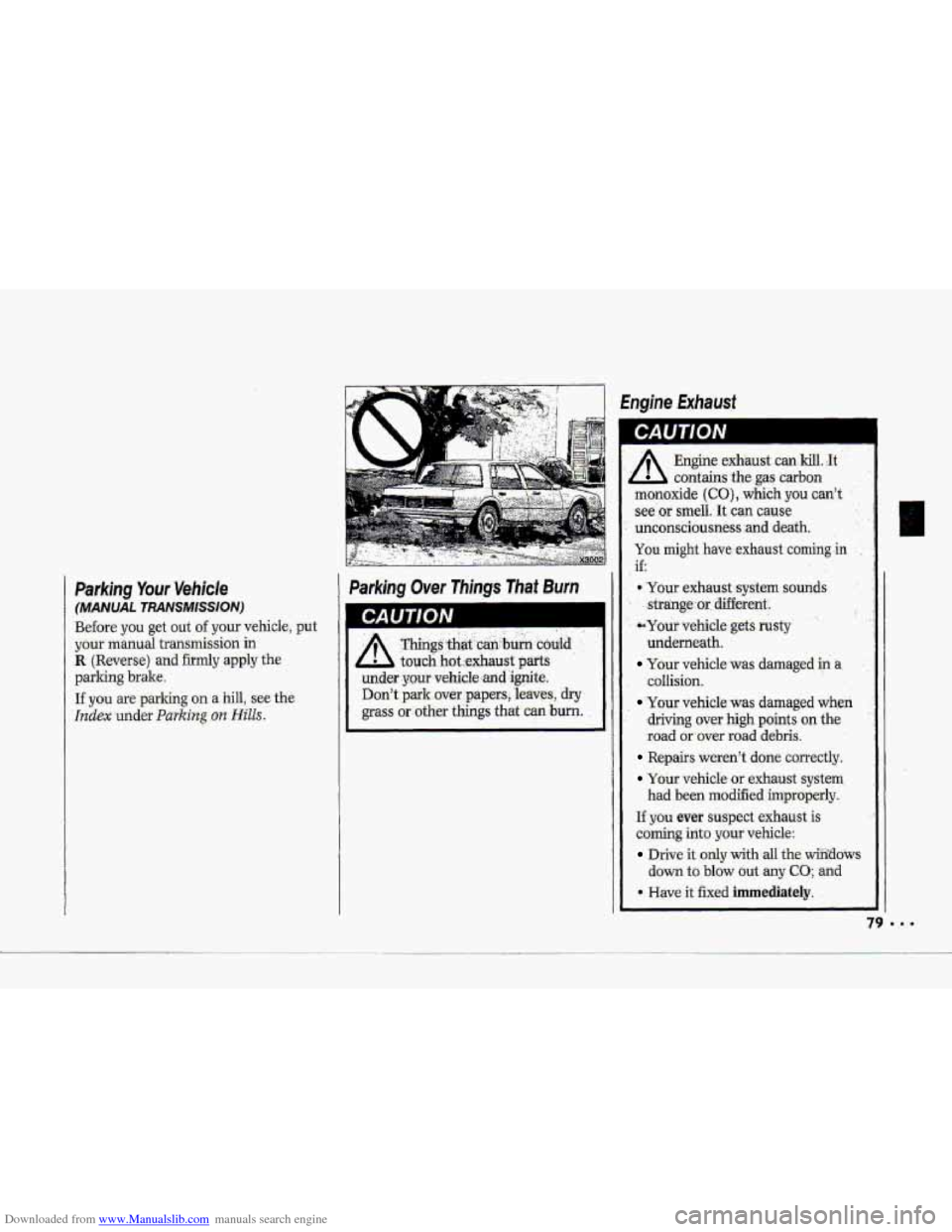
Parking
Your Vehicle
(MANUAL TRANSM/$SION)
Before you get out of your vehicle, put
your manual-transmission in
R (Reverse) and firmly apply the
parking brake.
If you are parking' on a. hill, see the
Index under Parking on Hills.
i
A Engine exhaust can-lull. !It
contains.the gas carbon
monoxide (CO) , which you can't,
see'or srnefl. It can cause
unconsciousness
:and death.
You might have .exhaust. coming .in ..
if:
.-Your exhaust system sounds-
*.your; vehicle gets Asty
: . . &r&g&sr. dserent.
..
underneath.
Your vehicle-was damaged .in a
collision.
Your vehicle. was d,amaged when
-driving over high points. on the
mad or over road debris.
Repairs weren't done correctly.
Your vehicle or exhaust system
had been modified 'irnprapeirly.
If you ever suspect exhaust is
corning into your .vehicle:
Drive. it only with all the wiiidows
down to 'blow out any CO; .and
Have it fixed immediately.
Page 81 of 370
Downloaded from www.Manualslib.com manuals search engine Features & Controls
Running Your Engine While You're Parked
(AUTOMATIC TRANSMISSION)
It's better not to park.with the engine running. But if.you ever have to, here !are
some things to know.
'Exhaust)-.
Also, idring in a: closed-in-place -c'm let..deadly carbon monoxide (CO) into your
vehicle even %$he fan switch
is at.the highest setting. One place this can
happen'
is :a garage.. 'Exhaust-wiih CO-can corne heady. Never park in a
garage-with.fhe engine
running.
.Another closed-in place can be a blizzard. (See the Index under.BZizzai.d.)
It dan'b.e .dangerous.
to get .out of your vehicle if the shift lever is not fully in
P (Park) with:ihe.parking brake firmly set. Your vehicle can roll. Don't leave
your vehicle whenthe engine
is running unless you have to. If you've left the
engine running, the-.vehicle can move suddenly.
You or others. could be injured.
To be su-re your vehicle won't.move, even when you'-re on fairly level-ground,
aiways set
your .parking-brake and move the shift lever to P (Park).
If you are parking on .a hill, also. see the Index under Parking on Hi'ZZs.
Rough Idling-
If you notice rough idling or surging of
the engine, especially after long periods
of idling;.or during slow city driving, the
oxygen sensors
may be clogged. If this
happens, place the automatic
' transmission in P- (Park) .or manual
transmission in
N (Neutral), firmly
apply the parlcing brake, and accelerate.
to
2000 rprn for two minutes. This will
clear the oxygen sensors,
80
Page 85 of 370
Downloaded from www.Manualslib.com manuals search engine Features & Controls
r
34
I NOTICE
With cruise control, you can maintain a
speed of about 25 mph (40 km/h) or
more without keeping your fo-ot 0.n the
accelerator. This can really help on long-
trips.
Cruise control does not work at speeds
below about 25 mph (40 Wh).
When you apply your brakes or the
clutkh pedal,
or when ASR is active, the
cruise-control shut.s off. -See the Index
under Accelerution Slip Regulation
{ASR) System.
Page 87 of 370
Downloaded from www.Manualslib.com manuals search engine Features & Controls
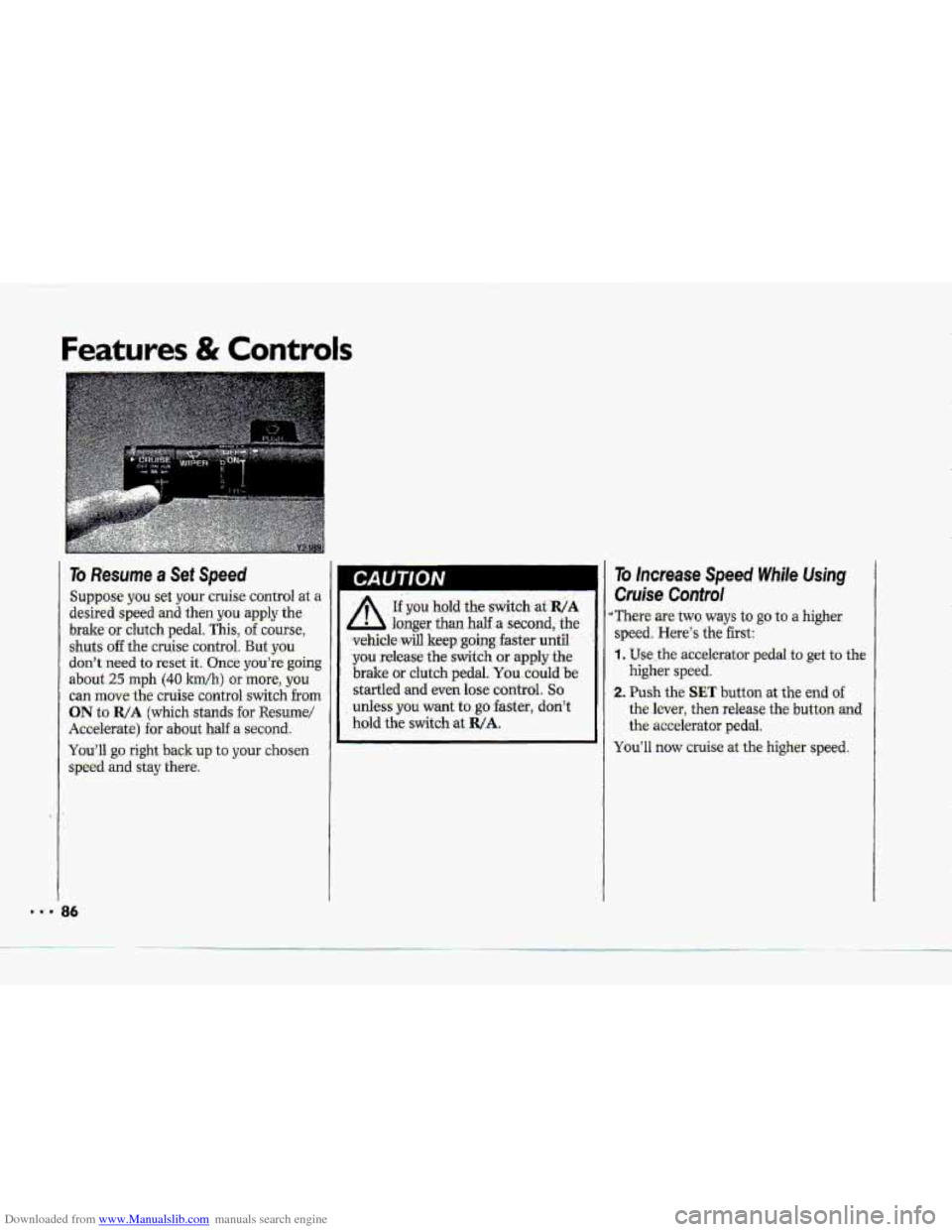
To Resume a Set Speed
Suppo,se you set your cruise control at a
desired' speed and then you apply the
brstke.or clutch pedal. This-, 6f. course,
shuts off the cruise control. But you
don't +need to reset it. Once you're going
about 25 mph (40 ldh) or more, you
can move- the cruise control switch from
ON to. R/A (which stands fur Resume/
Accelerate.) for about half-;a second.
You'll go right back up to your chosen
speed and stay there.
86
/r\. If you hold ihe .Witch ai WA
longer than half .a .second, the
.vehicle-wiU keep gaing faster, until
'you release the switch or apply .the
'brake or clutch pedal. Y6u..could'be.
startled and even lose control. So
unless you want to go .faster, don't
hold the switch at R/A.
To Increase Spe.ed While- Ushg
Cruise Control
There are two. ways to go t.o a higher
speed. Here's
the first:
1. Use ,the accelerator pedal to get to the
2. Push the SET button at the end of
higher speed.
the .lever, then release.the button and
the accelerator pedaI.
YoaII now ~ruise at the higher speed.
Page 89 of 370
Downloaded from www.Manualslib.com manuals search engine Features & Controls
88
Using Cruise. Control on HMs.
How well your cruise control will work
on hills depends upon y~ur speed, load,
and the steepness of. the hills. When
going up steep hills, you may have to
step
on the accelerator pedal to
maintain your
speed. When going
downhill, you may have to brake or
shift to zt lower gear to keep your speed
down. Of course, applying the brake or
dutch pedal takes you out of cruise
control.
Many drivers find this to be too
much trouble and don't use cruise
control
on steep hills.
Ti Get Out of Cruk Control
There are several ways to turn off the
cruise control:
Step lightly on the brake pedal or
push
the clutch pedal, if you have a
manual transmission; OR
Move the cruise switch to OFF; OR
* When the ASR systern.is4 activated, it
will turn off the cruise control. For
information about the ASR system,
see the lndex under Accekatiotz Slip
Regulation (ASR) System.
To Erase Cruise Speed Memory
When you turn off the cruise control or
*the ignition, your cruise control set
speed memory is erased.
f
L
F
Page 91 of 370

Downloaded from www.Manualslib.com manuals search engine us.
Features & Controls
Operation of Lights
Although your vehicle’s lighting system
(headlamps, parking lamps,
fog lamps,
side marker lamps and taillamps) meets
all applicable federal lighting
requirements, certain states
and
provinces may apply their own lighting
regulations that may require special
attention before
you operate these
lamps. For exampk, some jurisdictions
may require
that you operate your lower
beam lamps with fog lamps at all times,
or that headlamps be turned on
whenever
you must use your windshield
wipers. In addition, most jurisdictions
prohibit driving solely
with parking
lamps, especially at dawn or dusk It is
recommended that you check with your
own state or provincial highway
authority
for applicable lighting
regulations.
?O
Concealed Headlights
The headlights of your vehicle are
concealed behind protective doors. The
doors open when the headlights are
turned
on.
Do not force the doors open or closed.
To open them manually, turn the
manual hob
on the inside of each
headlight assembly countercloclnvise
until the doors are open.
Daytime Running Lights
(CANADA ONLY)
, The Canadian Federal Government has
decided that Daytime Running Lights
(Dm) are a useful feature, in that DRL
can make your vehicle more visible to
pedestrians and other drivers during
daylight hours.
DRL are required on
new vehicles sold in Canada,
Your
DRL work with a light sensor on
tap of the instrument panel. Don’t
1 come
cover
it
up.
Both front turn. signal lightswil
on in daylight when:
The ignition is on
The headlight switch.is &,-and
The parking brake is released.
Page 92 of 370
Downloaded from www.Manualslib.com manuals search engine P
I
P
At dusk, the exterior lights will come on
automatically and both front turn 9ignal
lights
will go out. At dawn, the exterior
lights will
go out and both front turn
signal lights
will come on (if the
headlight switch is
off).
Of course, you may still turn on the
headlights any time you need to.
To idle your vehicle with the DRL off,
set the parking brake while the ignition
is in the Off or Lock position. Then
start the vehicle. The DRL will stay off
until you release the parking brake.
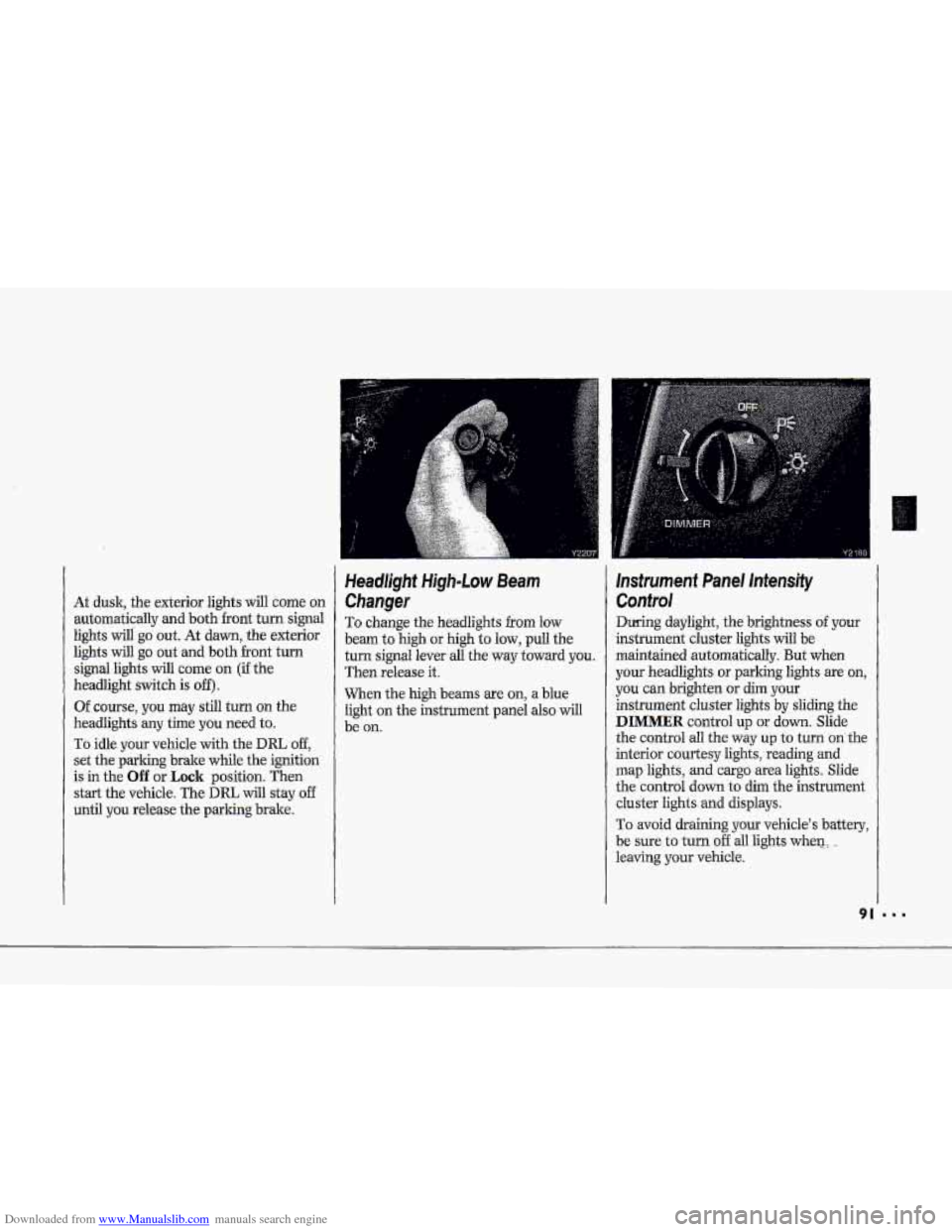
Changer
To change the headlights from low
beam to
high or high to low, pull the
turn signal lever all the
way toward you.
Then release it.
When the
high beams are on, a blue
light
on the instrument panel also will
be
on.
Instrument Panel Intensity
Confro!
During daylight, the brightness of your
instrument cluster lights will be
maintained automatically. But when
your headlights or parking lights are on,
you can brighten or dim your
instrument cluster lights by
sliding the
DIMMER control up or down. Slide
the control all
the way up to turn on the
interim courtesy lights,
reading and
map lights, and cargo area lights. Slide
the control
down to dim the instrument
cluster lights and displays.
To avoid draining.your vehicle's battery,
be sure to turn off all lights when.:. -
leaving your vehicleA
Page 107 of 370
Downloaded from www.Manualslib.com manuals search engine Features & Controls
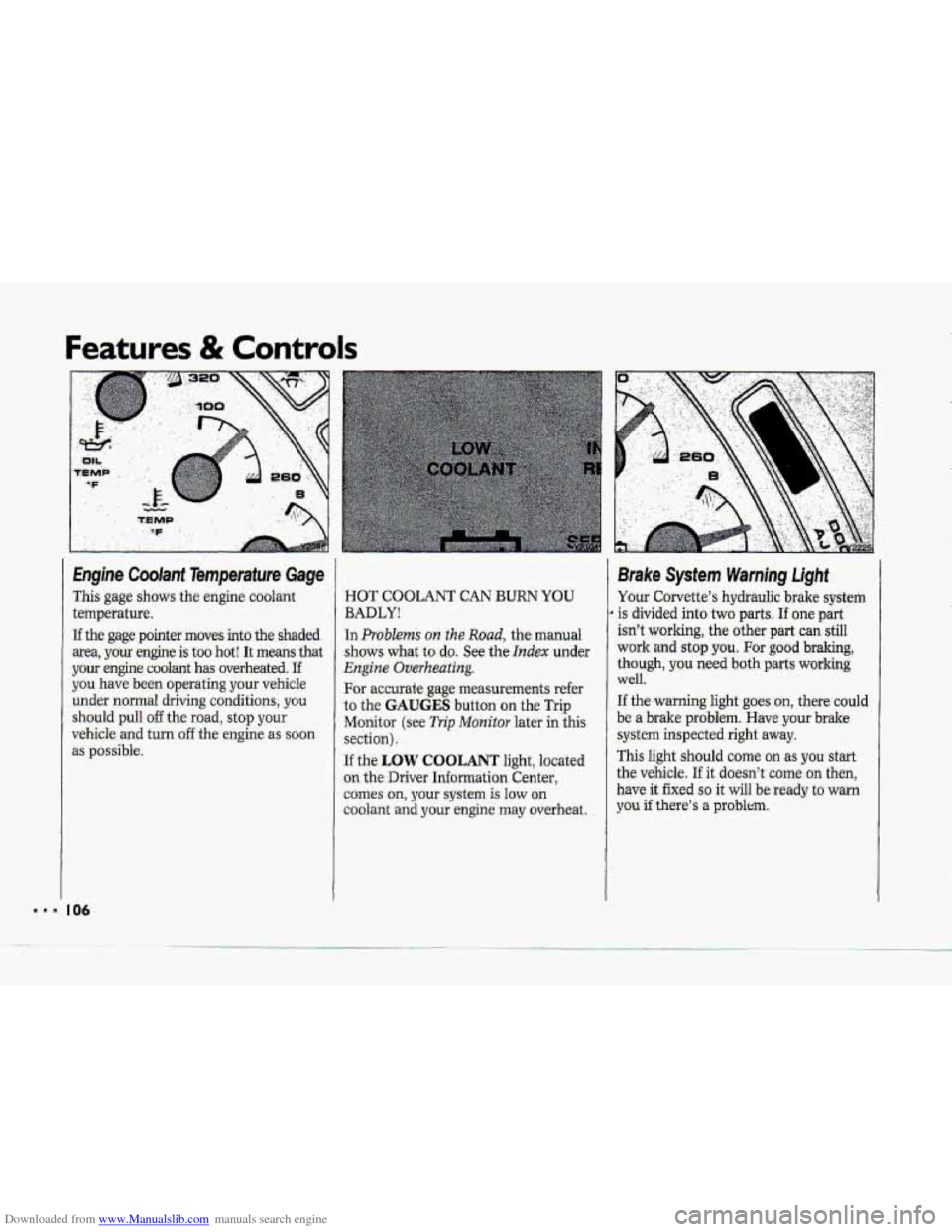
This gage shows the engine coolant
temperature,
I If the gage pointer moves-into the shaded
area, yow-engine is too
hot! It meamthat
your engine coolant
has overheated. If
you have, been operating your vehicle
under-
normal driving. conditions, you
should pull off the road, stop your
vehicle and turn off the engine as soon
as possible.
HOT COOLANT CAN BURN YOU
BADLY!
In Problems on the Road, the- manual
shows what to do. See the Ifidex under
Engine Overheating.
For -accurate gage measurements refer
to the
GAUGES button on the Trip
Monitor
(see Trip Monitov later in this
section).
If the LOW COOLANT light, located
-on the Driver Information Center,
comes on, your system is low on
coolant -and your engine may overheat.
Brake System Warning Light
Your Corvette’s hydraulic brake system
is divided.into two parts. If one part
isn’t working, the other part can still
work
and stop you. For good braking,
though,
you need both parts working
well.
If the warning light goes on, there could
be a brake problem. Have-your bralce
system inspected right away.
This light should come on as you start
the vehicle. If it doesn’t come on then,
have it
fixed.so it will be ready to warn
you if there’s a problem.
.-