Page 200 of 370

Downloaded from www.Manualslib.com manuals search engine m-4.
Driving on Snow or Ice
Most of the time, those ,places where
y6ur tires meet the road pr:obably
have
good traction.
However,
if there is mow or ice
betwe.en
you^ tires and the road, you
can have a very slippery Situati-on.
You’ll have alot lcss traction Crr
“@p”and -will need t.Cbe very careful.
What’s the wors;t- time for this? “Wet
ice;” Very cold
mow or ice can be slick
and hard to drive on. But-wet. ice can be
even more trouble .because it-may offer
the least
traction .o% all. You c.an iet wet
ice-when -it% about freezing (WF, PC)
2nd heezing pain begins- to fall. Try to
avoid driving an wet ice until salt, and
sand crews ean get there.
Allow greaterfollowing distafice on
any slippery road.
Watch for slippery spots. The road
might be fine until you hit a- spot
that% covered with ke. On an
othehvise dear roadyice patches may
appear in shaded areas- whefe. the sun
can’t reach: around clumps crf trees,
behind buildings, or under bridges.
Sometimes-
the &dace of. a curve or
an overpass may remain icy’when. the
surrounding roads are dear. If you see
a patch of ic.e ahead of you, brake
befgre you are on it. Try not to, brakc
while you?e:actu.al€y on the ice, and.
avoid
sudden steering maneuvers,
Page 211 of 370
Downloaded from www.Manualslib.com manuals search engine Towhg Your Corvette (CONT.)
When your vehicle is being towed, have
the ignition key
off. The steering wheel
should-be.
clamp,ed in a straight-ahead
position, with a clamping device
designed fur towing s-ervice. DO not use
the vehicle's stewing column iock for
this. The transmission shoLild be in
N [Neutral), and the.parlepg brake
released.
Don't have your vehicle tqwed on the
rear wheels,. unless you must. If the
vehicle
must. be t0we.d on the rear
wheels, dan't go more than 3mph
I
(56 km/h) or farther than 50 miles
(80.h) or your transmission will be
-damaged. Go slow over rough ground,
and position one wheel at a time
(angled 450j if you have- to go over
eurbs.and
rises. .Wheels &the lifted end
should be-
at. least 4 inches (10 cm)
above the ground. If these limits must
be
exceeded, then the rear wheels have
to be supported .on-a dolly.
I
.,
A
A vehicle can faH~~~m~a:c~
carrier if ,it isn't propgilp '
secured., This can cause a.colii$ion,
serious. pelrsonal injury .and:.vehicle.
damage.
The vehicle..shou[d be
t-ightly secured with chains or--sted -'
cables before it is transported-'
Don't use substitutes '(ropes,
leather straps, canvas webbing,
etc:.) that- can be cut by sharp edges
underneath the t.owed vehicle,
Page 225 of 370
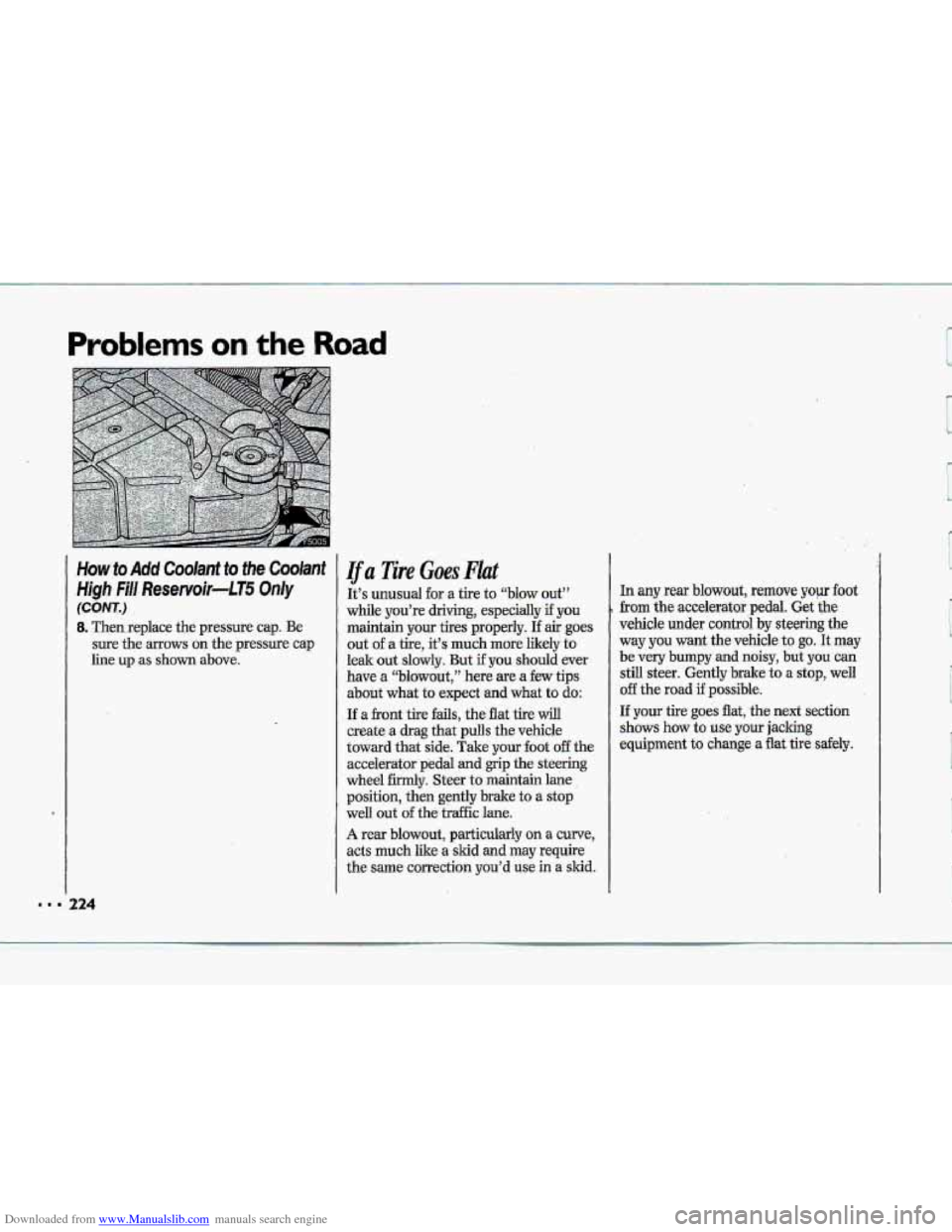
Downloaded from www.Manualslib.com manuals search engine Problems on the Road
lJu Tire Goes Flat
It’s unusual for a tire to “blow out”
while you’re driving, especially if-you
maintain
your tires properly. If air goes
out of a tire, it’s much more likely to
leak out
slowly. But if you should ever
have a “blowout,” here are a few tips-
about what to expect
and what to do:
If a front tire fails, the flat tire will
create a drag that pulls the vehicle
toward that side. Take yuur foot 08 the
accelerator pedal
and grip the steering
wheel firmly. Steer to maintain lane
p-osition, then gently brake to -a stop
well out of the. traffic lam.
A rear blowout, particularly on a curve,
acts much like a skid and may require
the
same corre&ion you’d use in a skid.
h any rear bhwout, remove yop foot
from the accelerator pedal. Get the
vehicle under control by steering the
way you want the vehicbto go. It may
be very bumpy and noisy, hut you can
still steer. Gently brake to B stop, well
off’ the road if posiible.
If your tire go& flat, the next section
shows how to use your jacking
equipment to change a flat tire sdely.
e
Page 247 of 370
Downloaded from www.Manualslib.com manuals search engine I
Service & Appearance Care
:A Electric. fansunder the hood
can stariup and .injure yuu
even when the engine is not
running. Keep hands, clothing and
tools away frornany underhood
electric
fan.
46
CAUTION
A
Things that burn can get on
hot engine parts and start a
fire. These include liquids like
gasoline,
oil, coolant, brake fluid,
windshield washer and other fluids,
and plastic or rubber. You or others
could be burned. Be careful not to
&op or spill things that will bum
onto a hot engine. Before
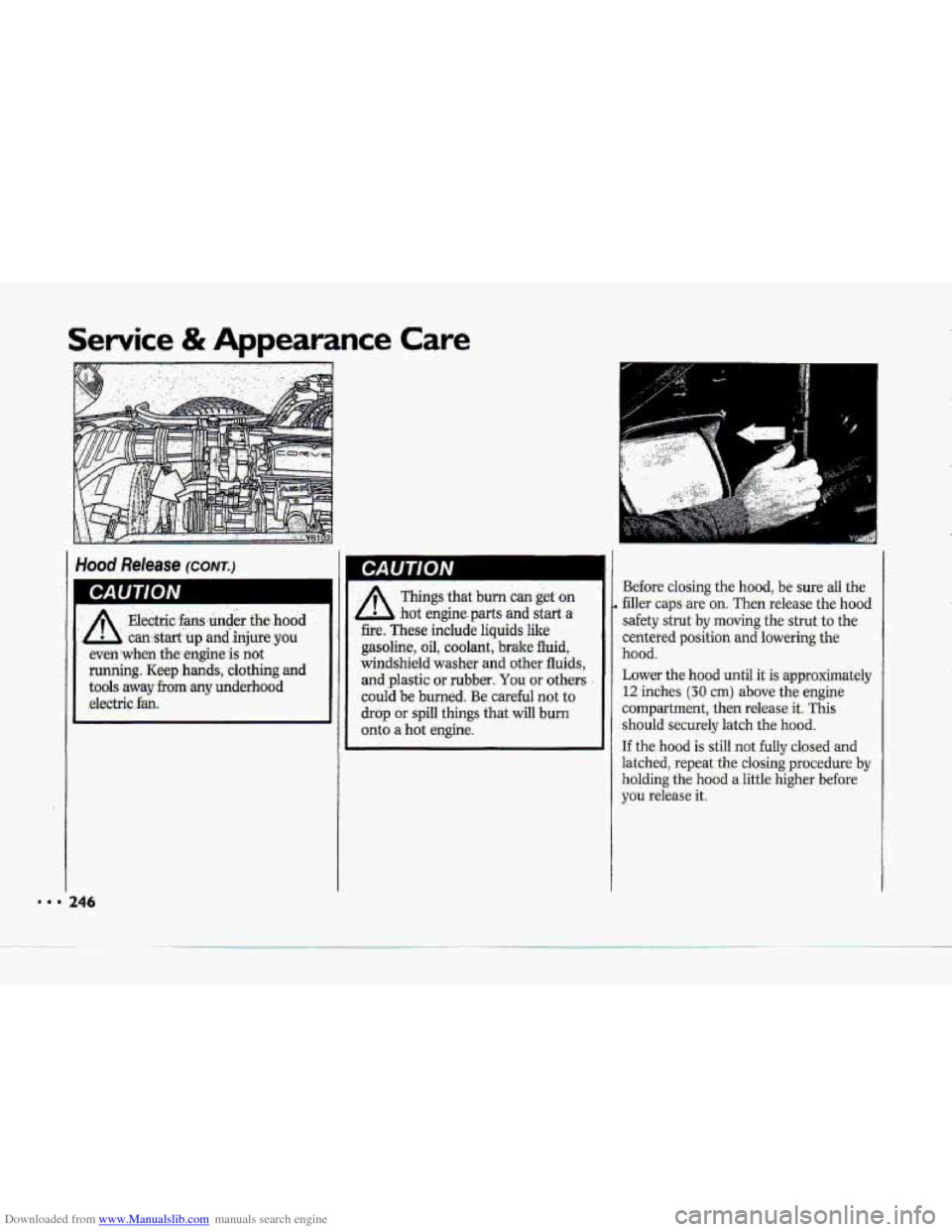
closing the
hood, be sure all the
filler caps are on. Then release the
hood
safety strut by moving the strut to the
centered position and lowering the
hood.
Lower the hood'until it is approximately
12 inches (30 cm) above the engine
compartment, then release it. This
should securely latch the hood.
If the hood is still not fully closed and
latched, repeat the
closing procedure by
holding the
hood a little higher before
you release it.
Page 248 of 370
Downloaded from www.Manualslib.com manuals search engine 0 Y6105
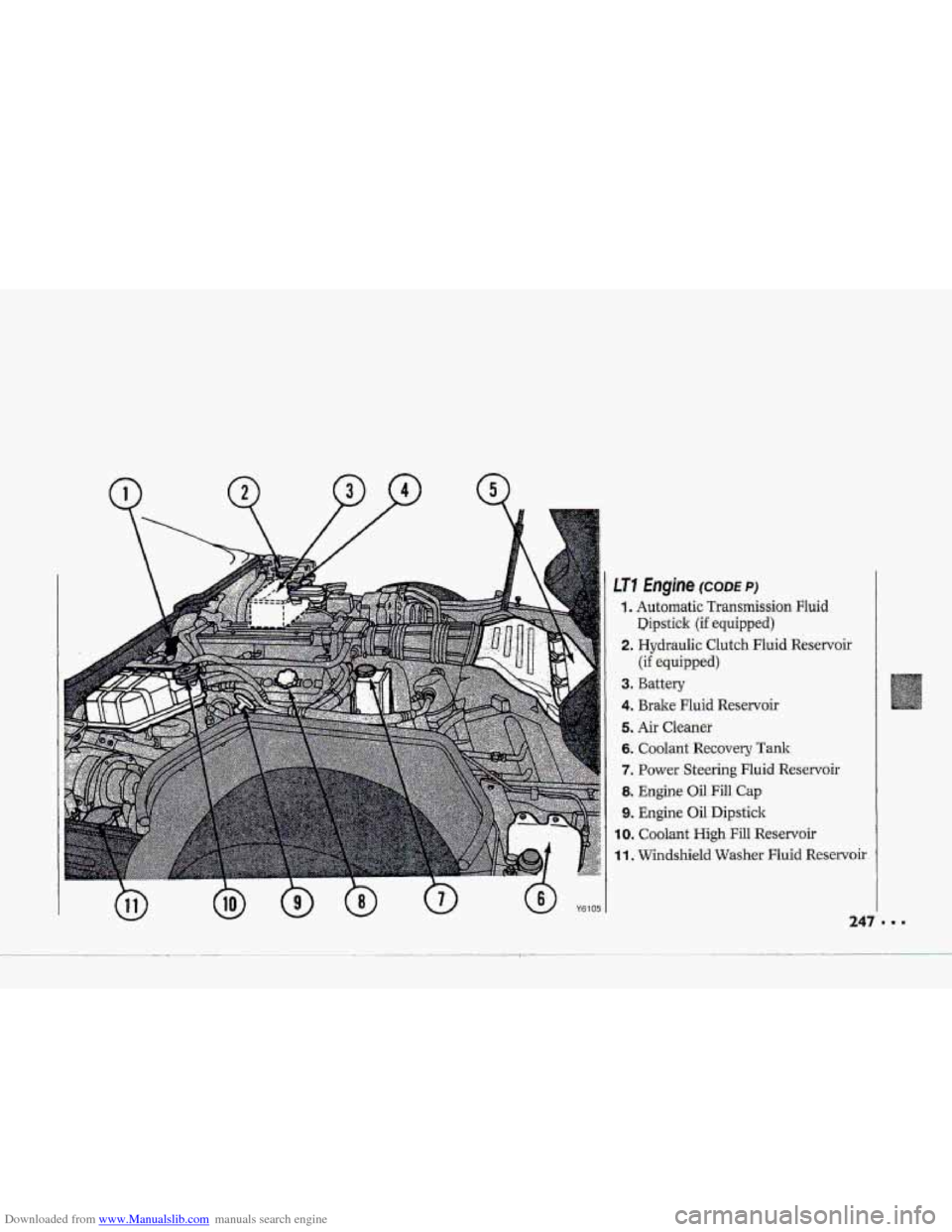
LT7 hgine (CODE PI
t a Automatic Transmission Fluid
2. Hydraulic Clutch Fluid Reservoir
3. Battery
4. Brake Fluid Reservoir
5. Air Cleaner
Dipstick
(if equipped)
(if equipped)
6. Coolant Recovery
Tank
7. Power Steering Fluid Reservoir
8. Engine Oil Fill Cap
9. Engine Oil Dipstick
IO. Coolant High Fill Reservoir
11. Windshield Washer Fluid Reser aoir
Page 249 of 370
Downloaded from www.Manualslib.com manuals search engine Service & Appearance Care ..
\!
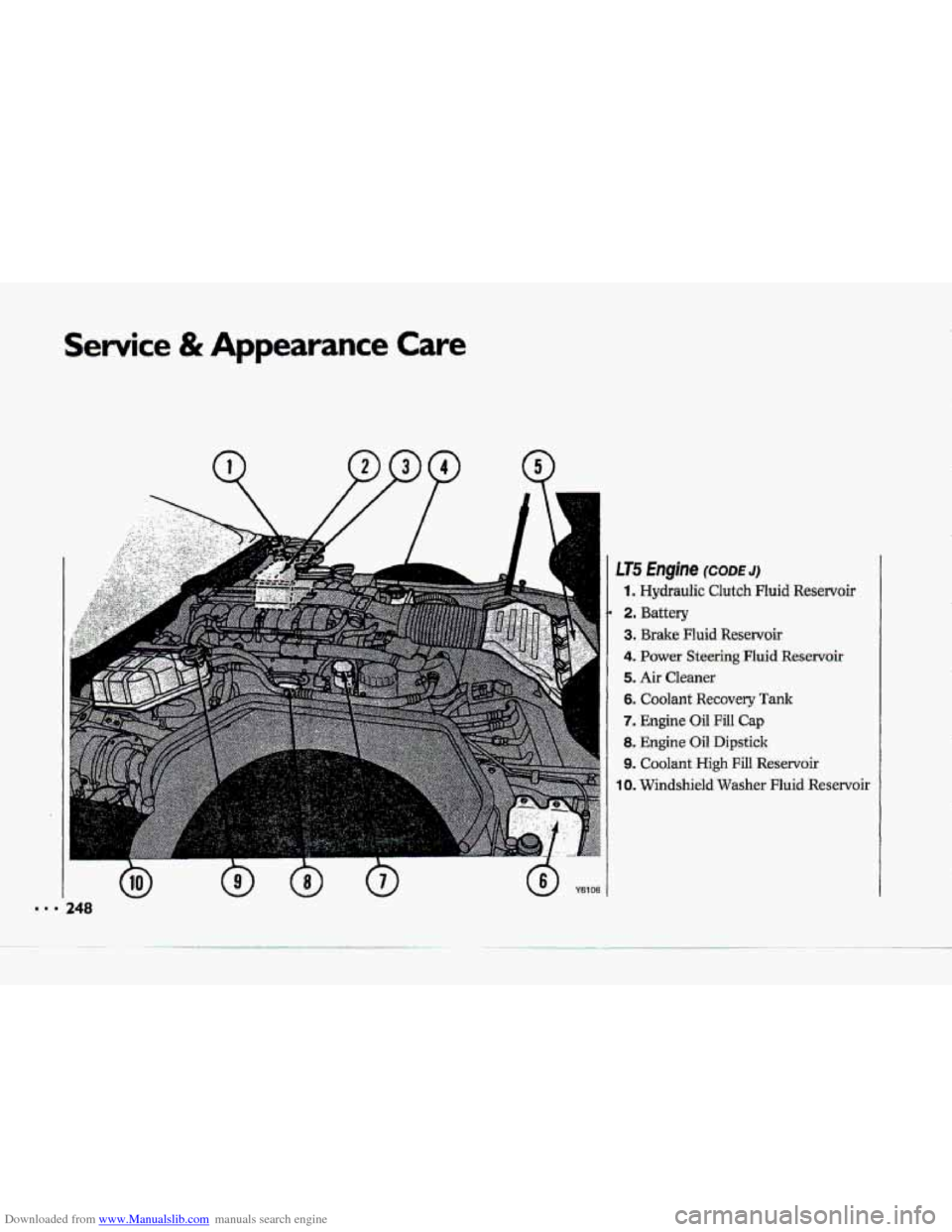
1 LT5 Engine (CODEJ)
1. Hydraulic Clutch Fluid Reservoir
2. Battery
3. Brake Fluid Reservoir
4. Power Steering Fluid Reservoir
5. Air Cleaner
6. Coolant Recovery Tank
7. Engine Oil Fill Cap
8. Engine Oil Dipstick
9. Coolant High Fill Reservoir
IO. Windshield Washer Fluid Reservoir
.I. 248
Page 259 of 370
Downloaded from www.Manualslib.com manuals search engine Service & Appearance Care
Automatic Transmission Fluid
(C.ONT.)
To Check Trafisinission Fluid Cold:.
A cold check is made after the-vehicle
has been sitting for eight hours-or miore
with. the engine offand is used only as :a
feference. Let the,engine run at idle for
five minutes if &utside temper&n%:_s are
50QF (10%) or-mare. If it's colder than
5QoF [lUaC), you may have-to idle the
engine longgr; A hat check must follou7
wheaffuid. is added dw"lqg a cold.check.
To Check the Fluid Hot or Cold
Park your vehicle- on: a- level place.
Place the ;shift lever in P (Park) with
With your foot on the brake pedal,
the .parkingbrake applied.
mave the shift lever through each gear
range, pausing for about three
seconds in each range. Then, p-asition
the-s-hift'lever in P (Park).
minutes ,or more;
Let the engine rd .at idle for three
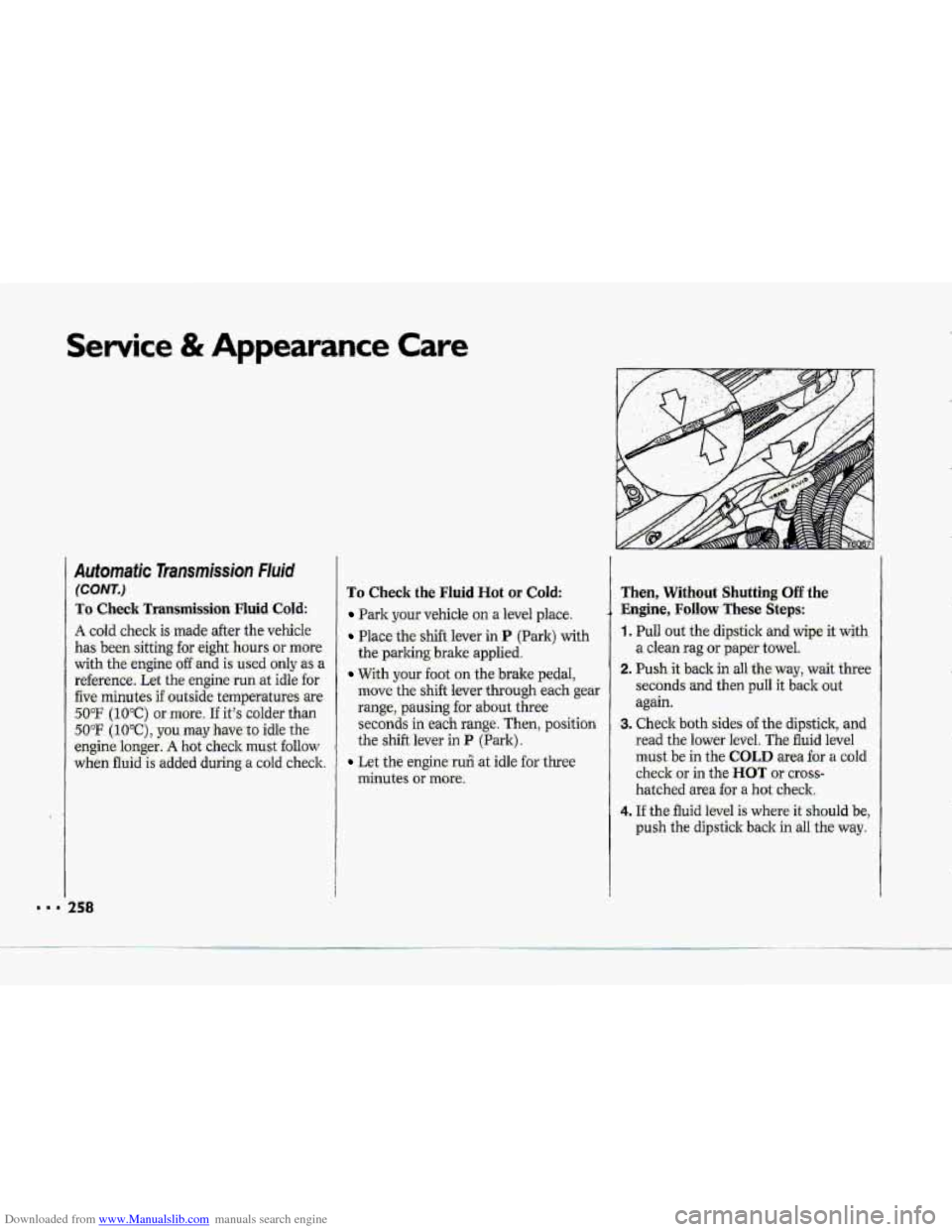
Then, Without Shutting Off the
Engine, Follow- These Steps:
1. Pull out the dipstick and wipe it with
a
clean rag or paper towel.
2. Push it back in all the. way, wait three
seconds and then pull; h back out
again.
3. Check b.& stdes af the dipstick, and
read the
loweg. limd. The hid he1
must be in the COLD area for a cold
checkor in th-e HOT or er0s.s-
hatched area for a hat checl<.
4. If the fluid level is whe$e it should. be,
push the dipstick b:ack in all the way.
Page 271 of 370
Downloaded from www.Manualslib.com manuals search engine Service & Appearance Care
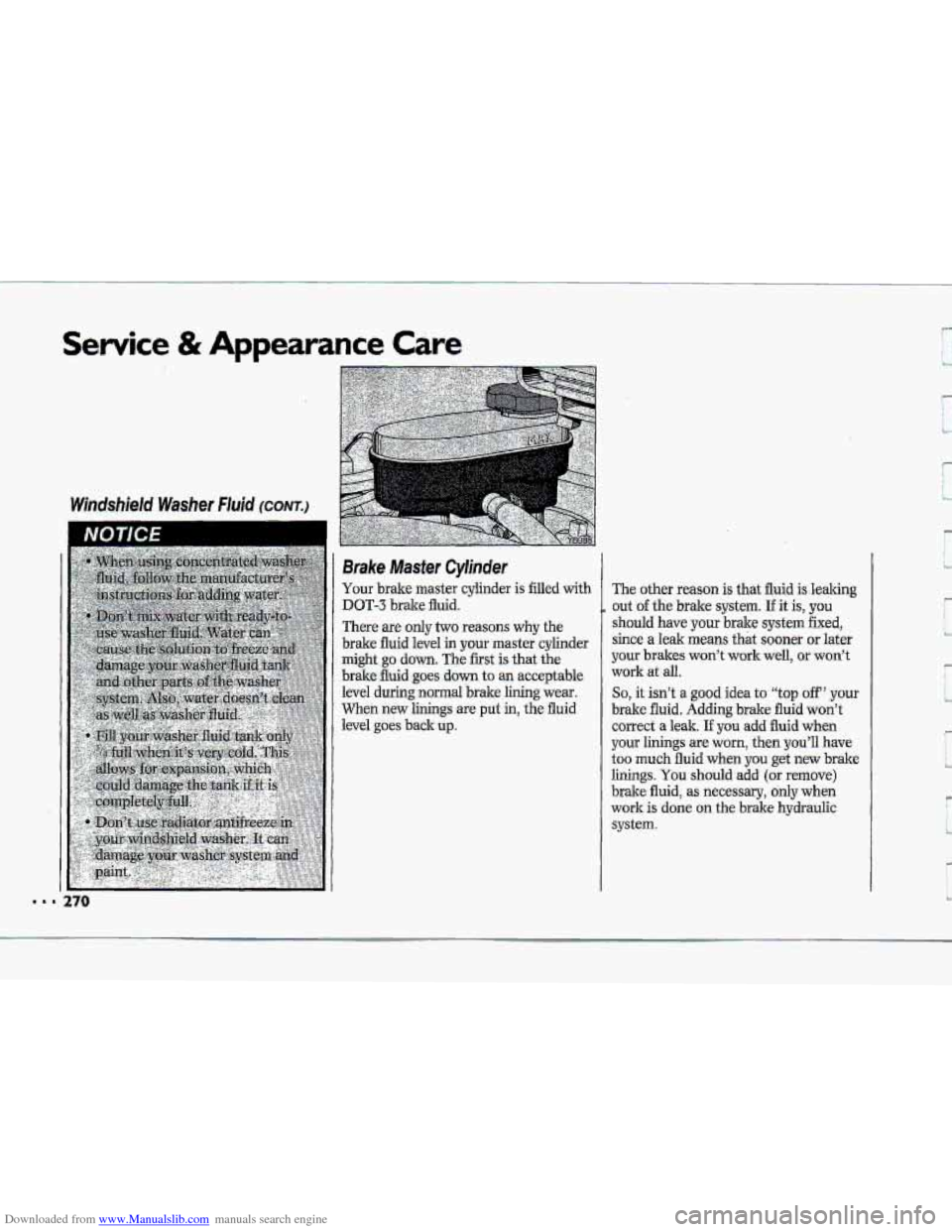
Brake Master Cylinder
Your brake master cylinder is filled with
DOT-3 brake fluid.
There are only two reasons why the
brake fluid level
in your master cylinder
might go down. The first is that the
brake fluid goes down to an acceptable
level during normal brake lining wear.
When new
linings are put in, the fluid
level goes back up.
The other reason is that fluid is Iealring
out
of the brake system. If it is, you
should have your brake system fixed,
since
a leak means that sooner or later
your brakes won’t work well, or won’t
work at all.
So, it isn’t a good idea to “top off” your
brake fluid. Adding brake fluid won’t
correct
a leak. If you add fluid when
your linings are worn, then you’ll have
too much fluid when you get new brake
linings. You should add (or remove)
brake fluid,
as necessary, only when
work
is done on the brake hydraulic
system.