Page 186 of 308
Downloaded from www.Manualslib.com manuals search engine Problems on the Road
Zf a Tire Goes Flat
It’s unusual for a tire to “blow out”
while you’re driving, especially if you
maintain your tires properly.
If air goes
out of a tire, it’s much more likely
to
leak out slowly. But if you should ever
have a “blowout,” here are a few tips
about what to expect and what to do:
If a front tire fails, the flat tire will
create a drag that pulls the vehicle
toward that side. Take your foot off the accelerator pedal and grip the steering
wheel firmly. Steer to maintain lane
position, then gently brake
to a stop well
out of
the traffic lane.
I 84
A rear blowout, particularly on a curve,
acts much like a skid and may require
the same correction you’d use in a skid.
In any rear blowout, remove your foot
from the accelerator pedal. Get the
vehicle under control by steering the
way
you want the vehicle to go. It may
be very bumpy and noisy, but you can
still steer. Gently brake
to a stop, well
off the road
if possible.
If your tire goes flat, the next section
shows how
to use your jacking
equipment to change
a flat tire safely.
Changing a Flat Tire
If a tire goes flat, avoid further tire and
wheel damage by driving slowly to a
level place.
Turn on your hazard
warning flashers.
Page 195 of 308
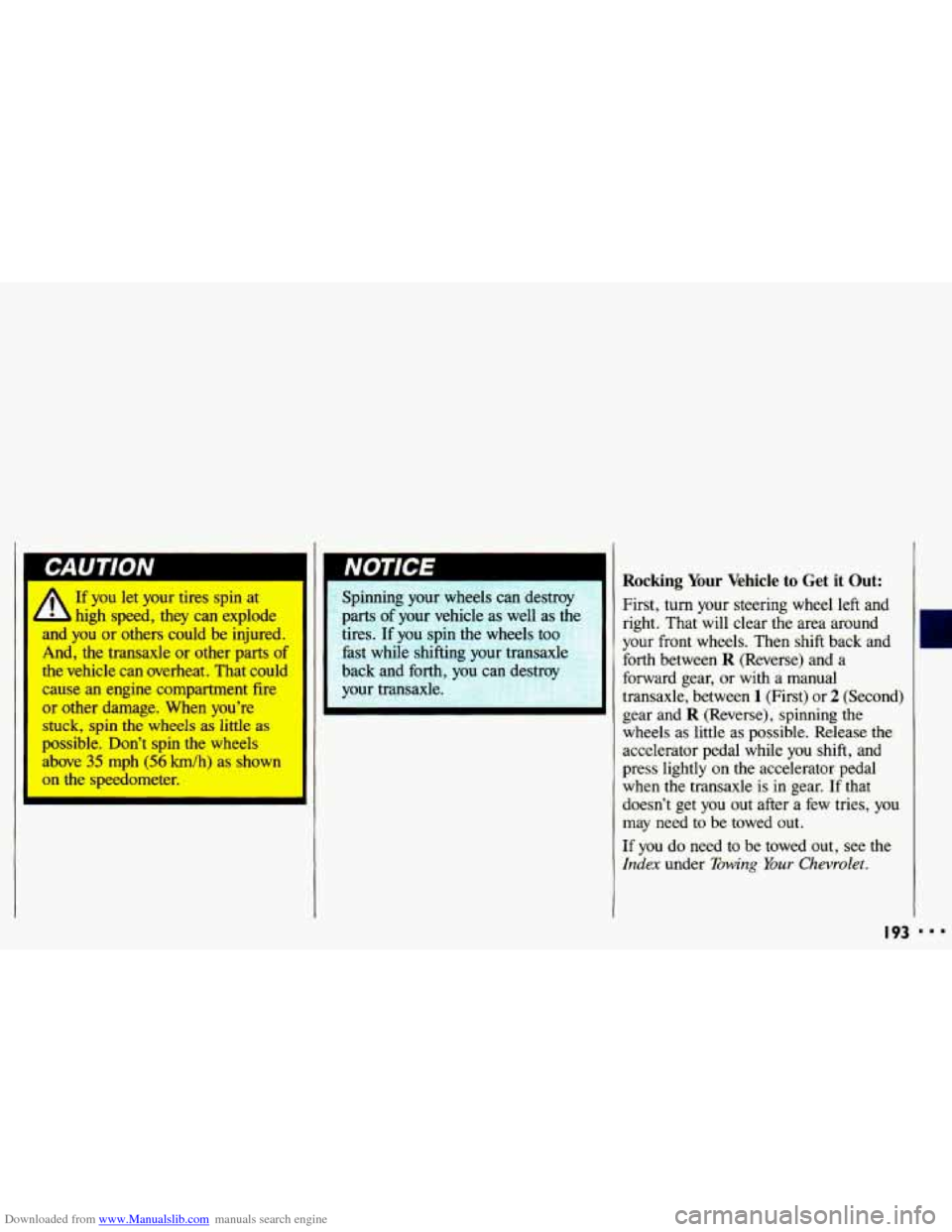
Downloaded from www.Manualslib.com manuals search engine If you let your tires spin at
- high speed, they can explode
and you or others could be injured.
And, the transaxle or other parts of
the vehicle can overheat. That could
cause an engine compartment fire
or other damage. When you’re
stuck, spin
the wheels as little as
possible. Don’t spin the wheels
above
35 mph (56 h/h) as shown
on
the speedometer. Spinning
your wheels can destroy
parts
of your vehicle as well as the
tires.
If you spin the wheels too
fast while shifting your transa:
back and forth, you can destroy
your transaxle.
-
Rocking Your Vehicle to Get it Out:
First, turn your steering wheel left and
right. That will clear the area around
your front wheels. Then shift back and
forth between
R (Reverse) and a
forward gear, or with a manual
transaxle, between
1 (First) or 2 (Second)
gear and
R (Reverse), spinning the
wheels as little as possible. Release
the
accelerator pedal while you shift, and
press lightly on the accelerator pedal
when the transaxle is in gear. If that
doesn’t get you out after a few tries,
you
may need to be towed out.
If
you do need to be towed out, see the
Index under Towing Your Chevrolet.
I93
Page 197 of 308
Downloaded from www.Manualslib.com manuals search engine i
.....
.................................. ...................
........ ... . &5
..... ..... .... .. --
' . I .. ~
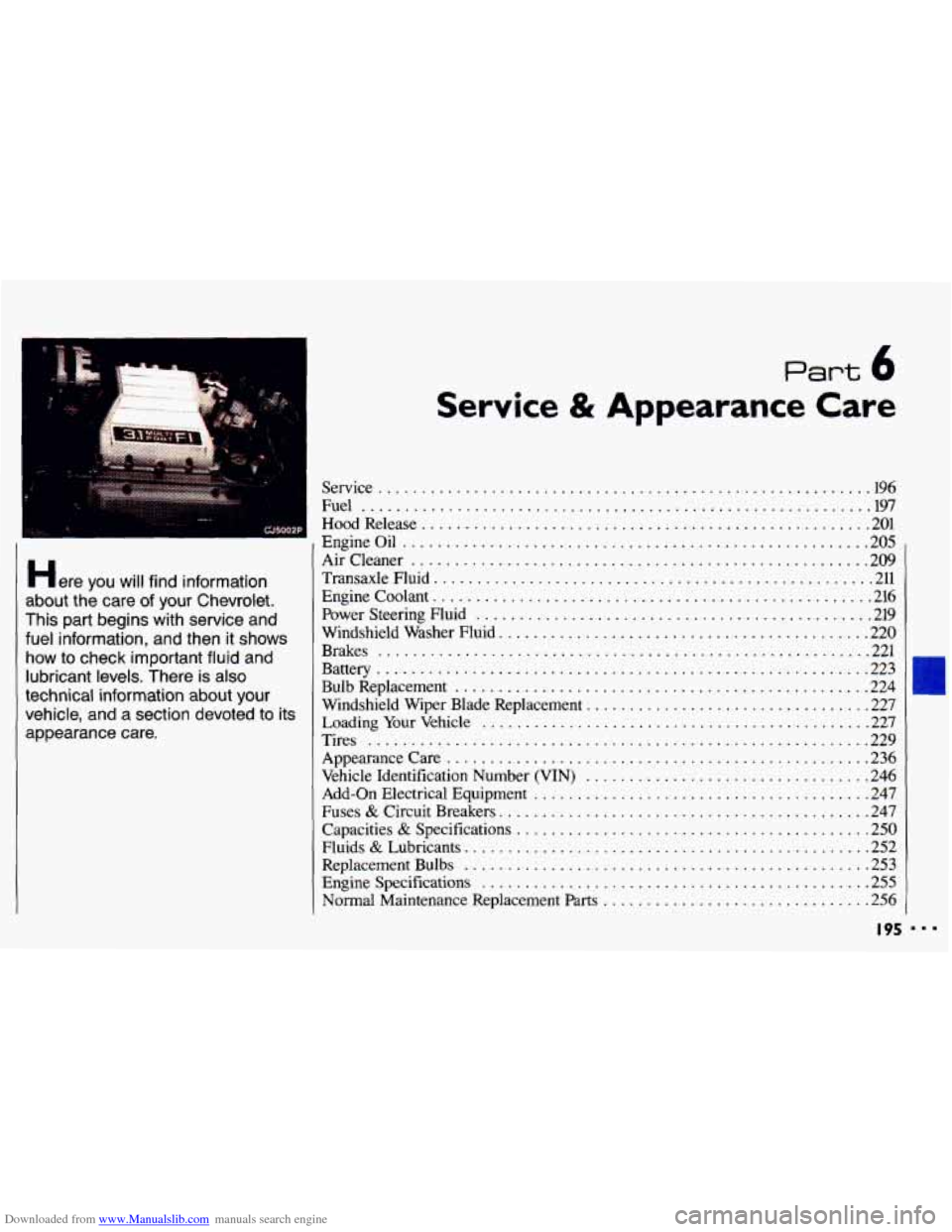
Here you wit1 find information
about the care
of your Chevrolet .
This part begins with service and
fuel information. and then
it shows
how to check important fluid and
lubricant levels
. There is also
technical information about your
vehicle. and
a section devoted to its
appearance care
.
Part 6
Service & Appearance Care
Service ......................................................... 196
Fuel ........................................................... 197
HoodRelease
.................................................... 201
EngineOil
...................................................... 205
Aircleaner
..................................................... 209
Transaxle Fluid
................................................... 211
Engine Coolant
................................................... 216
Power Steering Fluid
.............................................. 219
Windshield Washer Fluid
........................................... 220
Brakes
......................................................... 221
Battery
......................................................... 223
BulbReplacement
................................................ 224
Windshield Wiper Blade Replacement
................................. 227
Loading
Your Vehicle ............................................. 227
Vehicle Identification Number (VIN)
................................. 246
Add-on Electrical Equipment
....................................... 247
Fuses
& Circuit Breakers ........................................... 247
Capacities & Specifications ......................................... 250
Fluids & Lubricants ............................................... 252
Replacement Bulbs
............................................... 253
Engine Specifications
............................................. 255
Normal Maintenance Replacement
Parts ............................... 256
Tires .......................................................... 229
Appearancecare
................................................. 236
I95
Page 205 of 308
Downloaded from www.Manualslib.com manuals search engine d
56053
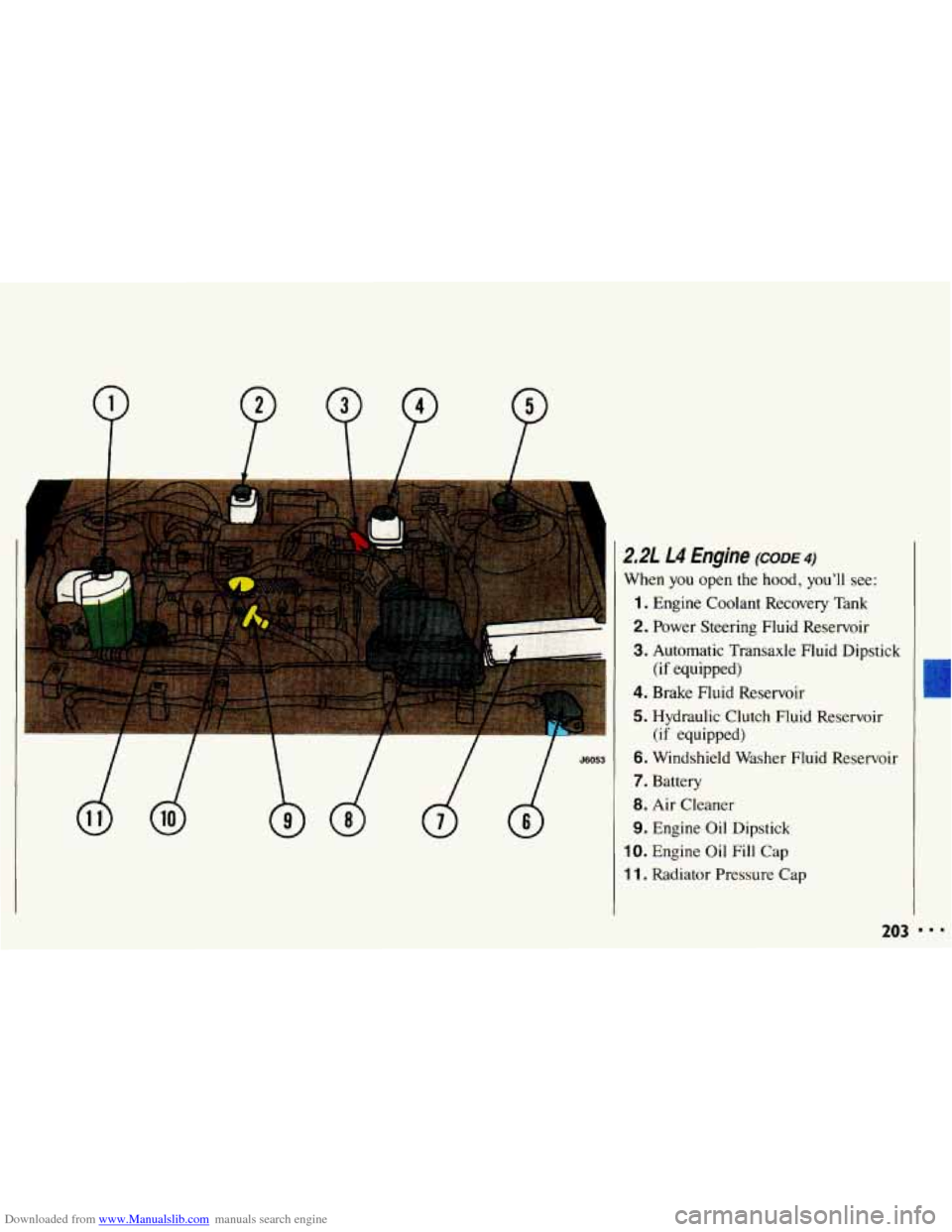
2.21 L4 Engine (CODE 4)
When you open the hood, you’ll see:
1. Engine Coolant Recovery Tank
2. Power Steering Fluid Reservoir
3. Automatic Transaxle Fluid Dipstick
4. Brake Fluid Reservoir
5. Hydraulic Clutch Fluid Reservoir
6. Windshield Washer Fluid Reservoir
7. Battery
8. Air Cleaner
9. Engine Oil Dipstick
IO. Engine Oil Fill Cap
1 1. Radiator Pressure Cap
(if equipped)
(if equipped)
203
Page 206 of 308
Downloaded from www.Manualslib.com manuals search engine Service & Appearance Care
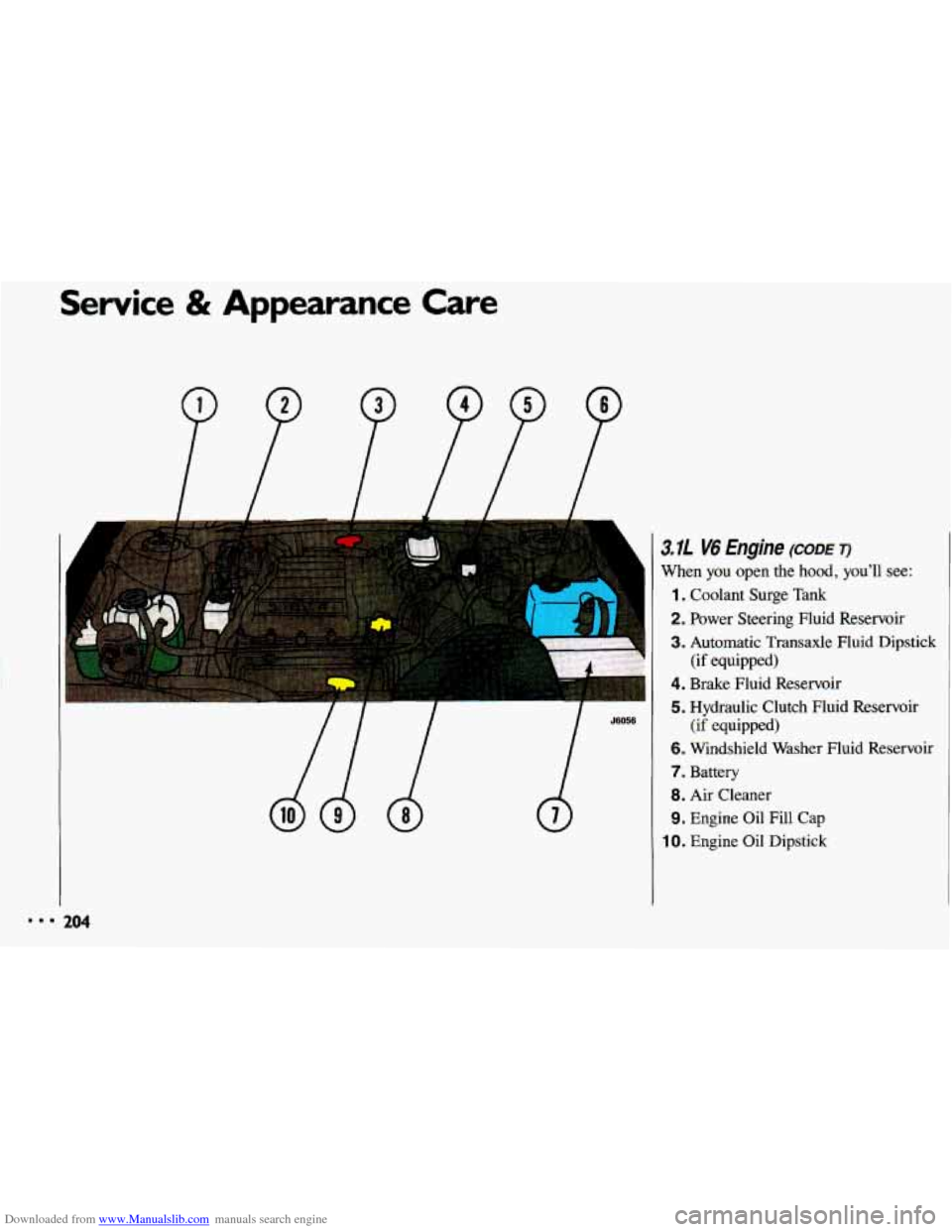
' 3.11 V6 Engine (CODE T)
1
When you open the hood, you'll see:
1. Coolant Surge Tank
2. Power Steering Fluid Reservoir
3. Automatic Transaxle Fluid Dipstick
4. Brake Fluid Reservoir
5. Hydraulic Clutch Fluid Reservoir
6. Windshield Washer Fluid Reservoir
7. Battery
8. Air Cleaner
9. Engine Oil Fill Cap
10. Engine Oil Dipstick
(if equipped)
(if equipped)
rn 204
Page 221 of 308
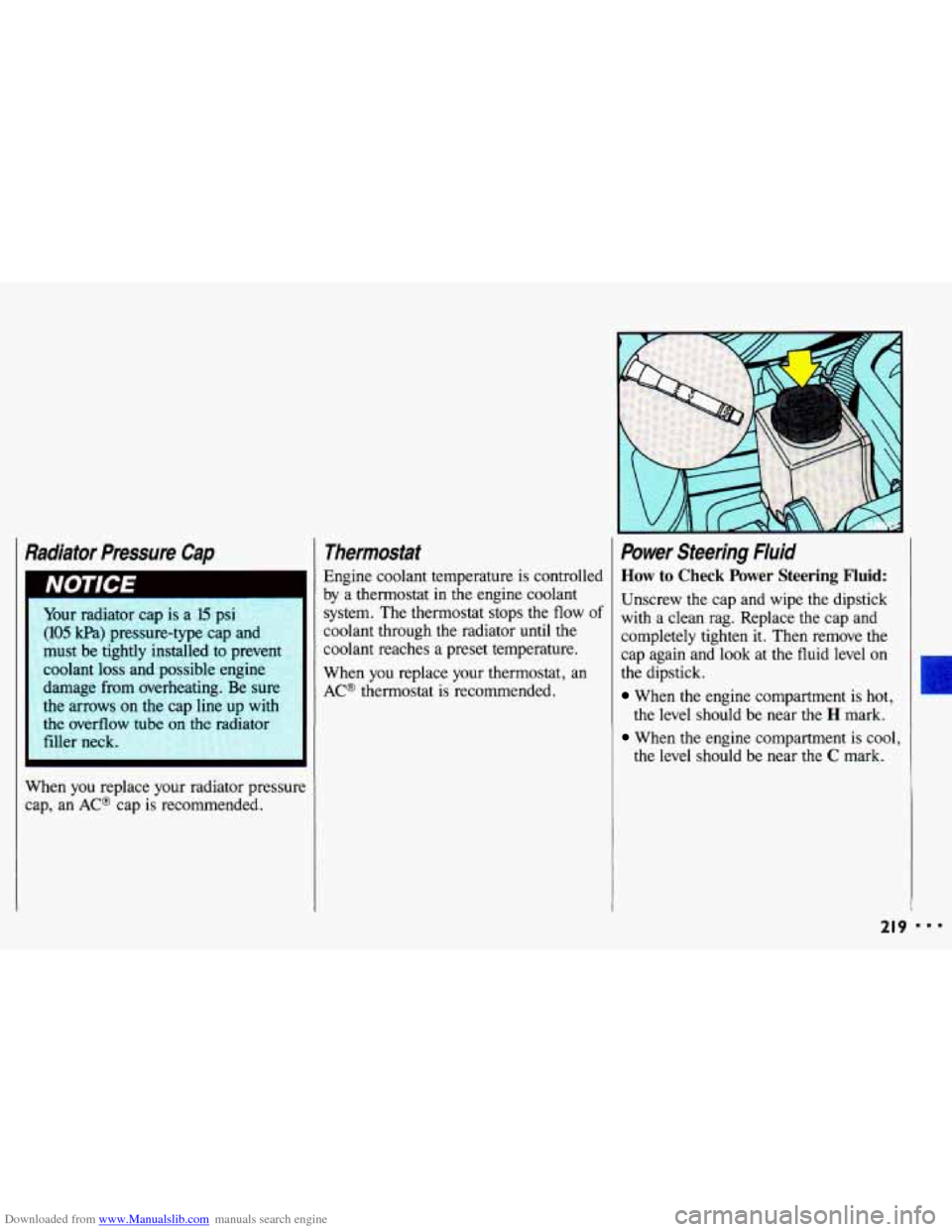
Downloaded from www.Manualslib.com manuals search engine Radiator Pressure Cap
, .. g.., ',!: Your radiator cap is a 15 psi
I.,, ''.' (105 kPa) pressure-type cap and
,;:, must be tightly installed to prevent
'.. coolant loss and possible engine
.':: damage from overheating. Be sure
.; the arrows on the cap line up with
the overflow
tube on the radiator
Y; _/,.__ filler neck.
When you replace your radiator pressurl
cap, an
AC@ cap is recommended.
.. . ..
~. .
..
F+
Thermostat
Engine coolant temperature is controlled
by a thermostat in the engine coolant
system. The thermostat stops the
flow of
coolant through the radiator until the
coolant reaches a preset temperature.
When you replace your thermostat, an
AC@ thermostat is recommended.
Power Steering Fluid
How to Check Power Steering Fluid:
Unscrew the cap and wipe the dipstick
with a clean rag. Replace the cap and
completely tighten it. Then remove the
cap again and
look at the fluid level on
the dipstick.
When the engine compartment is hot,
the level should be near the H mark.
When the engine compartment is cool,
the level should be near the
C mark.
21 9 I..
Page 222 of 308
Downloaded from www.Manualslib.com manuals search engine ..I
Service & Appearance Care
Power Steering Fluid (CONT.)
What to Add:
Refer to the Maintenance Schedule to determine what kind of fluid to use. See
the
Index under Fluids & Lubricants.
When adding power steering fluid
or making a complete fluid change,
always use the proper fluid. Failure
to use the proper fluid can cause
leaks and damage hoses and seals.
120
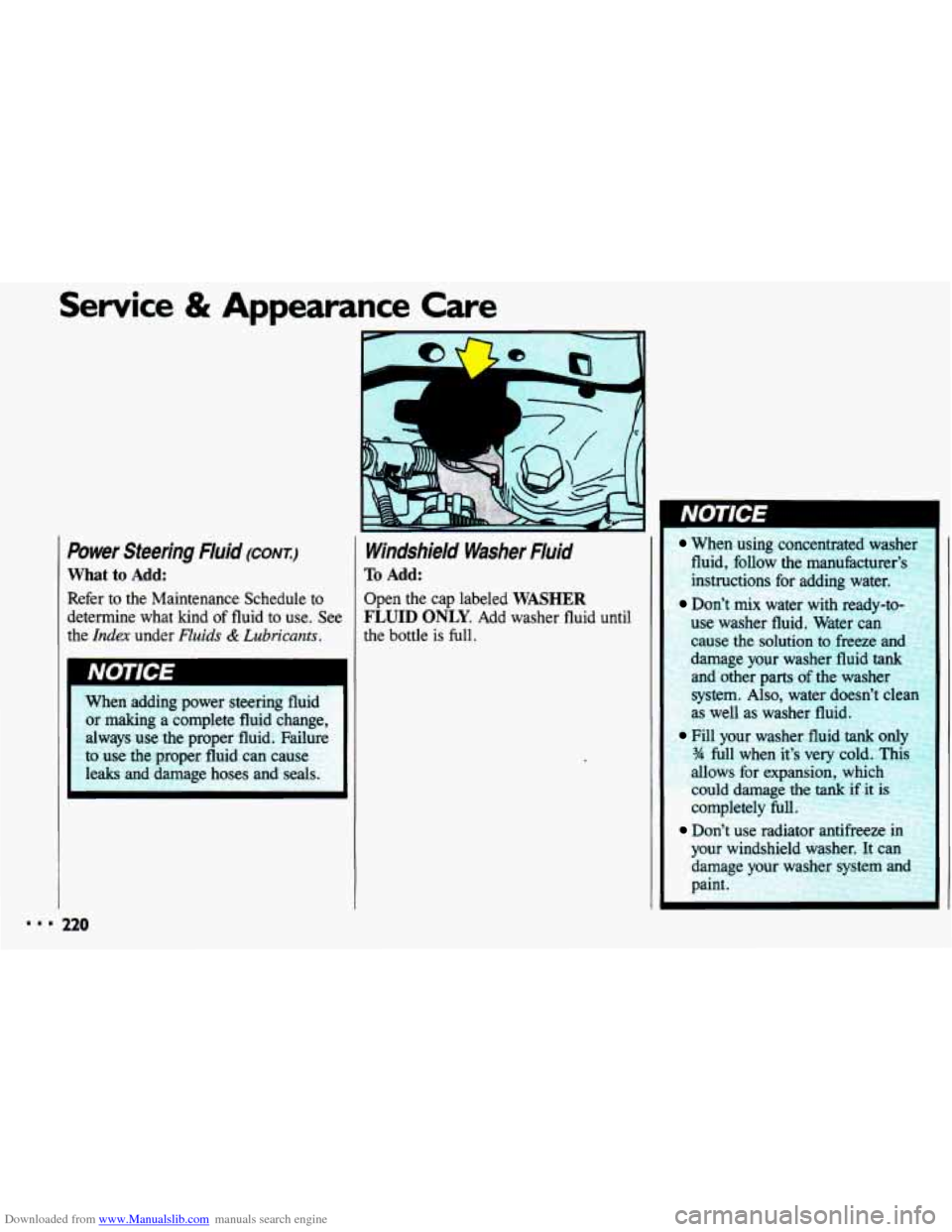
Windshield Washer Fluid
To Add:
Open the cap labeled WASHER
FLUID ONLY. Add washer fluid until
the bottle is full.
When using concentrated washer
fluid, follow the manufacturer’s
instructions for adding water.
Don’t mix water with ready-to-
l15e washer fluid. Water can
use the solution
to freeze and
. .tmage your washer fluid tank
and other parts of the washer
system.
Also, water doesn’t clean
s well as washer fluid.
Fill your washer fluid tank on14
?4 full when it’s very cold. Thir
allows for expansion, which
could damage the
tank if it is
completely
full
Don’t use radiator antifreeze
your windshield washer.
It can
damage your washer system an(
paint.
Page 253 of 308
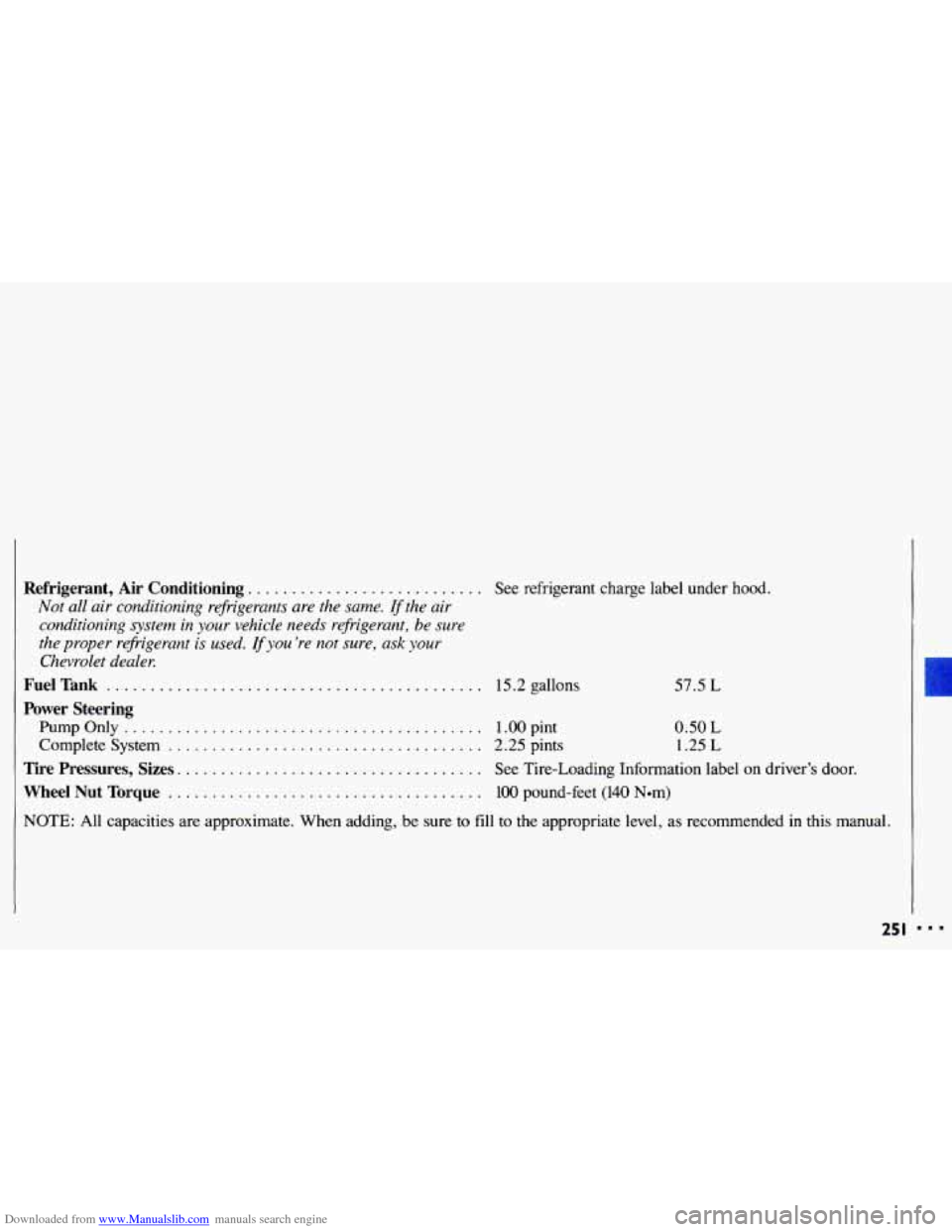
Downloaded from www.Manualslib.com manuals search engine Refrigerant, Air Conditioning. .......................... See refrigerant charge label under hood.
Not all air conditioning refrigerants are the same. If the air
conditioning system in
your vehicle needs refrigerant, be sure
the proper refrigerant is used.
If you 're not sure, ask your
Chmrolet dealer.
Fuel Tank ........................................... 15.2 gallons
Power Steering
Pump Only ......................................... 1 .OO pint
Complete System
.................................... 2.25 pints
57.5 L
0.50 L
1.25 L
Tire Pressures, Sizes. .................................. See Tire-Loading Information label on driver's door.
Wheel Nut Torque .................................... 100 pound-feet (140 Nem)
NOTE: All capacities are approximate. When adding, be sure
to fill to the appropriate level, as recommended in this manual.
25 I