1993 CHEVROLET CAVALIER oil level
[x] Cancel search: oil levelPage 213 of 308
Downloaded from www.Manualslib.com manuals search engine Automaric Transaxle Fluid
When to Check and Change:
A good time to check your automatic
transaxle fluid level is when the engine
oil is changed. Refer to the Maintenance
Schedule to determine when to change
your fluid. See the
Index under
Scheduled Maintenance Services.
How to Check:
Because this operation can be a little
difficult, you may choose to have this
done at a Chevrolet dealership Service
Department.
If you do it yourself, be sure to follow
all the instructions here, or you could
get a false reading on the dipstick.
Too much or too little fluid can
damage
your transaxle. Too much
can mean that some of the fluid
could come out and fall
on hot
engine parts, starting a fire. Be
sure to get an accurate reading
if
you check your transaxle fluid. Wait
at least 30 minutes before checking
the transaxle fluid level if you have been
driving:
When outside temperatures are above
At high speed for quite a while.
In heavy traffic-especially in hot
To get the right reading, the fluid should
be at normal operating temperature,
which is 180°F to 200°F (82°C to
93" C).
Get the vehicle warmed up by driving
about 15 miles (24
km) when outside
temperatures are above
50°F (10OC). If
it's colder than 50" F (10" C), you may
have to drive longer.
90°F (32°C).
weather.
21 I
Page 215 of 308
Downloaded from www.Manualslib.com manuals search engine How to Add Fluid: Refer to the
Maintenance Schedule to determine
what kind of transaxle fluid to use. See
the
Index under Fluids & Lubricants. If
the fluid level is low, add only enough
of the proper fluid to bring the level into
the cross-hatched area on the dipstick.
It doesn't take much fluid, generally less
than a pint
(0.5 L). Don't overfill. We
recommend you use only fluid labeled
DEXRON@-IIE, because fluids with that
label are made especially for your
automatic transaxle. Damage caused
by fluid other than DEXRON@-IIE is not
covered by your new vehicle warranty.
After adding fluid, recheck the fluid
level as described under
How to Check.
When the correct fluid level is obtained,
push the dipstick back in all the way.
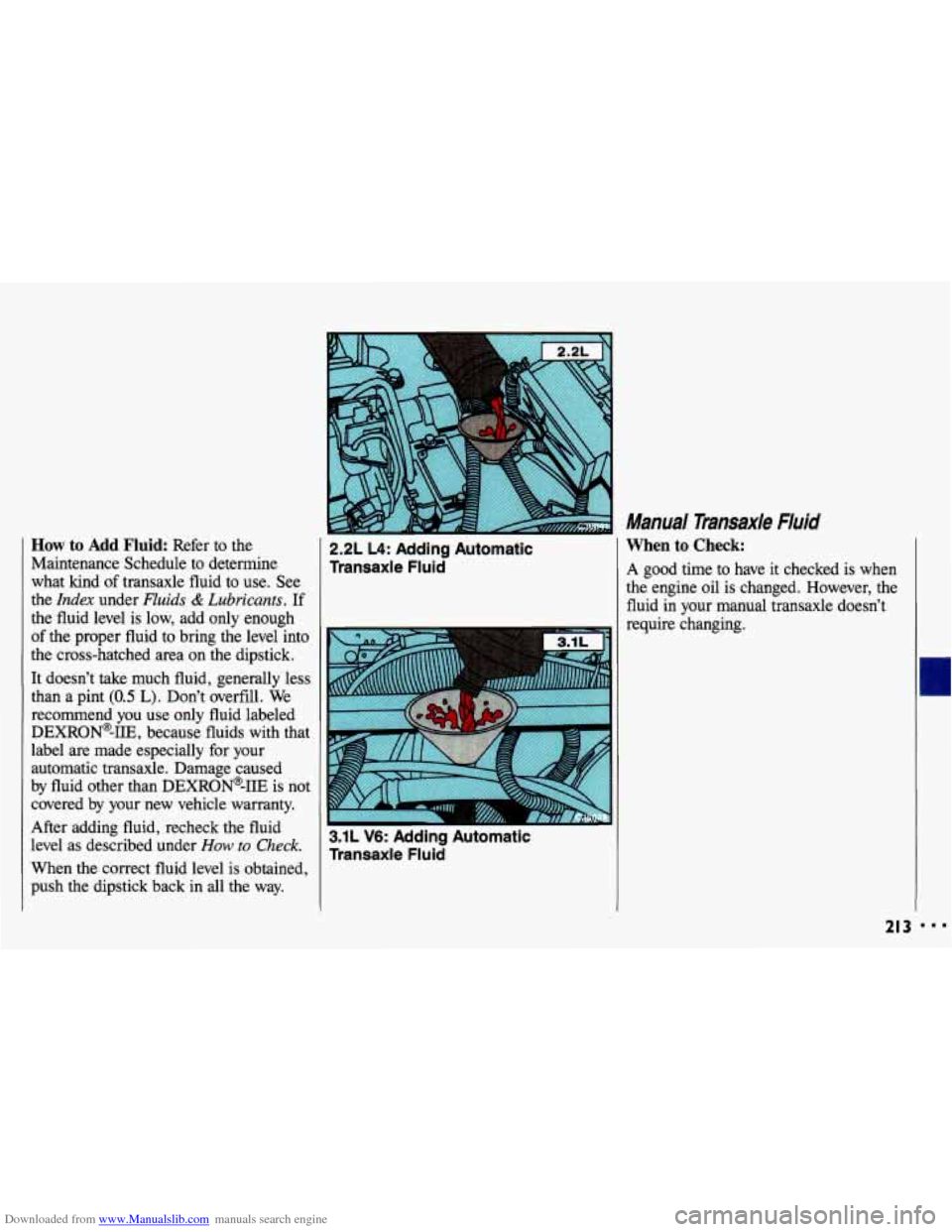
2.2L L4: Adding Automatic
Transaxle Fluid
3.1L V6: Adding Automatic
Transaxle Fluid
Manual Transaxle Fluid
When to Check:
A good time to have it checked is when
the engine oil is changed. However, the
fluid in your manual transaxle doesn't
require changing.
213
Page 218 of 308
Downloaded from www.Manualslib.com manuals search engine 888
Service rance Care
Hydraulic Clutch (CONTJ
How to Check:
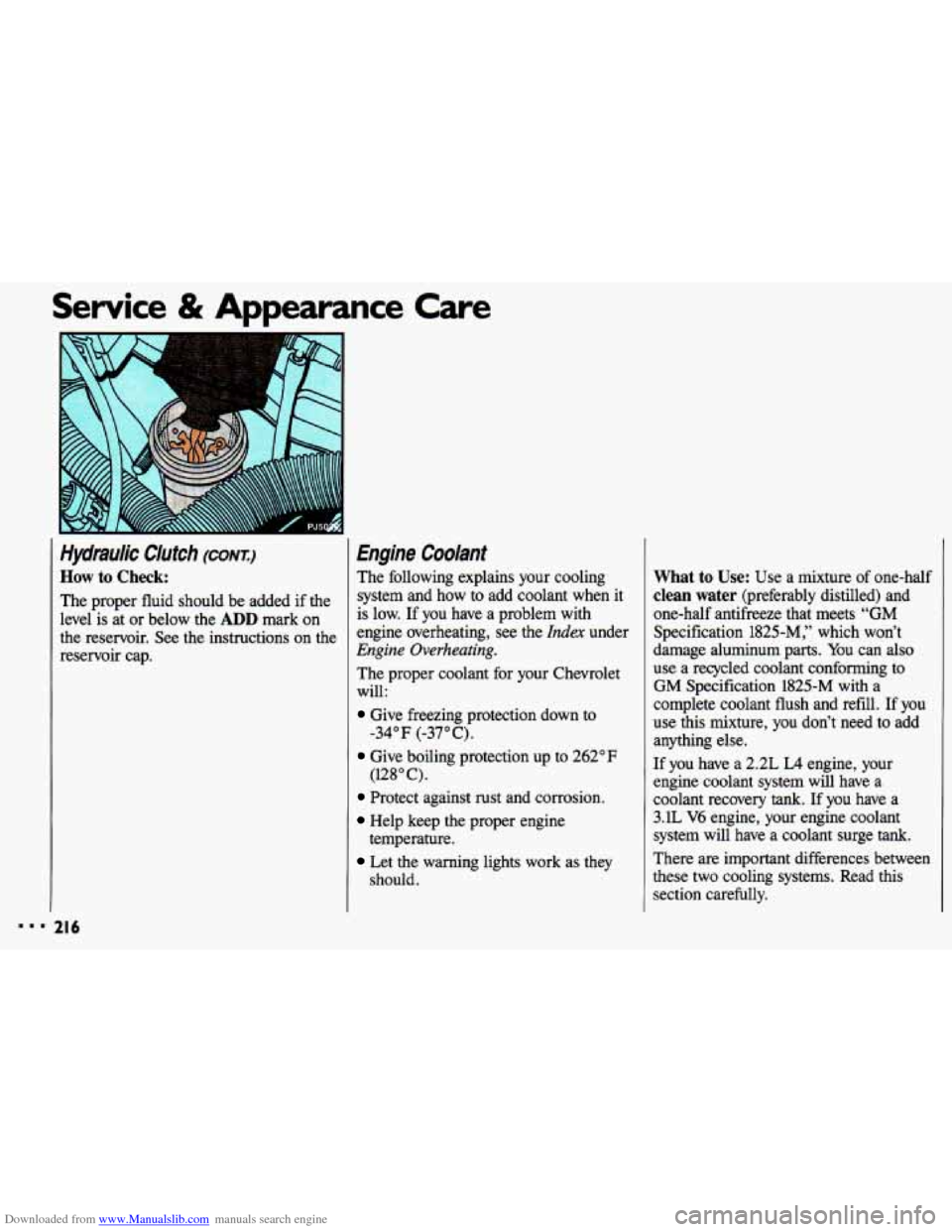
The proper fluid should be added if the
level is at or below the
ADD mark on
the reservoir.
See the instructions on the
reservoir cap.
216
Engine Coolant
The following explains your cooling
system and how to add coolant when it
is low. If you have a problem with
engine overheating,
see the Index under
Engine Overheating.
The proper coolant for your Chevrolet
will:
Give freezing protection down to
Give boiling protection up to 262°F
Protect against rust and corrosion.
Help keep the proper engine
Let the warning lights work as they
-34" F (-37" C).
(128" C).
temperature.
should.
What to Use: Use a mixture of one-half
clean water (preferably distilled) and
one-half antifreeze that meets "GM
Specification 1825-M," which won't
damage aluminum parts.
You can also
use a recycled coolant conforming to
GM Specification 1825-M with a
complete coolant flush and refill.
If you
use this mixture, you don't need to add
anything else.
If you have a 2.2L LA engine, your
engine coolant system will have a
coolant recovery
tank. If you have a
3.1L V6 engine, your engine coolant
system will have a coolant surge
tank.
There are important differences between
these two cooling systems. Read this section carefully.
Page 219 of 308
Downloaded from www.Manualslib.com manuals search engine L Adding only plain water to - your cooling system can be
dangerous. Plain water,
or some
other liquid like alcohol, can boil
before the proper coolant
mix will.
Your vehicle's coolant warning
system
is set for the proper coolant
mix. With plain water or the
wrong mix, your engine could get
too hot but
you wouldn't get the
overheat warning. Your engine
could catch
fire and you or others
could be burned. Use a
50150 mix
of clean water and a proper
antifreeze.
Adding Coolant-2,21 L4 Engine
To Check Coolant:
When your engine
is cold, the coolant
level should be at
FULL COLD, or a
little higher. When your engine
is warm,
the level should be up to
mJLL HOT,
or a little higher.
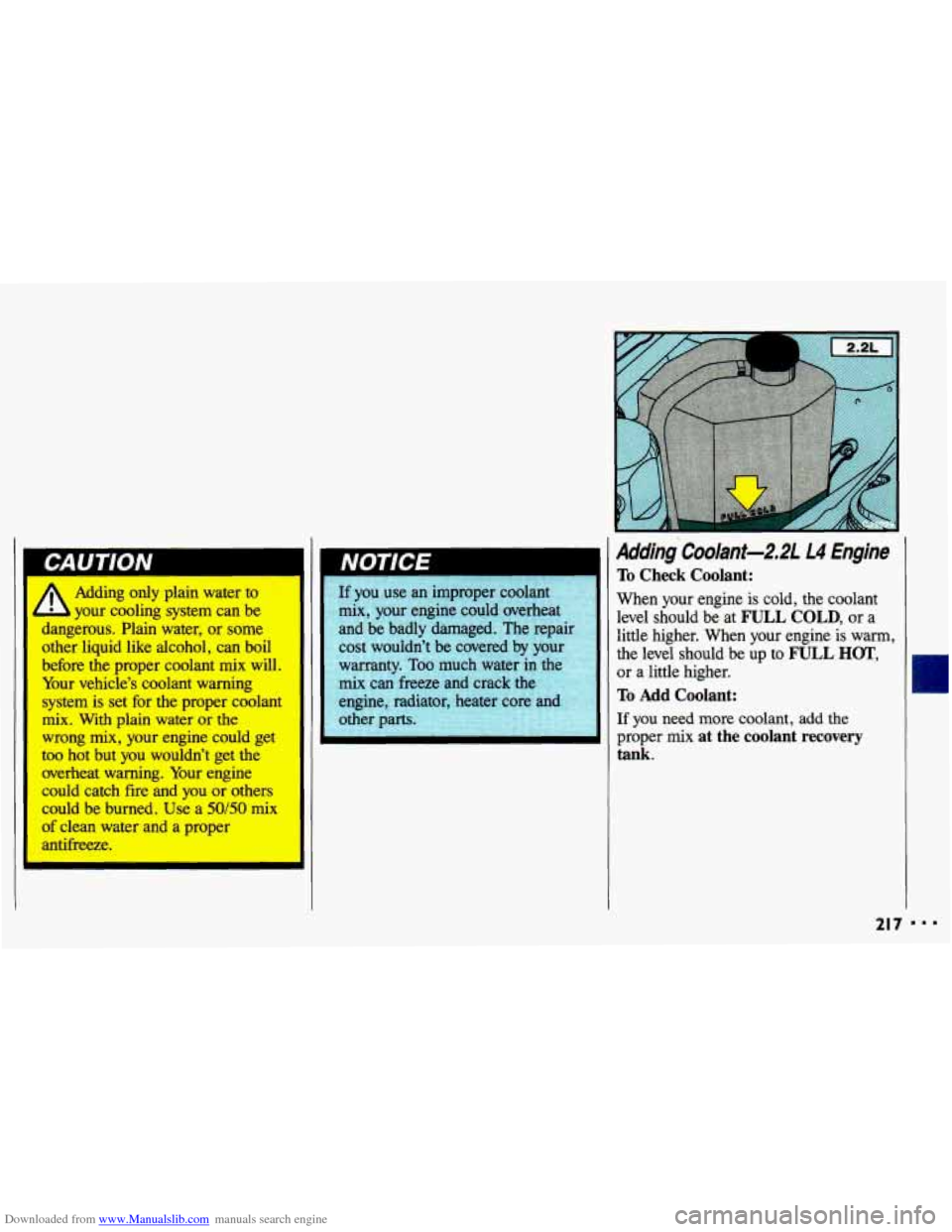
To Add Coolant:
If you need more coolant, add the
proper
mix at the coolant recovery
tank.
Page 224 of 308
Downloaded from www.Manualslib.com manuals search engine Service & Appearance Care
I’ A
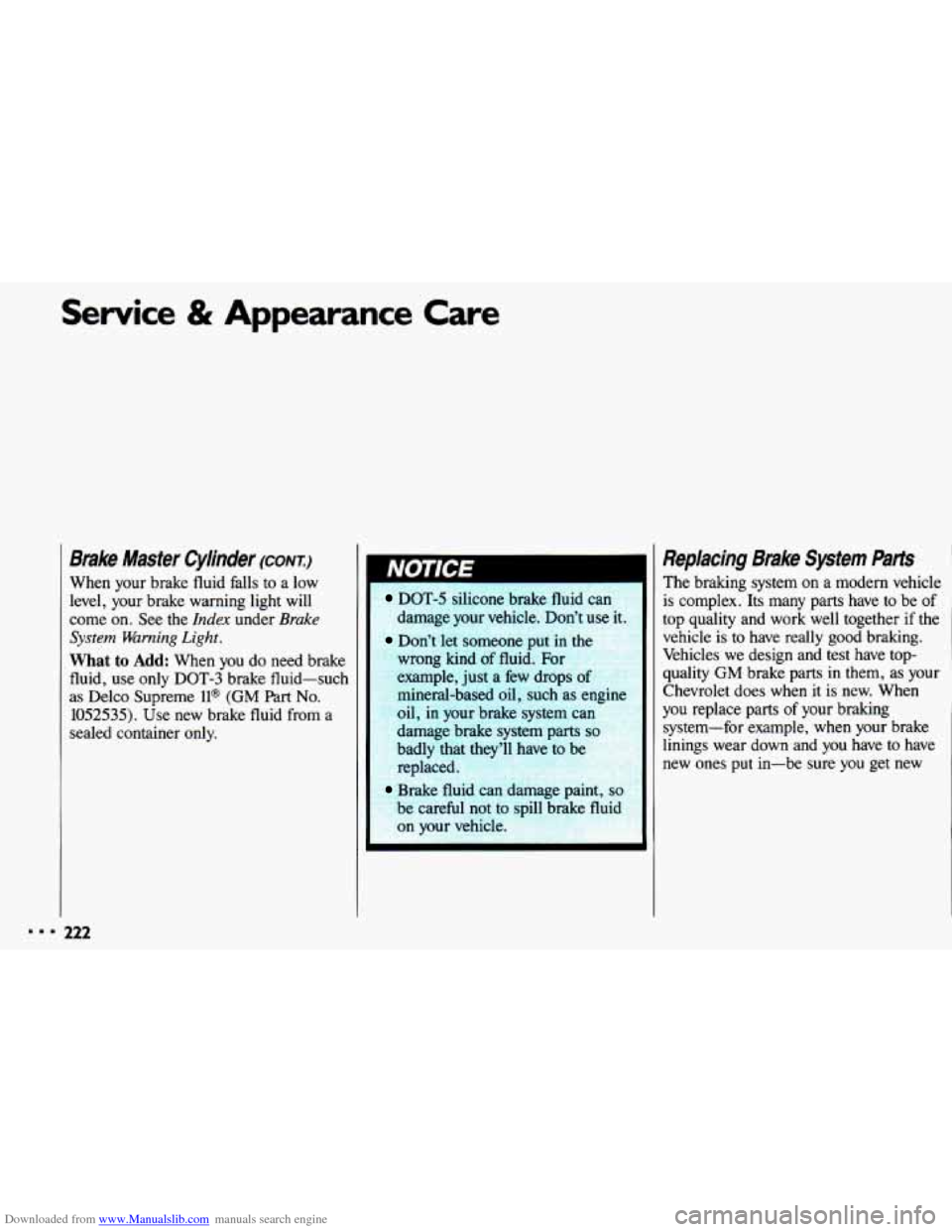
Brake Master Cylinder (CONT.)
When your brake fluid falls to a low
level, your brake warning light will
come
on. See the Index under Brake
System Warning Light.
What to Add: When you do need brake
fluid, use only DOT-3 brake fluid-such
as Delco Supreme
ll@ (GM Part No.
1052535). Use new brake fluid from a
sealed container only.
122
DOT-5 silicone brake fluid can
damage your vehicle. Don’t use it.
Don’t let someone put in the
wrong kind
of fluid. For
example, just a few drops
of
mineral-based oil, such as engine
oil, in your brake system can
damage brake system parts
so
badly that they’ll have to be
replaced.
Brake fluid can damage ‘.nt, so
be careful not to spill brae fluid
on your vehicle.
Replacing Brake System parfs
The braking system on a modern vehicle
is complex.
Its many parts have to be of
top quality and work well together
if the
vehicle
is to have really good braking.
Vehicles we design and test have top-
quality
GM brake parts in them, as your
Chevrolet does when it
is new. When
you replace parts of your braking
system-for example, when your brake
linings wear down and
you have to have
new ones put in-be sure you get new
Page 261 of 308
Downloaded from www.Manualslib.com manuals search engine I IMPORTANT
KEEP ENGINE OIL
AT THE PROPER
LEVEL AND CHANGE AS
RECOMMENDED
This part covers the maintenance
required for your Chevrolet. Your
vehicle needs these services to
retain its safety, dependability and
emission control performance.
Pian I
Section
Part 7
Maintenance Schedule
Have you purchased the
GM Protection Plan?
The Plan supplements your new vehicle warranties.
See your Chevrolet dealer for details.
Introduction
A Word About Maintenance . . . . . . . . . . . . . . . . . . . . . . . . . . . . . .260
Your Vehicle and the Environment
. . . . . . . . . . . . . . . . . . . . . . . , .260
How This
Part is Organized . . . . . . . . . . . . . . . . . . . . . . . . . . . . . . .261
Using Your Maintenance Schedules
. . . . . . . . . . . . . . . . . . . . . . . .262
Selecting the Right Schedule
. . . . . . . . . . . . . . . . . . . . . . . . . . . . . .262
Schedule1
............................................ 264
Schedule11
........................................... 266
Explanation of Scheduled Maintenance Services . . . . . . . . . . . . . .268
AtEachFuelFill
....................................... 271
AtLeastOnceaMonth
.................................. 271
At Least Twice a Year
. . . . . . . . . . . . . . . . . . . . . , . , . . . . . . . . . . .272
At Least Once a Year
. . . . . . . . . . . . . . . . . . . . . . . . . . . . . . . . . . . .272
C. Periodic Maintenance Inspections . . . . . . . . . . . . . . . . . . . . . . . . . . .275
D. Recommended Fluids & Lubricants . . . . . . . . . . . . . . . . . . . . . . . . .276
E. MaintenanceRecord ...................................... 279
A. Scheduled Maintenance Services
B. Owner Checks & Services
259 888
Page 271 of 308

Downloaded from www.Manualslib.com manuals search engine ITEM
NO. SERVICE ITEM NO. SERVICE
4
5
Engine
Accessory Drive Belt(s) Inspection*-
Inspect the belt(s) for cracks, fraying, wear and
proper tension. Replace as needed.
Cooling System Service*-Drain, flush and refill
the system with
new or approved recycled coolant
conforming to
GM Specification 1825M. Keep
coolant at the proper mixture as specified. See the
Index under Coolant. This provides proper freeze
protection, corrosion inhibitor level and engine
operating temperature.
Inspect hoses and replace if they are cracked,
swollen or deteriorated. Tighten screw-type hose
clamps. Clean the outside of the radiator and air
conditioning condenser. Wash
the pressure cap and
neck.
To help ensure proper operation, we recommend a
pressure test of both the cooling system and the
pressure cap.
6
7
8
9
Transaxle Service-For manual transaxles, fluid
doesn't require changing.
For automatic transaxles, change both the fluid and
filter every
15,000 miles (25 000 km) if the vehicle
is mainly driven under one or more of these
conditions:
In heavy city traffic where the outside temperature
In hilly or mountainous terrain.
Uses such as found in taxi, police car or delivery
regularly reaches
90" F (32" C) or higher.
service.
If you do not use your vehicle under any of
these conditions, change both the fluid and filter
every 100,000 miles (160
0oO km).
Spark Plug Replacement*-Replace spark plugs
with the proper type. See
the Index under
Replacement Parts.
Spark Plug Wire Inspection* *-Inspect for
burns, cracks or other damage. Check the boot
fit
at the coils and at the spark plugs. Replace wires as
needed.
Exhaust Gas Recirculation (EGR) System
Inspection
(2.2L L4 Code 4 engine)" *-Conduct
the
EGR system service as described in the service
manual. To purchase a service manual
, see the
Index under Service Publications.
Page 273 of 308
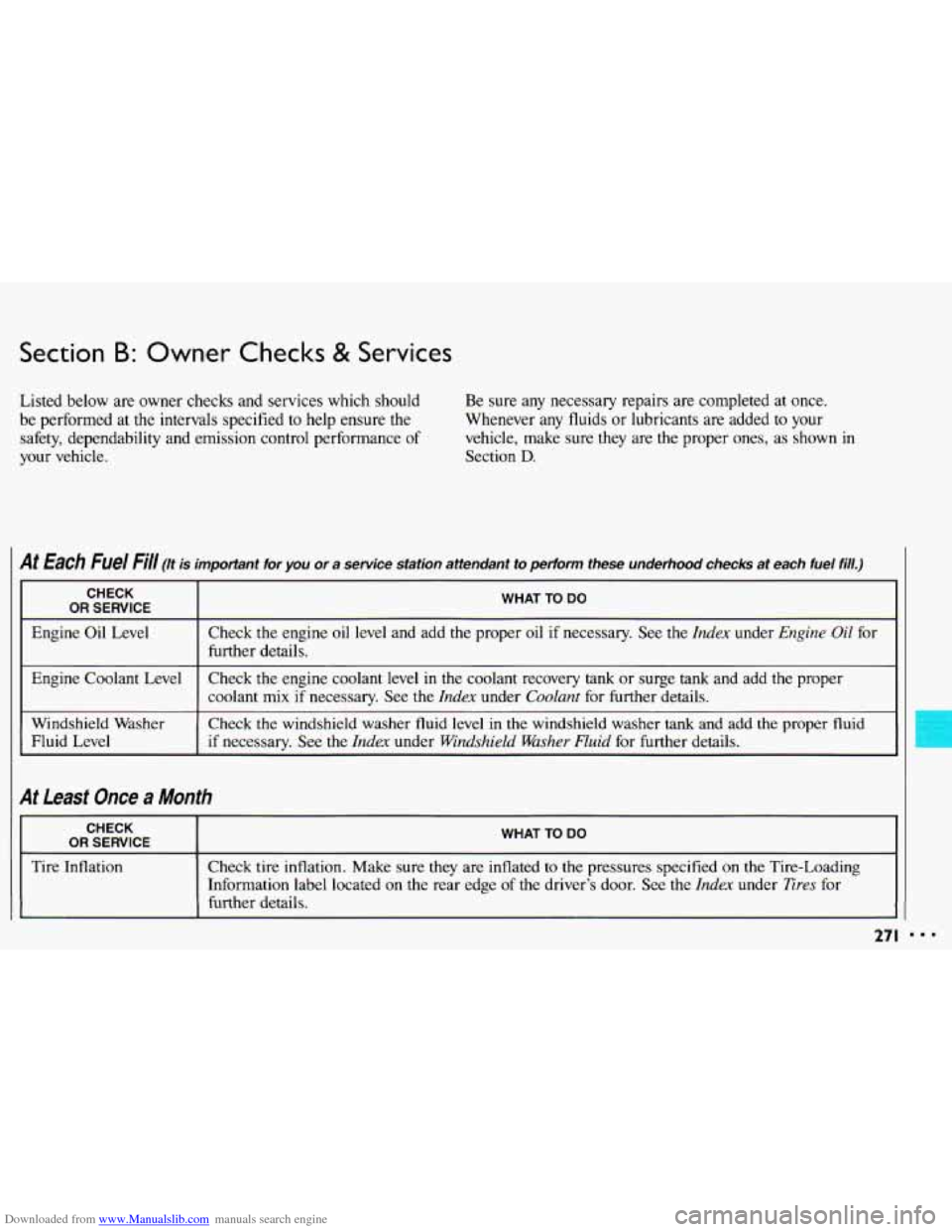
Downloaded from www.Manualslib.com manuals search engine Section B: Owner Checks & Services
Listed below are owner checks and services which should
be performed at the intervals specified to help
ensure the
safety, dependability and emission control performance of
your vehicle. Be
sure any necessary repairs are completed at once.
Whenever any fluids or lubricants are added to your
vehicle, make sure they are the proper ones, as shown in
Section D.
At Each Fuel Fill (It is important for you or a service station attendant to perform these underhood checks at \
each fuel fill.)
CHECK
OR SERVICE I WHAT TO DO
Engine Oil Level
1
Check the engine oil level and add the proper oil if necessary. See the Index under Engine Oil for
further details.
Engine Coolant Level Check the engine coolant level
in the coolant recovery tank or surge tank and add the proper
coolant
mix if necessary. See the Index under Coolant for further details.
Windshield Washer Check the windshield washer fluid level
in the windshield washer tank and add the proper fluid
Fluid Level if necessary. See the
Index under Windshield Washer Fluid for further details. I
At Least Once a Month
CHECK
I OR SERVICE I WHAT TO DO
Tire Inflation
Check tire inflation. Make sure they are inflated to the pressures specified on the Tire-Loading
Information label located on the rear edge of
the driver’s door. See the Index under fires for
further details.
27 I I..