1993 CHEVROLET CAMARO fuel
[x] Cancel search: fuelPage 177 of 358
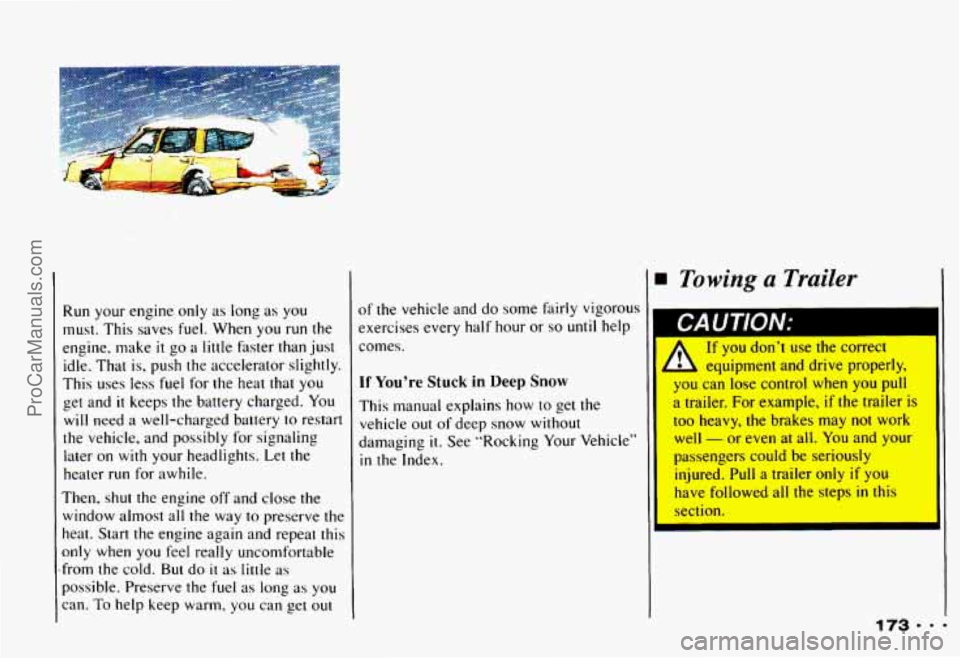
Run your engine only as long as you
must. This saves fuel. When you
run the
engine, make
it go a little faster than just
idle. That is, push the accelerator slightly.
This uses less fuel for the heat that you
get and
it keeps the battery charged. You
will need a well-charged battery to restart
the vehicle, and possibly for signaling
later on
with your headlights. Let the
heater
run for awhile.
Then. shut the engine off and close the
window almost all the way to preserve the
heat. Start the engine again and repeat this
only when you feel really uncomfortable
from the cold.
But do it as little as
possible. Preserve the fuel as long as you
can.
To help keep warm. you can get out
3f the vehicle and do some fairly vigorous
zxercises every half hour or
so until help
Zomes.
If You're Stuck in Deep Snow
This manual explains how to get the
vehicle
out of deep snow without
damaging it. See "Rocking Your Vehicle"
in the Index.
Towing a Trailer
you can lose control when you pull
a trailer. For example, if the trailer is
too heavy, the brakes may not work
well - or even at all. You and your
passengers could be seriously
injured. Pull a trailer only if you
have followed all the steps in this
section.
ProCarManuals.com
Page 178 of 358
Your Driving and the Road
I NOTICE:
AAtnage your vehicle and result i~
jtly repairs not covered by you.
warranty.
To pull a trailer correctly,
follow the advice
in this section.
I
Your vehicle can tow a trailer if it is
equipped
with the proper trailer towing
equipment.
To identify what the vehicle
trailering capacity
is for your vehicle, you
should read the information in “Weight
of the Trailer” that appears later
in this
section. But trailering is different than just
driving your vehicle by itself. Trailering
means changes
in handling, durability, and fuel economy.
Successful, safe
trailering takes correct equipment, and
it has to be used properly.
That’s the reason for this section, In it are
many time-tested, important trailering
tips and safety rules. Many of these are
important for your safety and that of your
passengers.
So please read this section
carefully before you pull a trailer.
Load-pulling components such as the
engine, transmission, wheel assemblies,
and tires are forced to work harder against
the drag of the added weight. The engine
is required to operate at relatively higher
speeds and under greater loads, generating extra
heat. What’s more,
the
trailer adds considerably to wind
resistance, increasing the pulling
requirements.
If You Do Decide to Pull a Trailer
If you do, here are some important points.
There are many different laws having
to do
with trailering. Make sure your
rig
will be legal, not only where you
live but also where you’ll be driving.
A good source for this information
can be state or provincial police.
ProCarManuals.com
Page 221 of 358

Part b
Here you will find information
about the care
of your Chevrolet .
This part begins with service and
fuel information. and then it shows
how
to check important fluid and
lubricant levels
. There is also
technical information about your
vehicle. and a section devoted to
its appearance care
.
Service & Appearance Care
Service .......................................................... 218
Fuel
............................................................ 219
Checking Things under the Hood
..................................... 223
HoodRelease
................................................... 223
Engineoil
...................................................... 226
Aircleaner
..................................................... 230
Automatic Transmission Fluid
...................................... 233
Manual Transmission Fluid
........................................ 235
Hydraulicclutch
................................................ 237
RearAxle
...................................................... 237
Enginecoolant
.................................................. 238
Power Steering Fluid
............................................. 242
Windshield Washer Fluid
.......................................... 243
Brake Master Cylinder
............................................ 244
Battery
........................................................ 246
Bulb Replacement
................................................. 247
Loading Your Vehicle
.............................................. 255
Appearance Care and Maintenance Materials
............................ 274
Vehicle Identification Number (VIN)
.................................. 275
Service Parts Identification Label
..................................... 275
Add-on Electrical Equipment
........................................ 275
Fuses and Circuit Breakers
.......................................... 276
Replacement Bulbs
................................................ 279
Capacities and Specifications
......................................... 280
Tires
............................................................ 256
Appearancecare
.................................................. 265
217
ProCarManuals.com
Page 223 of 358
NOTICE:
Fuel
The 8th digit of your Vehicle
Identification Number (VIN) shows
the code letter for your engine.
You will
find the VIN at the top left
of your
instrument panel. (See “Vehicle
Identification Number” in the Index.)
3.4L L32 (Code S)
Use regular unleaded gasoline rated at
87 octane or higher. It should meet
specifications ASTM
D4814 in the U.S.
and CGSB 3.5-92 in Canada. These fuels
should have the proper additives,
so you
should not have to add anything to the
fuel.
In the U.S. and Canada, it’s easy to
be
sure you get the right kind of gasoline
(unleaded). You’ll see
UNLEADED right
In the pump. And only unleaded nozzles
will
fit into your vehicle’s filler neck.
Be sure the posted octane is at least 87.
:f the octane is less than 87, you may get
sl heavy knocking noise when you drive.
If it’s bad enough, it can damage your
engine.
If you’re using fuel rated at
87 octane or
higher and you still hear heavy knocking,
your engine needs service. But don’t
worry if you hear a little pinging noise
when you’re accelerating or driving up a
hill. That’s normal, and you don’t have to
buy a higher octane fuel to get rid of
pinging. It’s the heavy, constant knock
that means you have a problem.
ProCarManuals.com
Page 224 of 358
Service & Appearance Care
= 220
5.7L LT1 (Code P)
Use premium unleaded gasoline rated at
91 octane or higher. You may use middle
grade
or regular unleaded gasolines, but
your vehicle may not accelerate as well.
The gasoline you use should meet
specifications ASTM
D48 14 in the U.S.
and CGSB 3.5-92 in Canada. These fuels should have the proper additives,
so you
should not have to add anything to the
fuel.
In the
U.S. and Canada, it’s easy to be
sure you get the right kind of gasoline
(unleaded). You’ll see
UNLEADED right
on the pump. And only unleaded nozzles
will fit into your vehicle’s filler neck. Be
sure
the posted octane for premium is
at least 91 (at least
89 for middle grade
and
87 for regular). If the octane is less
than
87, you may get a heavy knocking
noise when you drive. If it’s bad enough,
it can damage your engine.
If you’re using fuel rated at 91 octane or
higher and you still hear heavy knocking,
your engine needs service. But don’t
worry if you hear a little pinging noise
when you’re accelerating
or driving up a
hill. That’s normal and you don’t have to
buy a higher octane fuel to get rid of
pinging. It’s the heavy, constant knock
that means you have a problem.
All Engines
What about gasoline with blending
materials that contain oxygen, such as
MTBE
or alcohol?
MTBE is “methyl tertiary-butyl ether.”
Fuel that is no more than 15% MTBE is
fine for your vehicle.
Ethanol is ethyl or grain alcohol.
Properly-blended fuel that is no more
than 10%
ethanol is fine for your vehicle.
ProCarManuals.com
Page 225 of 358
Methanol is methyl or wood alcohol.
IC
NOTICE:
I
rue1 mat is more than 3% metha
is bad for your vehicle. Don’t use it.
It can corrode metal parts in your
fuel system and also damage plastic
and rubber parts. That damage wouldn’t
be covered under your I
rranty. And even at 5% or less,
there must be “cosolvents” and
corrosion preventers in this fuel
to
help avoid these problems.
I
Gasolines for Cleaner Air
Your use of gasoline with detergent
additives will help prevent deposits from
forming
in your engine and fuel system.
That helps keep your engine in tune and
your emission control system working
properly. It’s good for your vehicle, and
you’ll be doing your part for cleaner air.
Many gasolines are
now blended with
materials called oxygenates. General
Motors recommends that you use
gasolines
with these blending materials,
such as MTBE and ethanol.
By doing so,
you can help clean the air, especially in
those parts of the country that have high
carbon monoxide levels. In
addition, some gasoline suppliers are
now producing reformulated gasolines.
These gasolines are specially designed to
reduce vehicle emissions. General Motors
recommends that you
use reformulated
gasoline.
By doing so, you can help clean
the air, especially
in those parts of the
country that have high ozone levels.
You should ask your service station
operators
if their gasolines contain
detergents and oxygenates, and if they
have been reformulated to reduce vehicle
emissions.
221
ProCarManuals.com
Page 226 of 358
Service & Appearance Care
Fuels in Foreign Countries
If you plan on driving in another country
outside the
U.S. or Canada, unleaded fuel
may be hard to find.
Do not use leaded
gasoline.
If you use even one tankful,
your emission controls won’t work well or at all. With continuous use, spark plugs
can get fouled, the exhaust system can
corrode, and your engine oil can
deteriorate quickly.
Your vehicle’s oxygen
sensor will be damaged.
All of that means
costly repairs that wouldn’t be covered by
your warranty.
c L. 222
To check on fuel availability, ask an auto
club,
or contact a major oil company that
does business in the country where you’ll
be driving.
You can also write us at the following
address for advice. Just tell us where
you’re going and give your Vehicle
Identification Number (VIN).
General Motors of Canada Ltd.
International Export Sales
P.O. Box 828
Oshawa, Ontario L1H 7N1
Canada
I
Filling Your Tank
Gasoline vapor is highly
flammable. It burns violently,
and that can cause very bad injuries. Don’t smoke if you’re near gasoline
or refueling your vehicle. Keep
, sparks, flames, and smoking
C
materials away from gasoline.
‘I
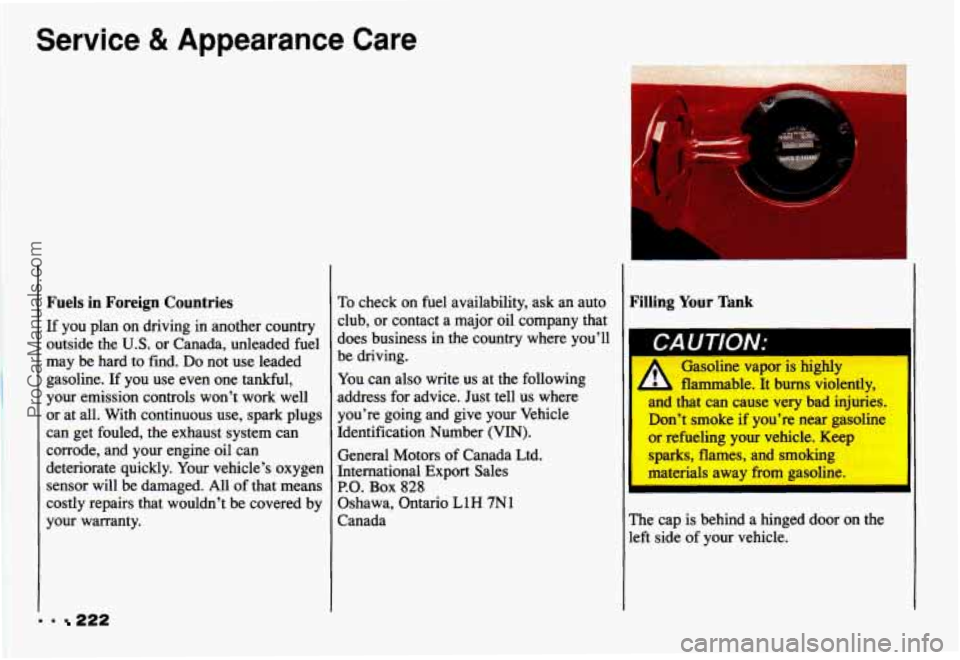
The cap is behind a hinged door on the
left side of your vehicle.
ProCarManuals.com
Page 227 of 358
To take off the cap, turn it slowly to the
left (counterclockwise). When you put the
cap back on, turn it to
the right until
you hear a clicking noise.
I A If you get gasoline on you and
L then something ignites it, you
could be badly
burned. Gasoline can
spray out on you if you open the
fuel filler
cap too quickly. This
spray
can happen if your tank is
nearly full, and is more likely in
hot ~
weather. Open the fuel filler cap
slowly
and wait for any “hiss” noise
to stop. Then unscrew the cap all the
way.
I
1
If you _____1 need a new cap, be sure to get
the right type. Your dealer can get
one for you. If you get the wrong
type, it may not fit and your fuel
tank and emissions system might be -
I damaged.
Checking Things under
the Hood
Hood Release
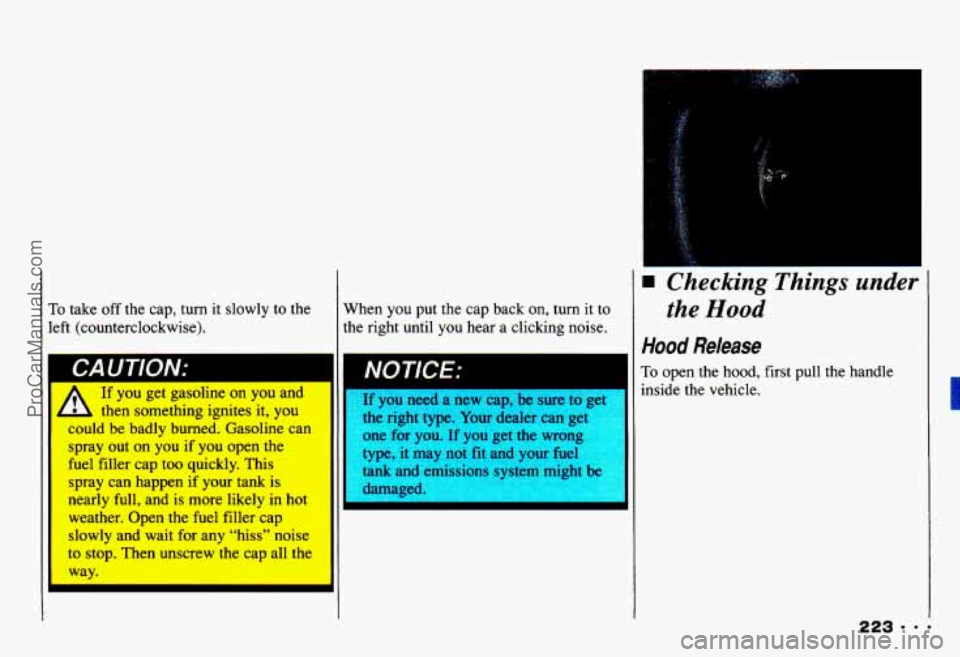
To open the hood, first pull the handle
inside the vehicle.
223 9 9 9
ProCarManuals.com