Page 116 of 358
Comfort Controls & Audio Systems
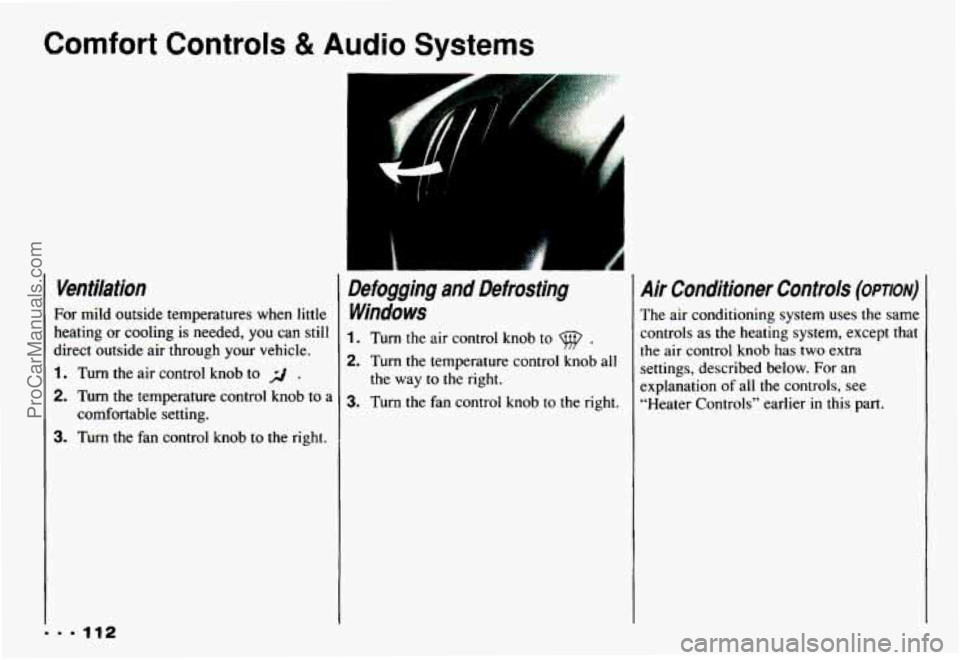
Ventilation
For mild outside temperatures when little
heating
or cooling is needed, you can still
direct outside air through your vehicle.
1. Turn the air control knob to r/ ,
2. Turn the temperature control knob to a
3. Turn the fan control knob to the right.
comfortable setting.
Defogging and Defrosting
Windows
1. Turn the air control knob to 9 .
2. Turn the temperature control knob all
3. Turn the fan control knob to the right.
the way
to the right.
Air Conditioner Controls (OPTION)
The
air conditioning system uses the same
controls as the heating system, except that
the air control
knob has two extra
settings, described below. For an
explanation of all
the controls, see
“Heater Controls” earlier in this part.
ProCarManuals.com
Page 183 of 358

Turn Signals When Towing a Trailer
When you tow a trailer, your vehicle has to
have a different turn signal flasher and
extra wiring. The green arrows on your
instrument panel will flash whenever you
signal a turn or lane change. Properly
hooked up, the trailer lights will also flash,
telling other drivers you’re about to
turn,
change lanes or stop.
When towing a trailer, the green arrows on
your instrument panel will flash for turns
even if the bulbs on the trailer are burned
out. Thus,
you may think drivers behind
you are seeing your signal when they are
not. It’s important to check occasionally to
be sure the trailer bulbs are still working.
Driving on Grades
Reduce speed and shift to a lower gear
before you start down a long or steep
downgrade. If
you don’t shift down, you
might have to use your brakes
so much
that they would get hot and no longer work well.
On a long uphill grade, shift down and
reduce your speed to around
45 mph
(70 km/h) to reduce the possibility of
engine and transmission overheating. If you
are towing a trailer and you
have an automatic transmission with
Overdrive, you may prefer to drive
in D
instead of Overdrive (or, as you need to,
a lower gear). Or, if you have a manual
transmission
with fifth (or sixth) gear
and you are towing a trailer, it’s better
not to use
fifth (or sixth) gear. Just drive
in fourth gear (fifth gear
if you have
a six-speed manual transmission)
(or, as you need to, a lower gear.
ProCarManuals.com
Page 187 of 358
Part 5
P
Here you’ll find what to do about
some problems that can occur on
the road.
rroblems on the Road
Hazard Warning Flashers ............................................. 184
Jump Starting ...................................................... 185
Towing Your Vehicle ................................................ 190
Engine Overheating ................................................. 193
If a Tire Goes Flat .................................................. 204
If You’re Stuck: In Sand, Mud, Ice or Snow .............................. 215
ProCarManuals.com
Page 197 of 358
I
c
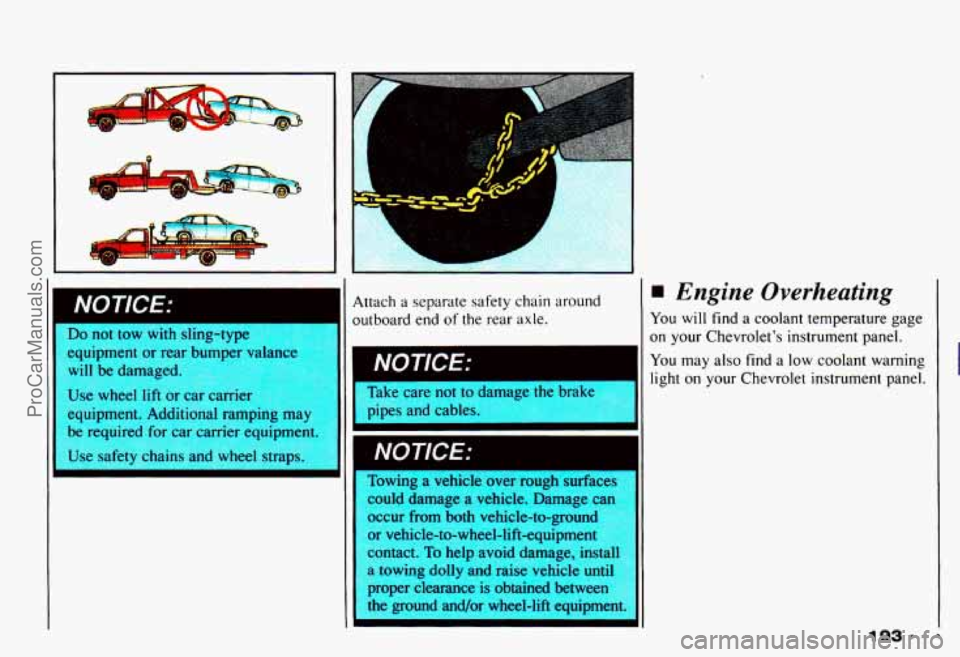
Do not tow with sling-type
eauipment or rear bumDer valance
equipment. Additional ramping may
be required for car carrier equipment.
Use safety chains and wheel straps. Attach
a separate
safety chain around
outboard end
of the rear axle.
NOTICE: I
could damage a vehicle. Damage can
occur from both vehicle-to-ground
or vehicle-to-wheel-lift-equipment
To help avoid damage, install
g dolly and raise vehicle until
er clearance is obtained between
the ground and/or wheel-lift equipment.
Engine Overheating
You will find a coolant temperature gage
on your Chevrolet's instrument panel.
You may also find a low coolant warning
light on your Chevrolet instrument panel.
193 9
ProCarManuals.com
Page 201 of 358
eng~ witho
r
u -.. .
tolar .-
[f there seems to be no leak, check to see
f the electric engine fan is running. If the
:ngine is overheating, the fan should be
-unning.
If it isn’t, your vehicle needs
iervice.
I I
How to Add Coolant to the Coolant
Recovery Tank
If you haven’t found a problem yet, but
the coolant level isn’t
at or above FULL
COLD,
add a 50/50 mixture of clean
water
(preferably distilled) and a proper
antifreeze at the coolant recovery tank.
(See “Engine Coolant”
in the Index for
more information about the proper
coolant
mix.)
A Adding only plain water to
L your cooling system can be
dangerous. Plain water, or some
I
other liquid like alcohol, can boil
before the proper coolant
mix will.
Your vehicle’s coolant warning
system
is set for the proper coolant
mix. With plain water or the wrong
mix, your engine could get too hot
but you wouldn’t get the overheat
warning. Your engine could catch
fire and you or others could
be
burned. Use a 50/50 mix of clean
water
and a proper antifreeze.
197-
ProCarManuals.com
Page 242 of 358
Service & Appearance Care
What to Use:
Standard and Limited-Slip Differential
Use Axle Lubricant (GM Part No.
1052271) or SAE 8OW-90 GL-5 gear
lubricant.
Engine Coolant
The following explains your cooling
system and how
to add coolant when it
is low. If
you have a problem with
engine overheating or if you need to add
coolant to your radiator, see “Engine
Overheating”
in the Index.
I
The proper coolant for your Chevrolet
will:
0
0
0
0
0
Give freezing protection down to
-34°F (-37°C).
Give boiling protection up to 262°F
(128°C).
Protect against rust and corrosion.
Help keep the proper engine
temperature.
Let
the warning lights work as they
should.
ProCarManuals.com
Page 244 of 358
Service & Appearance Care
1
Adding Coolant
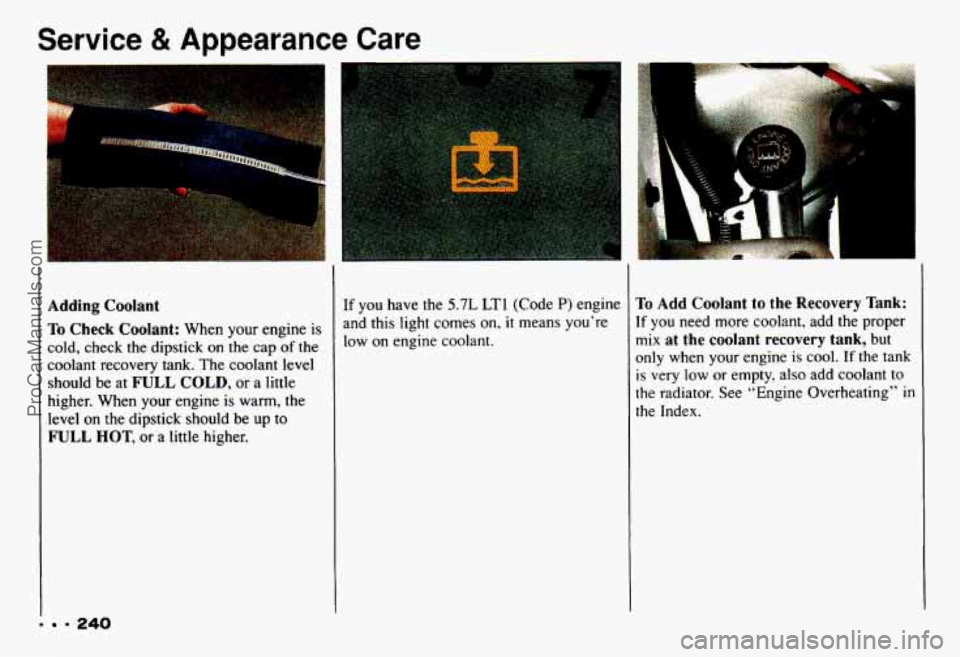
To Check Coolant: When your engine is
cold, check the dipstick on the cap of the
coolant recovery tank. The coolant level
should be at
FULL COLD, or a little
higher. When your engine is warm, the
level on the dipstick should be up to
FULL HOT, or a little higher.
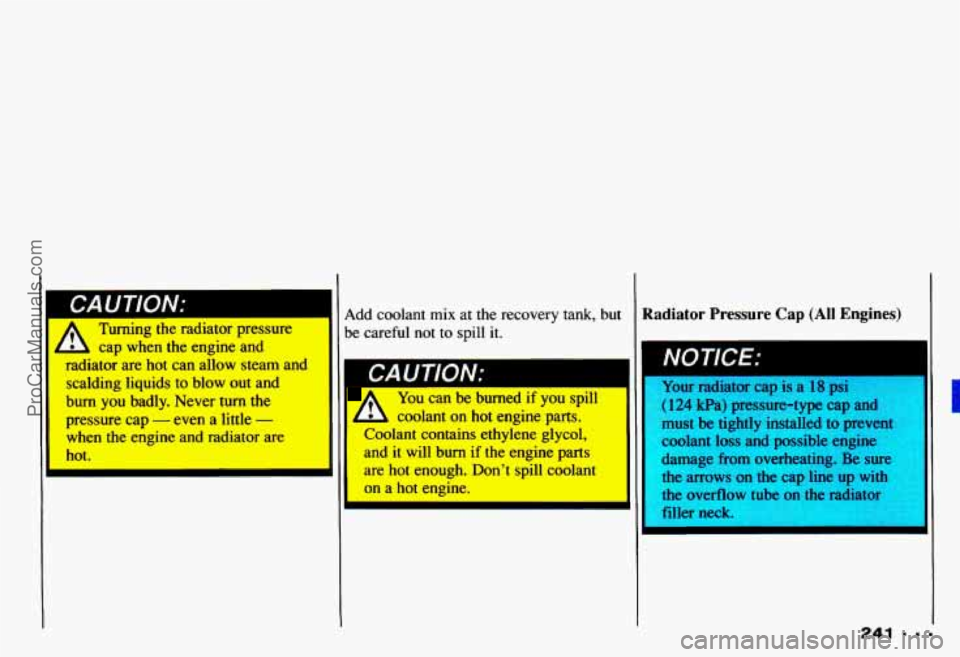
If you have the 5.7L LTl (Code P) engine
and this light comes on,
it means you’re
low on engine coolant.
To Add Coolant to the Recovery Tank:
If you need more coolant, add the proper
mix
at the coolant recovery tank, but
only when your engine
is cool. If the tank
is very low or empty, also add coolant to
the radiator. See “Engine Overheating” in
the Index.
9 240
ProCarManuals.com
Page 245 of 358
Turning the radiator pressure
L cap when the engine and
radiator
are hot can allow steam and
scalding liquids to blow out and
burn you badly. Never turn the
pressure
cap - even a little -
when the engine and radiator are
,dd coolant mix at the recovery tank, but
e careful not to spill it.
CA U TION:
I
I
You can be burned if you spill
coolant on hot engine parts.
Coolant contains ethylene glycol,
and it will burn
if the engine parts
are hot enough. Don’t spill coolant
on a hot engine.
Radiator Pressure Cap (All Engines)
~ NOTICE:
Your radiator cap is a 18 psi
(124 kPa) pressure-type cap and
must be tightly installed to prevent
coolant loss and possible engine
damage from overheating. Be sure
the arrows on the cap line
up with
the ovefflow tube on the radiator
filler neck.
ProCarManuals.com