Page 245 of 358
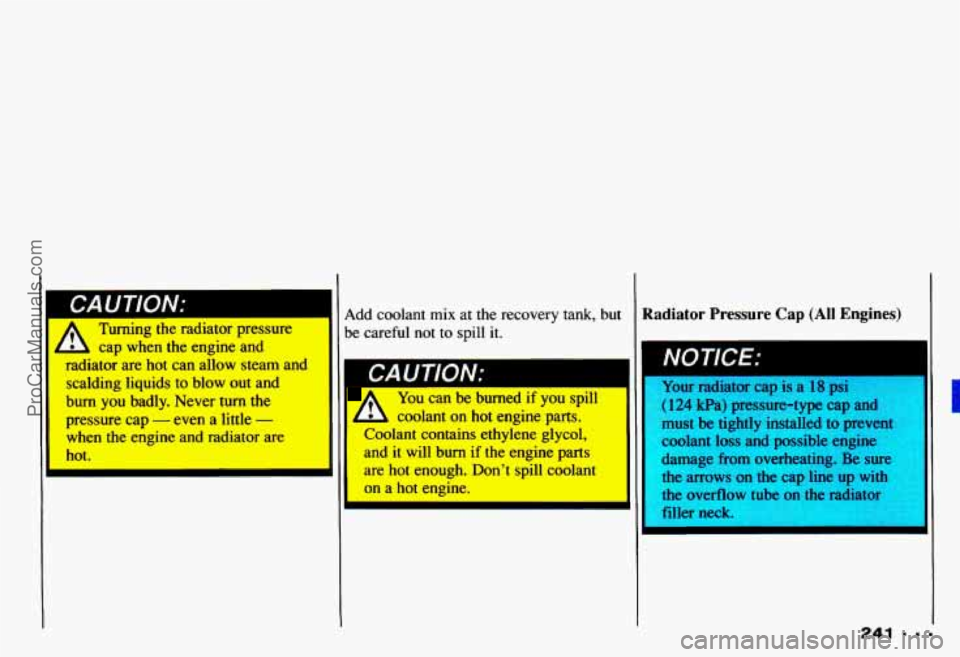
Turning the radiator pressure
L cap when the engine and
radiator
are hot can allow steam and
scalding liquids to blow out and
burn you badly. Never turn the
pressure
cap - even a little -
when the engine and radiator are
,dd coolant mix at the recovery tank, but
e careful not to spill it.
CA U TION:
I
I
You can be burned if you spill
coolant on hot engine parts.
Coolant contains ethylene glycol,
and it will burn
if the engine parts
are hot enough. Don’t spill coolant
on a hot engine.
Radiator Pressure Cap (All Engines)
~ NOTICE:
Your radiator cap is a 18 psi
(124 kPa) pressure-type cap and
must be tightly installed to prevent
coolant loss and possible engine
damage from overheating. Be sure
the arrows on the cap line
up with
the ovefflow tube on the radiator
filler neck.
ProCarManuals.com
Page 246 of 358
Service & Appearance Care
When you replace your radiator pressure
cap. an
AC3 cap is recommended.
Thermostat
Engine coolant temperature is controlled
by a thermostat in the engine coolant
system. The thermostat stops the flow
of
coolant through the radiator until the
coolant reaches a preset temperature.
When you replace
your thermostat, an
AC@ thermostat is recommended.
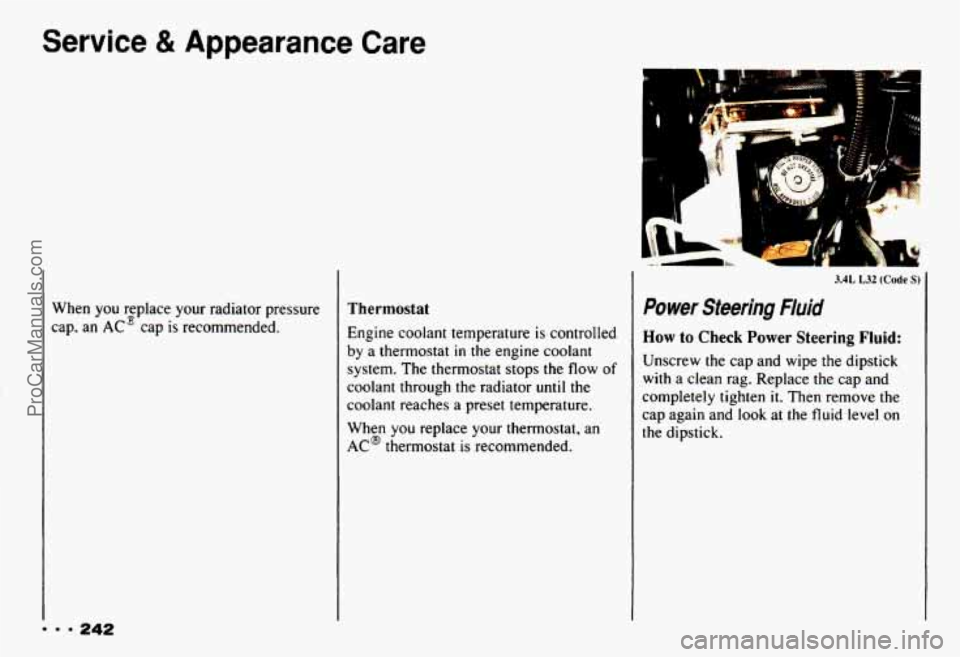
3.4L L32 (Code S)
Power Steering Fluid
How to Check Power Steering Fluid:
Unscrew the cap and wipe the dipstick
with a clean rag. Replace the cap and
completely tighten
it. Then remove the
cap again and look at the fluid level
on
the dipstick.
ProCarManuals.com
Page 247 of 358
0
0
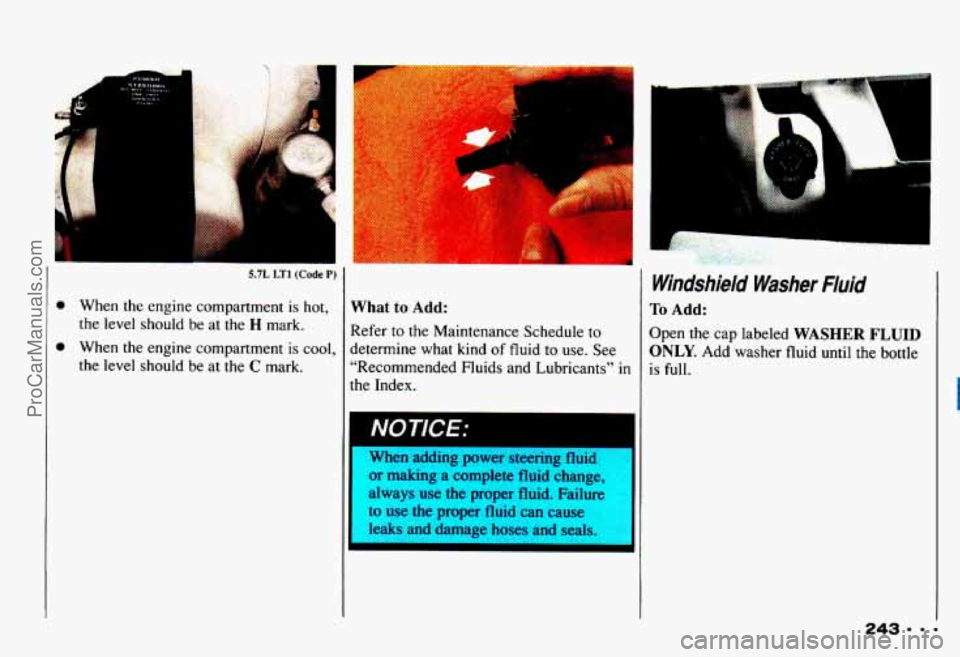
5.7L LTl (Code P)
When the engine compartment is hot,
the level should be at the
H mark.
When the engine compartment is cool,
the level should be at the
C mark.
;.,,
What to Add:
Refer to the Maintenance Schedule to
determine what kind of fluid to use. See
“Recommended Fluids and Lubricants”
in
the Index.
11 NOTICE: t
When adding power steering fluid
or making a complete fluid change,
always use
the proper fluid. Failure I
to use the proper fluid can cause
leaks and damage hoses and seals.
Windsmeld Washer Fluid
To Add:
Open the cap labeled WASHER FLUID
ONLY. Add washer fluid until the bottle
is full.
ProCarManuals.com
Page 249 of 358
I I A If you have too much brake
L , fluid, it can spill on the engine.
‘-L: fluid will burn if the engine is
hot enough. You or others could be
burned, and your vehicle could be
damaged. Add brake fluid only
when work is done
on the brake
hydraulic system.
Refer to the Maintenance Schedule
to
determine when to check your brake
fluid. See “Periodic Maintenance
Inspections” in the Index.
- Y
tE
fl
a1
11
c1
A
s:
P
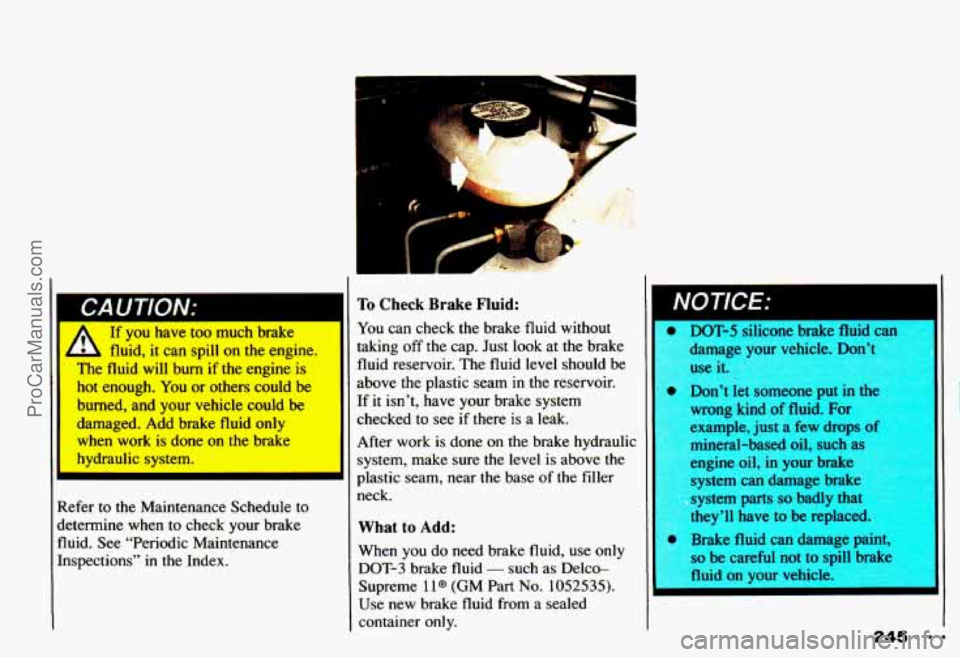
b Check Brake Fluid:
ou can check the brake fluid without
king
off the cap. Just look at the brake
.uid reservoir. The fluid level should be
bove the plastic seam in the reservoir.
: It isn’t, have your brake system
hecked to see
if there is a leak.
,fter work
is done on the brake hydraulic
ystem, make sure the level
is above the
lastic seam, near
the base of the filler
eck.
dhat to Add:
When you do need brake fluid, use only
DOT-3 brake fluid - such as Delco-
Supreme
1 l@ (GM Part No. 1052535).
Use new brake fluid from a sealed
container only.
*I
NOTICE: I
0 DOT-5 silicone brake fluid can
damage your vehicle. Don’t
use it.
0 Don’t let someone put in the
wrong kind of fluid. For
example, just a few drops
mineral-based oil, such a5
engine oil, in your brake
system can damage brake
system parts
so badly that
they’ll have to be replaced.
Srake fluid can damage p----.,
-0 be careful not to snill brake
ProCarManuals.com
Page 279 of 358
o TESTVNXX3XX009696
Vehicle Identification
Number (VIN)
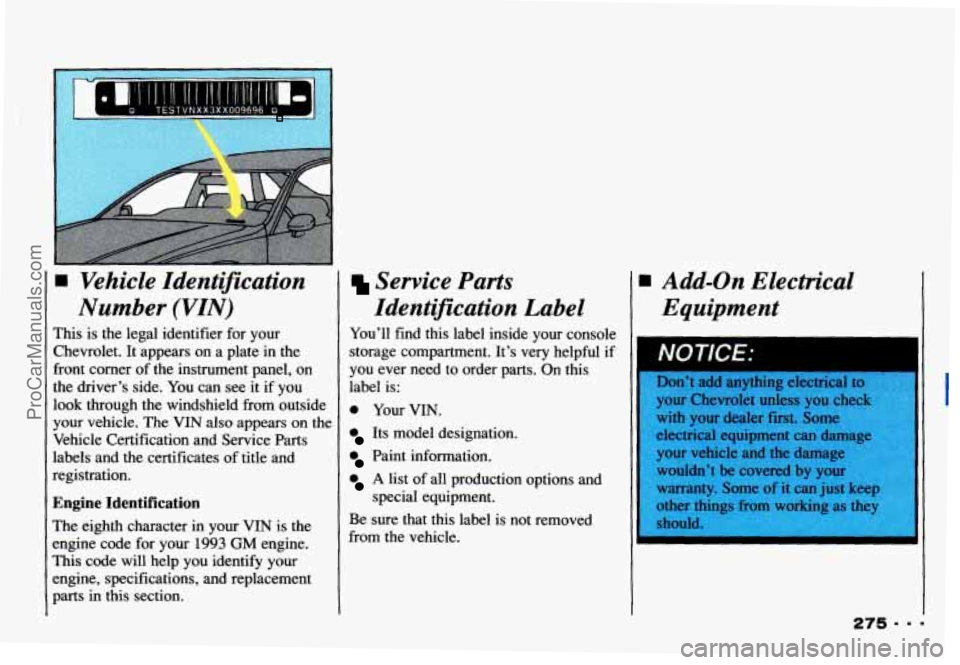
This is the legal identifier for your
Chevrolet. It appears on a plate in the
front corner of the instrument panel, on
the driver’s side. You can see it if you
look through the windshield from outside
your vehicle. The VIN also appears
on the
Vehicle Certification and Service
Parts
labels and the certificates of title and
registration.
Engine Identification
The eighth character in your VIN is the
engine code for your
1993 GM engine.
This code will help you identify your
engine, specifications, and replacement
parts
in this section.
Service ram idd-On Electrical
Identification Label Equipment
You’ll find this label inside your console
storage compartment. It’s very helpful if
you &er neid to order parts. On this
label
is:
0 Your VIN.
Its model designation.
Paint information.
A list of all production options and
special equipment.
Be sure that this label is not removed
from the vehicle.
I NOTICE;
ProCarManuals.com
Page 280 of 358
Service & Appearance Care
9 276
Fuses and Circuit
Breakers
The wiring circuits in your vehicle are
protected from short circuits by a
combination of fuses, circuit breakers,
and fusible thermal links in the wiring itself. This greatly reduces the chance of
fires caused by electrical problems.
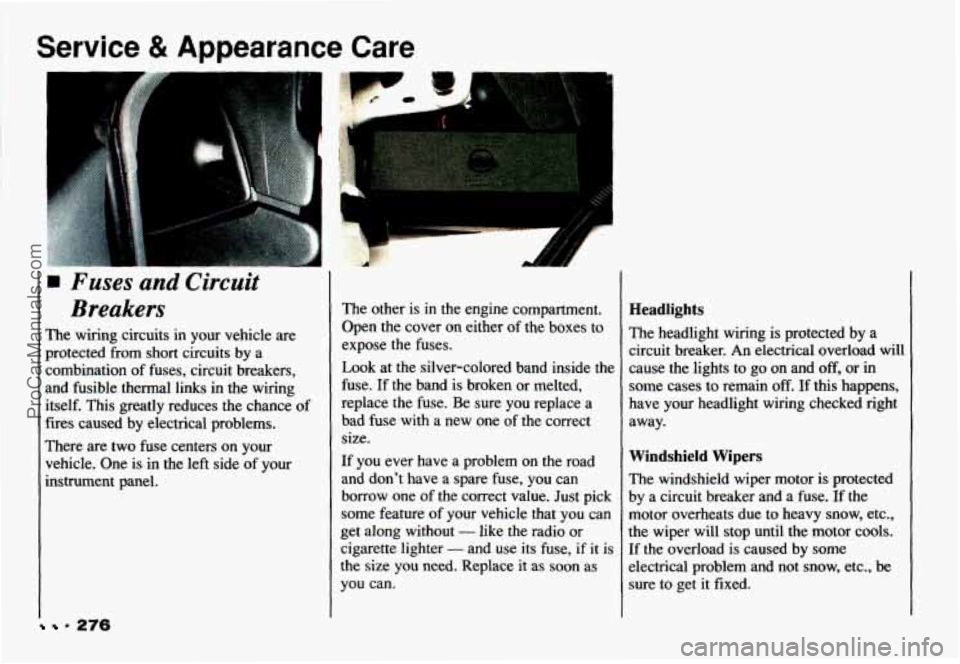
There are
two fuse centers on your
vehicle. One is
in the left side of your
instrument panel.
The other is in the engine compartment.
Open the cover on either of the boxes to
expose the fuses.
Look at the silver-colored band inside the
fuse. If the band
is broken or melted,
replace the fuse. Be sure you replace a
bad fuse with a new one
of the correct
size.
If you ever have a problem on the road
and don’t have a spare fuse, you can
borrow one
of the correct value. Just pick
some feature of your vehicle that you can
get along without
- like the radio or
cigarette lighter
- and use its fuse, if it is
the size you need. Replace
it as soon as
you can.
Headlights
The headlight wiring is protected by a
circuit breaker.
An electrical overload will
cause the lights to go on and off, or in
some cases to remain
off. If this happens,
have your headlight wiring checked right
away.
Windshield Wipers
The windshield wiper motor is protected
by a circuit breaker and a fuse.
If the
motor overheats due to heavy snow, etc.,
the wiper will stop until the motor cools.
If the overload is caused by some
electrical problem and not snow, etc., be
sure to get it fixed.
ProCarManuals.com
Page 281 of 358
Power Windows and Other Power
Options
Circuit breakers protect the power
windows and other power accessories.
When the current load is
too heavy, the
circuit breaker opens and closes,
protecting the circuit
until the problem is
fixed or goes away.
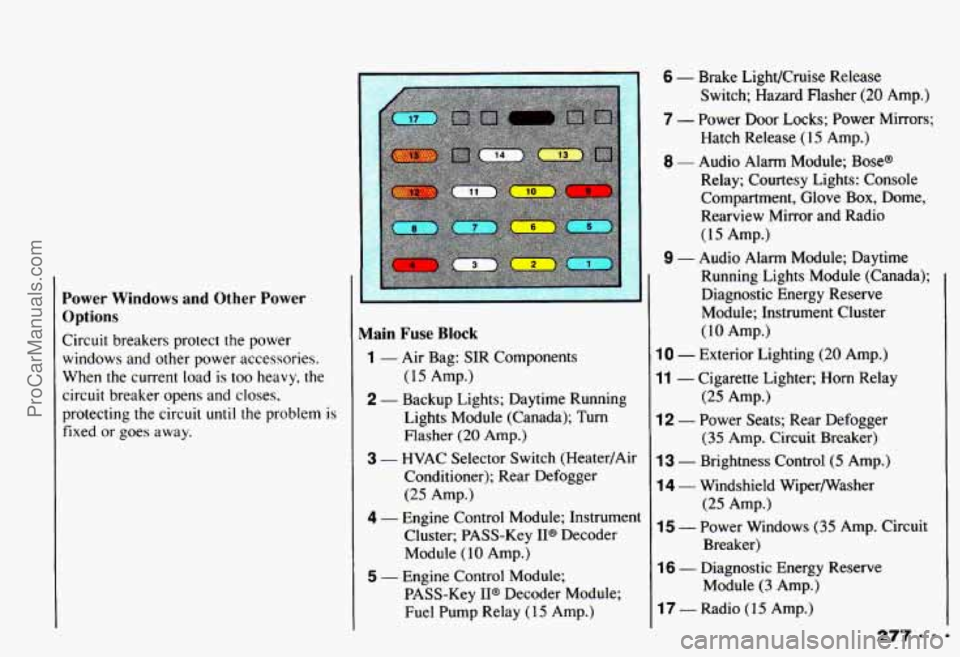
Main Fuse Block
(15 Amp.)
Lights Module (Canada); Turn Flasher
(20 Amp.)
3 - HVAC Selector Switch (Heater/Air
Conditioner); Rear Defogger
(25 Amp.)
4 - Engine Control Module; Instrument Cluster; PASS-Key IP Decoder
Module
( 10 Amp.)
1 - Air Bag: SIR Components
2 - Backup Lights; Daytime Running
I
5 - Engine Control Module; PASS-Key
II@ Decoder Module;
Fuel Pump Relay
(1 5 Amp.)
6 - Brake LighVCruise Release
Switch; Hazard Flasher
(20 Amp.)
7 - Power Door Locks; Power Mirrors; Hatch Release (15 Amp.)
8 - Audio Alarm Module; Base@
Relay; Courtesy Lights: Console
Compartment, Glove Box, Dome,
Rearview Mirror and Radio
(15 Amp.)
9 - Audio Alarm Module; Daytime
Running Lights Module (Canada); Diagnostic Energy Reserve
Module; Instrument Cluster
(10 Amp.)
10 - Exterior Lighting (20 Amp.)
11 - Cigarette Lighter; Horn Relay
12 - Power Seats; Rear Defogger
13 - Brightness Control (5 Amp.)
14 - Windshield Wipermasher
15 - Power Windows (35 Amp. Circuit
(25 Amp.)
(35 Amp. Circuit Breaker)
(25 Amp.)
Breaker)
16 - Diagnostic Energy Reserve Module
(3 Amp.)
17 - Radio (15 Amp.)
ProCarManuals.com
Page 282 of 358
Service & Appearance Care
278
Underhood Electrical Center
Fuses
1 - Electronic Brake Control Module
(5 Amp.)
2 - Fog Lamps (20 Amp.)
3 - Not Used
4 - Not Used
5 - Anti-Lock Brake System (5 Amp.)
6 - Coolant Fan Relays; EVAP
Canister Purge Solenoid; Exhaust
Gas Recirculation; Low Coolant
Relay; Reverse Lockout Solenoid
(10 Amp.)
7 - Air Injection Pump Assembly;
8 - Not Used
9 - Fuel Injectors (7.5 Amp.)
10 - Fuel Injectors (7.5 Amp.)
11 - VIN Engine Code S: Camshaft
Air
Pump Relay
(20 Amp.)
Position Sensor; Crankshaft
Position Sensor; Electronic
Ignition Module
(10 Amp.)
VIN Engine Code P: Ignition
Coil; Ignition Coil Driver
(10 Amp.)
12 - Air Conditioning Compressor
Relay; Cruise Control Switches
and Module
(20 Amp.)
Relays
B - Air Conditioning Compressor
C - Anti-Lock Brake System
D - Primary Coolant Fan (Driver Side)
E - Air Pump
F - Secondary Coolant Fan
(Passenger Side)
G - Low Coolant
H - Fog Lamps
J - High Blower
ProCarManuals.com