1993 CHEVROLET BLAZER stop start
[x] Cancel search: stop startPage 42 of 386
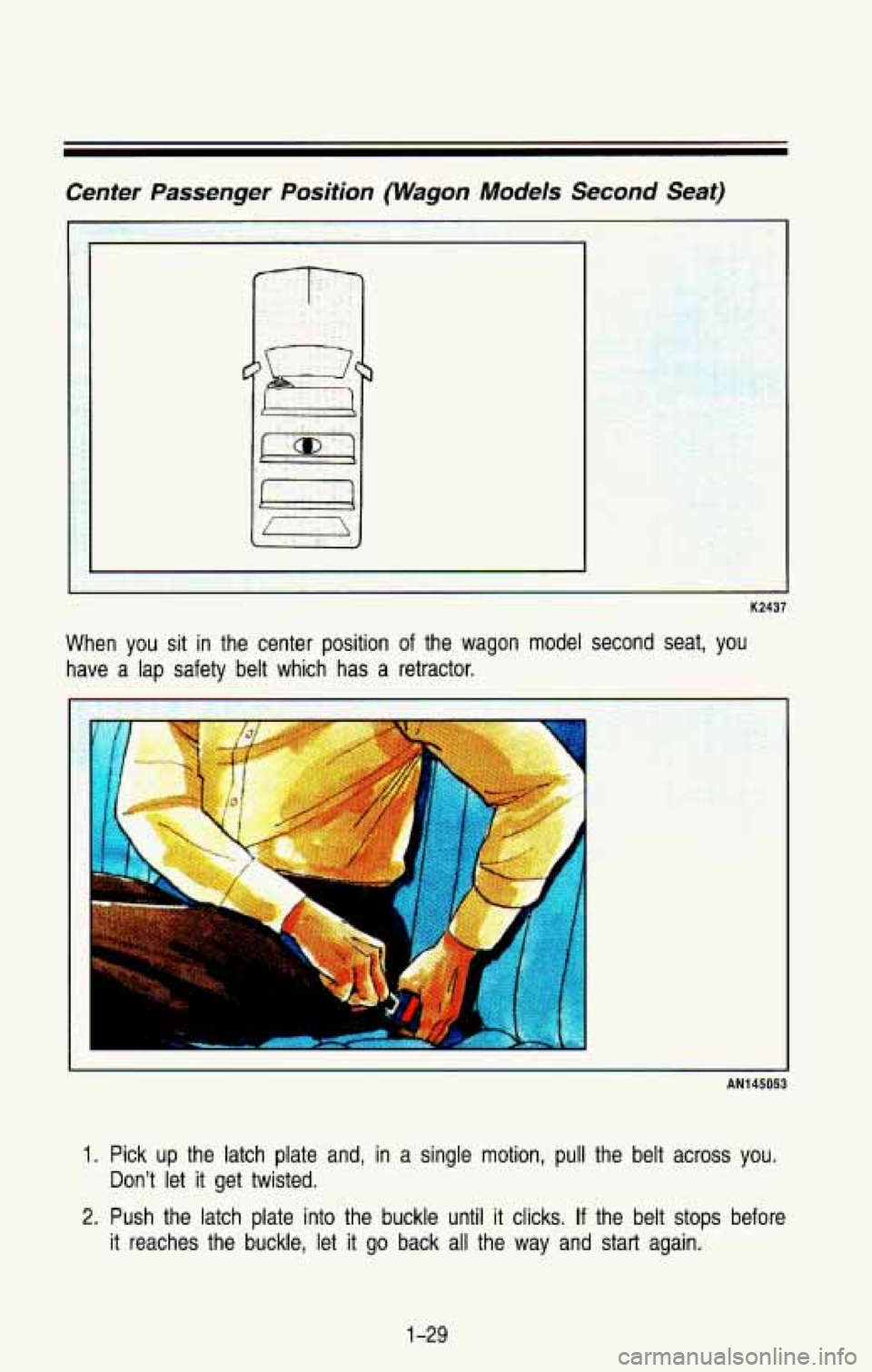
Center Passenger Position (Wagon Models Second Seat)
K2437
When you sit in the center position of the wagon model second seat, you
have a lap safety belt which has a retractor.
r
.. .. .
AN145053
I. Pick up the latch plate and, in a single motion, pull the belt across you.
2. Push the latch plate into the buckle until it clicks. If the belt stops before
Don’t let
it get twisted.
it reaches the buckle, let it go back all the way and start again.
1-29
Page 78 of 386
5. If your engine still won’t start (or starts but then stops), it could be
flooded with too much gasoline.
Try this:
Wait
15 seconds to let the starter motor cool down. Then push your
accelerator pedal all the way to the floor. Hold it there. Th\
en,
hold the
key in
Start for no more than ten seconds. This clears the extra
gasoline from the engine.
If the engine still doesn’t start, wait another
15 seconds and do Step 5 again.
Hot Engine Restart, 5.7L and 7.4L Engines (Vehicles Over 8500 GVWR): If
your engine is already hot and then stalls, turn your ignition\
key to Off. Then,
turn your key
to Run, and wait about 20 seconds before you restart your
engine.
When the engine starts, let go of the key and accelerator ped\
al.
rn rn I NOTICE 1
four engine is designed to work with the electronics in your vehicle. If you
1 electrical parts or accessories, you could change the way the fuel
tction system operates. Before adding electrical equipment, check\
with
hr dealer. If you don’t, your engine might not perform properly.
I you ever have to have your vehicle towed, see the part of this Man,,l
:hat tells how to do it without damaging your vehicle. See “Towing Your
Jehicle”
in the Index.
Driving Through Deep Standing Water
f you drive too quickly through deep puddles or standing water, water can I
:me in through your engine’s air intake and badly damage your engine. If
IOU can’t avoid deen ouddles or standino water, drive through very slowly.
-
2-1 5
Page 81 of 386
- It is dangerous to get out of your vehicle if the shift lever is not fully
4 in P (Park) with the parking brake firmly set. Your vehicle can roll.
Don’t leave your vehicle when the engine is running unless you have
to, If you have left the engine running, the vehicle can move
suddenly.
You or others could be injured. To be sure your vehicle
won’t
move, wh’en you’re on fairly level ground, always set your
parking brake and move the
shift lever to P (Park).
If you have four-wheel drive, your vehicle will be free to roll-even if
your shift lever is in P (Park)-if your transfer case is in N (Neutral).
So, be sure the transfer case is
in a drive gear-not N (Neutral).
See “Shifting Into Park” in the Index. If you are parking on a hill, or
if you’re pulling a trailer, also see “Parking on Hills’’ or ‘Towing a
Trailer”
in the Index.
R (Reverse)
Use this gear
to back up.
I NOTICE
I!
Shifting to R (Reverse) while your vehicle is moving forward could damage
jour transmission. Shift to R (Reverse) only after your vehicle is stopped.
To rock your vehicle back and forth
to get out of snow, ice or sand without
damaging your transmission, see “If You’re Stuck: In Sand, Mud, Ice or
Snow” in the Index.
N (Neutral)
In this setting, your engine doesn’t connect with the wheels.
To restart when
you’re already moving, use
N (Neutral) only. Also, use N when your vehicle is
being towed.
I CAUTION
Shifting out of P (Park) or N (Neutral) while your engine is “racing”
(run’ning at
high speed) is dangerous. Unless your foot is firmly on
the brake pedal, your vehicle could move very rapidly. You could lose
control and hit people or objects. Don’t shift out of P (Park) or N
(Neutral) while your engine is racing. I
2-1 8
Page 82 of 386
NOTICE
Damage to your transmission caused by shifting out of P (Park) or N
{Neutral) with the engine racing isn’t covered by your warranty.
OD (Automatic Overdrive)
This position is for normal driving.
If you need more power for passing, and
vou’re:
- Going less than about 35 mph (56 km/h), push your accelerator
pedal about halfway down
- Going about 35 mph (56 km/h) or more, push the accelerator all the
way down
You’ll shift down to the next gear and have more power.
OD should not be used when towing a trailer, carrying a heavy load, driving
on steep hills, or for off-road driving. Select
D (third gear) when operating the
vehicle under any of these conditions.
D (Third Gear)
This is like
OD, but you never go into Overdrive. You should use D when
towing a trailer, carrying a heavy load, driving on steep hills, or for off-road
driving.
2 (Second Gear)
This position gives you more power but lower fuel economy. You can use
2
on hills. It can help control your speed as you go down steep mountain
roads, but then you would also want
to use your brakes off and on.
If you manually select 2, the transmission will drive in second gear. You may
use this feature for reducing torque to the rear wheels when you are trying to
start your vehicle from a stop on slippery road surfaces.
1 (First Gear)
This position gives you even more power (but lower fuel economy) than
2.
You can use it on very steep hills, or in deep snow or mud. If the selector
lever is put
in 1, the transmission won’t shift into first gear until the vehicle is
going
‘slowly enough.
2-1 9
Page 84 of 386
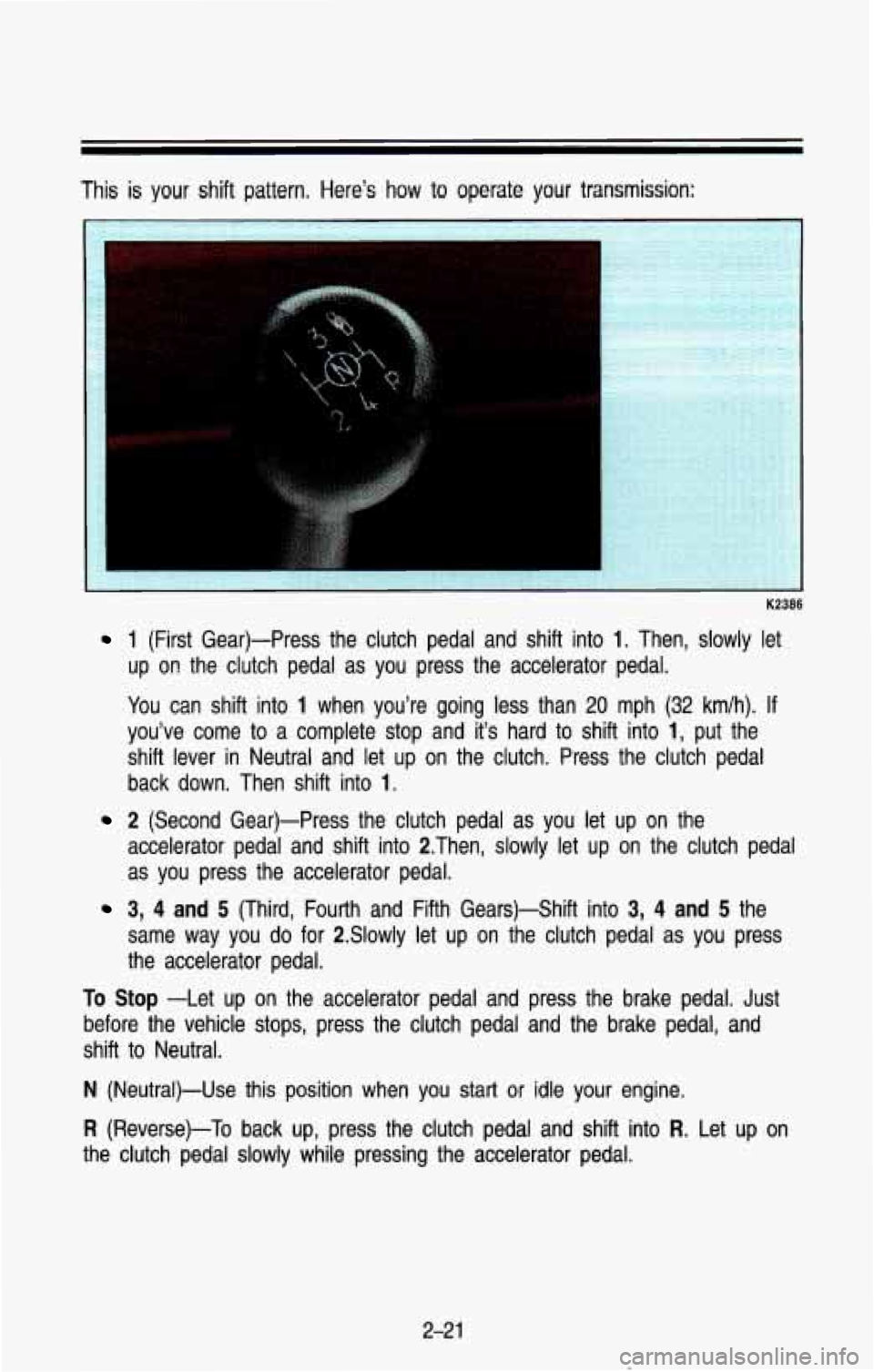
This is your shift pattern. Here’s how to operate your transmission:
-. ’ :- -. .. r
K2386
1 (First Gear)-Press the clutch pedal and shift into 1. Then, slowly let
up
on the clutch pedal as you press the accelerator pedal.
You can shift into
1 when you’re going less than 20 mph (32 km/h). If
you’ve come to a complete stop and it’s hard to shift i\
nto 1, put the
shift lever in Neutral and let up on the clutch. Press the c\
lutch pedal back down. Then shift into
1.
2 (Second Gear)-Press the clutch pedal as you let up on the
accelerator pedal and shift into 2.Then, slowly let up on the \
clutch pedal
as you press the accelerator pedal.
same way you
do for 2.Slowly let up on the clutch pedal as you press
the accelerator pedal.
3, 4 and 5 (Third, Fourth and Fifth Gears)-Shift into 3, 4 and 5 the
To Stop -Let up on the accelerator pedal and press the brake pedal. Just
before the vehicle stops, press the clutch pedal and the brake\
pedal, and
shift to Neutral.
N (Neutral)-Use this position when you start or idle your engine.
R (Reverse)-To back up, press the clutch pedal and shift into R. Let up on
the clutch pedal slowly while pressing the accelerator pedal.
2-21
Page 102 of 386
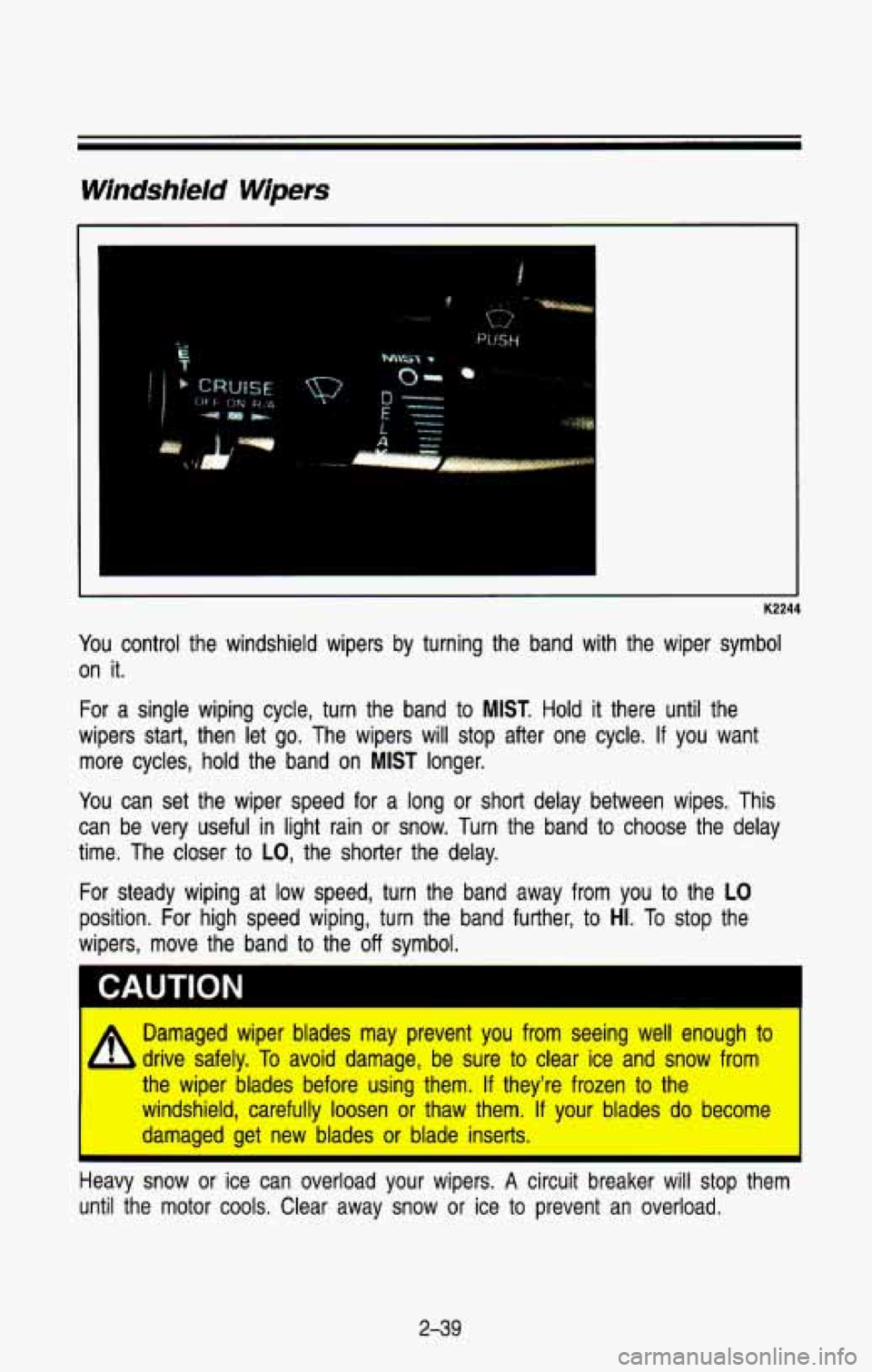
Windshield Wipers
K2244
You control the windshield wipers by turning the band with the wiper symbol
on it.
For a single wiping cycle, turn the band to MIST. Hold it there until the
wipers start, then let go. The wipers will stop after one cycle. If you want
more cycles, hold the band on
MIST longer.
You can set the wiper speed for a long or short delay between wi\
pes. This
can be very useful in light rain
or snow. Turn the band to choose the delay
time. The closer to
LO, the shorter the delay.
For steady wiping at low speed, turn the band away from you to the
LO
position. For high speed wiping, turn the band further, to HI. To stop the
wipers, move the band to the
off symbol.
A
Damaged wiper blades may prevent you from seeing well enough to
drive safely. To avoid damage, be sure to clear ice and snow from
the wiper blades before using them.
If they’re frozen to the
windshield, carefully loosen
or thaw them. If your blades do become
damaged get new blades
or blade inserts.
Heavy snow or ice can overload your wipers.
A circuit breaker will stop them
until the motor cools. Clear away snow
or ice to prevent an overload.
2-39
Page 132 of 386
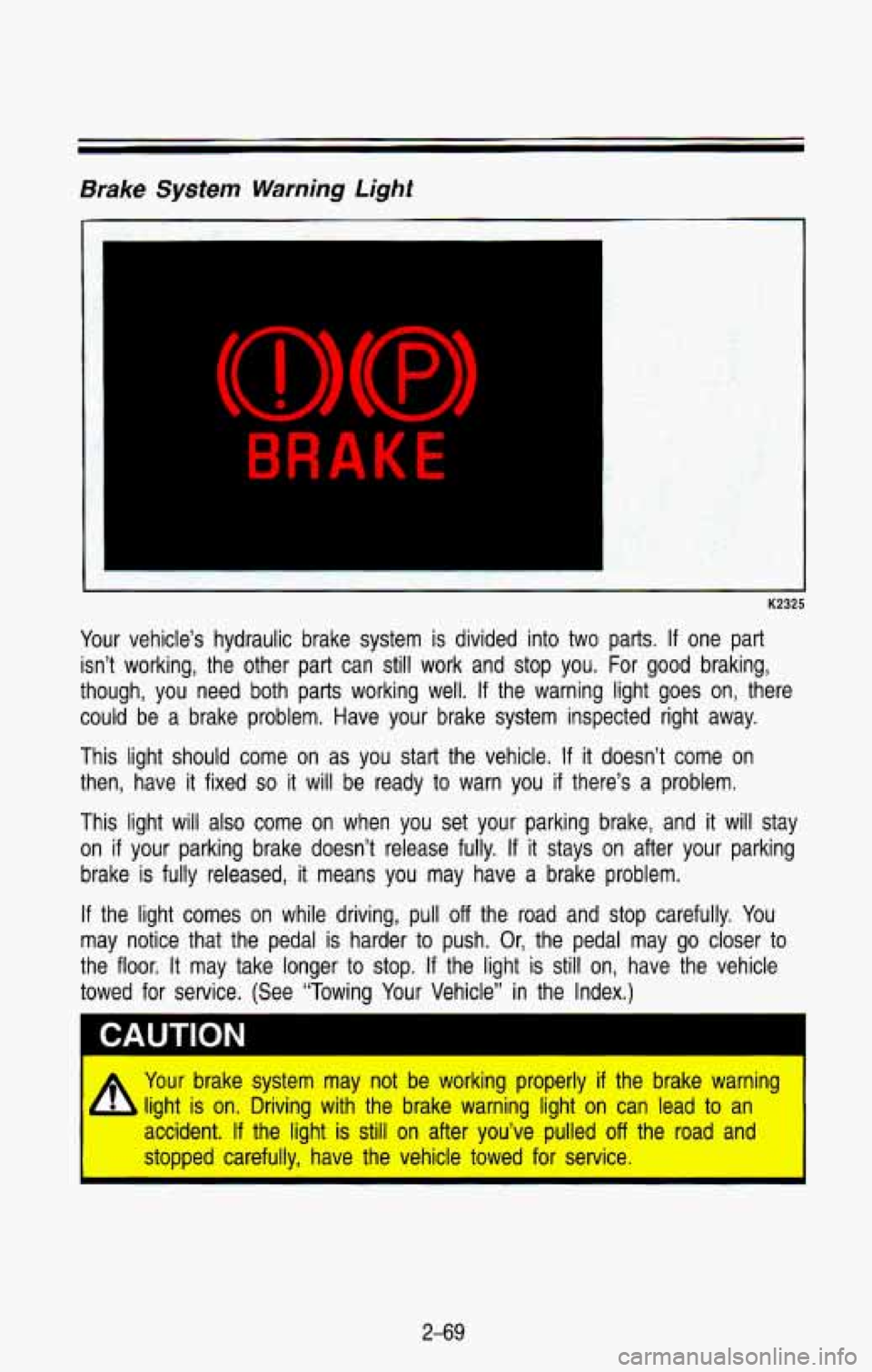
Brake System Warning Light
BRAKE
-
K2325
Your vehicle’s hydraulic brake system is divided into two parts. If one part
isn’t working, the other part can still work and stop you. For good braking,
though, you need both parts working well.
If the warning light goes on, there
could be
a brake problem. Have your brake system inspected right away.
This light should come on as you start the vehicle.
If it doesn’t come on
then, have it fixed
so it will be ready to warn you if there’s a problem.
This light will also come
on when you set your parking brake, and it will stay
on
if your parking brake doesn’t release fully. If it stays on after your parking
brake is fully released, it means you may have
a brake problem.
If the light comes on while driving, pull off the road and stop carefully. You
may notice that the pedal is harder to push. Or, the pedal may
go closer to
the floor. It may take longer
to stop. If the light is still on, have the vehicle
towed for service. (See “Towing Your Vehicle” in the Index.)
I CAUTION
I A Your brake system may not be working properly if the brake warning
b light is on. Driving with the brake warning light on can lead to an
I accident. If the light is still on after you’ve pulled off the road and
stopped carefully,
have the vehicle towed for service. I
2-69
Page 176 of 386

Defensive Driving
The best advice anyone can give about driving is: Drive defens\
ively.
Please start with a very important safety device in your vehicle: Buckle up.
(See ‘Safety Belts”
in the Index.)
Defensive driving really means “be ready for anything.” On\
city streets, rural
roads, or freeways,
it means “always expect the unexpected,”
Assume that pedestrians or other drivers are going to be careless and make
mistakes. Anticipate what they might
do. Be ready for their mistakes.
Expect children to dash out from behind parked cars, often followed
by other
children. Expect occupants in parked cars to open doors into traffic. Watch
for
movement in parked cars-someone may be about to open a door.
Expect other drivers to run stop signs when you are on a through street. Be
ready
to brake if necessary as you go through intersections. You may not
have to use the brake, but
if you do, you will be ready.
If you’re driving through a shopping center parking lot where there are
well-marked lanes, directional arrows, and designated parking are\
as, expect some drivers to ignore all these markings and dash straight toward one part
of the lot.
Pedestrians can be careless. Watch for them. In general, you must give way
to pedestrians even
if you know you have the right of way.
Rear-end collisions are about the most preventable
of accidents. Yet they are
common. Allow enough following distance. It’s the best defens\
ive driving
maneuver, in both city and rural driving. You never know when the vehicle
in
front of you is going to brake or turn suddenly.
Here’s a final bit of information about defensive driving. The most dangerous
time for driving in the
US. is very early on Sunday morning. In fact, GM
Research studies show that the most and the least dangerous times for
driving, every week, fall on the same day. That day is Sunday. The most
dangerous time is Sunday
3 a,m. to 4 a.m. The safest time is Sunday from
10 a.m. to 11 a.m. Driving the same distance on a Sunday at 3 a.m. isn’t
just
a little more dangerous than it is at 10 a.m. It’s about 134 times more
dangerous.
That leads to the next part.
4-9