Page 154 of 386
Rear Heater (Without Rear Air Conditioning)
K2172
If you have a rear heater (without rear air conditioning), the \
control switch is
located
on the instrument panel. To increase and decrease the flow of heated
air
to the rear floor vents, move the switch with the fan symbol on it to the
blower speed you want.
Move the switch all the way
to the left position to turn the rear blower off,
and each position to the right increases the flow of heated air.
Move the switch all the way
to the right position to turn the blower on high,
providing maximum flow of heated air.
3-9
Page 155 of 386
Comfort Controls & Audio Systems
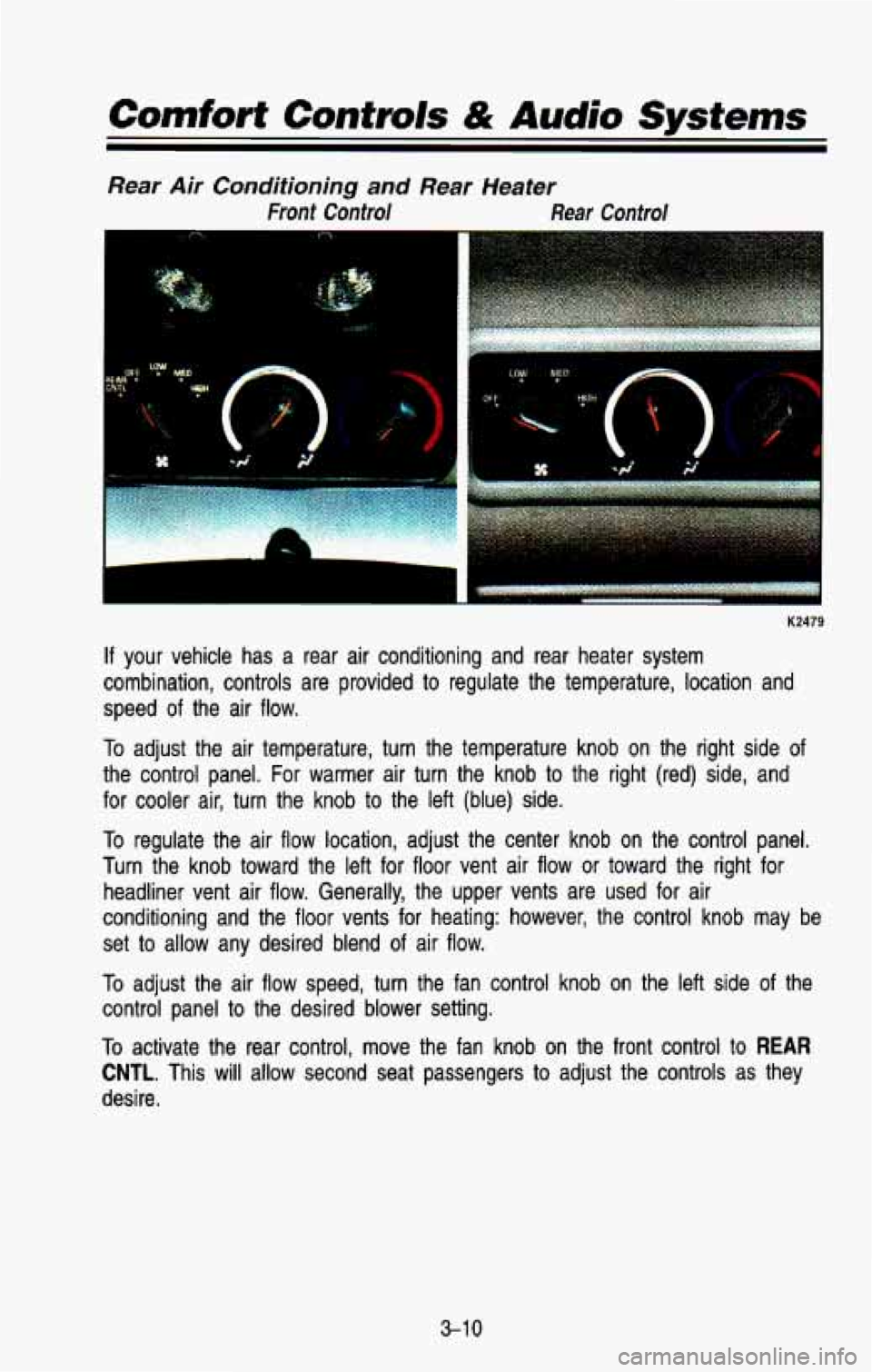
Rear Air Conditioning and Rear Heater
Front Control Rear Control
K2479
If your vehicle has a rear air conditioning and rear heater system
combination, controls are provided to regulate the temperature, \
location and
speed of the air flow.
To adjust the air temperature, turn the temperature knob on the r\
ight side of
the control panel. For warmer air turn the knob to the right (re\
d) side, and
for cooler air, turn the knob to the left (blue) side.
To regulate the air flow location, adjust the center knob on the \
control panel,
Turn the knob toward the left for floor vent air flow or tow\
ard the right for headliner vent air flow. Generally, the upper vents are used f\
or air
conditioning and the floor vents for heating: however, the cont\
rol knob may be
set to allow any desired blend
of air flow.
To adjust the air flow speed, turn the fan control knob on the \
left side of the
control panel to the desired blower setting.
To activate the rear control, move the fan knob on the front control to REAR
CNTL. This will allow second seat passengers to adjust the controls as they
desi re.
3-10
Page 156 of 386

Rear Window Defogger
K2112 J
You can tell if your vehicle has this option by looking at the rear window. If
you see lines running across the glass, you have it. These are the wires
which heat your window.
NOTICE
I Scraping the inside of your rear window could cut and damage the
defogger. Your warranty would not cover this damage. And don't put
decals there, you might have
to scrape them off. I
For best results, clear the window of as much snow or ice as possible first.
To turn on the rear window defogger, find the switch marked REAR DEFOG
on your instrument panel, just below the heater system. Press \
the right side
of the switch, with the defog symbol on it, until the light in the switch comes
on, then release
it. The rear window defogger will only work if the ignition
switch
is turned to RUN.
You can turn the defogger off at any time by pressing the left, lighted side of
the switch. The defogger will shut itself
off after several minutes, so that the
glass does not get too hot.
If the defogger shuts off, and the window still
isn't clear, turn the defogger on again.
3-1 1
Page 223 of 386
Your Driving and the Road
AN480044
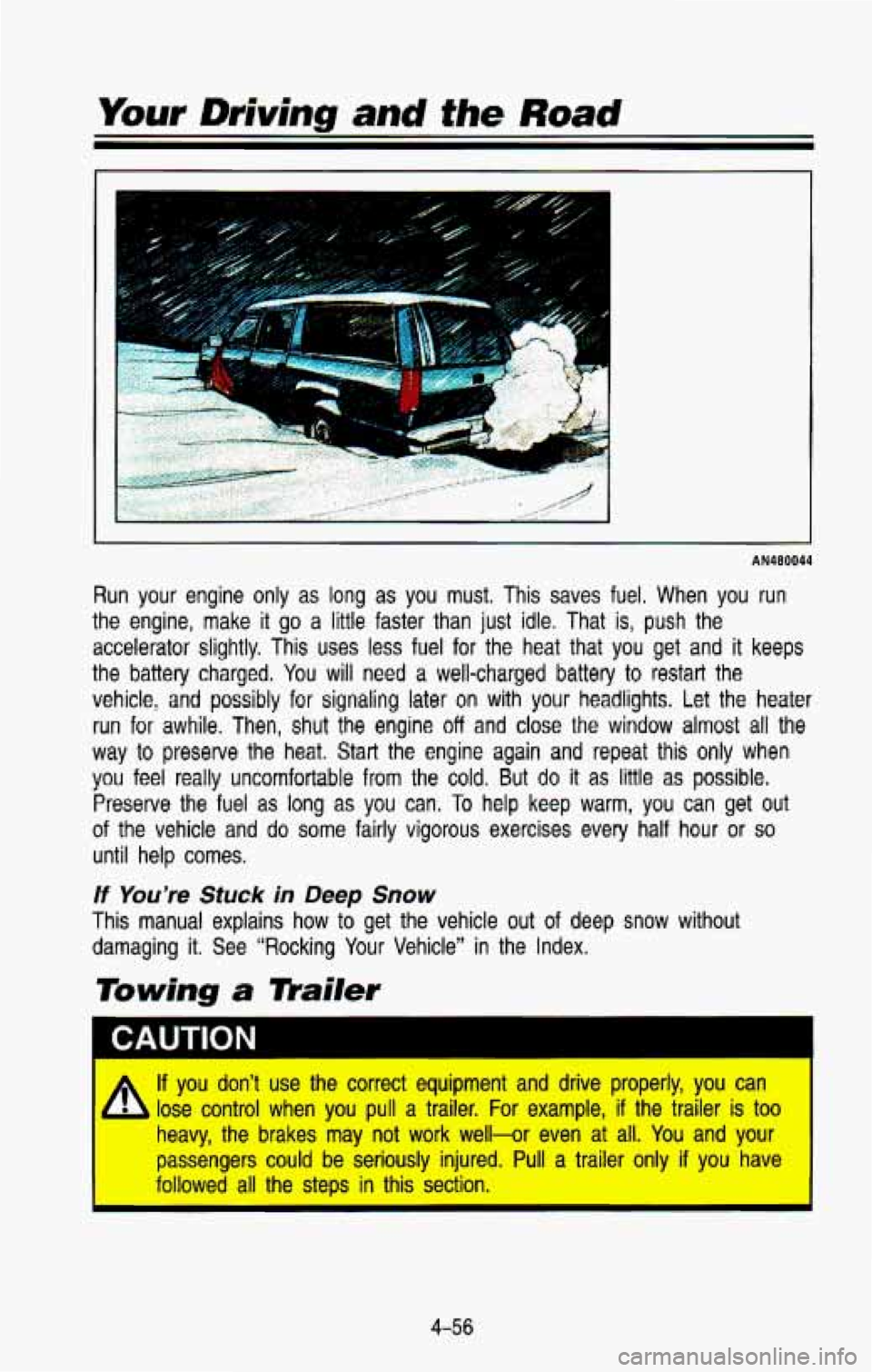
Run your engine only as long as you must. This saves fuel. When you run
the engine, make
it go a little faster than just idle. That is, push the
accelerator slightly. This uses
less fuel for the heat that you get and it keeps
the battery charged.
You will need a well-charged battery to restart the
vehicle, and possibly
for signaling later on with your headlights. Let the heater
run for awhile. Then,
shut the engine off and close the window almost all the
way to preserve the heat. Start the engine again and repeat this only when
you feel really uncomfortable from the cold. But do it as little as possible.
Preserve the fuel as long as you can. To help keep warm, you can get out
of the vehicle and do some fairly vigorous exercises every half hour or so
until help comes.
If You’re Stuck in Deep Snow
This manual explains how to get the vehicle out of deep snow without
damaging it. See “Rocking Your Vehicle” in the Index.
Towing a mailer
I A If you don’t use the correct equipment and drive properly, you can
lose control when
you pull a trailer. For example, if the trailer is too
heavy, the brakes may not work well-or even at all. You and your
passengers could be seriously injured. Pull a trailer only
if you have
followed all the steps in this section.
4-56
Page 240 of 386
If No Steam Is Coming From Your C gine:
If you get the overheat warning but see or hear no steam, the problem may
not be too serious. Sometimes the engine can get a little too hot when you:
Climb a long hill on a hot day.
Stop after high speed driving.
Idle for long periods in traffic.
Tow a trailer.
If you get the overheat warning with no sign of steam, try this for a minute
or so:
1. If you have an air conditioner, turn it off.
2. Turn on your heater to full hot at the highest fan speed and open the
3. If you’re in a traffic jam, shift to N (Neutral).
window
as necessary.
If you no longer have the overheat warning, you can drive. Just to be safe,
drive slower for about ten minutes.
If the warning doesn’t come back on, you
can drive normally.
If the warning continues, pull over, stop, and park your vehicle right away.
If there’s still no sign of steam, push the accelerator until the engine speed is
about twice as fast as normal idle speed. Bring the engine speed back to
normal idle speed after two or three minutes.
Now see if the warning stops.
But then,
if you still have the warning, TURN OFF THE ENGINE AND GET
EVERYONE
OUT OF THE VEHICLE until it cools down.
You may decide not
to lift the hood but to get service help right away.
5-9
Page 242 of 386

The coolant level should be at or above COLD. If it isn’t, you may have a
leak in the radiator hoses, heater hoses, radiator, water pump or somewhere
else in the cooling system.
CAUTION
A
Heater and radiator hoses, and other engine parts, can be very\
hot.
Don’t touch them. If you
do, you can be burned.
Don’t run the engine
if there is a leak. If you run the engine, 1‘ it coulc
lose all coolant. That could cause an engine fire, and you could
be
I burned. Get any leak fixed before you drive the vehicle.
I
If there seems to be no leak, check to see if the electric engine fan (if you
have one) is running. If the engine is overheating, the fan \
should be running.
If
it isn’t, your vehicle needs service.
Start the engine again to see
if the regular fan runs when the engine does.
If
it doesn’t, your vehicle needs service. Turn off the engine.
How to Add Coolant to the Coolant Recovery Tank
If you haven’t found a problem yet, but the coolant level \
isn’t at or above
COLD, add a 50150 mixture of clean water (preferably distilled) and a proper
5-1 1
Page 243 of 386

Adding only plain water to your cooling system")
antifreeze at the coolant recovery tank. (See “Coolant” i\
n the Index for more information about the proper coolant mix.)
Adding only plain water to your cooling system can be dangerou\
s. Plain water,
or some other liquid like alcohol, can boil before the
proper coolant mix will. Your vehicle’s coolant warning system is set
for the proper coolant mix. With plain water
or the wrong mix, your
engine
could get too hot but you wouldn’t get the overheat warning.
Your engine could catch fire and you or others could be burned. Use
a 50150 mix of clean water and a proper antifreeze. I I
NOTICE I
In cold weather, water can freeze and crack the engine. radiator, heater
I core and other parts. Use the recommended coolant.
1
1 ::.
L.
k’
II
PO206
CAUTION
- = -
You can be burned if you spill coolant on hot engine parts. Coolant
contains ethylene glycol
and it will burn if the engine parts are hot
enough. Don’t spill coolant on
a hot engine.
When the coolant in the coolant recovery
is at or above COLD, start your
vehicle.
5-1 2
Page 281 of 386

Service & Appearance Care
oil. If time determines when you change your oil, change the filter ea\
ch time
you change your oil.
Engine Block Heater:
An engine block heater can be a big help if you have to park outside in very
cold weather,
0°F (-18°C) or colder. If your vehicle has this option, see
“Engine Block Heater” in the Index.
What to Do with Used Oil:
Used engine oil contains things that have caused skin cancer in
laboratory animals. Don’t let
used oil stay on your skin for very long.
Clean
your skin and nails with soap and water, or a good hand ,,:: :‘:-;
cleaner. Wash or properly throw away clothing or rags containing-:’-:;$ ~
used engine oil.
. ,A:<< --.
L. .. . .. ,-. f .- , L ., -J ’,: ._ - -
..:.: ;,i, j I -.. : j ,!
Used oil can be a real threat to the environment. If YOU change your own oil,
be sure to drain all free-flowing oil from the filter before disposal. Don’t ever
dispose of oil by putting it in the trash, pouring it on the ground, into sewers,
or into streams or bodies of water. Instead, recycle it by taking it to a place
that collects used oil. If you have a problem properly disposing of your used
oil, ask your dealer, a service station or a local recycling center for help.
Air Cleaner
c
PO21 6
Refer to the Maintenance Schedule to determine when to replace the air
cleaner filter and crankcase ventilation filter. See “Schedule\
d Maintenance Services” in the Index.
6-1 6

K2172
If you have a rear heater (without rear air conditioning), the \
control switch is
located
on the instrument panel. To increase")