Page 259 of 407
Downloaded from www.Manualslib.com manuals search engine ...-
c
If there seems to be no leak, check to see if the electric engine fans are
running. If the engine
is overheating, both fans should be running. If they
aren’t, your vehicle needs service.
How to Add Coolant to the Coolant Surge Tank
If you haven’t found a problem yet, but the coolant level isn’t at or above
“FULL COLD,” add a 50/50 mixture of clean water (preferably distilled)
and a proper antifreeze at
the coolant recovery tank. (See “Engine
Coolant”
in the Index for more information about the proper coolant
mix.)
A CAUTION
Adding only plain water to your cooling system can De
dangerous. Plain water, or some other liquid like alcohol, can
boil before the proper coolant mix will.
Your vehicle’s coolant
warning system is set
for the proper coolant mix. With plain
water
or the wrong mix, your engine could get too hot but you
wouldn’t get the overheat warning. Your engine could catch fire
and you or others could be burned. Use a
50/50 mix of clean
water and
a proper antifreeze.
245
Page 260 of 407
Downloaded from www.Manualslib.com manuals search engine A CAUTION:
You can be burned if you spill coolant on hot engine parts.
Coolant contains ethylene glycol and
it will burn if the engine
parts are hot enough. Don’t spill coolant on
a hot engine.
Should a low coolant condition exist, an overheat protection “Limp
Home” feature
of the 4.6 L Northstar allows alternate firing groups of
four cylinders for
a predetermined number of cycles to prevent engine
damage, enabling your vehicle
to be driven to the nearest service center.
A CAUTION:
Steam and scalding liquids from a hot cooling system can blow
out and burn you badly. They are under pressure, and if you
turn the coolant surge tank pressure cap
-- even a little -- they
can come out
at high speed. Never turn the cap when the cooling
system, including the coolant surge tank pressure cap,
is hot.
Wait for the cooling system and coolant surge tank pressure cap
to cool if you ever have to turn the pressure cap.
246
L-
C
.J
c
Page 261 of 407
Downloaded from www.Manualslib.com manuals search engine F
P
!
P
c
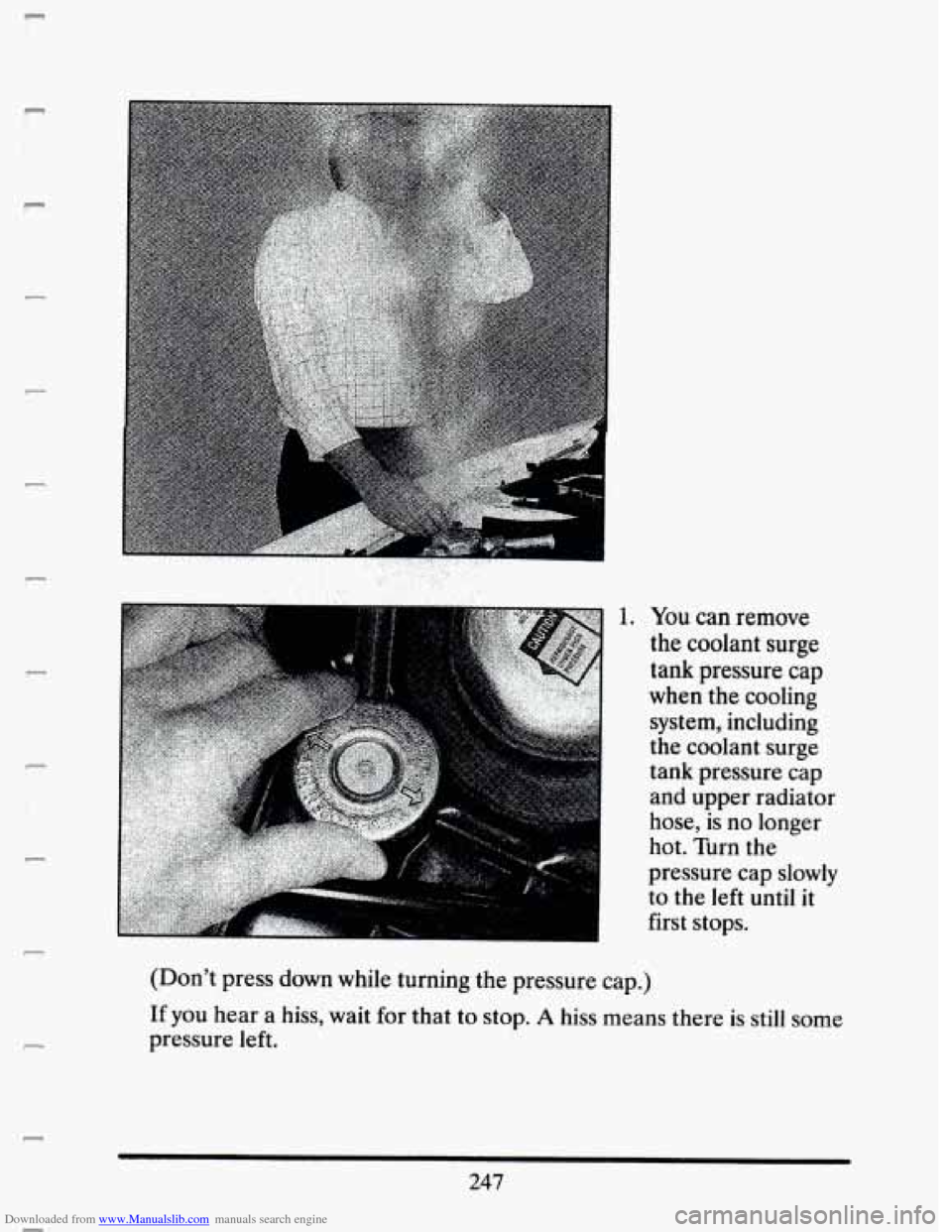
1. You can remove
the coolant surge
tank pressure cap
when
the cooling
system, including
the coolant surge
tank pressure cap
and upper radiator
hose, is no longer
hot. Turn the
pressure cap slowly
to the
left until it
first stops.
(Don’t press down while turning the pressure cap.)
If you hear a hiss, wait for that to stop. A hiss means there is still some
pressure left.
247
F
Page 262 of 407
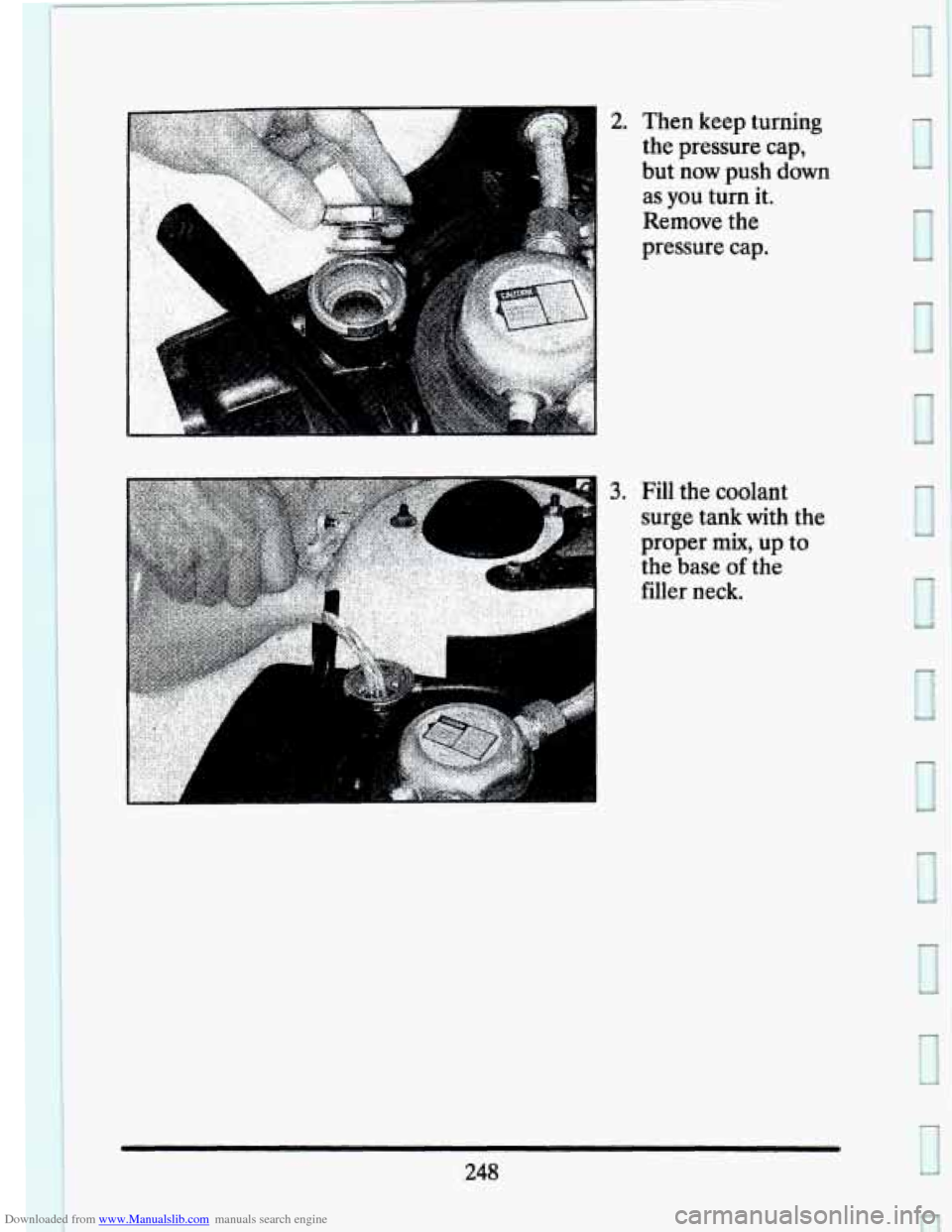
Downloaded from www.Manualslib.com manuals search engine 2. Then keep turning
the pressure cap,
but now push down
as you turn it. Remove the
pressure cap.
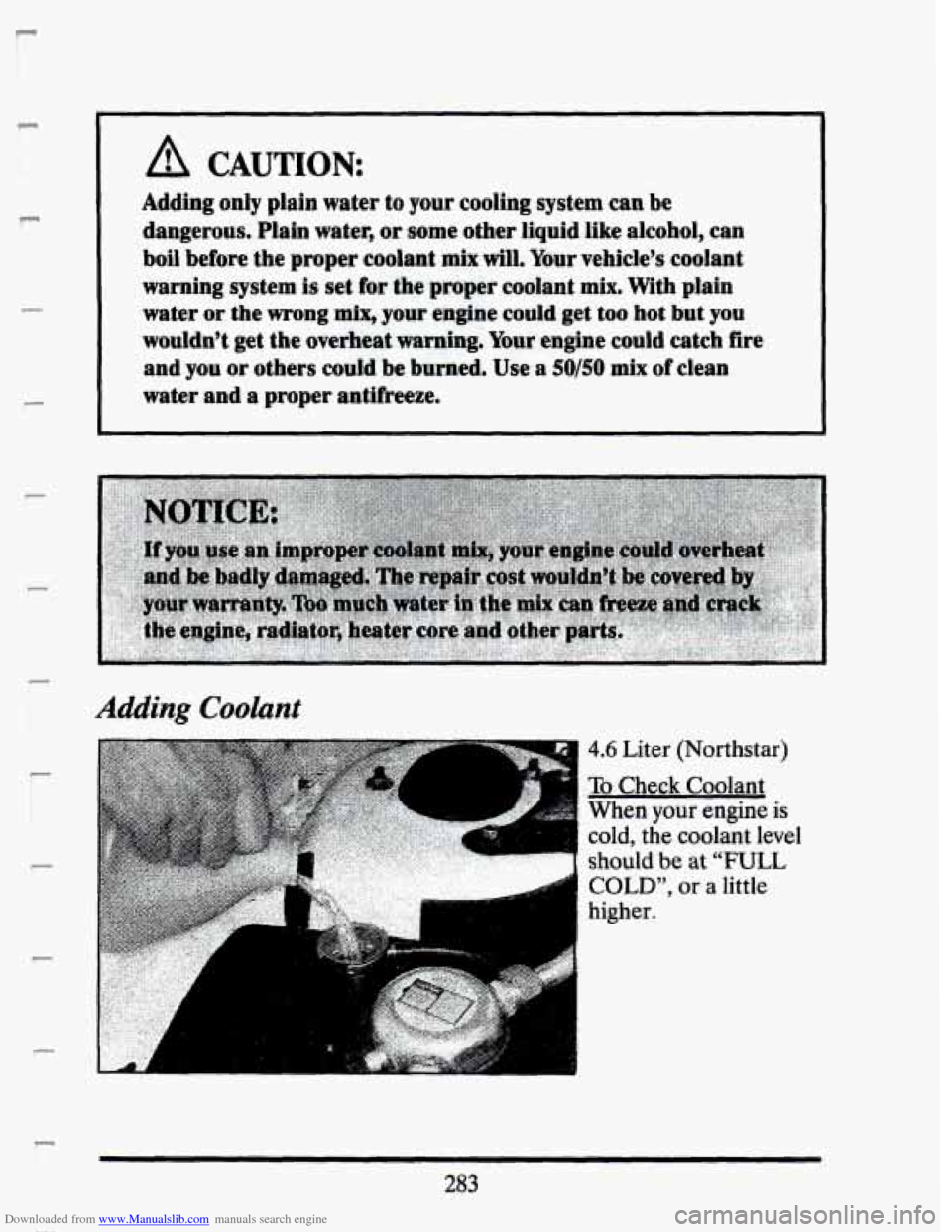
3. Fill the coolant
surge tank with the
proper
mix, up to
the base
of the
filler neck.
248
Page 263 of 407
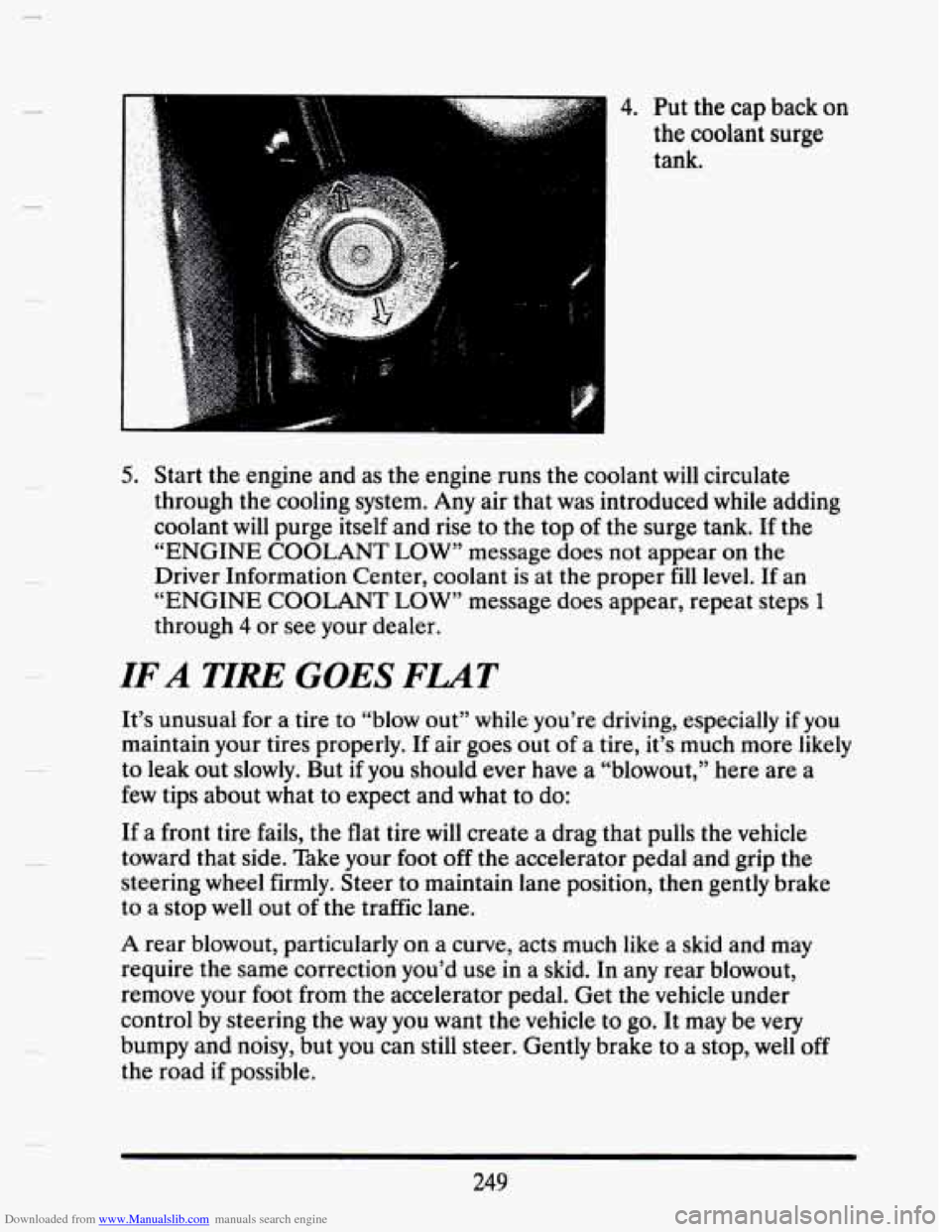
Downloaded from www.Manualslib.com manuals search engine . : 4. Put the cap back on
the coolant
surge
tank.
5. Start the engine and as the engine runs the coolant will circulate
through the cooling system. Any air that was introduced while adding
coolant
will purge itself and rise to the top of the surge tank. If the
“ENGINE COOLANT
LOW” message does not appear on the
Driver Information Center, coolant is at the proper
fill level. If an
“ENGINE
COOLANT LOW” message does appear, repeat steps 1
through 4 or see your dealer.
IFA TIRE GOES FLAT
It’s unusual for a tire to “blow out” while you’re driving, especially if you
maintain your tires properly. If air goes out of a tire, it’s much more likely
to leak out slowly. But if you should ever have a “blowout,” here are a
few tips about what to expect and what
to do:
If a front tire fails, the flat tire will create a drag that pulls the vehicle
toward that side. Take your foot off the accelerator pedal and grip the
steering
wheel firmly. Steer to maintain lane position, then gently brake
to a stop
well out of the traffic lane.
A rear blowout, particularly on a curve, acts much like a skid and may
require the same correction you’d use in a skid. In any rear blowout,
remove your foot from the accelerator pedal. Get the
vehicle under
control by steering the way you want the vehicle to
go. It may be very
bumpy and noisy, but you can still steer. Gently brake to a stop,
well off
the road if possible.
3
249
Page 296 of 407
Downloaded from www.Manualslib.com manuals search engine When the correct fluid level is obtained, push the dipstick back in all
the way.
How To Reset Transaxle Fluid Change Indicator: 4.6L (Northstar)
Your vehicle is equipped with a transaxle fluid change indicator.
A
“CHANGE TRANS FLUID” message will display on the Information
Center
when the power train computer determines that the transaxle
fluid needs to be changed or at each 100,000 miles
(160,000 km) interval,
whichever occurs first. When this message appears, change the t\
ransaxle
fluid and reset the transaxle fluid life indicator
as follows:
Turn the key “ON” with the engine stopped.
Press and hold the “OFF” and “REAR DEFOG” buttons on the
climate control simultaneously
until the “TRANS FLUID RESET”
message appears
in the Information Center (between 5 and 20
seconds).
ENGINE COOLANT
The following explains your cooling system and how to add coolant when
it is low. If you have
a problem with engine overheating, see “Engine
Overheating” in the Index.
The proper coo’ It for
your Cadillac will:
Give freezing protection down to -34°F (-37’C) .
Give boiling protection up to 262 ” F (128 ” C) .
Protect against rust and corrosion.
Help keep the proper engine temperature.
Let the warning lights work as they should.
What to Use:
Use a mixture of one-half clean water (preferably distilled) and one\
-half
antifreeze that meets
“GM Specification 1825-M,” which won’t damage
aluminum parts. You can also use a recycled coolant conforming to
GM
Specification 1825-M with a complete coolant flush and refill. Use GM
Engine Coolant Supplement (sealer) with any complete coolant c\
hange.
If you use these, you don’t need to add anything else.
Y
c.
282
Page 297 of 407
Downloaded from www.Manualslib.com manuals search engine r ir
P
P
r
P I
A CAUTION
Adding only plain water to your cooling system can be
dangerous. Plain water, or some other liquid like alcohol, can
boil before the proper coolant
mix will. Your vehicle’s coolant
warning system
is set for the proper coolant mix. With plain
water or the
wrong mix, your engine could get too hot but you
wouldn’t get the overheat warning. Your engine could catch fire
and you or others could be burned. Use a
50/50 mix of clean
water and a proper antifreeze.
Adding Coolant
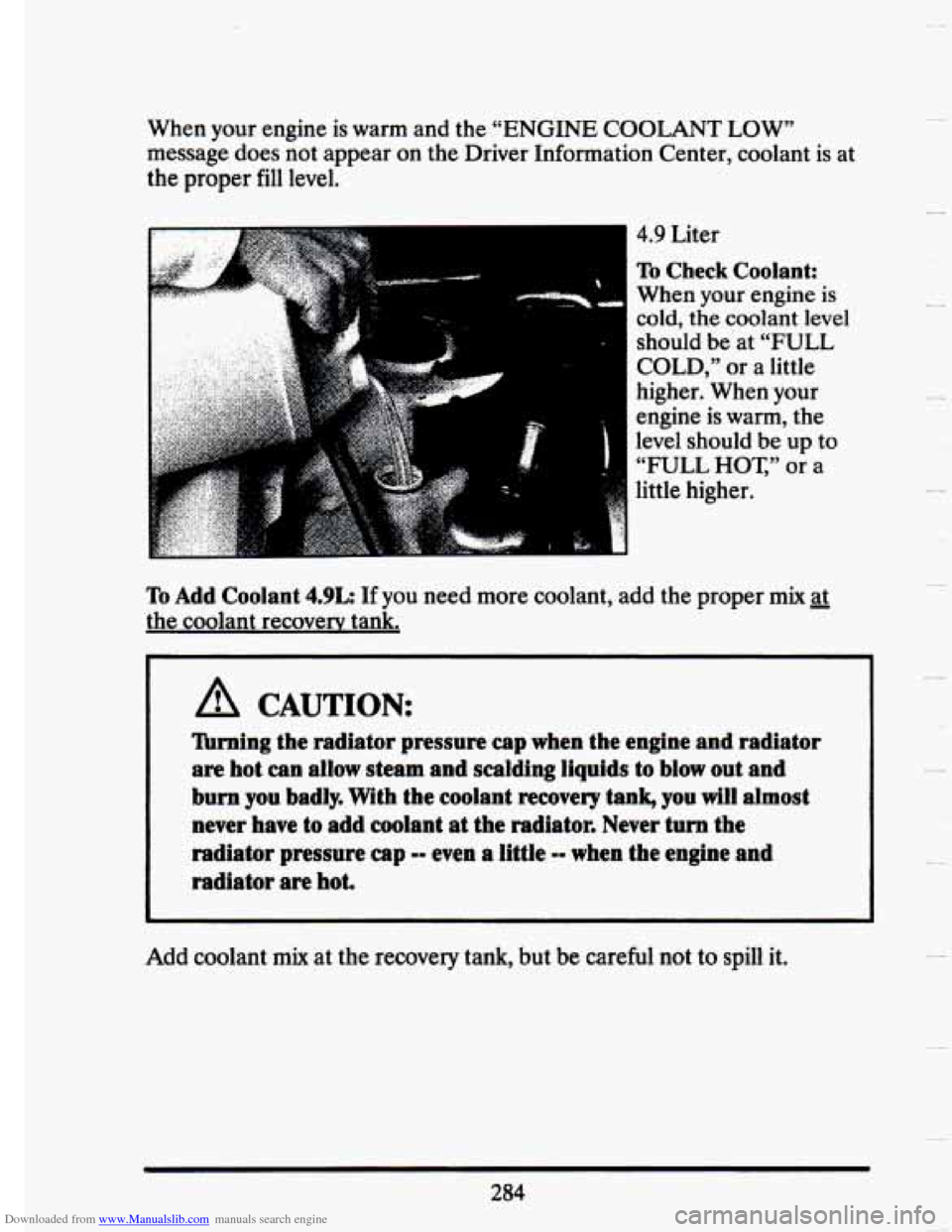
I 4.6 Liter (Northstar)
TO Check Coolant
When.
your engine is
cold, the coolant level
should be at “FULL
COLD”, or a little
higher.
283
P
Page 298 of 407
Downloaded from www.Manualslib.com manuals search engine When your engine is warm and the “ENGINE COOLANT LOW”
message does not appear on the Driver Information Center, coolant
is at
the proper fill level.
4.9 Liter
To Check Coolant:
When your engine is
cold, the coolant level
should be at
“FULL
COLD,” or a little
higher. When your
engine is warm,
the
level should be up to
“FULL
HOT,” or a
little higher.
To Add Coolant 4.9L If you need more coolant, add the proper mix at
the coolant recoverv tank.
A CAUTION
flrrning the radiator pressure cap when the engine and radiator
are hot can allow steam and scalding liquids to blow
out and
bum you badly. With the coolant recovery
tank, you will almost
never have to add coolant at the radiator. Never turn the
~ radiator pressure cap -- even a little -- when the engine and
radiator are hot.
Add coolant mix at the recovery tank, but be careful not to spill it.
284