Page 237 of 386
Downloaded from www.Manualslib.com manuals search engine TOWNG YOUR CXDILLAC
Try to have a GM dealer or a professional towing service tow your
Cadillac. The usual towing equipment
is a sling-type, or a wheel-lift, or
car carrier tow truck.
If your vehicle has been changed or modified since it was factory-new by
adding aftermarket items like fog lamps, aero skirting,
or special tires and
wheels, these instructions and illustrations may not be correct.
-- Before you do anything, turn on the hazard warning flashers.
When you call, tell the towing service:
0
0
0
-0
-
That your vehicle cannot be towed from the front or rear with wheel
lift equipment.
That your vehicle has rear-wheel drive.
The make, model, and year
of your vehicle.
Whether you can still move the shift lever.
If there was an accident, what was damaged.
223
Page 242 of 386
Downloaded from www.Manualslib.com manuals search engine IfNo Steam Is Coming From Your Engine:
If you get the overheat warning but see or hear no steam, the problem
may not be too serious. Sometimes the engine can get a little too hot
when you:
0 Climb a long hill on a hot day.
0 Stop after high speed driving.
0 Idle for long periods in traffic.
Tow a trailer.
If you get the overheat warning with no sign of steam, try this for a
minute or
so:
1. Turn off your air conditioner.
i I
31
n
L
CI
I
2. Turn on your heater to full hot at the highest fan speed and open the
3. If you’re in a traffic jam, shift to “N” (Neutral).
window
as necessary.
7
1 ‘I
If you no longer have the overheat warning, you can drive. Just to be safe, -
drive slower for about ten minutes. If the warning doesn’t come back on, 1
you can drive normally.
If the warning continues, pull over, stop, and park your vehicle right
away.
3
1
If there’s still no sign of steam, you can idle the engine for two or three
minutes while you’re parked, to see if the warning stops. But then,
if you
still have the warning, TURN
OFF THE ENGINE AND GET
EVERYONE OUT
OF THE VEHICLE until it cools down.
n 11
You may decide not to lift the hood but to get service help right away.
--
u
Page 245 of 386
Downloaded from www.Manualslib.com manuals search engine - How to Add Coolant to the Coohnt Recovery Tank
If you haven’t found a problem yet, but the coolant level isn’t at or above
“FULL COLD,” add a 50/50 mixture of clean water (preferably distilled)
Coolant” in the Index for more information about the proper coolant
mix.)
- and a proper antifreeze at the coolant recovery tank. (See “Engine
,-
A CAUTION:
I Adding only plain water to your cooling system can be
dangerous. Plain water, or some other liquid like alcohol, can
boil before the proper coolant mix
will. Your vehicle’s coolant
water or the wrong mix, your engine could get too hot but you
wouldn’t get the overheat warning. Your engine could catch fire
water and
a pmqer antifreeze.
I warning system is set for the proper coolant mix. With plain
I and you or others could be burned. Use a 50/50 mix of clean
23 1
Page 246 of 386
Downloaded from www.Manualslib.com manuals search engine i
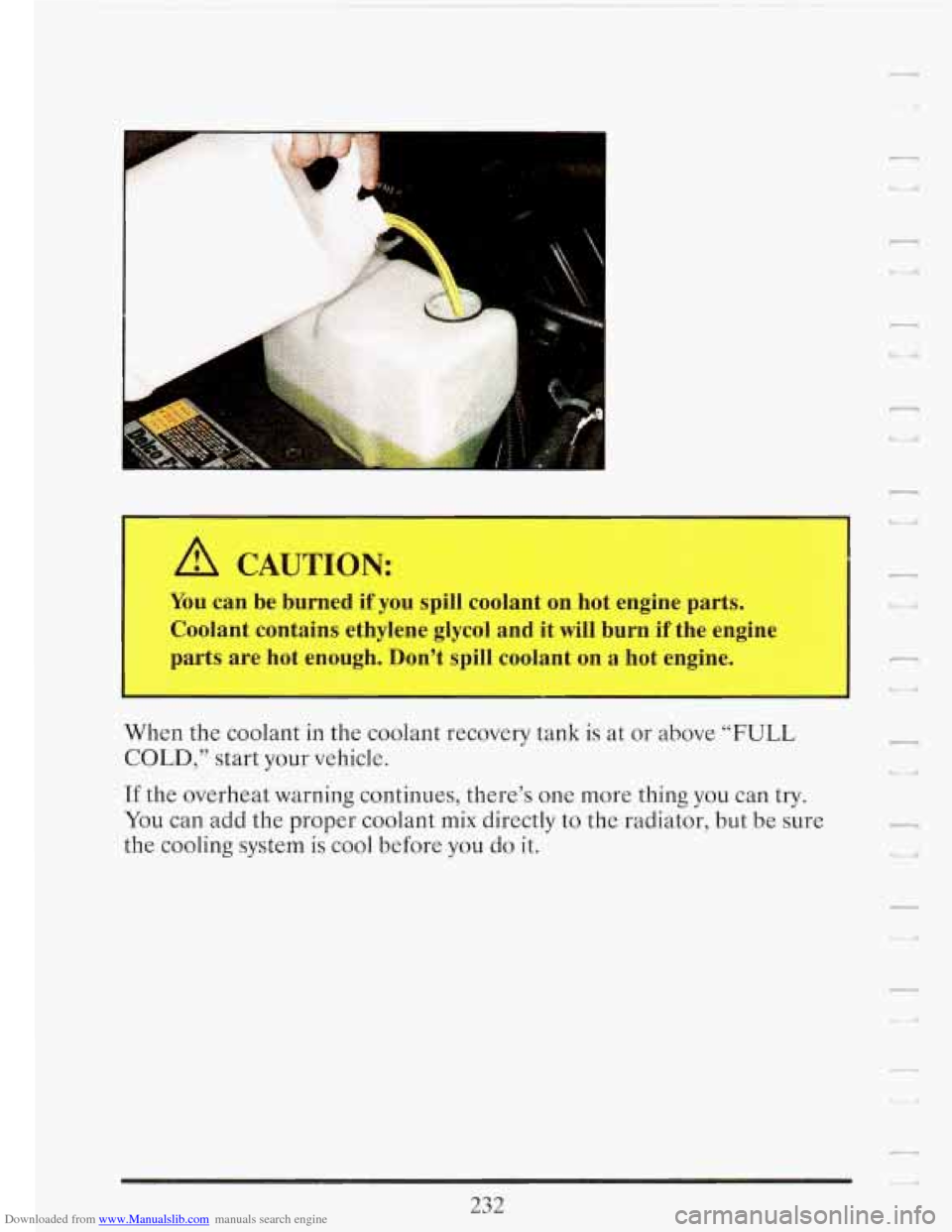
A CAUTION:
You can be burned if you spill coolant on hot engine parts.
Coolant contains ethylene glycol and
it will burn if the engine
parts are hot enough. Don’t spill coolant on a hot engine.
When the coolant in the coolant recovery tank is at or above “FULL
COLD,” start your vehicle.
If the overheat warning continues, there’s one more thing you can try.
You can add the proper coolant
mix directly to the radiator, but be sure
the cooling system is
cool before you do it.
T
Y
232
Page 251 of 386

Downloaded from www.Manualslib.com manuals search engine 8. Then replace the
pressure cap. Be
sure the arrows on
the pressure cap
line up like this.
IF A TIRE GOES FLAT
-- It’s unusual for a tire to “blow out” while you’re driving, especially if you
maintain your tires properly. If air goes out of a tire, it’s much more likely
to leak out slowly. But
if you should ever have a “blowout,” here are a
If a front tire fails, the flat tire will create a drag that pulls the vehicle
toward that side. Take your foot
off the accelerator pedal and grip the
to a stop well out of the traffic lane.
A rear blowout, particularly on a curve, acts much like a skid and may
remove your foot from the accelerator pedal. Get the vehicle under
control by steering the way you want the vehicle to go. It may be
very
the road if possible.
__ few tips about what to expect and what to do:
__ steering wheel firmly. Steer to maintain lane position, then gently brake
__ require the same correction you’d use in a skid. In any rear blowout,
__ bumpy and noisy, but you can still steer. Gently brake to a stop, well off
If your tire goes flat, the next section shows how to use your jacking
--- equipment to change a flat tire safely.
CHMGING A FLAT TIRE
._- If a tire goes flat, avoid further tire and wheel damage by driving slowly to
a
level place. Turn on your hazard warning flashers.
237
Page 262 of 386
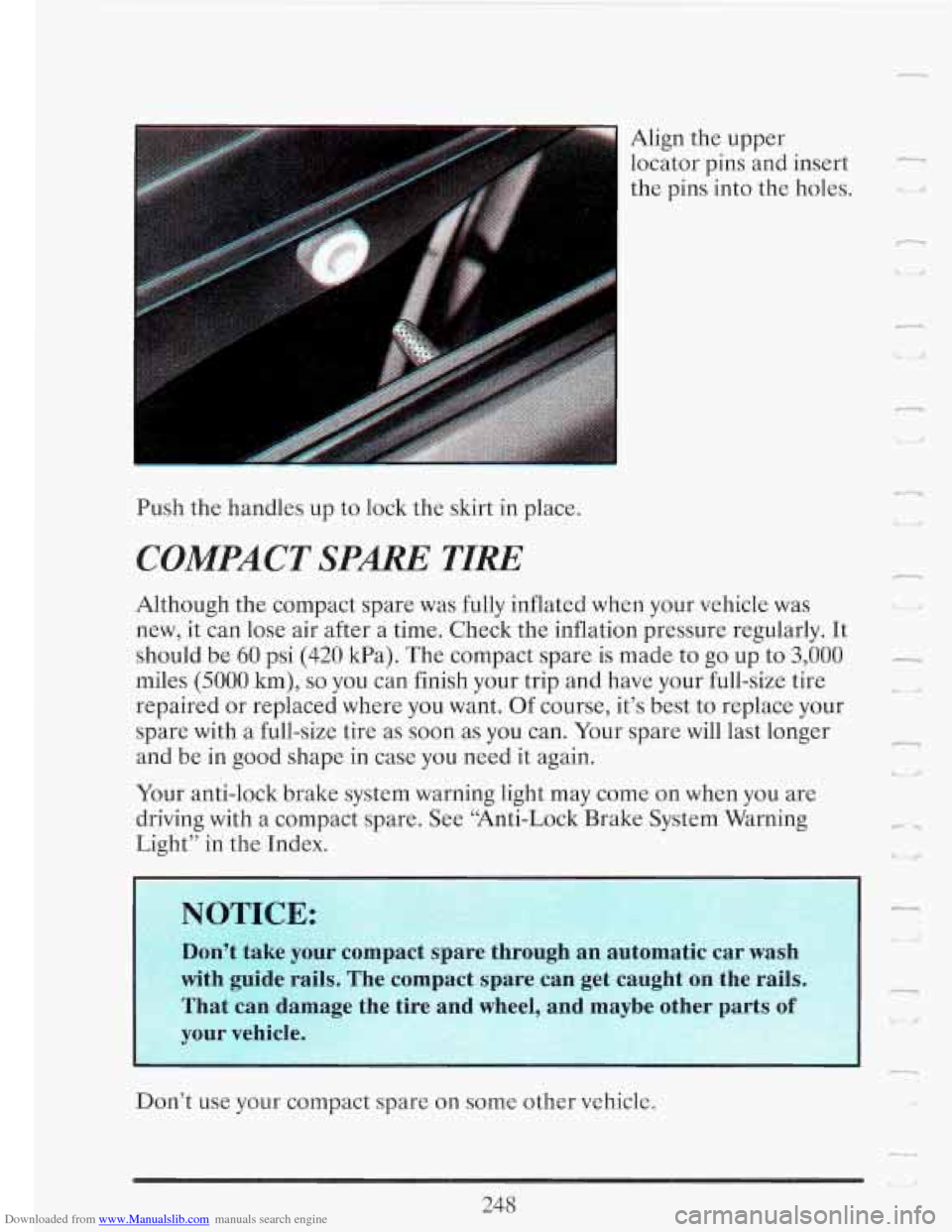
Downloaded from www.Manualslib.com manuals search engine Align the upper
locator pins and insert
-
the pins into the holes. .
n
Push the handles up to lock the skirt in place.
COMPACT SPARE TIRE
Although the compact spare was fully inflated when your vehicle was
new, it can lose air after a time. Check the inflation pressure regularly. It
should be
60 psi (420 kPa). The compact spare is made to go up to 3,000 -
miles (5000 km), so you can finish your trip and have your full-size tire i* u
repaired or replaced where you want. Of course, it’s best to replace your I
spare with a full-size tire as soon as you can. Your spare will last longer
and be in good shape in case you need it again.
Your anti-lock brake system warning light may come on when
you are
driving with a compact spare. See “Anti-Lock Brake System Warning
Light” in the Index.
Don’t use your compact spare on some other vehicle.
248
Page 283 of 386
Downloaded from www.Manualslib.com manuals search engine r REARAXLE
1
When to Check and Change Lubricant:
Refer to the Maintenance Schedule to determine how often to check the
lubricant and when to change it. See “Periodic Maintenance Inspections”
in the Index.
How to Check Lubricant:
If the level is below the bottom of the filler plug hole, you’ll need to add
some lubricant. Add enough lubricant to raise the level to the bottom of
What to Use:
~ the filler plug hole.
Standard Differential
Use Axle Lubricant (GM Part
No. 1052271) or SAE 8OW-90 GL-5 gear
lubricant.
Limited-Slip Differential
To add lubricant when the level is low, use Axle Lubricant (GM Part No.
1052271) or SAE 8OW-90 GL-5 gear lubricant. To completely refill after
draining, add
4 ounces (1 18 ml) of Limited-Slip Differential Lubricant
Additive (GM Part
No. 1052358). Then fill to the bottom of the filler plug
hole with Axle Lubricant (GM Part
No. 1052271) or SAE 8OW-90 GL-5
~ gear lubricant.
ENGINE COOLANT
The proper coolant for your Cadillac will:
Give freezing protection down to -34°F (-37’ C) .
_- Give boiling protection up to 262°F (128°C) .
0 Protect against rust and corrosion.
__ 0 Help keep the proper engine temperature.
Let the warning lights work as they should.
What to Use:
Use a mixture of one-half clean water (preferably distilled) and one-half
antifreeze that meets
“GM Specification 1825-M,” which won’t damage
269
Page 284 of 386
Downloaded from www.Manualslib.com manuals search engine .aluminum parts. You can also use a recycled coolant conforming to GM
Specification 1825-M with a complete coolant flush and refill. Use GM
Engine Coolant Supplement (sealer) with any complete coolant change. ,~
If you use these, you don’t need to add anything else.
A CAUTION:
Adding only plain water to your cooling system can be
dangerous. Plain water,
or some other liquid like alcohol, can
boil before the proper coolant mix will. Your vehicle’s coolant
warning system is set for the proper coolant mix. With plain
water or the wrong mix, your engine could get too hot but you
wouldn’t get the overheat warning. Your engine could catch fire
and you or others could be burned. Use
a 50/50 mix of clean
water and
a proper antifreeze.