Page 207 of 306
-
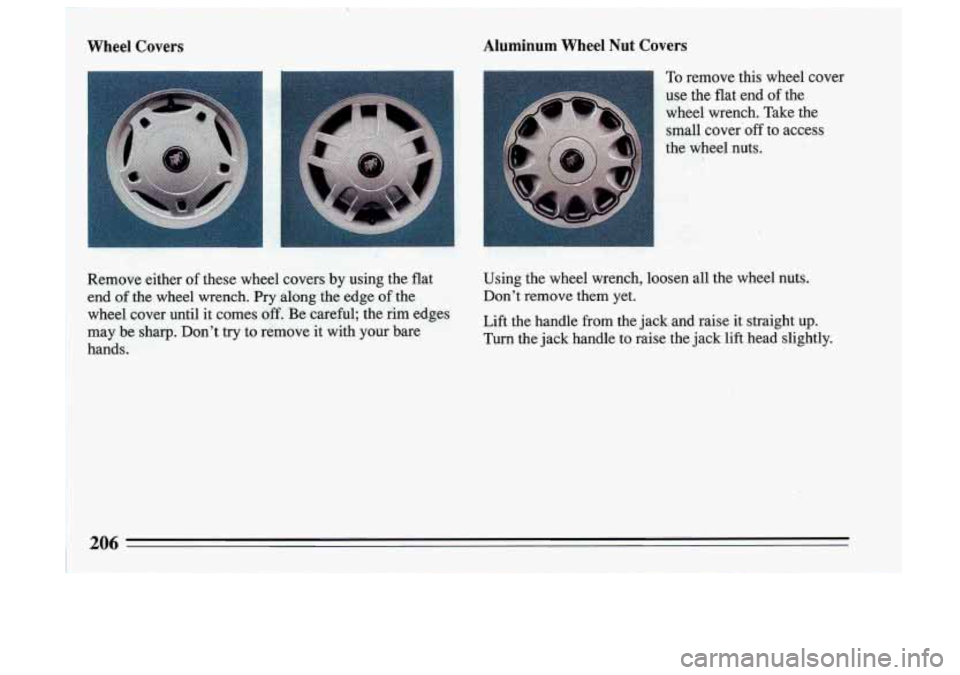
Wheel Covers Aluminum Wheel Nut Covers
To remove this wheel cover
use the flat end
of the
wheel wrench. Take the
small cover
‘off to access
the wheel nuts.
Remove either of these wheel covers by using the flat Using the wheel wrench, loosen all the wheel nuts.
end
of the wheel wrench. Pry along the edge of the Don’t remove them yet.
wheel cover until it comes
off. Be careful; the rim edges Lift the handle from the jack and raise it straight up.
may be sharp. Don’t try to remove it with your bare
hands. Turn the
jack handle to raise the jack lift head slightly.
206
Page 213 of 306
when you are driving with a compact spare. See
“Anti-Lock Brake System Warning Light” in the Index.
Page 215 of 306
Rocking your vehicle to get it out:
First, turn your steering wheel left and right. That will
clear the area around your front wheels. Then shift back
and forth between “R” and a forward gear
, spinning the
wheels as little as possible. Release the accelerator pedal
while you shift, and press lightly on the accelerator
pedal when the transaxle is in gear. If that doesn’t get
you out after a few tries, you may need
to be towed out.
If you do need to be towed out, see “Towing Your Car”
in the Index.
Page 232 of 306
0
0
0
0
0
Give freezing protection down to -34°F (-37 "C) .
Give boiling protection up to 262 F (128 " C) .
Protect against rust and corrosion.
Help keep the proper engine temperature.
Let the warning lights work
as they should.
231
Page 237 of 306
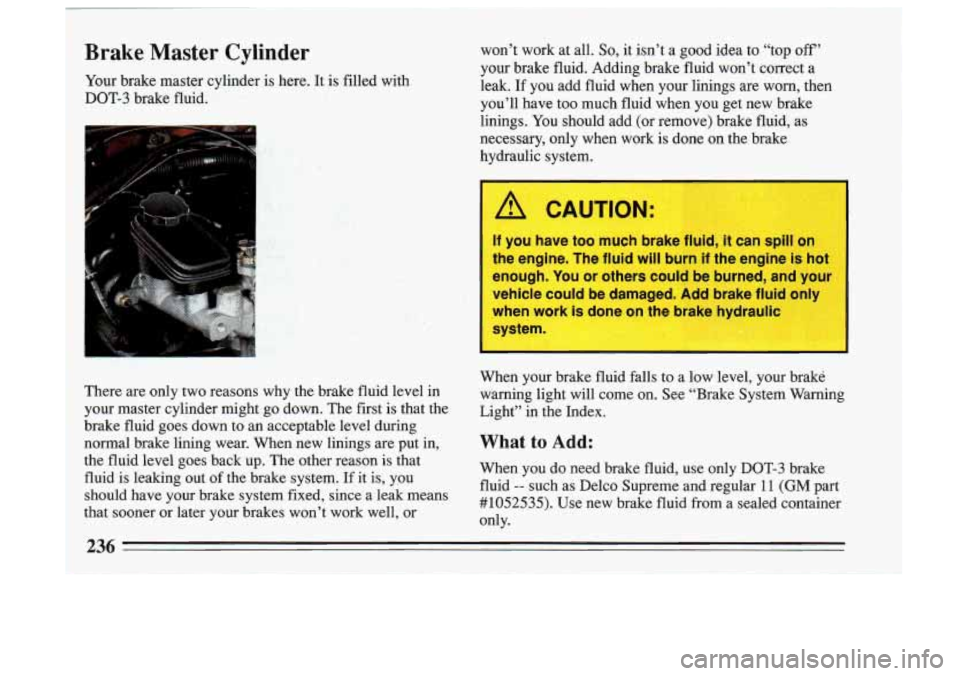
1 Brake Master Cylinder
Your brake master cylinder is here. It is filled with
1 DOT-3 brake fluid. won’t work
at all.
So, it isn’t a good idea to “top off’
your brake fluid. Adding brake. fluid won’t correct a
leak. If you add fluid when your linings are worn, then
you’ll have too much fluid when you get new brake
linings.
You should add (or remove) brake fluid, as
necessary, only when work is done
on the brake
hydraulic system.
I
A CAUTION:
If you have too much brake fluid, it can spill on
the engine. The fluid will burn
if the engine is hot
enough. You or others could be burned, and your
vehicle could be damaged. Add brake fluid only
when work is done on the br,
e hl ‘raulic
system.
1
There are only two reasons why the brake fluid level in
your master cylinder might go down. The first is that the
brake fluid goes down to an acceptable level during
normal brake lining wear. When new linings
are put in,
the fluid level goes back up. The other reason is that
fluid is leaking out
of the brake system. If it is, you
should have your brake system fixed, since a leak means
that sooner or later your brakes won’t work well, or When your brake fluid falls to a low level, your brake
warning light will come on. See “Brake System Warning
Light’’
in the Index.
What to Add:
When you do need brake fluid, use only DOT-3 brake
fluid
-- such as Delco Supreme and regular 11 (GM part
#1052535). Use new brake fluid from a sealed container only.
I
236
Page 251 of 306
r
1 e Use solvent-type cleaners in a well-ventilated area
only.
If you use them, don’t saturate the stained area.
If a ring forms after spot cleaning, clean the entire
area immediately or it will
set.
Using Foam-Type Cleaner on Fabric I
0 Vacuum and brush the area to remove any loose dirt.
0 Always clean a whole trim panel or section. Mask ’
surrounding trim along stitch or welt lines.
Mix Multi-Purpose Powdered Cleaner following the
directions on the container label.
0 Use suds only and apply with a clean sponge.
0 Don’t saturate the material.
Don’t rub it roughly.
As soon as you’ve cleaned the section, use a sponge
to remove the suds.
0 Rinse the section with a clean, wet sponge.
0 Wipe off what’s left with a slightly damp paper towel
or cloth.
0 Then dry it immediately with an air hose, a hair
dryer or a heat lamp.
1
0 Wipe *with a clean cloth.
Using Solvent-Type Cleaner on
Fabric
First, see if you have to use solvent-type cleaner at all.
Some spots and stains will clean
off better with just
water and mild soap.
If
you need to use it, then:
Gently scrape excess soil from the trim material with
a clean, dull knife or scraper. Use very little cleaner,
light pressure and clean cloths (preferably cheesecloth). Cleaning should start at the outside of
the stain, “feathering” toward the center. Keep
changing to a clean section of the cloth.
When you clean a stain from fabric, immediately dry
the area with an air hose, hair dryer, or heat lamp to
help prevent a cleaning ring. (See the previous
NOTICE.)
Page 252 of 306
Special Cleaning Problems
Greasy or Oily Stains: Like grease, oil, butter,
margarine, shoe polish, coffee with cream, chewing gum, cosmetic creams, vegetable oils, wax crayon, tar
and asphalt.
Carefully scrape off excess stain.
Then follow the solvent-type instructions above.
0 Shoe polish, wax crayon, tar and asphalt will stain if
left on a vehicle seat fabric. They should be removed
as soon as possible. Be careful, because the cleaner
will dissolve them and may cause them to bleed.
Non-Greasy Stains: Like catsup, coffee (black), egg,
fruit, fruit juice, milk, soft drinks, wine, vomit, urine and
blood.
Carefully scrape off excess stain, then sponge the
soiled area with cool water.
If a stain remains, follow the foam-type instructions
above.
If an odor lingers after cleaning vomit or urine, treat
the area with a waterbaking soda solution:
1
teaspoon (5 ml) of baking soda to 1 cup (250 ml)
of lukewarm water.
Finally, if needed, clean lightly with solvent-type
cleaner.
Combination Stains: Like candy, ice cream,
mayonnaise, chili sauce and unknown stains.
Carefully scrape off excess stain, then clean with
0 If a stain remains, clean it with solvent-type cleaner.
cool water and allow to dry.
Cleaning Vinyl or Leather
Just use warm water and a clean cloth.
0 Rub with a clean, damp cloth to remove dirt. You
Things like tar, asphalt and shoe polish will stain if
may have to
do it more than once.
you don’t get them
off quickly. Use a clean cloth and
solvent-type vinylbeather cleaner.
Cleaning the Top of the Instrument
Panel
Use only mild soap and water to clean the top surfaces
of the instrument panel. Sprays containing silicones or
waxes may cause annoying reflections in the windshield
and even make it difficult to see through the windshield
under certain conditions.
251
Page 259 of 306
Fuses and Circuit Breakers
The wiring circuits in your car are protected from short
circuits.by a combination of fuses, circuit breakers, and
fusible thermal links in the wiring itself. This greatly
reduces the chance of fires caused by electrical
problems.
Be sure to use the correct fuse. If you ever have a
problem on the road and don’t have a spare fuse, you
I
can “borrow” one of the identical size and rating. Just
pick some feature of your car that you can get along
without
-- like the radio or cigarette lighter -- and use its
fuse, if it is of the value you need. Replace it as soon as
you can.
The fuse panel
is to the left of the steering column, near
the parking brake release lever. Pull the cover down to
access the fus.es.
I
258