1993 BUICK SKYLARK light
[x] Cancel search: lightPage 157 of 306

I
Off-Road Recovery
You may find sometime that your right wheels have
dropped off the edge
of a road onto the shoulder while
you’re driving.
If the level of the shoulder is only slightly below the
pavement, recovery should be fairly easy. Ease off the
accelerator and then, if there is nothing in the way, steer
so that your vehicle straddles the edge of the pavement.
You can turn the steering wheel up to
1/4 turn until the
right front tire contacts the pavement edge. Then turn
your steering wheel to go straight down the roadway. If
the shoulder appears to be about four inches
(100 mm) or more below the pavement, this difference
can cause problems. If there
is not enough room to pull
entirely onto the shoulder and stop, then follow the same
procedures. But if the right front tire scrubs against the
side
of the pavement, do NOT steer more sharply. With
too much steering angle, the vehicle may jump back
onto the road with
so much steering input that it crosses
over into the oncoming traffic before you can bring it
back under control.
Instead, ease off again on the accelerator and steering
input, straddle the pavement once more, then try again.
Passing
The driver of a vehicle about to pass another on a
two-lane highway waits for just the right moment,
accelerates, moves around the vehicle ahead, then goes
back into the right lane again.
A simple maneuver?
Not necessarily! Passing another vehicle on a two-lane
highway is a potentially dangerous move, since the
passing vehicle occupies the same lane as oncoming
traffic for several seconds.
A miscalculation, an error in
judgment, or a brief surrender to frustration or anger can
suddenly put the passing driver face to face with the
worst of all traffic accidents
-- the head-on collision.
Page 159 of 306

0
0
0
Try not to pass more than one vehicle at a time on
two-lane roads. Reconsider before passing the next
vehicle.
Don’t overtake a slowly moving vehicle too rapidly.
Even though the brake lights are not flashing, it may
be slowing down or starting to turn.
If you’re being passed, make it easy for the
following driver to get ahead of you. Perhaps you
can ease a.little to the right.
Loss of Control
Let’s review what driving experts say about what
happens when the three control systems (brakes, steering and acceleration) don’t have enough friction where the
tires meet the road to do what the driver has asked.
In any emergency, don’t give up. Keep trying to steer
and constantly seek an escape route or area of less
danger.
Skidding
In a skid, a driver can lose control of the vehicle.
Defensive drivers avoid most skids by taking reasonable
care suited to existing conditions, and by not
“overdriving” those conditions. But skids are always
possible. The three types
of skids correspond
to your Buick’s
three control systems. In the braking skid your wheels
aren’t rolling.
In the steering or cornering skid, too
much speed or steering in a curve causes tires to slip and
lose cornering force. And in the acceleration skid too
much throttle causes the driving wheels to spin.
A cornering skid and an acceleration skid are best
handled by easing your foot off the accelerator pedal.
If your vehicle starts to slide (as when you- turn a corner
on a wet, snow- or ice-covered road), ease your foot
off
the accelerator pedal as soon as you feel the vehicle start
to slide. Quickly steer the way you want the vehicle to
go. If you start steering quickly enough, your vehicle
will straighten out. As it does, straighten the front
wheels.
Of course, traction is reduced when water, snow, ice,
gravel, or other material is on the road. For safety, you’l\
l
..
want to slow down and adjust your driving to these
conditions. It is important to slow down on slippery
surfaces because stopping distance will be longer and
vehicle control more limited.
While driving on a surface with reduced traction, try
your best to avoid sudden steering, acceleration, or
braking (including engine braking by shifting to a lower gear). Any sudden changes could cause the tires to slide.
You may not realize the surface is slippery until your
I
Page 160 of 306
vehicle is skidding. Learn to recognize warning clues --
such as enough water, ice or packed snow on the road to
make a “mirrored surface”
-- and slow down when you
have any doubt.
Remember: Any anti-lock braking system (ABS) helps avoid only the braking skid. Steer the way you want to
go.
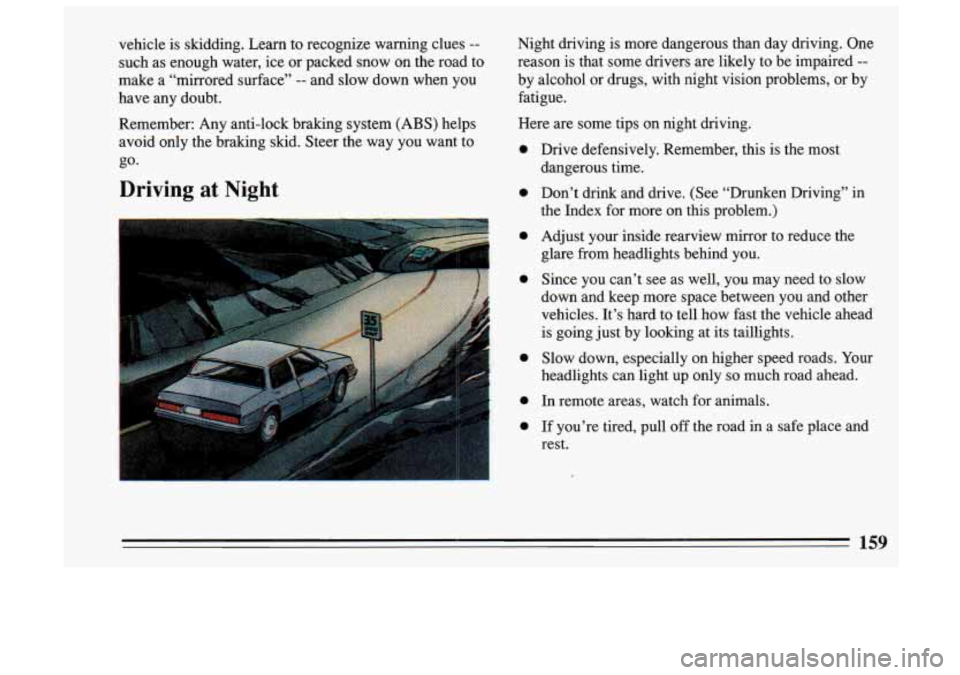
Driving at Night
Night driving is more dangerous than day driving. One
reason is that some drivers are likely to be impaired
--
by alcohol or drugs, with night vision problems, or by
fatigue.
Here are some tips on night driving.
0
0 0
0
0 Drive defensively. Remember, this is the most
dangerous time. Don’t drink and drive. (See “Drunken Driving” in
the Index for more
on this problem.)
Adjust your inside rearview mirror to reduce the glare from headlights behind you.
Since you can’t see as well, you may need to slow
down and keep more space between you and other vehicles. It’s hard to tell how fast the vehicle ahead
is going just by looking at its taillights.
Slow down, especially on higher speed roads.
Your
headlights can light up only’s0 much road ahead.
In remote areas, watch for animals.
If you’re tired, pull
off the road in a safe place and
rest.
Page 161 of 306
Avoid staring directly into the approaching lights. If
there is a line of opposing traffic, make occasional
glances over the line of headlights to make certain that
one of the vehicles isn’t starting to move into your lane.
Once you are past the bright lights, give your eyes time
to readjust before resuming speed.
High Beams
If the vehicle approaching you has its high beams on,
signal by flicking yours to high and then back to low
beam. This is the usual signal to lower the headlight
beams. If the other driver still doesn’t lower the beams,
resist the temptation to put your high beams on. This
only makes two half-blinded drivers.
On
a freeway, use your high beams only in remote areas
where you won’t impair approaching drivers. In some
places, like cities, using high beams is illegal.
I
Night Vision
No one can see as well at night as in the daytime. But as
we get older these differences increase. A 50-year-old
driver may require
at least twice as much light to see the
same thing at night as a 20-year-old.
What you do in the daytime can also affect your night
vision. For example,
if you spend the day @ bright
sunshine you are wise to wear sunglasses. ,Your eyes will
have less trouble adjusting to night.
But
if you’re driving, don’t wear sunglasses at night.
They may cut down on glare from headlights, but they
also make a lot of things invisible that should remain
visible
- such as parked cars, obstacles, pedestrians, or
even trains blocking railway crossings. You may want to
put on your sunglasses after
you have pulled into a
brightly-lighted service or refreshment area. Eyes
shielded from that glare may adjust more quickly to
darkness back on the road: But be sure to remove your
sunglasses before you leave the service area.
You can be temporarily blinded by approaching lights.
It can take a second or two, or even several seconds, for
your eyes to readjust to the dark. When you are faced
with severe glare (as from a driver who doesn’t lower
the high beams, or
a vehicle with misaimed headlights),
slow down a little.
..
When you follow another vehicle on a freeway or
highway, use low beams. True, most vehicles now have
day-night mirrors that enable the driver to reduce glare. But outside mirrors are not
of this type and. rh beams
from behind can bother the driver ahead.
160
Page 162 of 306

A. Few ,More Night Driving Suggestions Driving in the Rain
Keep your eyes moving; that way, it’s easier to pick out
dimly lighted objects.
i
Just as your headlights should be checked regularly for
Rain and wet roads can mean driving trouble. On a wet
proper aim,
so should your eyes be examined regularly. road you can’t stop, accelerate or turn as well because
Some drivers suffer from night blindness
-- the inability
your tire-to-road traction isn’t as good as on dry roads.
to see in dim light
-- and aren’t even aware of it. And, if your tires don’t have much tread left, you’ll get
even less traction.
It’s always wise to go slower and be cautious
if rain
starts to fall while
you are driving. The surface may get
P 161
Page 164 of 306

A CAUTION:
Wet brakes can cause accidents. The: ton’t
work well in
a quick stop and may cause pulling
to one side. You could lose control of the vehicle.
After driving through a large puddle of water or
car wash, apply your brake pedal ligh rtil
your brakes work normally.
Hydroplaning
Hydroplaning is dangerous. So much water can build up
under your tires that they can actually ride on the water.
This can happen if the road is wet enough and you’re
going fast enough. When your vehicle is hydroplaning,
it has little or no contact with the road.
You might not be aware of hydroplaning. You could drive
along for some time without realizing your tires aren’t in
constant contact with the road. -You could find out the
hard way: when you have to slow, turn, move out to,pass
-- or if you get hit by a gust of wind. You could suddenly
fiid yourself out of control.
Hydroplaning doesn’t happen often. But it can if your
tires haven’t much tread or if the pressure in ?ne or more
is low. It can happen
if a lot of water is standing on the road. If you can
see reflections from trees, telephone
poles, or other vehicles, and raindrops “dimple” the water’s surface, there could
be hydroplaning.
Hydroplaning usually happens at higher speeds. There
just isn’t a hard and fast rule about hydroplaning. The
best advice is to
slow down when it is raining, and be
careful.
Some Other Rainy Weather Tips
0 Turn on your headlights -- not just your parang
lights
-- to help make you more visible to others.
0 Look for hard-to-see vehicles coming from behind.
You may want to use your headlights even in
daytime if it’s raining hard.
0 Besides slowing down, allow some extra following
distance. And be especially careful when you pass
another vehicle. Allow yourself more clear room
ahead, and
be prepared to have your view restricted
by road spray.
If the road spray is so heavy you are
actually blinded, drop back. Don’t pass until
conditions improve. Going more slowly is better
than having an accident.
Use your defogger if it helps.
Have good tires with proper tread depth. (See “Tires” in the Index.)
163
Page 165 of 306

Driving in Fog, Mist and Haze
Fog can occur with high humidity or heavy frost. It can
be
so mild that you can see through it for several
hundred feet (meters). Or it might be
so thick that you
can see only a few feet (meters) ahead. It may come
suddenly to an otherwise clear road. And it can be a
major hazard.
When you drive into a fog patch, your visibility will be
reduced quickly. The biggest dangers are striking the vehicle ahead or being struck by the one behind. Try
to
“read” the fog density down the road. If the vehicle
ahead starts to become less clear or, at night,
if the
taillights are harder to see, the fog is probably
thickening. Slow down to give traffic behind you a chance to slow down. Everybody then has a better
chance to avoid hitting the vehicle ahead.
A patch of dense fog may extend only for a few feet
(meters) or for miles (kilometers); you can’tyeally tell
while you’re in it. You can only treat the situation with
extreme care.
One common fog condition
-- sometimes called mist or
ground fog
-- can happen in weather that seems perfect,
especially at night or in the early morning in valley and
low, marshy areas. You can be suddenly enveloped
in
thick, wet haze that may even coat your windshield. You
can often spot these fog patches or mist layers with your
headlights. But sometimes they can be waiting for you
as you come over a hill or dip into a shallow valley.
Start your windshield wipers and washer, to help clear
accumulated road dirt. Slow down carefully.
Tips on Driving in Fog
If you get caught in fog, turn your headlights on low
beam, even in daytime. You’ll see
-- and be seen --
better. Use your fog lights if your vehicle has them.
Page 168 of 306

Entering the Freeway
At the entrance there is usually a ramp that leads to the
freeway. If you have a clear view of the freeway as you
drive along the entrance ramp, you should begin to
check traffic. Try to determine where
you expect to
blend with the flow. If traffic is light, you may have no
problem. But if it is heavy, find a gap as you move along
the entering lane and time your approach. Try to merge
into the gap at close to the prevailing speed. Switch on
your turn signal, check your rearview mirrors as you
move along, and glance over your shoulder as often as
necessary. Try to blend smoothly with the traffic flow.
Driving on the Freeway
Once you are on the freeway, adjust your speed to the
posted limit or to the prevailing rate
if it’s slower. Stay
in the right lane unless you want to pass.
If you are on a
two-lane freeway, treat the right lane as the slow lane
and the left lane as the passing lane.
If you are on a three-lane freeway, treat the right lane as
the slower-speed through lane, the middle lane as the
higher-speed through lane, and the left lane as the
passing lane.
Before changing lanes, check your rearview mirrors.
Then use your turn signal. Just before you leave the lane, glance quickly over your
shoulder to make sure there isn’t another vehicle in your
“blind” spot.
If you are moving from an outside to a center lane on a
freeway having more than two lanes, make sure another vehicle isn’t about to move into the same spot.
Look at
the vehicles two lanes over and watch for telltale signs:
turn signals flashing, an increase in speed, or moving
toward the edge of the lane. Be prepared
to delay your
move.
Once
you are moving on the freeway, make certain you
allow a reasonable following distance. Expect to move slightly slower at night.
Leaving the Freeway
When you want to leave the freeway, move to the proper
lane well in advance. Dashing across lanes at the last
minute is dangerous. If you miss your exit do not, under
any circumstances, stop and back up. Drive on to the
next exit.
At each exit point is a deceleration lane. Ideally it
should be long enough for you to enter it at freeway
speed (after signaling, of course) and then do your
braking before moving onto the exit ramp.
Unfortunately, not all deceleration lanes are long enough
-- some are too short for all the braking. Decide when to
167 2-