Page 251 of 340
Engine OiI
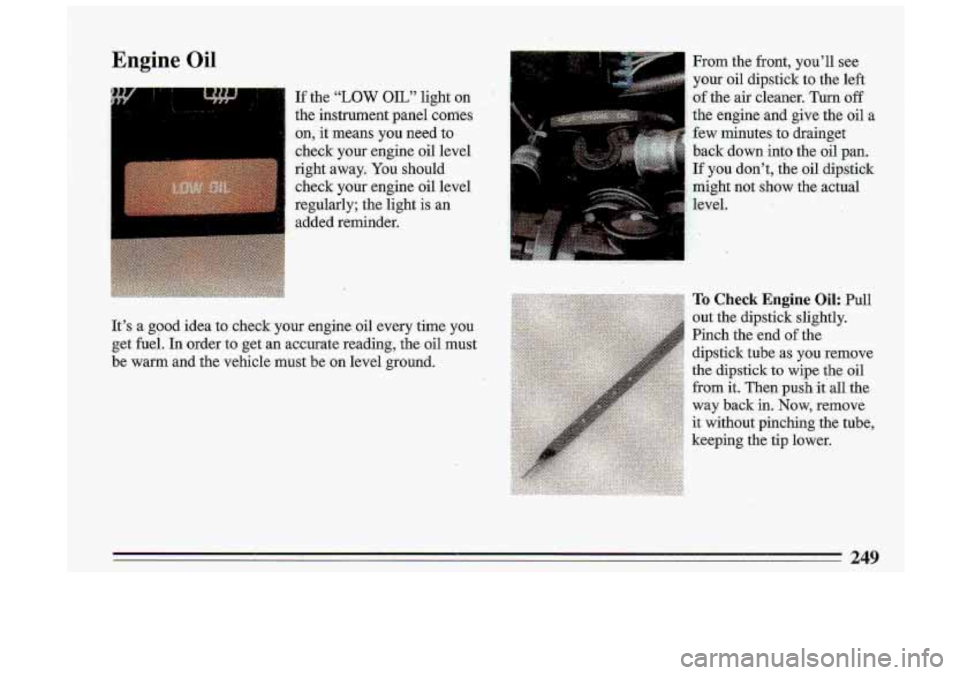
If the "LOW OIL" light on '
the instrument panel comes
on, it means .you need to
check your engine oil level
right away. You should
check your engine oil level
regularly; the light
is an
added reminder.
It's a good idea to check your engine oil every time you
get fuel. In order to get an accurate reading, the oil must
be warm and the vehicle must be on level ground. From the front, you'll
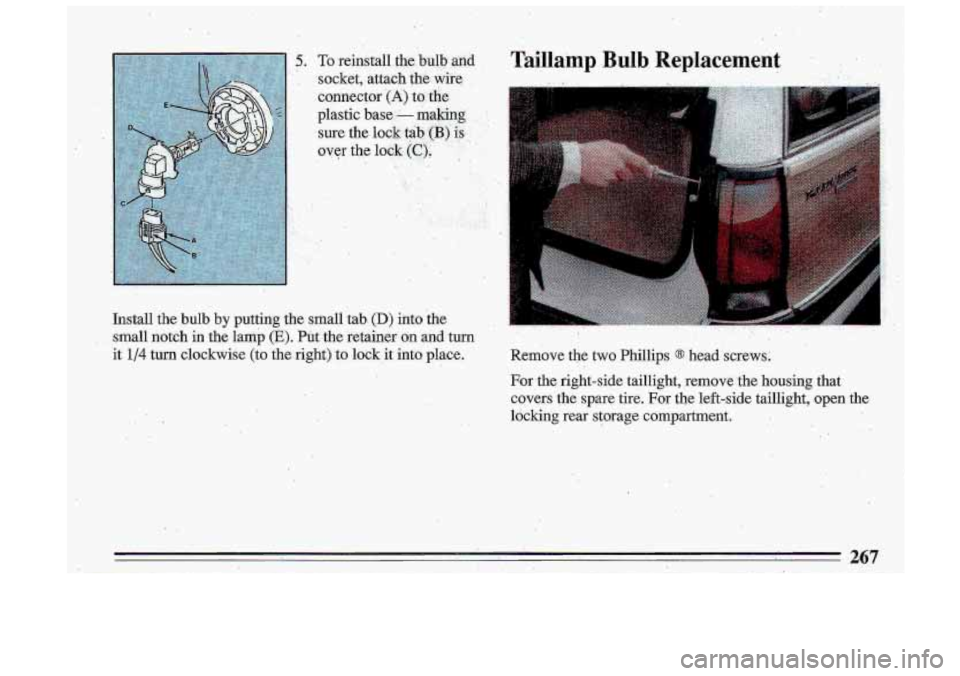
see
your oil hpstick to the left
of 'the air cleaner. Turn off
the engine and give the oil a
fe.w minutes.
to drainget
back down-into the
oil pan.
If
you don't, the oil dipstick
might not show the actual
h%l.
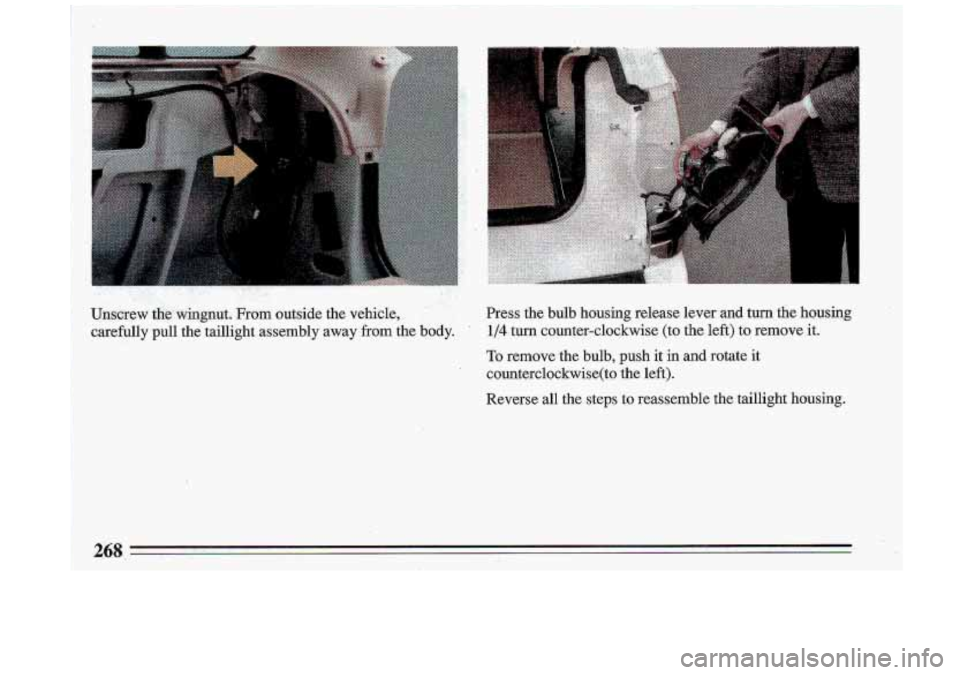
To Check Engine Oil: Pull
out the dipstick slightly.
Pinch the ,end of the
dipstiek tube as you remove
the dipstick to wipe the oil
fi-om it. Then,push it' all the
way back
in. No.w, remgve
it without pinching the tube,
keeping the tip lcmer.
Page 269 of 340
5. Bulb
I_ -. _I-
Replacement , . ..
. -.
j.! i I I. !
Install the bulb by putting the sriJall tab- (D) hto the J;: ~ I..' '
small notch in the lamb (E). PGt the 'retainer: on and. turn
. ..
it 1/4 tun clockwise (to the.right).'to lock it into place. Remove-the two Phillips @ head screws;
For .the right-side taillight, remove The housing that
covers the spare tire'. For the left-side taillight, open the
ldcking rear storage compartment.
267
Page 270 of 340
. ,. , .. ., , ...
Unskrew .tht$wingnut. From outside the vehicle,,
carefully
pull the taillight assembly away from the body. Press the
bulb housing release lever and turn the housing
1/4.turn counter-clockwise (to the left) to remove it..
To remove the bulb, push it in and rotate it
counterclockwise(to the left).
Reverse
all the steps to reassemble the taillight housing.
Page 271 of 340
Center High Mounted Stop Light
Replacement
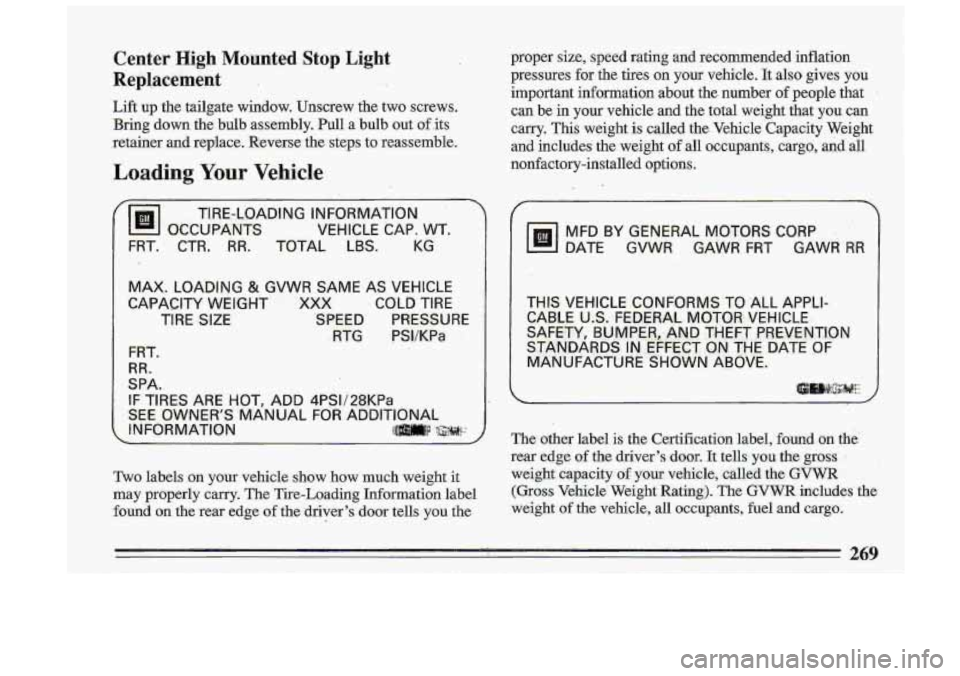
Lift up the tailgate window. Unscrew the two screws. Bring down the bulb assembly. Pull a bulb out of.its
retainer and replace. Reverse the,steps to reassemble.
Loading Your Vehi.cIe
proper size, speed rating and recommended inflation
pressures for the tires
on your vehicle. It also gives you
important information about the number
of people that
can be in your vehicle and the total weight that you can
carry.
This weight is called the Vehicle Capacity Weight
and includes the weight of
all occupants, cargo, and all
nonfactory-installed options.
@I OCCUPAN'TS TIRE-LOADING
INF0,RMATlON
.
V:EHICLE CAP, WT.
FRT.. CTR. RR. TOTAL LBS. KG
1
MAX. LOADING & GVWR SAME AS VEHICLE
CAPACITY
WEIGHT XXX COLD TIRE
TIRE SIZE
SPEED PRESSURE
.RTG PSI/KPa
FRT.
RR.
SPA.
IF TIRES ARE HOT, ADD 4PSI/28KPa
SEE OWNER'S 'MANUAL FOR ADDITIONAL
INF0,RMATlON
ll]mp ,$$$#/:::
Two labels on your vehicle show how much weight it
may properly carry. The Tire-Loading Information label
found -on- the rear edge of the driver's door tells you the
Y
MFD BY GENER-At MOTORS CORP
DATE GVWR GAWR FRT GAWR
RR
THIS VEHICLE CONFORMS TO 'ALL APPLI- CABLE US. FE,DE.RAL MOT0.R'
VEH'ICLE
SAFETY, BU.MPER,-AND THiEFT PREVENTI0.N
STANDARD,S IN EFFECT ON THE DATE
OF
MANUFACTURE SHOWN ABOVE.
~i~,l\i$;~!~~!~
The other label is the Certification 'label, found on the'
rear edge of the driver's do,ar. It tells you the gross
weight capacity
of your vehicle, called the GVWR
(Gross Vehicle' Weight Rating). The GVWX includes the.
weight of the vehicle, all occupants, fuel and cargo.
269
Page 282 of 340
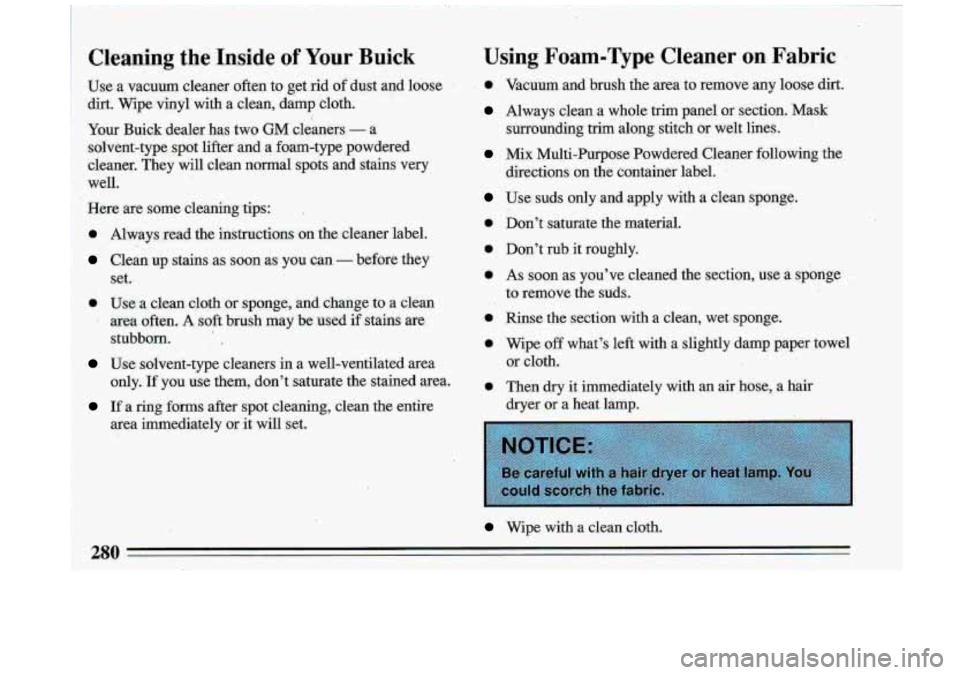
Cleaning the Inside of Your Buick using r oam-Type Cleaner on Fabric
Use a vacuum cleaner often to get rid of dust and loose
'dirt. Wipe vinyl with
a clean, damp cloth.
Your Buick dealer has two
GM cleaners - a
solvent-type spot lifter and a foam-type,powdered
'cleaner. They will clean normal spots and stains very well.
:Here are some cleaning tips:
0 Always read the instructions on the cleaner label.
Clean up stains as soon as: you,.cgnm- before they
0 use a clean dotn or sponge, and change to a clean
- area often. A soft brush may be used if stains are
Use soivent-type cleaners in a well-ventilated area
If a ring forms after spot cleaning, clean the entire
se
stubborn..
1.
only, If you use them,
don't saturate the stained area.
area immediately
or it will set.
0 Vacuum and brush the area to remove any loose dirt.
Always clean a whole trim panel or section. Mask surrounding trim along stitch or welt lines.
~ '
Mix Multi-Purpose Powdered 'Cleaner following the
directions on the container label.
.
Use suds only and apply with a clean sponge.
0 Don't saturate the material.
0 Don't rub it roughly; -''
0 As SOOR as you've cleaned the section, use a sponge , *,
to remove the suds.
0 Rinse the section with a clean, wet sponge.
0 Wipe off what's left with a slightly damp paper towel
or cloth. ' ,? I ..
0 Then dry it immediately with an air hose, a hair dryer
or a heat lamp.
Wipe with a clean cloth.
280 7
-
Page 283 of 340

Using Solvent-Type Cleaner on
Fabric
First, see if you have to use solvent-type cleaner at all.
Some sp-ots and stains will clean
off better with just
water and mild soap.
If you need to use it, then:
0
0
Gently scrape excess soil from the trim material with
a clean, dull knife or scraper. Use very. little cleaner,
light pressure and clean cloths (preferably
cheesecloth). Cleaning should start at the outside
of
the stain, “feathering” toward the center. Keep changing to a clean section of the cloth.
When you clean a stain from fabric, immediately dry
the area with an air hose; hair dryer, or heat lamp to
help prevent a cleaning ring. (See the previous
NOTICE.)
1
Special Cleaning Problems I, I.
Greasy or Oily Stains: Like grease, oil, butter,
margarine, shoe polish, coffee with cream, chewing i:
and asphalt. gum, cosmetic creams, vegetable oils, wax crayon, tar
Carefully scrape
off excess stain. 1,
Then follow the solvent-type instructions above. !
Shoe polish, wax crayon, tar and asphalt will stain if
left on a vehicle seat fabric. They should be removed
as soon as possible. Be careful, because the cleaner
will dissolve them and may cause them
to bleed.
Non-Greasy Stains: Like catsup, coffee (black), egg,
fruit, fruit juice, milk,
so& drinks, wine, vomit, urine and
blood.
0 Carefully scrape off excess stain, then sponge the
If a stain remains, follow the foam-type instructions
If an odor lingers after cleaning vomit or urine, treat
I
i
soiled area with cool’water.
above.
, ..:
the area with a waterbaking soda solution:
1 teaspoon (5 ml) of baking soda to 1 cup (250, ml)
of lukewarm water.
- 281
Page 284 of 340
Finally, if needed, clean lightly with solvent-type Care of Safety Belts
cleaner.
Combination Stains: Like candy, ice cream,
mayonnaise, chili sauce and unknown stains.
@ Carefully scrape off excess stain, then clean with
If a stain remains, clean it with solvent-type cleaner.
cool water and allow to dry.
Cleaning Vinyl .or Leather
Just use warm water and a clean cloth.
Rub with a clean, damp cloth to remove dirt. You
may have to do it more than once.
Things
like tar, asphalt and shoe polish will stain if
you don’t get them off quickly. Use a clean.-clQth -and.
solvent-type vinylfleather cleaner.
Cleaning the Top of the Instrument
Panel
Use only mild soap and water to clean the top surtaces
,of the instrument panel. Sprays containing silicones or
.
waxes may cause annoying reflections in the windshield
and even make
it difficult to see through the windshield
under certain conditions.
-
Keep belts clean and dry.
/L CAUTIOC
Do not bleach or dye satety belts. IT you UO, I
may severely weaken them. In a crash they
might not
be able to provide adequate
protection. Clean safety belts only with
mi
soap and lukewarm water.
I
Glass
Glass should be cleaned often. GM Glass Cleaner (GM
Part No. 1050427) or a liquid household! glass cleaner
will remove normal tobacco smoke and dust films.
Don’t use abrasive cleaners on glass, because they may
cause scratches. Avoid placing decals
OR the inside rear
window, since thay may have to be scraped
off later. If
abrasive cleaners are used on the inside of the rear
window, an electric defogger element may be damaged.
Any temporary license should not be attached across the defogger grid.
Page 290 of 340
Fuses and Circuit Breakers
The wiring circuits in your car are protected from short
circuits by a combination of fuses, circuit breakers, and
fusible thermal links in the wiring itself. This greatly
reduces the chance.
of fires caused by electrical
problems.
Be sure to use the correct fuse if you need to replace
one.
If you ever have a problem on the road and don’t
have a spare fuse, you can ‘‘borrow” one of the correct
value. Just pick some feature
of your car that you can
get along without
- like the radio or cigarette lighter -
and use its fuse, if it is of the value you need. Replace it
as soon as you can.
The cover will pull right
off. To put the cover ,hack
on make sure the tabs are
inserted in the front first.