It’s the arnount.of alcahd that counts. For example, if
the same person drank three double martinis,
(3 ounces
or
90 ml of liquor each) within an hour, the persqn’s,
BAC would be close to 0.12 percent. A person who
consumes fwd
just before or during drinking will. have a
slightlyi’lower
BA@ -, level’.
..
..
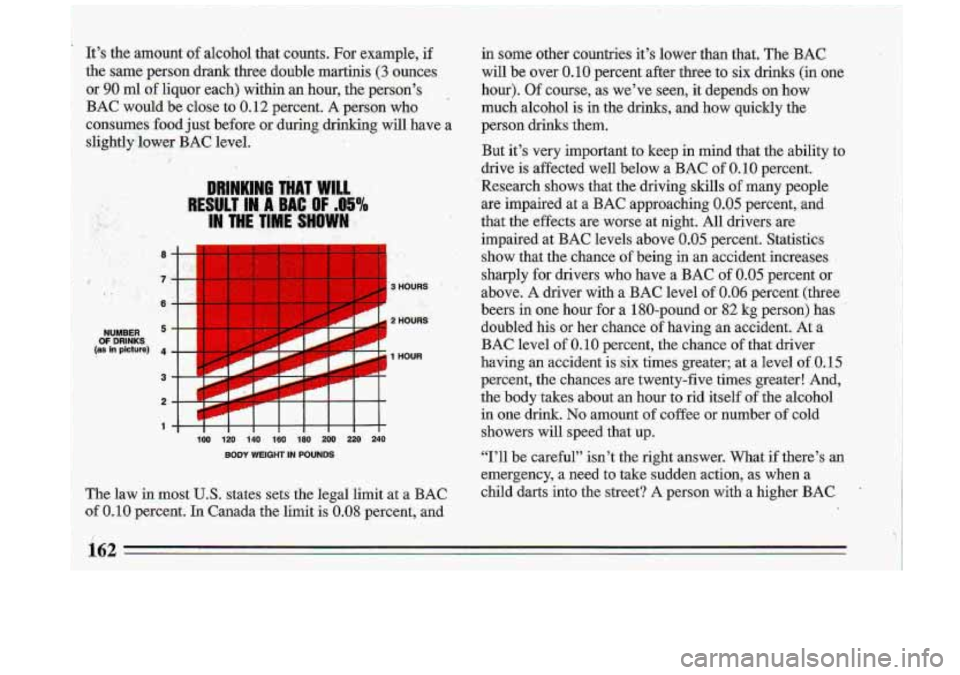
DRINKING THAT WILL
, .,11 RESULT IN, A BAC -OF .@5’/0
.. IN THE JiME. SHOWN. .. .. ., C‘ , . ’/ ,.
p; ,~ I, ..I.’ ., . x-j:.
,? . 3 HOURS ’, ’ , 1, : (.
(as in picture) 4 OF DRI-NKS
T 2 7111
2 HOURS
1 HOUR
in some other countries it’s lower than that. The BAC
will be over 0.16 percent after three to six drinks (in one
hour).
Of course, as we’ve seen, it depends on how
much alcohol is in the drinks, and how quickly the
person drinks them.
But it’s very important to keep in mind that the ability to
drive is affected well below a
BAC of 0.10 percent..
Research
shows that the driving skills of many people
are impaired at
a BAC approaching 0.05 percent, and
that the effects are worse at night. All drivers are
impaired at
BAC levels above 0.05 percent. Statistics
show that the.chance
of being in an accident increases
sharply for drivers who have a
BAC of 0.05 percent or
above. A driver with a BAC level of 0.06 percent (three
beers
in one hour for a 180-pound or 82 kg person) has
doubled his or her chance
of having an accident. At a
BAC level of 0.10 percent, the chance of that driver
having an accident
is six times greater; at a level of.O.15
percent, the chances are twenty-five times greater! And,
the body takes about an hour
to rid itself of the alcohol
in one drink.
No amount of coffee or number of cold
showers will speed that up.
“I’ll be careful’’
isn’t the right,answer. What if there’s an
emergency, a need.
to take sudden action, as when a
child darts into the street? A person with a higher BAC
1 1
1:O IiO 1:O 1:O 16B 2:O 2:O 240 I
BODY WEIGHT’IN POUNDS
How to Add Fluid:
Refer to the Maintenance Schedule to determine what
kind
of transmission fluid to use. See “Recommended
Fluids and.lLubricants” in the Index.
If the fluid level is low, add only enough of the proper
fluid to bring the level up to the COLD area for a cold
check or the
HOT area fora hot check. It doesn’t take
much fluid, generally less than a pint. Don’t overfill.
we
recommend you use only fluid labeled DEXRONBIIE,
because fluids with that label are made-especially for
you automatic transmission. Damage caused by fluid
other than DEXRON@IIE
is not covered by your new
vehicle warranty.
0 After adding fluid, recheck the fluid level as
described under “How to Check.77
0 When the correct-fluid level is obtained, push the
dipstick back in all the way.
Rear Axle
When to Check and Change Lubricant:
Refer to the Maintenance Schedule to determine how
often to check the lubricant and when to change it. See
“Periodic Maintenance Inspections” in the Index.
How to Check Lubricant:
If the level is below the bottom of the filler plug hole,
you’ll need to add some lubricant. Add enough lubricant
to raise the level to the bottom
of the filler plug hole.
What
to Use:
Standard Differential
Use Axle Lubricant (GM Part
No. 1052271) or SAE
80W-90 GL-5 gear lubricant.
Limited-Slip Differential
To add lubricant when the level is low, use Axle
Lubricant (GM Part
No. 1052271) or SAE 8OW-90
GL-5 gear lubricant.
To completely refill after draining,
add
4 ounces (1 18 ml) of Limited-Slip Differential
Lubricant Additive (GM Part
No. 1052358). Then fill to
the bottom of the filler plug hole with Axle Lubricant
(GM Part
No. 1052271) or SAE 80W-90 GL-5 gear
lubricant.