1993 BUICK RIVIERA specifications
[x] Cancel search: specificationsPage 219 of 324
Fuel
Use regular unleaded gasoline rated at 87 octane or
higher: It should meet specifications ASTM D4814 in
the U.S. and CGSB 3.5.92 in Canada. These fuels
should have the proper additives,
so you should not have
to add anything to the fuel.
Use regular unleaded gasoline rated at 87 octane or
higher. It should meet specifications ASTM D4814 in
the U.S. and CGSB 3.5-92 in Canada. These fuels should have the proper additives,
so you should not have
to add anything to the
fuel.
In the U.S. and Canada, it’s easy to be sure you get the
right kind of gasoline (unleaded). You’ll see
“UNLEADED” right on the pump. And only unleaded
nozzles will fit into your vehicle’s filler neck.
Be sure the posted octane
is at least 87. If the octane is
less than
87, you may get a heavy knocking noise when
you drive. If it’s bad enough,
it can damage your engine.
If you’re using fuel rated at 87 octane or higher and you
still hear heavy knocking, your engine needs service.
But don’t worry if you hear a little pinging noise when
you’re accelerating or driving up a hill. That’s normal,
and you don’t have to buy a higher octane fuel to get rid
of pinging. It’s the heavy, constant knock that means
you have a problem. What about gasoline with blending materials that
contain oxygen, such as MTBE or alcohol?
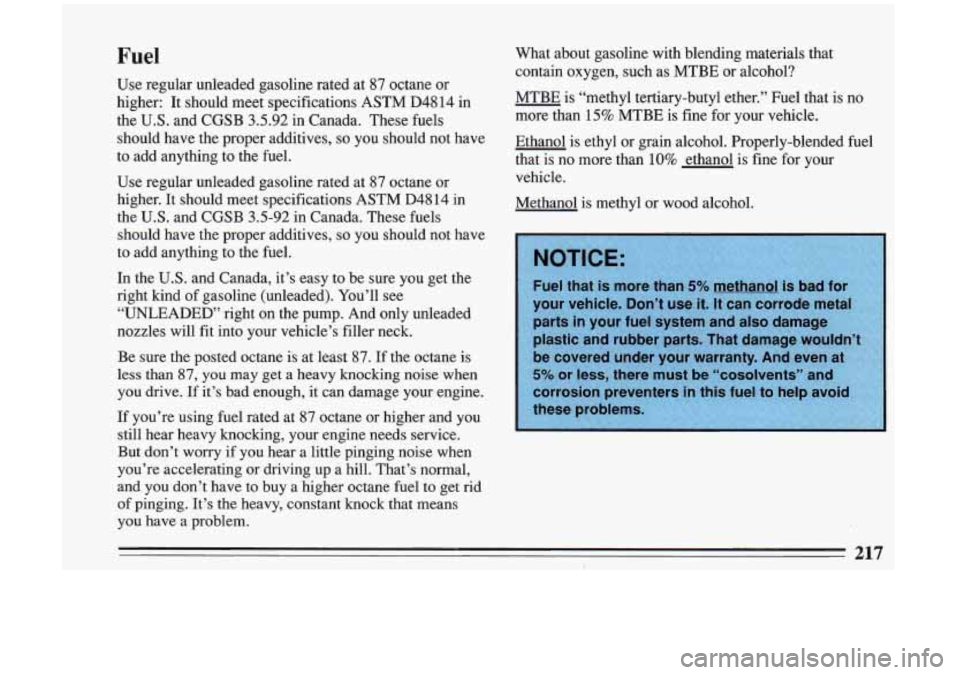
MTBE is “methyl tertiary-butyl ether.” Fuel that is no
more than 15% MTBE is fine for your vehicle.
Ethanol
is ethyl or grain alcohol. Properly-blended fuel
that is no more than
10% ethanol is fine for your
vehicle.
Methanol is methyl or wood alcohol.
217
Page 226 of 324
Engine Oil
It’s a good idea to check your engine oil every time you
get fuel.
In order to get an accurate reading, the oil must
be warm and the vehicle must be on level ground.
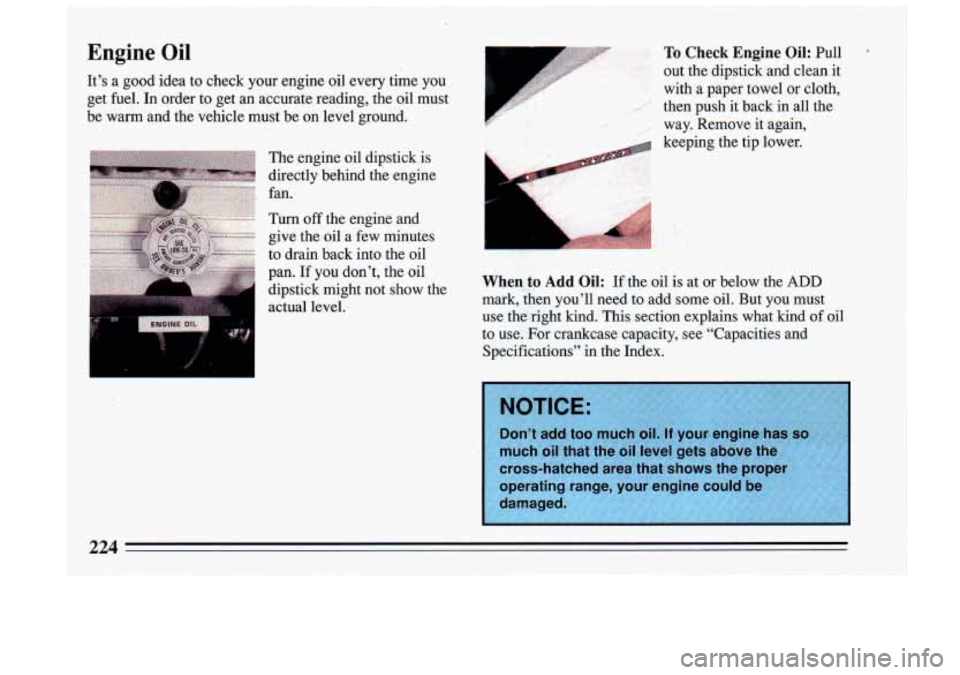
The engine
oil dipstick.is
directly behind the engine
fan..
Turn off the engine and
give the oil a
few minutes
to drain back into the oil
pan.
If you don’t, the oil
dipstick might not show the
actual level.
To Check Engine Oil: Pull ’
1 out the dipstick and clean it
with a paper towel or cloth,
I.ii’ ” then push it back in all the
.. , way. Remove it again,
When to Add Oil: If the oil is at or below the ADD
mark, then you’ll need to add some oil. But you must
use tlwright kind. This section explains what kind
of oil
to use. For crankcase capacity, see “Capacities and
Specifications”
in the Index.
Page 233 of 324
are made especially for your automatic transaxle.
Damage caused by fluid other than
DEXRONs-IIE is
not covered by your new vehicle warranty.
After adding fluid, recheck the fluid level as
described under
“How to Check.”
When the correct fluid level is obtained, push the
dipstick back in all the way.
Engine Coolant
The following explains your cooling system and how to
add coolant when it is low. If you have a problem with
engine overheating, see “Engine Overheating” in the
Index.
The proper coolant for your Buick
will:
Give freezing protection down to -34’F (-37 ’ C) .
0 Give boiling protection up to 262 ’ F ( 128 ’ C) .
Protect against rust and corrosion.
Help keep the proper engine temperature.
0 Let the warning lights work as they should.
What to Use:
Use a mixture of one-half clean water (preferably
distilled) and one-half antifreeze that meets “GM Specification 1825-M,” which won’t damage aluminum
parts. Use GM Engine Coolant Supplement (sealer) with
any complete coolant change. You can also use a
recycled coolant conforming to “GM Specifications
1825-M” with a complete coolant flush and-refill.
If you
use these, you don’t need to add anything else.
Adding only plain water to your cooling system
can be dangerous. Plain water, or some other
liquid like alcohol, can boil before the proper
coolant mix will. Your vehicle’s coolant warnin!
system
is set for the proper coolant mix. With
plain water or the wrong mix, your engine coul
get
too hot but you wouldn’t get the overheat
warning. Your engine could catch fire and you
or others could be burned. Use a
50150 mix of
clean water and
a proper antifreeze.
231
Page 281 of 324

conditioning condenser. Wash the pressure cap and
neck.
To help ensure proper operation, we recommend a
pressure test of both the, cooling system and the
pressure cap.
7. Transaxle Service -- Change both the fluid and filter
every
15,000 miles (25 000 km) if the vehicle is
mainly driven under one or more of these conditions:
In heavy city traffic where the outside
temperature regularly reaches
90 F (32 C) or
higher.
In hilly or mountainous terrain.
Uses such as found in taxi, police car or delivery
If you do not use your vehicle under any of these
conditions, change both the fluid and filter every
100,000 miles (160 000 km).
8. Spark Plug Replacement* -- Replace spark plugs
with the proper type. See “Specifications Chart” in
the Index.
service.
9. Spark
Plug Wire Inspection*? -- Inspect for burns,
cracks or other damage. Check the boot fit at the
distributor and at the spark plugs. Replace wires as
needed.
10. Air Cleaner Filter Replacement* -- Replace every
30,000 miles
(50 000 km) or more often under dusty
conditions.
Ask your dealer for the proper
replacement intervals for your driving conditions.
11. Fuel Tank, Caa, and Lines Insa,ection*T -- Inspect
fuel tank, cap and lines (including fuel rails and
injection assembly, if equipped) for damage or leaks.
Inspect fuel cap gasket for an even filler neck
imprint or any damage. Replace parts as needed.
Periodic replacement of the fuel filter is not required.
i
* An Emission Control Service.
3‘ The U.S. Environmental Protection Agency has determined that the failure \
to perform this maintenance item will not nullify the emission warranty or limitrecall liability prior to the completion of vehicle
useful life. General Motors, however, urges that all recommended maintenance services be performed at the indicated intervals and the maintenance be recorded in “Section EMaintenance Record“.
1 279
1:
Page 288 of 324

I
USAGE I FLUID/LUBRICANT
Hydraulic Brake Delco Supreme ll@ Brake Fluid
System (GM Part No. 1052535) or
Parking Brake Chassis lubricant meeting Guides requirements
of NLGI Grade 2,
Category LB or GC-LB (GM Part
No. 1052497 or equivalent).
Power Steering GM Hydraulic Power Steering Fluid System
- (GM Part No. 1052884) or
equivalent
DOT-3 brake fluid.
equivalent.
Automatic
Transaxle
1
Key Lock
Cylinders
DEXFtON@ IIE Automatic
Transmission Fluid (GM Part No. 1234588 1) or equivalent.
Lubricate with Multi-Purpose
Lubricant (GM Part
No. 12345 120),
synthetic
SAE 5W-30 engine oil or
silicone lubricant (GM Part
No.
1052276 or 1052277).
Automatic Engine oil.
Transaxle Shift Linkage ~ ~~~
Chassis
Lubrication Chassis lubricant . meeting
requirements
of NLGI Grade 2,
Category LB
or GC-LB (GM Part
No. 1052497 or equivalent).
USAGE
Windshield
Washer Solvent
Hood Latch Assembly
a. Pivots and Spring
Anchor
b. Release Pawl
Hood and Door
Hinges, Fuel Door Hinge
Weatherstrips
FLUIDLUBRICANT
GM Optikleen@ Washer Solvent
(GM Part No. 1051515) or
equivalent.
a. Engine oil.
b. Chassis lubricant meeting
requirements
of NLGI Grade 2,
Category LB or GC-LB (GM Part
No. 1052497 or equivalent).
Engine oil or Lubriplate Lubricant (GM Part No. 1050109).
Dielectric Silicone Grease (GM Part
No. 12345579 or equivalent).
See “Specifications Chart” in the Index for
recommended replacement filters, valves and
spark
plugs.
286