1993 BUICK RIVIERA headlights
[x] Cancel search: headlightsPage 89 of 324
Headlight High-Low Beam
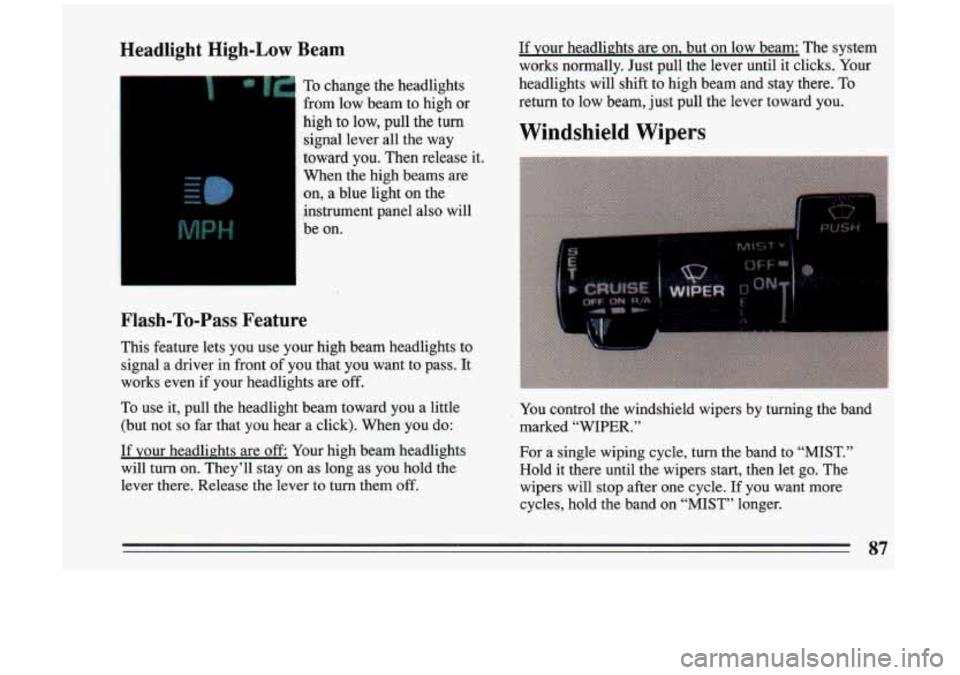
To change the headlights
from low beam to high or
high to low, pull the turn signal lever all the way
toward
you. Then release it.
When the high beams are
on, a blue light on the
instrument panel also will
be on.
If your headlights are on, but on low beam: The system
works normally. Just pull the lever until it clicks. Your
headlights will shift to high beam and stay there. To
return to low beam, just pull the lever toward you.
Windshield Wipers
Flash-To-Pass Feature
This feature lets you use your high beam headlights to
signal a driver in front of you that
you want to pass. It
works even if your headlights are
off.
To use it, pull the headlight beam toward you a little
(but not
so far that you hear a click). When you do:
If your headlights are off Your high beam headlights
will
turn on. They’ll stay on as long as you hold the
lever there. Release the lever to turn them
off.
.
. . . ~
You control the windshield wipers by turning the band
marked “WIPER.”
For a single wiping cycle, turn the band to
“MIST.”
Hold it there until the wipers start, then let go. The
wipers will stop after one cycle. If
you want more
cycles, hold the band on
“MIST” longer.
87
Page 98 of 324
Lights
'
1 0 Headlights
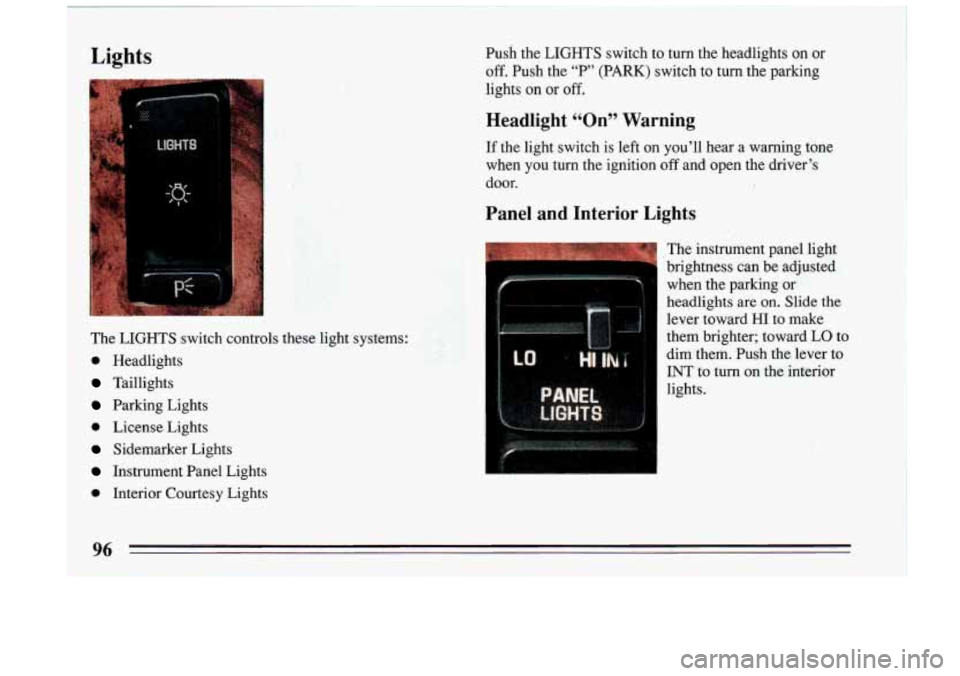
The LIGHTS switch controls these light systems:
Taillights
Parking Lights
0 License Lights
Sidemarker Lights
Instrument Panel Lights
0 Interior Courtesy Lights
Push the LIGHTS switch to turn the
headlights on or
off. Push the "P" (PARK) switch to turn the parking
lights
on or off.
Headlight ''On" Warning
If the light switch is left on you'll hear a warning tone
when you turn the ignition off and open the driver's
door.
\,
Panel and Interior Lights
The instrument panel light
brightness can be adjusted when the parking or
headlights are
on. Slide the
lever toward HI to make
them brighter; toward
LO to
dim them. Push the lever to
INT to
turn on the interior
lights.
96
Page 99 of 324
Twilight Sentinel
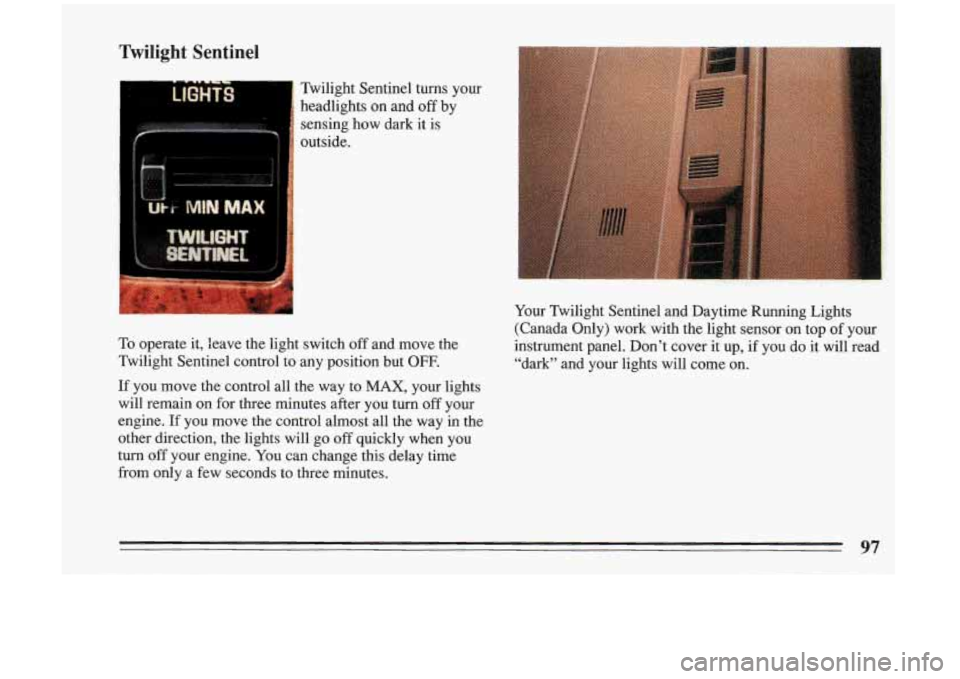
Twilight Sentinel turns your headlights
on and off by
sensing how dark it
is
outside.
To operate
it, leave the light switch off and move the
Twilight Sentinel control to any position but
OFF.
If you move the control. all the way to MAX, your lights
will remain on for three minutes after you turn
off your
engine.
If you move the control almost all the way in the
other direction, the lights will
go off quickly when you
turn off your engine. You can change this delay time
from only a few seconds to three minutes. Your
Twilight Sentinel and Daytime Running Lights
(Canada Only) work with the light sensor
on top of your
instrument panel. Don’t cover it up, if you
do it will read
“dark” and your lights will come on.
97
Page 100 of 324
-Headlights Reminder Light (Canada Only)
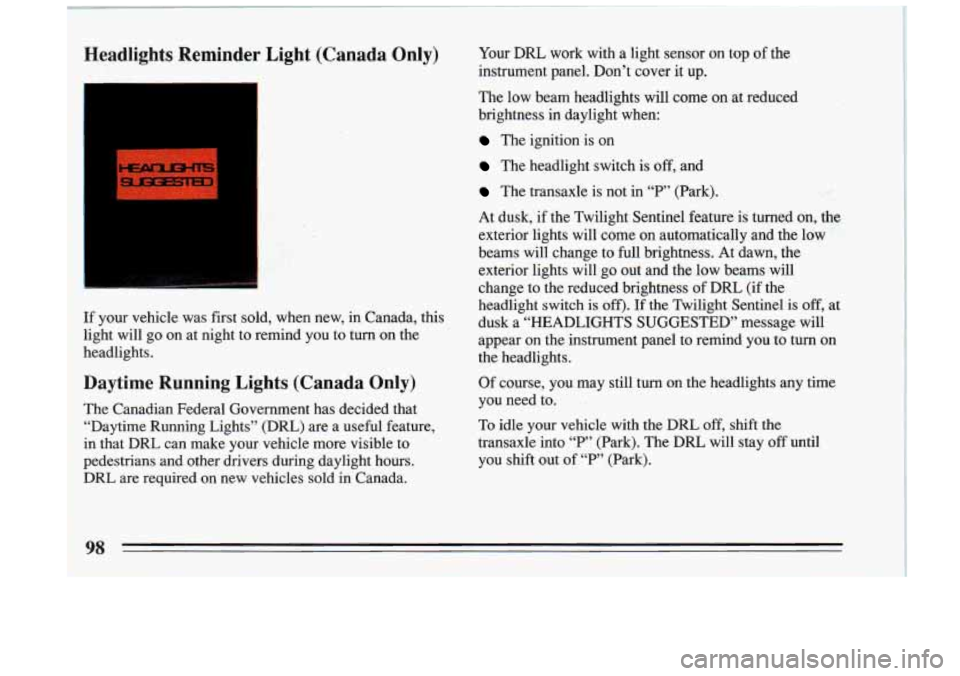
If your vehicle was first sold, when new, in Canada, this
light will go on at night to remind you to turn on the
headlights.
Daytime Running Lights (Canada Only)
The Canadian Federal Government has decided that
“Daytime Running Lights” (DRL) are a useful feature,
in that DRL can make your vehicle more visible to
pedestrians and other drivers during daylight hours.
DRL are required on new vehicles sold in Canada. Your
DRL work with a light sensor on
top of the
instrument panel. Don’t cover it up.
The low beam headlights will come
on at reduced
brightness in daylight when:
The ignition is on.
The headlight switch is off, and
The transaxle is not in “P” (Park).
At dusk, if the Twilight Sentinel feature is turned
on, the
exterior lights will come on automatically and the low
beams will change to
full brightness. At dawn, the
exterior lights will
go out and the low beams will
change to the reduced brightness of DRL (if the
headlight switch is
off). If the Twilight Sentinel is off, at
dusk a “HEADLIGHTS SUGGESTED” message will
appear on the instrument panel to remind you to turn. on
the headlights.
Of course, you may still turn on the headlights any time
you need to.
.
To idle your vehicle with the DRL off, shift the
transaxle into
T“ (Park). The DRL will stay off until
you shift out of “P”.(Park).
98
Page 102 of 324
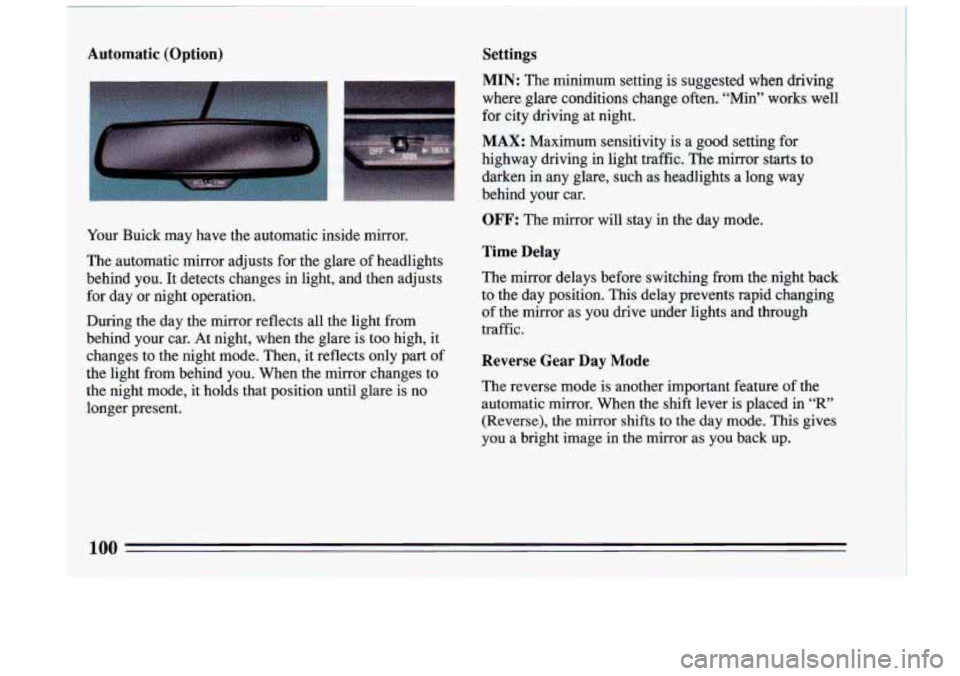
Automatic (Option) Settings
Your Buick may have the automatic inside mirror.
The automatic mirror adjusts for the glare of headlights
behind you.
It detects changes in light, and then adjusts
for day or night operatiol-~
During the day the mirror reflects all the light from
behind your car. At night, when the glare is too high, it
changes to the night mode. Then,
it reflects only part of
the light from behind you. When the mirror changes to
the night mode, it holds that position until glare is no
longer present.
MIN: The minimum setting is suggested when driving
where glare conditions change
often. '"in" works well
for city driving at night.
MAX: Maximum sensitivity is a good setting for
highway driving in light traffic. The mirror
starts to
darken in any glare, such as headlights a long way
behind your car.
OFF: The mirror will stay in the day mode.
Time Delay
The mirror delays before switching from the night back
to the day position.
This delay prevents rapid changing
of the mirror as you drive under lights and through
traffic.
Reverse Gear Day Mode
The reverse mode is another important feature of the
automatic mirror. When the shift lever is placed in
"R"
(Reverse), the mirror shifts to the day mode. This gives
you a bright image in the mirror as you back up.
I
100
Page 165 of 324
by alcohol or drugs, with night vision problems, or by
fatigue.
Here are some tips on night driving.
0
0
0
0
0
0
0
Drive defensively. Remember, this is the most
dangerous time.
Don’t drink and drive. (See “Drunken Driving” in
the Index for more on this problem.)
Adjust your inside rearview mirror to reduce the
glare
from headlights behind you.
Since you can’t see as well, you may need to slow
down and keep more space between you and other
vehicles. It’s hard to tell how fast the vehicle ahead
is going just by looking at its tail’lights.
Slow’’ down, especially on higher speed roads. Your
headlights can light up only
so much road ahead.
In remote areas, watch for’animals.
If you’re tired, pull off the road in a safe place and
rest.
Night Vision
No one can see as well at night as in the daytime. But as
we get older these differences increase. A 50-year-old
driver may require at least twice as much light to see the
same thing at night as a 20-year-old. What you
do in the daytime can also affect your night
I
vision. For example, if you spend the day in bright
sunshine you are wise to wear sunglasses. Your eyes will
have less trouble adjusting to night.
But if you’re driving, don’t wear sunglasses at night.
They may cut down on glare from headlights, but they
also make a lot of things invisible that should remain
visible
- such as parked cars, obstacles, pedestrians, or
even trains blocking railway crossings. You may want to
put on your sunglasses after you have pulled into a
brightly-lighted service or refreshment area. Eyes
shielded from that glare may adjust more quickly to
darkness back on the road. But be sure to remove your
sunglasses before you leave the service area.
You can be temporarily blinded by approaching lights. It
can take a second or two, or even several seconds, for
your eyes
to readjust to the dark. When you are faced
with severe glare (as from a driver who doesn’t lower
the hi.gh beams, or a vehicle with misaimed headlights),
slow down a little. Avoid staring directly into the
approaching lights.
If there is a line of opposing traffic,
make occasional glances over the line of headlights to
make certain that one of the vehicles isn’t starting to
move into your lane. Once you are past the bright lights,
give
your eyes time to readjust before resuming speed.
163 ,
Page 166 of 324
I
-
contract repeatedly. You might even want to keep a cloth
and some glass cleaner in your vehicle if you need to
clean your glass frequently.
Remember that your headlights light up.far less of a
roadway when you are in a turn or curve.
Keep your eyes moving; that way, it’s easier to pick out
dimly lighted objects.
Just as your headlights should be checked regularly for
proper aim,
so should your eyes be examined regularly.
Some drivers suffer from night blindness
-- the inability
to see in dim light
-- and aren’t even aware of it.
f
164
Page 169 of 324
if the pressure in one or more is low. It can happen if a
lot of water
is standing on the road. If you can see
reflections from trees, telephone poles, or other vehicles, and raindrops “dimple” the water’s surface, there could \
be hydroplaning.
Hydroplaning usually happens at higher speeds. There
just isn’t a hard and fast rule about hydroplaning. The
best advice is to slow down when it is raining, and be
.
careful.
Some Other .Rainy Weather Tips
0
0
0
0
0
Turn on your headlights -- not just your parking
lights
-- to help make you more visible to others.
Look for hard-to-see vehicles corning from behind.
You may want to use your headlights even in
daytime if it’s raining hard.
Besides slowing down, allow some extra following
distance. And be especially careful when you pass
another vehicle. Allow yourself more clear room
ahead, and be prepared to have your view restricted
by road spray. If the road spray is
so heavy you are
actually blinded, drop back. Don’t pass until conditions improve. Going more slowly
is better
than having an accident.
Use your defogger
if it helps.
Have good tires with proper tread depth. (See
“Tires” in the Index.)
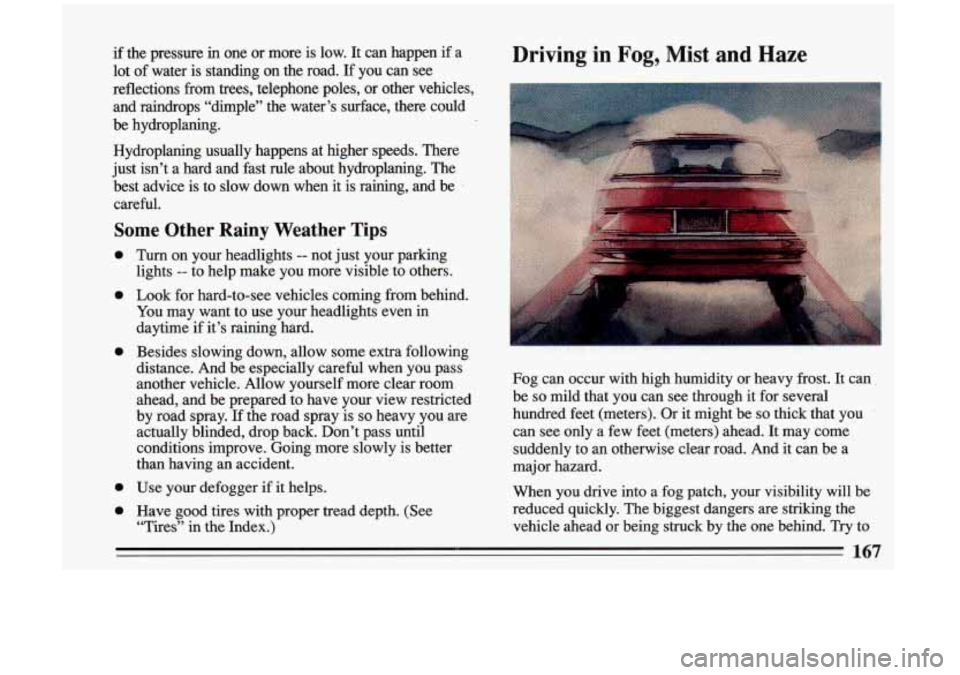
Driving in Fog, Mist and Haze
IIII
Fog can occur with high humidity or heavy frost. It can,
be
so mild that you can see through it for several
hundred feet (meters).
Or it might be so thick that you
can see only a few feet (meters) ahead. It may come
suddenly to an otherwise clear road. And it can be a
major hazard.
When you drive into a fog patch, your visibility will be
reduced quickly. The biggest dangers are striking the
vehicle ahead
or being struck by the one behind. Try to
167