bags, rags, floor mats -- anything you can wrap around
yourself or tuck under your clothing to keep warm.
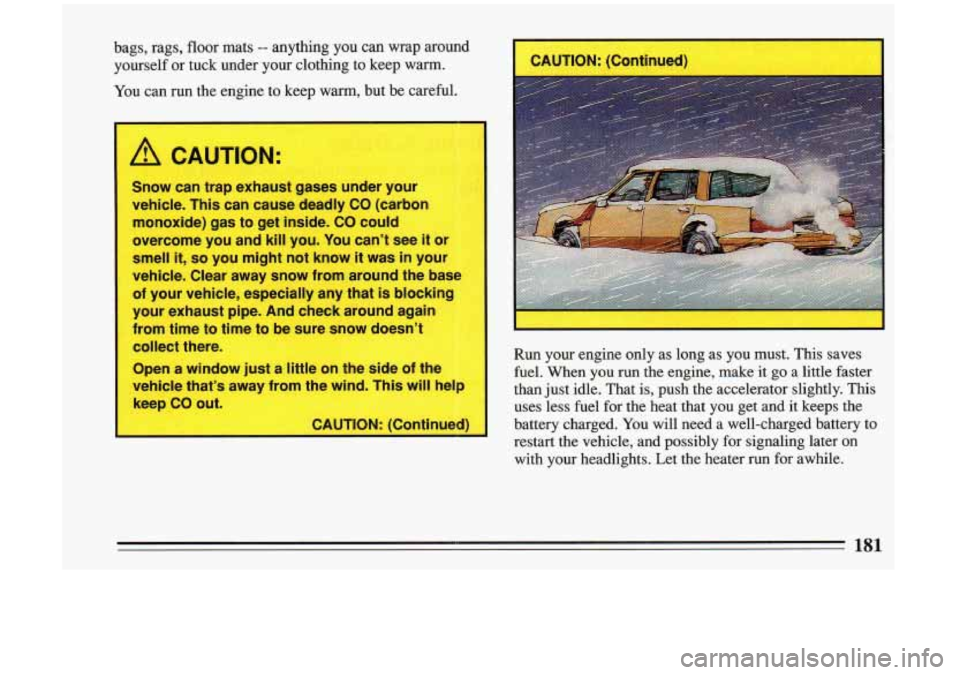
You can run the engine to keep warm, but be careful.
Snow can trap exhaust gases under your
vehicle. This can cause deadly CO (carbon
monoxide) gas to get inside. CO could
overcome you and kill you. You can’t see
it or
smell it,
so you might not know it was in your
vehicle. Clear away snow from around the ba
!
of your vehicle, especially any that is blocking
your exhaust pipe- And check ar
from time to time to be sure snow
collect there.
Open a window just a little on the side of the
vehicle that’s away from the wind. This
will heir
keep CO out.
I CAUTION: (Continued)
Run your engine only
as long as you must. This saves
fuel. When you run the engine, make
it go a little faster
than just idle. That is, push the accelerator slightly.
This
uses less fuel for the heat that you get and it keeps the
battery charged. You will need a well-charged battery to
restart the vehicle, and possibly for signaling later on
with your headlights. Let the heater run for awhile.
181
i
Fuse Usage
(Interior Relay Center -
Lower Right Side of Console)
Amp Description
1. Not Used
2. 25 Defog
3. 15 Keyless Entry
4. 10 Anti-lock
5. 10 PCMflgnition
6. 15 PCM Solenoid
7. 15 Neutral Start Safety Switch
8. 15 ' IGN MOD -
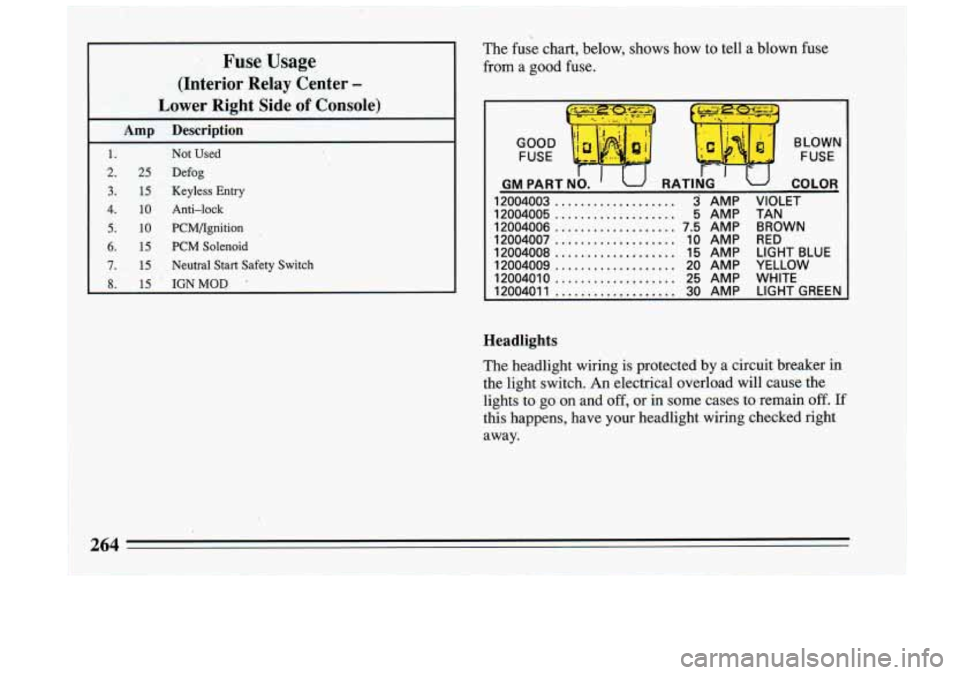
The fuse chart, below, shows how to tell a blown fuse
from a good fuse.
GOOD
FUSE '
rll
-1
I
BLOWN
FUSE
GM PARTNO. ' U RATING ' U COLO~
12004003
................... 3 AMP VIOLET
'12004005
................... 5 AMP TAN
12004006
................... 7.5 AMP BROWN
12004007
................... 10 AMP RED
12004008
.................... 15 AMP LIGHT BLUE
12004009
................... 20 AMP
YELLOW
12004010
................... 25 AMP WHITE
120040.1 1
................... 30 AMP LIGHT GREEN
Headlights
The headlight wiring is protected by a circuit breaker in
the light switch.
An electrical overload will cause the
lights to go on and
off, or in some cases to remain off. If
this happens, have your headlight wiring checked right away.